
Key Takeaways
Attention First: If your ad doesn’t stop the scroll in the first 3 seconds, nothing else in your funnel matters, no clicks, no conversions, no results.
Three Drivers: High-performing thumbstops rely on emotion, clear problem statements, and strong hooks to instantly capture attention and make viewers care.
Format Matters: Short-form videos and high-impact visuals work best when they communicate value instantly with minimal distractions and strong relevance.
Test & Iterate: Winning creatives don’t come from guesswork. Test multiple concepts, identify what works, and refine winners systematically.
Data Wins: The real advantage comes from knowing why a creative worked, so you can scale high-performing patterns instead of relying on intuition.
Do you find it hard to consistently create ads that stop the scroll?
As a creative strategist, you spend hours brainstorming concepts, producing creatives, and launching campaigns, but the moment your ad hits the feed, it gets skipped. In those first few seconds, if you fail to create a thumbstop, every scroll past your ad is wasted spend and lost conversions. And the worst part? You don’t even know what went wrong.
In this blog, you’ll learn how to create thumbstopping ads that win attention in the first 3 seconds, what actually makes people pause mid-scroll, and how you can turn those insights into repeatable winning creatives.
What Is a Thumbstop?
A thumbstop is the moment your ad makes someone pause their scroll in the first 1–3 seconds. It’s the point where your creative grabs attention before the user skips past. If your ad doesn’t create that pause, nothing else in your funnel gets a chance to work.
As a creative strategist, this is your first and most important job. Every hook, visual, and opening frame you plan should aim to stop the scroll instantly. If you fail here, your best messaging, offer, or product never gets seen, so your entire creative strategy breaks at the very first step.
Once you understand what a thumbstop is, the real question is, why does it matter so much for your ad performance?
Why Thumbstops Matter?
Your thumbstop decides if someone wants to know more or ignore you. Better thumbstops attract more engaged viewers, leading to stronger metrics like conversions and ROAS.
Here are the reasons why thumbstops are critical for your ad performance: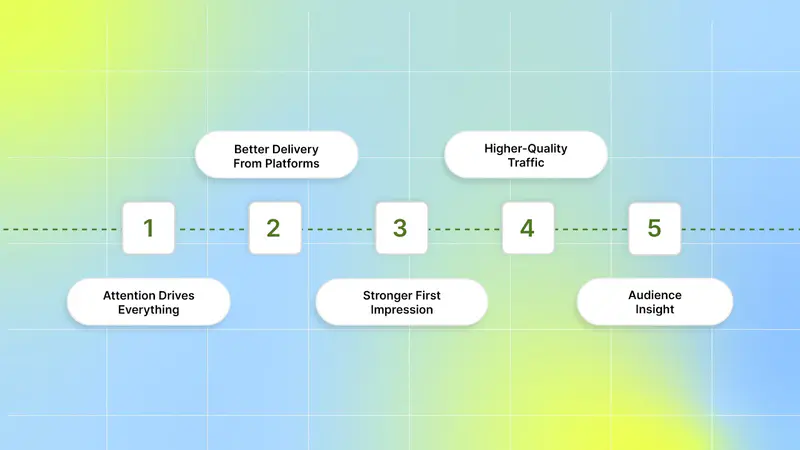
Attention drives everything: If people don’t pause, they won’t watch, click, or convert.
Better delivery from platforms: Ads that grab attention early often get more reach at lower costs.
Stronger first impression: Your thumbstop is the first interaction someone has with your mobile game, subscription app, or DTC brand; it sets the tone instantly.
Higher-quality traffic: When the right people stop, you attract users who are more likely to engage and convert.
Audience insight: Your thumbstop performance shows what hooks, visuals, and messages actually resonate with your audience.
So, the next question is what actually makes a thumbstop effective?
Also Read: A Comprehensive Guide to Creative and Audience Intelligence
Key Elements of a High-Performing Thumbstop
A high-performing thumbstop is built on clear, relatable, and visually striking elements that instantly grab attention. It’s not about random creativity; it’s about combining the right triggers that make someone pause and care.
Here are the key elements that make your thumbstop actually work:
1. The Human Connection
As a creative strategist, your fastest way to stop the scroll is through human emotion. People connect with people, not products.
When you show a real person expressing a clear emotion, frustration, excitement, or curiosity, it makes your audience feel something instantly. For example, in a DTC ad, showing someone visibly struggling with a problem (like skin irritation or messy hair) makes the viewer think, “That’s relatable.”
In mobile games or apps, this could be a player reacting to a win or a loss. That emotional cue is what pulls your audience in before they even process the rest of the ad.
2. The Bold Problem Statement
Once you’ve grabbed attention, you need to quickly answer: “Why should you even care?”
That’s where a bold problem statement comes in. It clearly calls out the pain point your audience relates to, and it should be visible even without sound.
As a creative strategist, you should think in terms of instant clarity:
“Tired of ads that don’t convert?”
“Struggling to get installs that actually stick?”
For DTC brands, it could highlight a common frustration. For subscription apps, it could call out poor retention. This works because users often watch ads on mute, so your message must be impossible to miss at first glance.
3. The Shocking or Satisfying Hook
This is where you truly break the scroll. A strong thumbstop needs something visually unexpected, intriguing, or satisfying that makes people want to keep watching.
As a creative strategist, you can approach this in three ways:
Product-based hook: Show something visually satisfying (like a product in action, delivering a clean result).
Result-based hook: Reveal an outcome that feels surprising or impressive.
Problem-based hook: Show an exaggerated or uncomfortable version of the problem (like a close-up of a bug bite or damage).
For example, in a mobile game ad, this could be a dramatic fail or a near-win moment. In DTC, it could be a surprising transformation. The goal is simple; make the viewer curious enough to stay for the next second.
But how do you know which hooks actually work best for your audience? This is where a creative intelligence platform like Segwise comes in.
With tag-level creative element mapping, you can see which specific creative elements drive performance. You can also discover patterns like "this hook appears in 80% of top-performing creatives" with complete MMP attribution integration.
When you combine these three elements—emotion, clarity, and visual impact, you don’t just create ads. You create thumbstopping moments that actually perform.
Even with the right elements, the format you choose plays a big role in how quickly your ad captures attention.
Which Ad Formats Drive the Highest Thumbstop
Not every format performs the same when it comes to stopping the scroll. As a creative strategist, choosing the right format can help you win attention in the first few seconds.
Here are the ad formats that consistently drive the highest thumbstop performance:
1. Short-Form Video (Best for Most Use Cases)
Short-form videos work well because they combine motion, storytelling, and clarity in the first few seconds. To make this format work, focus on a strong first frame, fast pacing, and clear messaging. Your goal is to communicate value before the user scrolls away.
2. Static Creatives (Still Useful When Done Right)
Static images can still create strong thumbstops if they are visually striking and easy to understand. A single image showing emotion, surprise, or a bold idea can grab attention quickly. For example, a DTC brand can use a high-contrast product image with a strong problem statement.
No matter the format, the best-performing creatives follow a few common principles:
Immediate clarity: The user understands the message instantly.
Minimal distractions: No unnecessary elements competing for attention.
Audience relevance: The creative matches what your audience cares about.
Formats help you capture attention, but the real impact comes from how you launch, test, and scale.
How to Launch and Scale Thumbstopping Ads
Creating a thumbstopping ad is only half the job. The real advantage comes from how you test, learn, and scale what works. Without a clear process, even strong creatives can fail or go unnoticed.
Here’s a simple system to help turn thumbstops into a repeatable growth engine:
1. Check Your Budget
Before you start testing thumbstops, you need to be clear on how much budget you can allocate for testing. Without enough spending, your results won’t be reliable, and you may end up making wrong decisions about what works.
At a minimum, you should allocate around $100 per thumbstop and run it for at least three days. This gives your ad enough time to gather impressions, clicks, and early engagement signals. For you, as a creative strategist, this step is important because it helps you evaluate thumbstop performance based on real data rather than assumptions.
2. Draft Your First Thumbstops
Next, you need to create your initial set of video ads, each with a different thumbstop. When you’re testing for the first time, don’t rely on small changes. Instead, create at least three completely different versions so you can understand what direction works best.
The variation should come from the core idea or storyline of the thumbstop. For example:
Thumbstop 1: A player fails repeatedly at a level, creating frustration.
Thumbstop 2: A satisfying win moment with high rewards.
Thumbstop 3: A “can you solve this?” challenge-style gameplay.
By comparing how each version performs, you can clearly see which message connects with your audience and use that insight to move forward.
3. Iterate on the Winners
Once you identify which thumbstop performs best, the next step is to build on it. Instead of creating new ideas from scratch, focus on improving and refining the winning concept.
For example, if Thumbstop 2 performs best, you now know that showing satisfying win moments works. From here, you can test variations like:
Studio-shot visuals vs UGC-style visuals.
Different products used in the cleaning demo.
But how do you know which creatives to iterate on and which ones to stop? This is where a creative intelligence platform like Segwise comes in.
Withdata-backed creative iterations, you can generate creative variations based on actual performance data from your campaigns. Segwise understands which specific creative elements drive ROAS, CPA, and conversion rates via its Creative Tagging and Analytics agents.
Each test should change only one element at a time. This helps you clearly understand what is improving performance. Over time, this process gives you strong insights into what works for your audience and helps you consistently create better thumbstopping ads.
You’ve tested different thumbstops and identified early winners, but without measuring performance, it’s hard to know what to scale.
How to Measure Thumbstop Performance
Creating thumbstopping ads is only useful if you can measure what’s working and improve from it. Without tracking the right signals, it’s easy to keep producing ads that look good but don’t perform.
Here’s how to evaluate whether your thumbstops are actually doing their job:
1. Primary KPIs to track
The first metric to track is your thumbstop rate.
This is calculated as:
3-second video views ÷ impressions × 100
It shows how many people actually paused long enough to watch your ad. A higher thumbstop rate means your hook is working.
Instead of chasing “industry benchmarks,” focus on building your own baseline. What matters is consistent improvement across your creatives, not comparing with generic numbers.
Along with this, track engagement signals like likes, comments, and shares. These indicate whether your creative is not just stopping the scroll, but also creating interest. Strong engagement also improves delivery by adding social proof.
2. Secondary KPIs to track
Thumbstop is just the start. You also need to understand if that attention leads to meaningful outcomes.
Look at conversion-focused metrics like:
Click-through rate.
Installs or purchases.
Retention or downstream actions.
This helps answer a critical question: Are you attracting the right audience or just getting attention?
For example:
A DTC ad may get strong engagement, but low purchases. This shows a mismatch between the hook and the offer.
Use this data to:
Identify which hooks consistently perform.
Understand what visuals or messages drive engagement.
Refine future creatives based on real signals.
Over time, this turns thumbstop from a one-off win into a repeatable creative system.
Measuring performance tells you what’s working, but winning consistently comes from how you create.
7 Tips for Creating Thumb-Stopping Ads That Actually Perform
Creating thumbstopping ads is not just about understanding elements; it’s about executing them correctly in your creatives.
Here are the tips you can use to consistently create scroll-stopping ads:
1. Go big, bold, and high contrast
Your ad is competing with a fast-moving feed where users scroll without thinking. Bold visuals, strong colors, and high contrast help your creative stand out instantly. Small details or subtle design choices usually get lost on mobile screens, especially when users are scrolling quickly.
To use this, make your first frame visually dominant. For a mobile game, show an intense gameplay moment with bright elements. For a DTC brand, highlight the product with contrasting backgrounds. Avoid muted tones and clutter. Your goal is to make the user pause because your ad looks different from everything else around it.
2. Use motion strategically (not randomly)
Motion is one of the fastest ways to grab attention, but random animation can confuse the viewer. Every movement in your ad should guide the viewer’s focus toward the main message or product. If motion doesn’t add meaning, it becomes noise.
Use motion in the first second to highlight action. Show a character reacting, a product being used, or a transformation happening. For example, in a subscription app, show the app interface changing or improving something instantly. The movement should clearly communicate what your product does, not just fill space.
3. Keep it simple and scannable
Users don’t analyze ads; they scan them. If your first frame is overloaded with elements, text, or multiple messages, the viewer won’t process anything and will scroll past. Simplicity makes your message easier to understand instantly.
Focus on one clear idea per creative. For example, if you’re promoting a skincare product, show one benefit like “Clear skin in 7 days” instead of multiple claims. Use clean visuals, minimal text, and a single focal point so your audience gets the message without effort.
4. Use human + UGC-style creatives
People trust content that feels real and relatable. UGC-style creatives work because they blend into the feed and don’t feel like traditional ads. Seeing a real person using or reacting to a product makes the content more engaging.
Use creators, customers, or actors to show real reactions. For a mobile game, show a player struggling or celebrating a win. For a DTC brand, show someone using the product and reacting to results. The goal is to make your ad feel like content your audience would naturally stop and watch.
5. Add captions and bold text overlays
Most users scroll without sound, so your message needs to be clear visually. Text overlays help communicate your hook instantly, even if the viewer doesn’t hear anything. Without captions, you risk losing attention in the first second.
Use bold, easy-to-read text in your opening frame. Highlight the main benefit, problem, or hook. For example, “Why is this game so addictive?” or “Stop hair fall in 30 days.” Keep the text short and impactful so users can read it while scrolling.
6. Lead with product + payoff
Many ads delay showing the product or result, which causes users to lose interest. If people don’t understand what you’re offering immediately, they won’t wait for the reveal. Showing the product and its benefit upfront builds clarity and trust.
Start your ad by showing the product in action or the outcome it delivers. For a subscription app, show the feature that solves the problem right away. For DTC, show before-and-after results. This helps users quickly decide if your ad is relevant to them.
7. Creative copywriting and storytelling
Your opening line or visual should create curiosity or connect with a real problem. Good storytelling doesn’t mean long narratives—it means setting up a situation that makes the viewer want to know what happens next.
Use problem-first hooks or relatable scenarios. For example, “This level looks easy, but no one can beat it.” These hooks make users pause to see the outcome.
Also Read: Best Ad Creative Hooks for DTC Brands in 2026
Conclusion
Creating thumbstopping ads is about understanding what captures attention and applying it consistently. The first 3 seconds decide whether your ad gets watched or ignored. By focusing on strong elements like emotion, clear problem statements, and scroll-breaking hooks, you can start winning attention instantly.
But most teams still struggle to understand why a creative worked. This is where platforms like Segwise come in.
Segwise is a creative intelligence platform that helps you analyze your creatives at the element level. With creative analytics and AI creative tagging, the platform connects creative elements (hooks, dialogs, visuals, formats, etc.) directly to business outcomes (ROAS, CPA/CPI, LTV, IPM, conversion rates), so teams stop guessing what works and start scaling creatives with data-backed confidence.
Moreover, with tag-level performance optimization, you can instantly see which creative elements, themes, and formats drive results across all your campaigns and apps. This means instead of relying on intuition, you can clearly see which hooks, visuals, and messages are actually stopping the scroll—and scale them with confidence.
So start your free trial today and turn your ideas into a repeatable, data-backed creative strategy that consistently drives performance!