
Key Highlights
Integration of Creative and Audience Intelligence: Combining creative intelligence with audience intelligence is essential for developing impactful marketing strategies that resonate with target demographics.
Audience Intelligence Insights: Gathering comprehensive insights into consumer behavior, preferences, and motivations through advanced data analysis techniques like machine learning and natural language processing.
Creative Intelligence Strategies: Leverage data analytics to inform creative processes, fostering collaboration between data analysts and creative teams to enhance campaign relevance and emotional resonance.
Best Practices for Engagement: Implement sentiment analysis, monitor trends, and utilize data-driven strategies that adapt to changing audience behaviors to maximize marketing effectiveness.
Personalized Marketing Experiences: Merging creative and audience intelligence allows brands to create personalized experiences, fostering continuous improvement in marketing efforts.
Understanding Creative and Audience Intelligence
You can't create ads that convert if you don't know who you're talking to. Integrating creative intelligence with audience intelligence is non-negotiable for performance marketers.
Audience intelligence goes beyond demographics. It reveals why users click, what makes them scroll past, and what converts them. This means analyzing install-to-event conversion patterns, retention cohorts, and creative element performance across Meta, TikTok, and Google.
Creative intelligence transforms those insights into campaigns that drive installs. When you know which creative elements (hooks, characters, backgrounds, CTAs) correlate with higher IPM and lower CPI for specific audience segments, you systematically optimize production.
For mobile game marketers:
Use performance data to test creative elements. If "mystery" hooks generate 12+ IPM while "action" hooks generate 8 IPM, that's a 50% performance difference exploitable across your entire pipeline.
Monitor competitor strategies before saturation. When competitors launch 15+ creatives with "Jester" characters you haven't tested, validate quickly before 20 studios flood the market. Segwise's Competitor Tracking Agent monitors your top competitors on Meta, tagging creative elements and alerting you to new experiments, giving you first-mover advantage on emerging trends.
Implement automated monitoring for creative fatigue. If CTR drops from 5.5% to 4.2% (24% decline) over 5 days, Segwise's Fatigue Detection Agent catches this before wasting $10K. Launch Tracking Agents monitor new creatives against baseline metrics (10+ IPM, $3.50 CPI), flagging underperformers within 72 hours.
Understanding Creative Intelligence
Creative intelligence uses element-level performance data to make smarter decisions. You can launch 50 creatives across Meta and TikTok, but without it, you're guessing. With it, you know why Creative A beat Creative B. Was it the "solve this puzzle" hook versus "beat this level"? The "King" character versus "Archer"? The "Palace Garden" background versus "Mystic Forest"?
By analyzing element-level data, you identify which variables drive IPM above 10, CPI below $3, and D7 retention above 25%. Creatives with "King" characters might generate 11.5 IPM while "Archer" generates 8.6 IPM, a 34% difference impacting scaling capacity.
UA teams harness this effectively by:
Starting with granular data. Track performance by character (King, Queen, Archer, Jester), background (Palace Garden, Mystic Forest, Dining Hall), hook ("only 2% solve this" versus "try this viral puzzle"), and CTA ("Download Free" versus "Play Now"). Segwise's AI automatically tags these variables across all formats, mapping them to metrics from every ad network and MMP.
Fostering collaboration. UA analysts identify patterns like "Palace Garden backgrounds achieve 11.52 IPM versus 9.78 for Dining Hall (18% lift)," while creative teams execute five variations without making ads identical.
Iterating on thresholds. Set automated alerts for degradation (CTR dropping 5% daily for 5 days or IPM below 10) to catch fatigue before thousands in wasted spend.
What is Audience Intelligence?
Audience intelligence moves you from assumptions to certainty about which user segments drive business metrics. Using cohort analysis and event mapping, you understand which segments achieve D7 retention above 30%, pLTV above $8, and which creative variables attract these high-value users.
For mobile game marketers:
Unified Data Collection: Pull consolidated data from ad networks (Meta, TikTok, Google, AppLovin, Unity), MMPs (Adjust, AppsFlyer, Singular), and BI tools. Segwise provides no-code integrations with 10+ networks and all major MMPs, importing 90 days of historical data automatically.
Cohort Analysis: Understand post-install behavior. Which creative variables attract users with D1 retention above 40%? Which drive D7 retention above 25%? Which correlate with first IAP within 72 hours? This connects creative elements to LTV metrics, not just install volume.
High-Value Identification: Segment beyond "18-34, male." Identify which creative variables attract users achieving Level 10 within 3 days (strong pLTV predictor), engaging with social features (2.3x higher LTV), and converting on limited-time offers.
Answer questions like: "Why is CPI rising 18% on Meta while flat on TikTok?" (creative fatigue on top 3 Meta creatives) or "Which variables attract users with pLTV above $10?" ("mystery" themes + "female protagonist" = 35% higher pLTV).
Types of Data Analytics for UA Teams
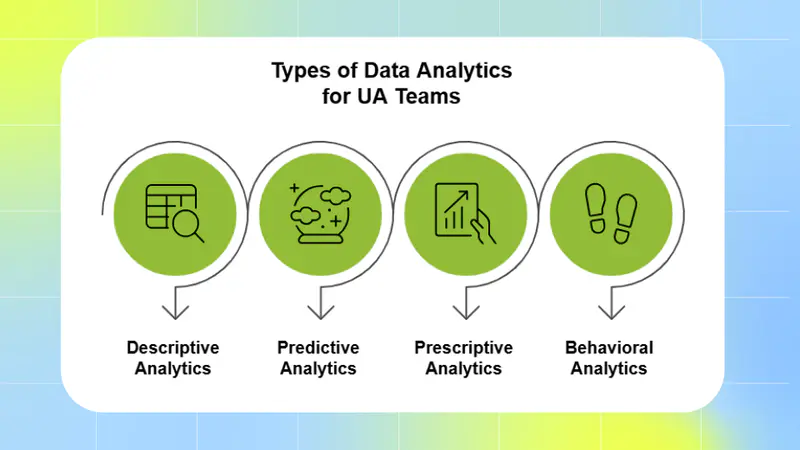
Descriptive Analytics reveals what happened at element level: "Creatives with 'King' character generated 2,847 installs at $2.80 CPI, with 11.5 IPM and 5.8% CTR last week."
Predictive Analytics forecasts outcomes using 60-90 days of data. If "mystery hooks + female protagonists" consistently correlate with 32% higher D7 retention across 50+ tests, prioritize those variables in Q1 production. Critical for pLTV optimization where Day 1-7 signals predict Day 30-60 value, essential for SKAN 5.0 navigation.
Prescriptive Analytics recommends actions. If pausing 8 underperformers (7.2 IPM average) and reallocating $12K to top 5 performers (13.5 IPM) would improve efficiency by 22% and reduce CPI from $3.80 to $3.10, that's actionable.
Behavioral Analytics tracks user interactions: video completion rates, which elements correlate with tutorial completion, which variables attract high IAP converters.
Leverage all types together. You're not reacting to yesterday's CPI spike, you're anticipating fatigue 3 days early, testing based on competitor intelligence, and taking prescriptive action before budget waste compounds.
Integrating Creative and Audience Intelligence
Combine creative intelligence with audience intelligence to systematically improve IPM, reduce CPI, and increase D7 retention.
Step-by-Step Workflow:
Weekly Creative Reviews: Every Monday, UA lead, media buyer, and creative director meet for 30 minutes. UA lead presents insights: "King characters achieved 11.5 IPM versus 8.6 for Archer (34% lift). Palace Garden backgrounds drove 11.52 IPM versus 9.78 for Dining Hall (18% lift). Challenge hooks generated 13.2 IPM versus discovery hooks at 9.1 (45% lift)." Creative director commits to 8 new variations combining winners: King + Palace Garden + Challenge hook, with 4 first-frame variations and 4 CTAs.
Automated Launch Tracking: When 8 creatives launch Thursday, Segwise's Launch Tracking Agent monitors against targets (10+ IPM, $3.50 CPI, 5% CTR). By Saturday, you receive alerts: "3 of 8 hitting targets (12.1 IPM, $3.20 CPI). 5 underperforming (8.3 IPM, $4.10 CPI). Pause 5, scale 3." This prevents wasting $15K discovering this manually over 2 weeks.
Fatigue Monitoring: Your top creative from 3 weeks ago starts fatiguing. CTR drops from 6.2% to 5.0% over 5 days (19% decline). Segwise's Fatigue Detection Agent alerts Thursday (after 4 consecutive 5%+ daily drops): "Creative ID 4782 showing fatigue. CTR declined 16% over 4 days. Pause to prevent ROAS degradation." You pause Friday, preventing $3K weekend waste.
Competitor Intelligence: Your top competitor launched 22 creatives in 10 days. Segwise's Competitor Tracking Agent (currently monitoring Meta with additional platforms coming soon) reveals 18 feature "Jester" characters (untested by you), and 6 ran 12+ days (performance signal). Test Jester + your proven Palace Garden + Challenge hook combo next sprint.
Real Example: A puzzle game discovers short clips (6-10 seconds) with "challenge" hooks generate 14.3 IPM versus 9.8 for longer explainers (46% difference). Competitor Tracking shows top rivals launched 31 similar creatives in 14 days, but none use "female protagonist." They create 12 new 8-second challenge creatives with female protagonists + Palace Garden backgrounds. Launch Tracking shows 9 of 12 hit targets within 48 hours, averaging 15.1 IPM and $2.90 CPI. They scale to 40% of budget, improving efficiency 26% month-over-month.
Case Studies of Successful Integration
Amazon uses behavioral purchase data for personalized recommendations. "Customers who bought this also bought" suggestions analyze millions of transactions, showing 34% of users who bought coffee maker X also bought grinder Y within 30 days. This drives 35% of Amazon's revenue.
Netflix analyzes viewing behavior to inform content creation. They track which thumbnails generate highest CTR for different segments, which episodes have highest drop-off rates, and which shows drive lowest churn. "Supernatural thriller" content drives 28% higher completion and 15% lower churn among women 25-34.
Top Mobile Game Studios tag 300+ creative variations, analyzing which combinations drive D7 retention above 28%. A match-3 studio discovered "mystery" hooks + "female protagonist" + "garden/palace" backgrounds attract users with 31% D7 retention and $8.20 pLTV (versus 24% and $5.40 baseline), improving UA efficiency 34% over 2 quarters.
Key Takeaways: Test at element level, not creative level. "King beats Archer by 34%, Palace Garden beats Dining Hall by 18%, Challenge beats Discovery by 45%" is systematically actionable. Automate fatigue detection and launch tracking at scale. Use competitor intelligence for first-mover advantage (3-4 weeks efficiency gains before market copies).
Future Trends in Creative Intelligence
AI-Powered Tagging is Standard. What required 40 hours weekly (tagging 200+ creatives) now happens automatically via multimodal AI. Segwise's Creative Agent tags 50+ variables (character, background, hook, CTA, gameplay, emotion, color) in seconds.
Automated Fatigue Detection Replaces Manual Monitoring. Studios spending $200K/month previously lost $8K-12K monthly to undetected fatigue. Automated detection reduces this to under $2K (75%+ improvement).
Competitor Intelligence Scales Systematically. Platforms automatically monitor top competitors on Meta, tagging creative elements and surfacing actionable insights: "Competitor A launched 18 Jester creatives this week. 6 running 12+ days. You haven't tested this. Add to roadmap."
Launch Tracking Prevents Early Waste. New creatives monitored against thresholds (10+ IPM, $3.50 CPI). If not hitting within 48-72 hours, automated alerts flag for review, preventing $5K-10K waste per underperformer.
Privacy-First Attribution Drives Creative Optimization. With iOS ATT limiting IDFA to 15-25% and SKAN 5.0 providing only aggregated data, optimizing creative variables using early signals (IPM, CTR, video completion) becomes critical. Studios build models: "12+ IPM typically generates users with 30%+ D7 retention and $7+ pLTV."
Cross-Platform Analysis Fully Unified. Instead of analyzing Meta, TikTok, Google, AppLovin separately, Segwise integrates 10+ networks and all major MMPs, showing which variables work universally versus platform-specifically.
Best Practices for Mobile Game Market Research
Define Measurable Objectives: Start with specific questions: "Which creative variables attract users with D7 retention above 28% and pLTV above $7?" not vague "understand our audience better."
Use Systematic Testing: Test 5 characters (King, Queen, Archer, Wizard, Jester) with identical background/hook/CTA to isolate character performance. Then test 5 backgrounds with winning character. This builds a library of proven variables for 100+ confident variations.
Leverage Competitor Intelligence with Action Thresholds: "If 2+ competitors launch 10+ creatives with same variable within 14 days, and those run 10+ days, add to testing roadmap within 1 week." Captures first-mover advantage.
Segment by User Value: Analyze which variables attract users with D7 retention above 28%, pLTV above $7, tutorial completion, and first IAP within 72 hours. Volume drivers often differ from quality drivers.
Document Learnings: "Palace Garden backgrounds: 11.52 IPM average across 18 creatives, 18% lift versus baseline. Works universally. Pairs well with King (13.2 IPM combined). Avoid with Archer (9.1 IPM, below baseline)." This library scales creative production confidently.
Tools and Solutions for Creative Intelligence
For mobile game UA teams running creative-heavy campaigns across multiple networks, you need specialized creative intelligence platforms.
Essential Capabilities:
Automated Multimodal Tagging: AI tagging 50+ variables across images, videos, playables. Segwise processes 200+ creatives in under 10 minutes (versus 40+ hours manually).
Unified Cross-Network Analytics: Consolidated reporting from all major ad networks and MMPs in one dashboard.
Automated Fatigue Detection: Monitors all creatives 24/7, catching degradation (CTR dropping 5% daily for 5 days) 4-6 days before manual review, saving $8K-12K monthly for $200K+/month spenders.
Launch Tracking: Monitors new creatives against thresholds (10+ IPM, $3.50 CPI), flagging underperformers within 48-72 hours with statistical validation.
Competitor Tracking: Monitors top competitors on Meta with AI tagging, surfacing: "Competitor launched 18 Jester creatives. 6 running 12+ days. Add to roadmap."
Element-Level Performance Mapping: "Palace Garden drives 11.52 IPM versus 9.78 baseline (18% lift, 95% confidence across 18 creatives)."
AI Creative Suggestions: "Your top 10 combine Palace Garden + Challenge hooks + King character. Create 8 new variations with different first-frames."
Start your 14-day free trial with Segwise for AI-powered creative intelligence automating tagging, detecting fatigue, tracking competitors, monitoring launches, and unifying analytics across all UA platforms. No credit card required, 90 days historical data included.
Conclusion and Key Takeaways
Integrating creative and audience intelligence is how UA teams scale past $50K monthly spend with systematic 20-30% quarterly efficiency improvement.
Implement Immediately:
Leverage Element-Level Data: Track which elements drive performance. Test systematically (isolate characters, then backgrounds, then hooks) to build a proven variable library for 100+ confident variations.
Automate Monitoring: Manual monitoring can't scale beyond 30 creatives. Automated systems catch fatigue and flag underperformers before $5K-10K weekly waste compounds.
Monitor Competitors: Track top competitors on Meta to identify emerging trends before saturation. First-movers get 3-4 weeks efficiency advantage.
Unify Data: Consolidate from all networks and MMPs using Segwise, eliminating 4-6 hours weekly manual work.
Run Weekly Reviews: Every Monday, review top performers (which elements shared?), fatigued creatives (pause or refresh?), launches (hit targets or underperformed?), and competitor activity (new variables tested?).
Ready for systematic creative intelligence? Start your 14-day free trial with Segwise today. Get automated tagging, fatigue detection, launch tracking, competitor monitoring, and unified analytics. No credit card required.