
Updated July 2026
Key Takeaways
Retention First: TikTok rewards early retention and watch time. If your hook fails in the first 3-6 seconds, distribution drops and costs increase.
Structure Wins: A strong hook, one clear message, and a direct CTA outperform random creative testing. Structure turns attention into scalable engagement.
Test Intentionally: Don't change everything at once. Isolate variables like hook, angle, and format so you can identify what truly drives CTR, CVR, and ROAS.
Optimize Signals: Focus on metrics that connect engagement to revenue: early retention, CTR, CVR, and ROAS, not vanity impressions.
System Over Guesswork: Creative optimization becomes scalable when you track creative elements, detect fatigue early, and double down on proven patterns instead of relying on intuition.
Creative optimization for TikTok ads in 2026 means systematically improving the elements inside each creative (hook, message, format, and CTA) based on performance data, because TikTok rewards early retention and watch time: if your hook fails in the first 3 to 6 seconds, distribution drops and costs rise.
Are you testing multiple creatives every week but still unsure what to double down on?
As a creative strategist in mobile gaming, DTC, subscription apps, or a growth agency, you don't just need more ideas; you need clarity on what's actually driving engagement. On TikTok, weak engagement doesn't hurt just one ad. It signals the algorithm to reduce distribution, increase your costs, and kill momentum fast. If your hooks don't stop the scroll, your entire creative strategy stalls.
This blog covers how to maximize engagement with creative optimization for TikTok ads using a structured, data-backed approach. You'll learn how to test smarter, iterate faster, and build repeatable creative patterns that scale instead of relying on guesswork.
What is TikTok Creative Optimization?
TikTok creative optimization is the structured process of improving your ad creatives based on performance data, not guesswork. It focuses on testing and refining specific creative elements to increase engagement and drive better business outcomes. Instead of changing audiences first, you improve what the viewer actually sees.
As a creative strategist, this means you stop launching random new concepts every week. You analyze what's working inside your creatives, which hook holds attention, which angle drives comments, which format improves watch time, and build your next iterations from that insight.
Now that you understand what TikTok creative optimization means, the next step is recognizing why it directly impacts your engagement, distribution, and overall ad performance.
Why Creative optimization Matter in TikTok Ads
Creative optimization matters in TikTok ads because the algorithm prioritizes content that captures and keeps attention. If your creative does not drive strong engagement signals, your reach drops, costs increase, and scaling becomes difficult.
Here are five reasons why creative optimization is critical for your TikTok ad performance: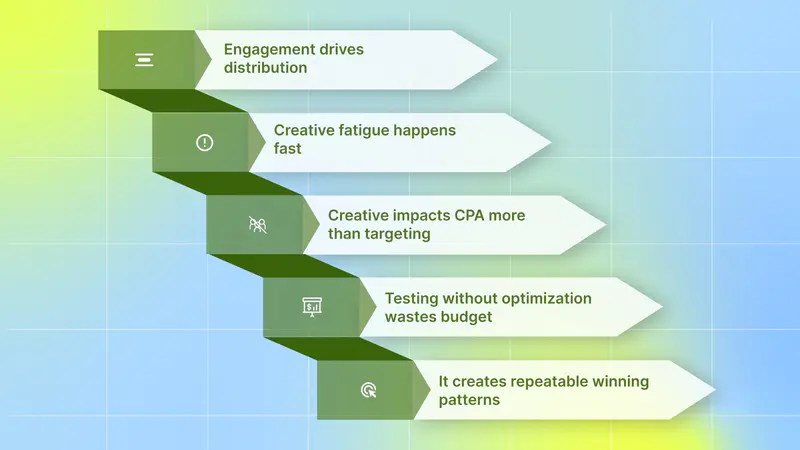
Engagement drives distribution: TikTok pushes ads that generate watch time, shares, and comments. Optimized creatives help you earn more organic-style engagement, which increases delivery and lowers CPM over time.
Creative fatigue happens fast: On TikTok, creatives can burn out in days. Continuous optimization helps you refresh hooks, angles, and visuals before performance drops.
Creative impacts CPA more than targeting: Once your audience targeting is stable, creative becomes the main variable affecting CPA and ROAS. Stronger creatives improve conversion without constantly changing campaign structure.
Testing without optimization wastes budget: If you launch new ads without analyzing what worked in previous ones, you repeat mistakes. Optimization helps you build on proven hooks, formats, and messaging instead of starting from zero.
It creates repeatable winning patterns: Agencies and in-house teams need scalable systems. Creative optimization helps you identify patterns in high-performing ads so you can produce more winners consistently, not occasionally.
To understand why creative optimization has such a direct impact on performance, you need to look at how the TikTok algorithm works.
Also Read: Cross-Platform Ad Creative Strategy Across Meta, TikTok, Google, and Pinterest
How Does the TikTok Algorithm Work?
The algorithm ranks videos based on how users interact with content and how long they stay engaged. If your creative holds attention and drives interaction, TikTok rewards it with more distribution.
Three main factors influence how the algorithm evaluates your ads:
User interactions: TikTok tracks what users like, share, comment on, save, and watch fully. If your ad generates strong engagement signals, especially watch time and shares, it is more likely to reach similar users.
Video information: The algorithm reads your captions, on-screen text, hashtags, sounds, and visual themes. Trending audio, relevant keywords, and clear messaging help TikTok understand who your creative is for.
Device and account settings: Location, language, and device type help TikTok match your ad to the right audience. This is less controllable, but it still influences delivery.
One of the most important signals is how much of your video users actually watch. Completion rate and early retention matter more than surface-level metrics. If users drop off in the first few seconds, distribution slows. If they watch most or all of the video, your ad gains momentum.
The real impact happens when you understand the structure of TikTok ads.
How to Structure TikTok Ads
On TikTok, shorter does not mean incomplete; it means efficient. Your goal is not to fill time, but to hold attention. If your video loses momentum early, engagement drops, and distribution slows. That's why structure and length directly impact performance.
Most high-performing TikTok ads fall between 20-40 seconds, with ~30 seconds being a strong starting point. This gives you enough time to communicate value without testing the viewer's attention span.
Here's how to structure your ads for better engagement:
1. The Hook (First 3 to 6 Seconds)
The opening seconds decide whether your ad survives. Use a bold claim, relatable pain point, surprising visual, or strong gameplay moment. For mobile games, show immediate action. For DTC and subscription apps, highlight the outcome users care about most.
When your hook increases early retention, the algorithm rewards your creative with stronger distribution.
But how do you know which hook is actually driving performance?
This is where creative-level analysis becomes critical. With Segwise's tag-level creative element mapping, you can see which specific creative elements drive performance. You can discover patterns like "this hook appears in 80% of top-performing creatives" with complete MMP attribution integration.
2. The Key Message (Core Value Delivery)
Once attention is secured, communicate your main value clearly and quickly. Focus on one selling point transformation, benefit, proof, or unique functionality. Avoid overloading the viewer with multiple messages.
Clear and focused messaging improves mid-video retention and increases engagement depth.
3. The Call to Action (Clear Next Step)
End with a direct, simple instruction. Whether it's install, shop now, try free, or explore features, make the next step obvious. Avoid vague CTAs that reduce clarity. A strong CTA ensures engagement translates into measurable action.
When you structure your TikTok ads intentionally, you reduce drop-offs and improve the quality of engagement across the entire video. A clear hook, focused message, and strong CTA turn your creative from passive content into a performance asset that can scale consistently.
Once your ad structure is strong, the next step is to apply practical creative optimization tips that improve retention, strengthen engagement signals, and increase overall performance.
Creative Optimization Tips to Improve TikTok Ad Engagement
Optimizing TikTok ad creative is about improving the elements that influence attention, retention, and conversion behavior. As a creative strategist in mobile games, DTC, subscription apps, or growth agencies, your goal is to build a repeatable system where engagement improves with every iteration.
Here are the most impactful tips to focus on:
1. Make Your Creative Feel Native to TikTok
TikTok favors content that blends into the feed. Use vertical framing, subtitles, real-life environments, and conversational tone. Avoid overly polished ads that feel repurposed from another platform.
Native-style creative increases watch time because users perceive it as organic content. The more natural your ad feels, the more engagement signals you generate.
2. Test Variations With Clear Hypotheses
Each creative variation should test a specific variable: hook, angle, format, or CTA. Avoid changing everything at once. Structured testing helps you isolate what truly drives engagement.
This turns creative optimization into a learning system. Once you identify a winning pattern, you can efficiently scale it across multiple creatives.
3. Leverage UGC to Increase Relatability and Trust
User-generated content builds authenticity. Real reactions, testimonials, or gameplay moments feel more trustworthy than scripted ads. For DTC brands and subscription apps, this often increases comments and shares.
Relatable content lowers resistance. When viewers feel understood, engagement becomes more natural, and conversion intent strengthens.
4. Optimize Visual Clarity and Framing
Ensure your visuals are easy to process immediately. Gameplay should be clear, product benefits visible, and scenes uncluttered. If users cannot quickly understand what they are seeing, they scroll.
Clear framing improves early retention, which strengthens algorithmic distribution and engagement performance.
5. Sound-On Strategy
TikTok is a sound-on platform. Audio is not optional; it is a performance lever. Use strong voice-overs, sound effects, or trending audio that enhances your message rather than distracting from it.
Well-designed audio increases immersion and emotional engagement. When sound reinforces your hook and message, watch time improves significantly.
6. Allocate Enough Budget to Creative Testing
Creative optimization depends on data. If your testing budget is too small, you may cut potential winners prematurely. Ensure each creative receives enough impressions to evaluate retention trends, engagement depth, and conversion signals.
Optimization without sufficient data leads to wrong conclusions. When you give creatives enough room to generate reliable signals, you make smarter scaling decisions.
7. Leverage TikTok Smart Creative Tool
TikTok's Smart Creative features let you automatically generate and test multiple variations of your ads by adjusting elements such as captions, creatives, and formats. These tools can help you explore combinations faster without manually rebuilding each version.
However, automation should support your strategy, not replace it. Use Smart Creative to enhance structured testing, then analyze which variations truly drive retention, engagement, and conversions.
8. Use Trends Strategically
Trending sounds, formats, and challenges can significantly boost discoverability on TikTok. However, not every trend fits your brand, product, or audience intent. As a creative strategist, your job is to evaluate whether a trend reinforces or distracts from your core message.
When a trending format naturally supports your product benefit, gameplay moment, or value proposition, it can increase reach and engagement. But if you force-fit a trend that lacks strategic relevance, you may generate views without meaningful interaction or conversions.
9. Iterate and Refresh Before Fatigue Hits
Even strong creatives decline over time. Monitor retention trends, engagement drop-offs, and frequency increases. Refresh hooks, angles, or visuals before performance crashes.
Proactive iteration protects engagement momentum. Instead of reacting to declining performance, you extend the lifecycle of winning concepts through controlled updates.
But how do you know when performance drops significantly?
With Segwise's creative fatigue tracking, you can catch performance decline before it impacts budget allocation and campaign results. You can also set custom fatigue criteria and monitor creative performance across TikTok and all major ad networks to catch fatigue before it impacts your ROAS.
Without analyzing performance correctly, you won't know which changes are actually improving engagement.
How to Analyze TikTok Ad Performance for Creative Optimization
As a creative strategist, your goal is not to track every available metric. It is to focus on the signals that reveal how your creative influences attention, engagement, and conversion behavior. Tracking too many metrics creates noise. Tracking the right ones creates insight.
Instead of vanity metrics, focus on performance indicators that help you diagnose creative strengths and weaknesses across the funnel.
Here are the key metrics that reflect creative impact:
Click-through rate (CTR): CTR shows how compelling your hook and angle are. If CTR is low, your opening or positioning may not be strong enough to stop the scroll.
Average watch time and early retention: These metrics tell you whether your structure holds attention. A drop in the first few seconds often signals a weak hook or unclear framing.
Cost per click (CPC): CPC reflects efficiency, but it should always be evaluated alongside CTR. A low CPC with weak engagement may indicate low-quality traffic.
Add-to-cart or install rate: These mid-funnel signals indicate whether your messaging aligns with user intent. Strong engagement but weak add-to-cart rates may mean your value proposition needs refinement.
Conversion rate (CVR): CVR reveals whether engagement translates into action. If users click but do not convert, your creative promise may not match the landing experience.
Return on ad spend (ROAS):ROAS measures overall profitability. It confirms whether your creative strategy is driving sustainable performance, not just attention.
The real insight comes from connecting these metrics together. For example, a high CTR with low CVR often means your hook works, but your core message lacks clarity or alignment. Creative optimization is not about isolated numbers; it's about interpreting performance patterns and iterating accordingly.
The real advantage comes when you convert those insights into a structured system that consistently improves your creative output.
How to Turn These Insights into a Repeatable Creative System
TikTok's native reporting provides useful data, but true creative optimization requires deeper analysis. Instead of reviewing performance only at the campaign or ad group level, you need to evaluate results at the creative element level.
The real goal of reporting is not just to see which ad won. It is to identify which hooks, angles, formats, and visual patterns consistently drive engagement and revenue, and use those insights to inform creative briefs and guide future iterations.
This is where a creative intelligence platform like Segwise becomes essential.
Segwise is an AI-powered creative intelligence platform that integrates directly with your TikTok ad account and other major ad networks to help mobile game studios, DTC brands, subscription apps, and performance marketing agencies optimize their creative performance at scale.
Here's how Segwise helps you unlock creative-level insights:
Unified view across ad networks: Stop switching between TikTok, your MMP, and other ad network dashboards. Segwise centralizes creative-level ROAS, CPA, LTV, and conversion metrics in one unified view.
AI-Powered creative tagging: Automatically identifies and tags creative elements like hook dialogs, characters, colors, and audio components across images, videos, text, and playable ads to reveal their impact on performance metrics like IPM, CTR, and ROAS.
Tag-level creative element mapping: Identify which specific creative elements consistently drive performance so you can scale proven patterns. You can discover patterns like "this hook appears in 80% of top-performing creatives."
Creative fatigue detection: You can catch performance decline before it impacts budget allocation and campaign results.
Custom dashboards & reporting: You can build dashboards around your specific KPIs and stakeholder needs. Also, create automated reports that show how creative decisions impact ROAS across all your apps and campaigns.
Data-backed creative iterations: You can generate creative variations based on actual performance data from your campaigns. Segwise understands which specific creative elements drive ROAS, CPA, and conversion rates via its Creative Tagging and Analytics agents.
By centralizing creative insights and linking them directly to performance outcomes, you move from reactive testing to a structured creative optimization system that scales consistently.
However, even with a structured system in place, creative performance can still suffer if certain mistakes quietly slip into your process.
Common Creative Optimization Mistakes to Avoid on TikTok
Even with a clear structure and testing process, certain mistakes can quietly damage your performance. As a creative strategist, avoiding these pitfalls is just as important as launching new variations.
Here are the most common creative optimization mistakes that limit engagement and scale:
Chasing trends without strategic fit: Jumping on viral sounds or formats can increase visibility, but if the trend does not align with your product positioning or audience intent, engagement will be shallow. Optimization requires consistency and pattern recognition. Trends should support your core message, not replace it.
Optimizing for views instead of quality signals: High impressions or low CPM can look attractive, but they do not guarantee impact. If you focus only on reach without analyzing retention, CTR, or downstream conversion metrics, you may scale creatives that generate attention but not revenue.
Changing too many variables at once: Launching new creatives that alter hook, angle, format, and CTA simultaneously makes it impossible to learn what actually worked. Creative optimization depends on structured testing. Without variable isolation, insights become guesswork.
Ignoring early retention drop-offs: If users drop within the first 3 to 6 seconds, distribution slows quickly. Many teams focus on CTR or ROAS without diagnosing early engagement decay. Early retention is often the first signal that your hook or framing needs refinement.
Ignoring platform guidelines: TikTok has strict community and advertising guidelines. Violations can lead to rejected ads, limited delivery, or even account suspension. Staying updated on platform policies ensures your campaigns run smoothly without unnecessary disruptions.
Also Read: How to Overcome TikTok Creative Fatigue
Frequently Asked Questions
What is creative optimization for TikTok ads?
Creative optimization for TikTok ads is the structured process of improving specific creative elements (hook, message, format, and CTA) based on performance data rather than guesswork. The goal is to increase early retention and engagement signals so the algorithm distributes your ad more widely and at a lower cost.
How long should a TikTok ad be?
Most high-performing TikTok ads run between 20 and 40 seconds, with roughly 30 seconds a strong starting point. That is enough time to deliver a clear hook, one core message, and a direct CTA without losing the viewer's attention.
Why is the first 3 to 6 seconds so important on TikTok?
Early retention is one of the strongest signals the TikTok algorithm uses to decide how far to distribute a video. If viewers drop off in the first 3 to 6 seconds, delivery slows and costs climb, so the opening hook does most of the work in determining whether an ad scales.
How do I know when a TikTok creative is fatiguing?
Watch for declining early retention, falling CTR, rising frequency, and a drop in spend share on a creative that was previously winning. Tools with native fatigue detection, such as Segwise, monitor these patterns across TikTok and other networks and alert you before performance crashes, so you can refresh hooks or angles proactively.
Which metrics matter most for TikTok creative optimization?
Focus on metrics that connect engagement to revenue: early retention and average watch time, CTR, CVR, and ROAS. Vanity metrics like raw impressions or low CPM can look attractive but do not confirm that a creative drives profitable action.
How does Segwise help optimize TikTok ad creatives?
Segwise is an AI-powered creative intelligence platform that connects to TikTok and 15+ ad networks plus 4 MMPs (including Singular) with no-code integration. Its Creative Tagging Agent tags elements across image, video, and playable ads (Segwise is the only platform that tags playable ads), maps them to metrics like CTR, CPA, and ROAS, and its always-on Creative Strategy Agent flags fatigue early. Teams use it to save up to 20 hours a week and improve ROAS by up to 50%.
Conclusion
Creative optimization for TikTok ads is not about producing more creatives; it's about improving the right elements inside each one. TikTok's algorithm rewards retention, engagement, and meaningful interaction, which means structure, hooks, messaging, and iteration directly impact distribution and costs. When testing is structured and performance signals are analyzed correctly, creative patterns start to emerge. That's when engagement becomes consistent and scalable instead of unpredictable.
To truly maximize engagement with creative optimization for TikTok ads, you need visibility beyond surface-level metrics. This is where a creative intelligence platform like Segwise comes in.
Segwise integrates with your TikTok ad account with no-code integration, so you can start analyzing creative performance without any engineering work. To set it up, go to the Segwise Dashboard → Settings → Ad Networks, click Connect under TikTok Ads, sign in, and select your Ads account for full creative analysis.
Once integrated, Segwise creative analytics gives you a unified view of your creative performance across TikTok and other major ad networks, eliminating the need to switch between multiple dashboards.
Our AI-powered creative tagging automatically identifies hooks, visuals, audio elements, and formats across video, image, and playable ads, then maps those elements directly to metrics like CTR, CPA, LTV, and ROAS. With tag-level creative element mapping, you can clearly see which specific creative elements drive performance.
So, are you ready to turn creative insights into measurable growth?
Start your free trial today and see which creative elements are actually driving your performance!