
Updated July 2026.
How many of your ads struggle to grab attention before users scroll past?
As a performance marketer, you pour hours into ad testing, but your hooks miss the spark that gets viewers actually to buy. And while your competitors keep scaling their winning ads, your ROAS quietly drops with every new creative. If your hooks don't connect in the first three seconds, your entire user acquisition funnel collapses before it even begins.
Are you also tired of guessing which ad hook will make your next campaign a winner? This blog breaks down the best ad creative hooks for DTC brands in 2026 that actually grab attention, hold interest, and drive more customer acquisition.
Updated July 2026.
Quick answer: A DTC ad creative hook is the opening line, scene, or moment (the first two to three seconds) that stops the scroll and ties your product to a viewer's pain point or desire before they swipe past. The best-performing DTC hooks in 2026 fall into five families: curiosity, problem or negative, proof (social proof, before-after, stats), value (benefit, price, FOMO), and native or format hooks (UGC, handwriting, list). A solid opener now earns a hook rate near 28% on Meta and 33% on TikTok, with the top 10% of advertisers hitting 45% to 55%. This guide is the full DTC hook playbook across static and video; for the deeper mechanics of video openers specifically, see our companion guide on video ad hooks that drive conversions.
Why DTC Brands Need Well-Crafted Ad Hooks?
A well-crafted ad creative hook is the opening line, scene, or moment in your ad that instantly captures attention and makes someone stop scrolling. It's the "thumb-stopper" that connects your message to the viewer's curiosity or pain point within seconds.
For DTC brands running paid video, your hook decides whether you win a new customer or lose them before the ad even begins. Here are the key reasons why strong DTC ad hooks matter for your acquisition goals:
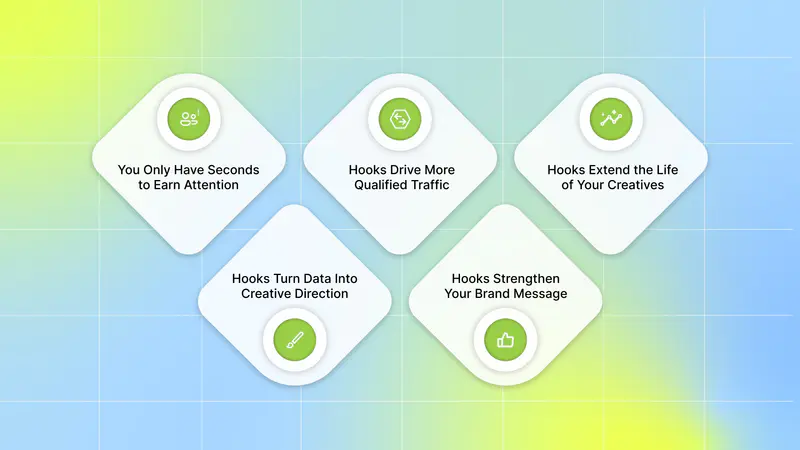
1. You Only Have Seconds to Earn Attention
Your audience scrolls fast, and every second counts. A powerful hook buys you those extra few seconds that turn a casual viewer into a potential customer. Without it, your budget burns on impressions that never convert.
The data backs this up: creatives that frontload a problem, shock, or payoff in the opening frames see 30% to 50% higher view-through rates, and user-focused scripts can lift click-through up to 2x versus generic edits.
2. Hooks Drive More Qualified Traffic
When your hook clearly connects to your offer or product benefit, you attract people who actually want what you sell. That means better click-through rates (CTR), stronger conversion intent, and more efficient customer acquisition.
3. Hooks Keep Your Creatives Fresh Longer
Even your best-performing ads lose impact over time. By rotating and testing new hooks, you can refresh existing creatives without rebuilding them from scratch, keeping your campaigns profitable longer.
4. Hooks Turn Data Into Creative Direction
With clear creative hooks, it's easier to test and tag performance patterns. You can see which hook styles consistently drive installs or purchases, and double down on what works instead of guessing.
This is the shift toward creative intelligence: understanding why a creative works, not just whether it did. It matters because roughly 40% to 50% of the creative assets brands produce never get activated in a campaign, so knowing which hooks earn their spend directly cuts wasted production.
5. Hooks Strengthen Your Brand Message
A great hook doesn't just grab attention, it builds recall. When your audience instantly recognizes your tone, story, or promise, you're not only driving conversions but also reinforcing your brand's unique voice.
Strong ad hooks aren't just creative; they give you control. The better your hooks, the more predictable and scalable your acquisition results become.
Now that you understand why strong hooks matter, let's look at the key principles that make them truly effective.
Also Read: Facebook Ad Hooks That Actually Work: A Breakdown of 2024's Most Engaging Approaches
Core Principles Behind High-Performing DTC Ad Hooks
High-performing DTC ad hooks follow clear principles that make viewers stop, pay attention, and act. A great hook connects your product's value to what your audience actually wants or struggles with.
Here are the core principles that make DTC ad hooks perform consistently across campaigns:
1. Start with the Audience's Pain or Desire
Your hook should speak to what your audience feels, not just what you sell. Call out a pain point ("Tired of dull skin?") or promise a desired outcome ("Finally, a moisturizer that lasts all day"). When people instantly relate, they keep watching.
2. Create Curiosity, Don't Reveal Everything
A strong hook sparks interest but leaves something unsaid. Use curiosity gaps; a surprising statement, a question, or a visual twist that makes people want to see what happens next. Curiosity keeps viewers engaged long enough for your message.
3. Show, Don't Tell
In fast-moving feeds, visuals speak louder than text. Use product demos, transformations, or real reactions to show the benefit immediately. The faster viewers see proof, the more likely they are to convert or click "shop now."
Design for silence, too: more than 70% of social video is watched on mute, so your hook has to land on the visual alone. It is also why static creative still dominates DTC. Across 67,852 ads from 106 brands, static images made up 55.6% of all ads and 64.8% among DTC brands specifically, so treat your static hook (the first frame, the headline, the thumb-stopping image) with the same rigor as a video opener.
4. Match Emotion with Action
Emotions drive buying behavior. Whether it's relief, excitement, or confidence, use tone, visuals, or sound to make your audience feel something that connects to your offer. A hook that triggers emotion makes people stop scrolling and start clicking.
5. Keep It Native to the Platform
Your hook should feel natural where it appears. A TikTok hook should sound like UGC; a Meta ad should blend into the feed. When your creative matches the platform's behavior, it earns attention rather than being ignored as an obvious ad.
6. Lead with the Benefit, Not the Product
Viewers don't care about your brand at first; they care about what's in it for them. Highlight the transformation or result your product brings right away. Once the benefit clicks, the product becomes relevant.
7. Test, Tag, and Learn Continuously
No single hook wins forever. Test multiple openings, pain-based, curiosity-based, testimonial, or emotional, and tag them properly. Track what actually drives installs, purchases, or sign-ups. The data will tell you what your audience truly responds to.
When your hooks follow these principles, your ads stop feeling like "ads." They feel like relevant, attention-worthy content, and that's exactly how you turn scrolls into customers.
Now, let's explore the top-performing DTC ad hooks that are actually converting in 2026.
Top DTC Ad Hooks That Convert in 2026
Your audience scrolls faster, skips quicker, and buys smarter. The first few seconds of your ad decide whether you win a new customer or lose a paid impression. Great hooks make people pause, feel, and click, while average ones silently burn your ad budget.
Here are the top DTC ad hooks proven to convert attention into action this year:
These ten hooks cluster into five families, and strong DTC accounts keep at least one live from each: curiosity (curiosity, list), problem or negative (negative), proof (social proof, before-after, facts and stats), value (benefit-driven, FOMO, price), and native (handwriting, plus any of the above shot as UGC). Map your winners to these families so you always know which angle to test next.
1. Curiosity Hook
A curiosity hook makes people stop because they need to know what happens next. It uses questions, cliffhangers, or bold statements that build intrigue without revealing the whole story. It's all about creating tension in your ad that is later resolved.
Why It Works: Curiosity triggers instant engagement. When people are curious, they stay to learn, giving your ad enough time to deliver the pitch and drive conversions.
Curiosity is the dominant lever heading into 2026: 84% of top-performing ads in early 2026 leaned on either a direct viewer challenge or a deliberately unresolved ending, provoking the "what happens next?" question that keeps viewers watching.
Example:
This ALDO Shoes ad instantly hooks viewers by combining familiar curiosity ("Have you ever seen sneakers that look") with an unexpected twist (sneakers as art). The question invites participation and keeps viewers watching to see what makes ALDO's sneakers so unique. It turns a standard product intro into a short, story-like reveal perfect for DTC ads where attention is everything.
2. Negative Hook
A negative hook highlights pain, frustration, or something people dislike about their current experience. It starts with what's wrong, then shows how your product fixes it.
Why It Works: Pain points grab attention because they feel personal. When you start with a frustration your audience already feels, they're immediately ready to hear your solution.
Example:
This Fake Fragrances ad opens with the line "Never spend a fortune on luxury colognes," instantly tapping into the frustration of overpriced scents. The ad shows premium-looking bottles that promise luxury without the high price tag. It's a great negative hook that flips a common pain point into a reason to try the brand.
3. Social Proof Hook
This hook leverages real people, reviews, or credibility to show your product is already loved. It instantly builds trust, perfect for DTC brands trying to convert cold audiences.
Why It Works: People trust other people more than ads. Social proof creates credibility fast and helps you acquire new customers who want to be part of what others already love.
Example:
This ad by Nike uses authentic user-generated content (UGC) to showcase real customers showing love for their sneakers. The creator shares genuine excitement and close-up visuals of the product, instantly signaling quality and satisfaction to viewers.
By showing a real person expressing enthusiasm instead of polished brand visuals, Nike builds trust and relatability. This social proof hook works because it tells potential buyers, "people like you already love this," making it easier for new users to take action.
4. Before-After / Transformation Hook
This hook, whether visual or verbal, shows a clear transformation from problem to result. It's powerful because it lets viewers imagine their own "after."
Why It Works: People buy transformation, not features. When they see visible proof of change, it shortens their decision time and makes the purchase feel inevitable.

Lakme uses a powerful before-and-after visual to show the transformation from dull, textured skin to a radiant, smooth complexion. The clear contrast instantly communicates results, supported by the claim "Visible signs from 14 days." It's a perfect transformation hook that helps viewers picture their own glowing "after" and motivates immediate purchase.
5. Benefit-Driven / Outcome Hook
This hook leads with the benefit the result your product delivers, rather than what it is. It's short, bold, and value-focused.
Why It Works: You immediately show what's in it for the viewer. This drives faster clicks and higher conversion rates, especially for audiences already considering similar products.
Example:

The ad leads with the line "What makes BioAge different?", instantly focusing on the benefit rather than just the product. It visually compares BioAge's absorption, efficiency, and affordability with other products, showing viewers the clear outcome: better performance and value. It's a classic benefit-driven hook that highlights why this supplement delivers more for your money.
6. FOMO (Fear of Missing Out) Hook
This hook taps urgency and scarcity, reminding people that others are buying or that time is running out. It turns hesitation into instant action.
Why It Works: No one wants to miss a good deal or trend. FOMO-based hooks trigger immediate clicks and conversions by creating time pressure.
Example:
Myntra grabs attention instantly with the bold announcement: "End of Season Sale is now LIVE Price Crash!" The ad uses urgency and scarcity to push immediate action, signaling that deals are happening right now and won't last long. It's a fast-paced, time-sensitive, and designed to make shoppers click before they miss out.
7. Facts, Numbers, and Stats Hook
Lead with a surprising or impressive data point that instantly builds credibility and curiosity. It's ideal for health, beauty, or performance-focused products.
Why It Works: Numbers feel objective. When backed by proof, they make your ad sound credible and worth watching, essential for scaling UA campaigns.
Example:

Nioxin grabs attention with a bold, credibility-driven claim: "93% of people have less hair loss." The use of a specific, data-backed stat instantly builds trust and curiosity, making viewers believe the product is clinically proven to deliver results. It's a strong facts-and-stats hook that reassures potential buyers their results are measurable, not just promised.
8. Price-Focused Hook
This hook emphasizes price advantage or perceived value, showing viewers they can get premium quality without the premium price.
Why It Works: For price-sensitive shoppers, a value-first message cuts through instantly. It triggers fast action and drives conversions for new customers still on the fence.
Examples:

MAC Cosmetics grabs attention instantly with a bold price drop "New Markdown: $16.50 (50% off)". The message delivers instant perceived value, showing shoppers they can get premium products at a steal. This price-focused hook works because it triggers the "smart deal" mindset, driving faster clicks and conversions.
9. Handwriting Hook
A handwriting hook uses text written by hand on-screen, on packaging, or on paper to create a personal, authentic feel. These handwritten messages develop a sense of personalization and authenticity, which grabs the target audience's attention.
Why It Works: In a feed full of polished visuals, handwritten elements feel real and organic. They stop scrolls, build trust, and humanize your brand, a huge advantage in DTC storytelling.
Example:

B-Tight nails authenticity with a handwritten note saying, "TikTok says this booty mask makes your booty pop!" The casual, hand-drawn text feels personal, like a recommendation from a friend, not a brand. This handwriting hook instantly builds trust and curiosity, making viewers stop and pay attention.
10. List Hooks
List hooks are incredibly popular because they offer quick, digestible information in a structured format, which makes them ideal for audiences with short attention spans.
Why It Works: This type of hook works well as people are naturally drawn to numbered lists that promise a specific number of tips or solutions. These are perfect for DTC brands targeting short attention spans.
Example:

Wellamoon uses a clean, visual list format to show exactly how their Sleep Patches work "Peel Off, Stick It On, Sleep Tight." Each step is short, easy to follow, and visually supported, making the product feel simple and trustworthy.
Strong DTC ad hooks are not about tricks; they're about connection. Each of these formats helps you grab attention, spark emotion, and move people closer to clicking that "Order Now" button, turning awareness into actual customer acquisition.
How to Measure DTC Ad Hook Performance (2026 Benchmarks)
A hook is only as good as the numbers it moves. Three metrics tell you whether an opener is working, and each answers a different question.
Hook rate (3-second views divided by impressions) measures whether your opener stops the scroll. In 2026, the median hook rate is about 28% on Meta and 33% on TikTok; the top 25% of advertisers reach 37% and 44%, and the top 10% hit 45% and 55%. If a DTC hook is landing below 25%, the audience is skipping you before your message even starts.
Hold rate tells you whether the hook earned the watch. As one benchmark frames it, hook rate buys the audition and hold rate decides whether you get the role: two ads can share the same 30% hook rate yet show a 6x ROAS gap when one holds 22% of viewers and the other only 4%. A healthy 15-second hold rate on cold traffic sits around 15% to 25%, and best-in-class clears 30%.
Thumb-stop rate is the same idea as hook rate under a different name; treat under 15% as a kill signal and 45% or higher as best-in-class. Remember that TikTok retention runs 5 to 10 points lower than Meta because the platform autoplays the next video, so benchmark each channel against itself rather than one blended target.
Measuring hooks by eye does not scale once you are shipping dozens of variations a week. This is where creative analytics comes in: Segwise's Creative Tagging Agent automatically tags every hook (opening dialogue, on-screen text, visual style, audio) across images, video, static, and playable ads, then maps each tag to metrics like hook rate, CTR, IPM, and ROAS. Asset clustering isolates which specific hook or treatment caused a ROAS difference between two otherwise identical creatives, and native fatigue tracking flags a winning hook before its performance crashes. For the full metric-by-metric breakdown, see our guide on what hook rate is and how to improve it and the master guide to creative analytics.
Next, let's break down the key tips for crafting high-performing hooks that actually drive results.
Crucial Tips for Crafting Effective Creative Ad Hooks

As someone managing paid campaigns across channels, you already know your creative hook needs to speak directly to user intent, emotion, and curiosity all within seconds. Here are proven tips to help you craft ad hooks that grab attention and drive higher customer acquisition for your DTC brand:
1. Lead with Emotion, Not Logic
People buy based on emotion and justify later. Start with feelings of excitement, frustration, or curiosity before showing the product. The emotional pull gets users to stop and engage.
2. Keep It Simple and Conversational
Don't overcomplicate your message. Speak as your customer does. A natural tone feels authentic, builds trust, and increases watch time, especially on social platforms.
3. Match Hook to Funnel Stage
Use awareness-stage hooks for curiosity, and bottom-funnel hooks for urgency or social proof. Align your messaging with where users are in their journey to improve conversion efficiency.
4. Back Every Hook with Data
Use creative analytics to find patterns to show which opening lines, emotions, or visuals are driving ROAS. Double down on the winners instead of relying on creative intuition.
You can use Segwise Creative Analytics to make creative decisions based on actual performance data from both ad networks and MMPs to scale winners and avoid losers.
Because Segwise unifies data from 15+ ad networks and MMPs, you can ask the Creative Strategy Agent (AI Chat) plain-language questions like "which hook style drove the most purchases last month?" and get an instant answer. From there, the Creative Generation Agent can produce net-new creatives built around your winning hooks, so proven openers turn into your next batch of tests without starting from scratch.
5. Test, Iterate, Repeat
Even the best hook can cause creative fatigue over time. Run multiple variations, monitor drop-off points, and refresh your top-performing ads frequently to maintain engagement.
How fast? Heavily spent creatives often start fatiguing after 7 to 14 days, and roughly 80% to 90% of new variations never become winners, which is exactly why volume plus disciplined hook rotation beats betting on any single opener.
When you apply these tips, you'll turn scrolls into views, views into clicks, and clicks into loyal DTC customers.
Also Read: 8 AI Tools Every Marketer Needs for Creative Analytics in 2025
Conclusion
In 2026, winning attention in the first three seconds isn't optional; it determines whether your ad converts or quietly drains your budget. The right ad hooks help you stop the scroll, spark emotion, and guide viewers toward taking action. Whether you use curiosity, transformation, social proof, or price-driven angles, strong hooks directly influence your customer acquisition, ROAS, and overall campaign performance.
If you're ready to stop guessing which hooks will perform and start scaling with clarity, Segwise can make a difference.
Our multi-modal AI creative tagging automatically identifies and tags creative elements like hook dialogues, characters, colors, and audio components across images, videos, text, and playable ads to reveal their impact on performance metrics like IPM, CTR, and ROAS.
With tag-level creative element mapping and MMP attribution integration, Segwise reveals patterns like "this hook dialogue appears in 80% of our top-performing creatives," helping you double down on what works and scale acquisition with confidence.
If you want to unlock your top-performing hooks and scale user acquisition smarter, start your free trial!
FAQs
1. How often should you refresh ad hooks/creatives to avoid ad fatigue for DTC campaigns?
Many high-performing DTC advertisers refresh hooks or creatives every few weeks (depending on spend and audience size) to avoid creative fatigue and maintain engagement. Consistent rotation paired with data-driven tagging helps sustain performance.
2. Do hooks matter more than product features in 2026 DTC ads?
For most DTC campaigns, yes hooks + benefit-focused messaging outperform pure feature-based messaging. Users scroll quickly; what compels them is relevance to their needs or desires. Features matter, but only after a compelling hook gets their attention.
3. How important is sound vs subtitles in video ad hooks (given many users mute videos)?
Very important, many viewers watch on mute. Hence, using bold visuals, on-screen text overlay, or subtitles ensures your hook message gets across even without audio, maximizing reach and retention.
4. What is a good hook rate for DTC ads in 2026?
A solid hook rate is roughly 28% on Meta and 33% on TikTok, which is the 2026 median. Reaching 37% to 44% puts you in the top 25%, and 45% to 55% is top-10% territory. Anything under 25% usually means the opening frame or message is not resonating and should be reworked before you scale spend.
5. What is the difference between hook rate and hold rate?
Hook rate measures whether people stop scrolling (3-second views divided by impressions), while hold rate measures whether they keep watching after the hook. A high hook rate with a low hold rate means your opener over-promises and the body under-delivers, and two ads with the same hook rate can show a large ROAS gap depending on hold, so track both.
6. Are static or video hooks better for DTC brands?
Both matter. Static images still make up the majority of DTC ads (around 65%) because they are cheap to produce and durable for mid-funnel conversion, while video hooks win for prospecting and storytelling. The practical move is to run both and treat the first frame of a static with the same care as a video opener.
7. How do I know which hook actually drove conversions?
Tag your hooks and map them to outcomes. With creative tagging and tag-to-metric mapping (for example, in Segwise), every opener is automatically categorized and connected to hook rate, CTR, and ROAS, and asset clustering isolates which specific hook caused a performance difference between near-identical creatives, so you can attribute results instead of guessing.