
Updated July 2026.
Segwise is an AI creative-analytics platform that auto-tags every element of your TikTok and cross-network ad creatives and maps each one to the KPIs that matter, so you can see which creatives and elements drive performance, not just which campaigns spent.
Key Takeaways
Stop Guessing: Your TikTok dashboard shows performance numbers, but without the right KPIs, you’re making decisions based on assumptions instead of evidence.
Track What Matters: With engagement, focus on retention, CTR, CPA, and ROAS together to scale campaigns.
Test Systematically: Winning on TikTok in 2026 requires structured concept testing, fast iteration, and refreshing creatives before fatigue hurts performance.
Dashboard Limits: TikTok Ads Manager tells you what happened, but not which hook, angle, or creative element actually drove results.
Creative Intelligence Wins: Tools like Segwise connect creative elements directly to performance metrics, helping you scale winning patterns faster across campaigns.
Updated July 2026.
The TikTok ad metrics that matter most in 2026 are retention (average watch time and completion rate), CTR, CPA/CPI, and ROAS, read together rather than in isolation. TikTok Ads Manager tells you what happened, but not which hook, angle, or creative element drove it, so pair it with a creative intelligence layer like Segwise to map specific creative elements to performance.
Are you staring at your TikTok dashboard and wondering which hook, angle, or concept actually worked?
You see performance numbers moving, but they don’t clearly explain why one video scaled while another stalled. If you build your next brief on assumptions, you risk repeating weak concepts. If you misread the signals, your best creative themes fade before you double down.
As a creative strategist, you need clarity on which creatives truly drive results for your campaigns. Whether you work on mobile games, DTC brands, subscription apps, or manage growth for clients, you can’t afford guesswork. This blog covers TikTok dashboard best practices for 2026, the KPIs that actually matter, and the creative metrics that help you build winning concepts with confidence.
What Is a TikTok Ads Dashboard?
A TikTok Ads dashboard lets you track how your ads are performing. It pulls all your campaign data into one place and shows metrics like impressions, reach, conversions, and engagement. You can analyze performance at the campaign, ad group, and ad level to understand what is working and what is not.
For a creative strategist, the dashboard serves as a "feedback system" to turn data into creative insights. It helps move away from guessing to knowing which creative concepts perform with real audiences. You can compare video variations, monitor watch time, track click-through rate, and measure conversions.
Now that you understand how the TikTok dashboard helps you track performance, the next step is to know which ad types you can run.
Also Read: How TikTok Ads Manager Helps Marketers Build Stronger Campaigns
What Kinds of Ads Can You Run on TikTok?
You can run multiple ad formats on TikTok, depending on your campaign goal installs, purchases, subscriptions, or brand awareness. Each format gives you a different level of visibility and engagement. As a creative strategist, the format you choose directly affects how your hook, storytelling, and CTA perform.
Here are the different types:
In-Feed Ads: In-Feed Ads appear inside the “For You” feed as users scroll. They look similar to organic TikTok videos and autoplay with sound. These ads include a call-to-action button that drives traffic to a website, app store page, or TikTok profile.
TopView Ads: TopView Ads appear at the top of the For You feed when a user opens the TikTok app. They provide premium visibility with no competing content at that moment. Videos can run up to 60 seconds and are mainly used for awareness campaigns.
Brand Takeover Ads: Brand Takeover Ads are full-screen ads that appear immediately when a user opens TikTok. They can be a short video, an image, or a link to an internal or external destination.
Branded Effects: Branded Effects allow to create custom filters, stickers, or AR effects. Users can apply these effects in their own videos. This format increases interaction by encouraging audience participation.
Branded Hashtag Challenge: Branded hashtag challenges invite users to create videos around a specific hashtag. The campaign is promoted through in-feed ads and a featured Discover banner. It drives large-scale engagement through user-generated content.
Spark Ads: Spark Ads allow brands to promote existing organic TikTok posts as ads. These can be posts from the brand’s account or from creators (with permission). Spark Ads help maintain native engagement while amplifying reach through paid promotion.
Each format serves a different purpose, from driving direct conversions to building large-scale awareness and engagement. Choosing the right ad type depends on your campaign objective, budget, and how you want users to interact with your brand on TikTok.
Running the right ad format is only half the equation. To understand whether your ad is actually delivering results, you need to check the right metrics.
Why TikTok Metrics Matter?
You don’t just launch ads, you build concepts that need to prove their impact. Tracking the right metrics helps you understand which ads actually drive results. Without clear metrics, you’re guessing what worked instead of building on proven performance.
Here are five reasons why tracking these metrics matters for your TikTok ads: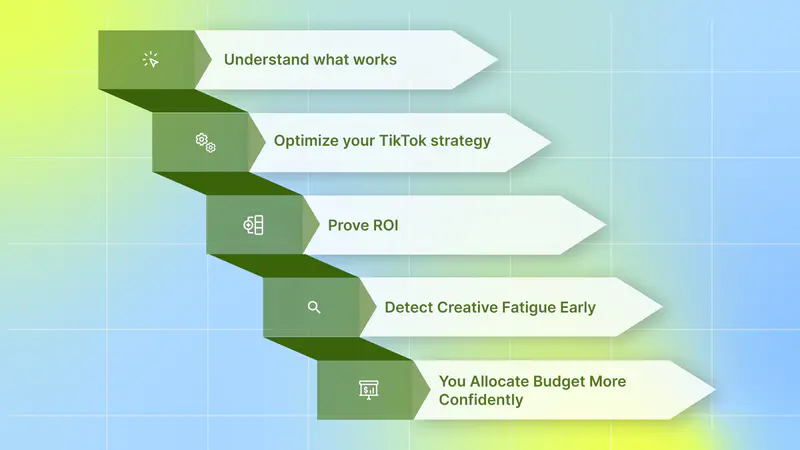
Understand what works: Compare engagement rate, average watch time, and profile visits to see which videos perform best. Reuse winning hooks, sounds, or styles to stay consistent.
Optimize your TikTok strategy: Use metrics to spot trends, test new ideas, and improve every video post.
Prove ROI: Link your TikTok performance to results like traffic, conversions, or sales to show real impact.
Detect Creative Fatigue Early: Performance can decline quickly on TikTok. Monitoring KPIs like CTR, conversion rate, and cost trends helps you spot drops early and refresh creatives before results suffer.
You Allocate Budget More Confidently: KPIs guide where to increase spend and where to pull back. This helps you protect your budget, scale winners faster, and improve overall campaign efficiency.
The next step is knowing exactly where to access those insights inside TikTok.
Where to Find Your TikTok Metrics?
You can find your TikTok metrics inside the TikTok app and TikTok Ads Manager. The app shows organic performance data, while Ads Manager provides paid campaign and conversion metrics. Together, these platforms help you understand how your content and ads are performing.
Here’s how you can access them:
Open the TikTok app and go to your business account.
Tap the Menu (☰) in the top-right corner.
Select Creator Tools.
Click “View all” under “Overview” for a detailed look at your account analytics.
While organic metrics show engagement patterns, Ads Manager is where real revenue insights live. Inside Ads Manager, you can view conversion data, including click-through rate, ad spend, and ROI. For creative strategists, this dashboard becomes essential for comparing different video variations and identifying which concepts deliver real results.
The next step is understanding which metrics actually matter for your ad performance and creative decisions.
What Metrics to Include in a TikTok Ads Dashboard
Your TikTok dashboard should combine delivery, engagement, retention, and conversion metrics to provide a comprehensive view of ad performance. The right metrics help you understand what to scale, what to optimize, and what to pause before it impacts results.
Here are the key metrics:
1. Reach and Visibility Metrics
Impressions: The total number of times your ad was shown in users’ feeds. This includes multiple views from the same person.
Reach: The number of unique users who saw your ad at least once during a selected time period.
Frequency: The average number of times each user saw your ad. It is calculated as impressions divided by reach.
Spend: The total amount of money invested in your ad campaign.
These metrics help you understand whether TikTok’s algorithm is favoring your creative. If impressions are high but CTR and conversions are low, your concept may not be compelling enough. Rising frequency with declining performance signals that your creative needs refreshing.
2. Engagement Metrics
Likes, Comments, and Shares: These are direct interactions users make with your ad. They show how much your content resonates with viewers.
Engagement Rate (Ad Level): The percentage of users who engaged with your ad after seeing it. It is calculated as total engagements divided by impressions.
Video Views (2-second, 6-second, and 100%): TikTok measures how long users watch your ad, including short views and full completions.
Engagement reveals whether your concept connects emotionally or visually. If users are commenting or sharing, your message likely resonates. Strong early video views suggest your hook is working, while low engagement signals the need to rethink your angle or storytelling.
3. Retention and Watch Metrics
Average Watch Time: The average amount of time users spend watching your ad before scrolling away.
Video Completion Rate: The percentage of viewers who watched your video until the end.
Video View Rate (VVR): The percentage of impressions that resulted in a counted video view.
Retention shows whether your script, pacing, and structure hold attention. If viewers drop off early, your hook or opening scene needs improvement. High completion rates often indicate strong storytelling and message clarity.
4. Click and Traffic Metrics
Clicks: The total number of times users clicked on your ad.
Click-Through Rate (CTR): The percentage of impressions that resulted in a click. It is calculated as clicks divided by impressions.
Landing Page Views: The number of users who successfully loaded your landing page after clicking the ad.
CTR shows whether your creative motivates people to take action. If engagement is strong but clicks are low, your CTA or offer may need improvement. These metrics help you refine messaging and value propositions.
5. Conversion Metrics
Conversion Rate: The total number of desired actions taken after someone interacts with your ad, such as installs, purchases, or subscriptions.
Cost Per Acquisition (CPA) / Cost Per Install (CPI): The average cost required to generate one conversion or install.
These metrics identify which creative concepts attract high-quality users. High conversion rates indicate strong alignment between creative messaging and audience intent.
6. Revenue and Efficiency Metrics
Revenue: The total income generated from users who converted after interacting with your TikTok ads. This includes purchases, subscription payments, or in-app revenue attributed to your campaign.
Return on Ad Spend (ROAS): The amount of revenue earned for every dollar spent on ads. It is calculated as total revenue divided by total ad spend. ROAS shows whether your campaigns are profitable and sustainable.
Cost Per Mille (CPM): The cost you pay for 1,000 impressions. CPM reflects how competitive your audience and targeting are within TikTok’s auction system.
These metrics help you identify scalable creatives. Creatives with strong ROAS and efficient CPM should be prioritized for scaling, while inefficient creatives should be replaced or improved.
Tracking the right metrics is important, but real growth happens when you turn those numbers into clear creative decisions.
How to Use These Metrics to Improve Your Creative Strategy
Understanding TikTok metrics is only the first step. Real growth happens when you use those signals to shape your next creative decision. Your TikTok dashboard should not just report performance; it should guide what you test, scale, and replace.
Here’s how to turn data into a stronger creative strategy:
1. Identify High-Performing Creative Patterns
Start by analyzing ads with the highest average watch time, strongest engagement rate, and best conversion performance. Do not look at one metric in isolation. Compare retention, CTR, and CPA together to understand what truly works.
If you notice that a certain hook style, gameplay demo, UGC format, or offer angle consistently performs better, turn that into a repeatable framework. Instead of copying one winning video, build variations around the winning pattern.
2. Optimize Your Posting and Launch Timing
Use follower activity and campaign performance data to understand when your audience is most active. Launching ads or organic posts during peak activity increases early engagement signals.
For paid campaigns, early engagement helps the algorithm distribute your creative more efficiently. Consistent creative testing also keeps your account active and reduces long gaps that slow performance momentum.
3. Test, Measure, and Iterate Continuously
TikTok rewards experimentation. Test different hooks, video lengths, visual styles, and CTAs within controlled variations.
Compare retention, CTR, conversion rate, and ROAS across creatives within the same campaign. Keep what drives both engagement and results. Pause what underperforms. This testing cycle builds a data-backed creative engine instead of relying on assumptions.
4. Improve Hooks and Story Structure Using Retention Data
Focus on watch time and completion rates to evaluate your storytelling. If viewers drop in the first few seconds, your opening hook needs improvement. If they watch but do not click, your message or CTA may need stronger clarity.
Shorter videos often perform well, but structure matters more than length. Use retention curves to identify where attention drops and adjust pacing, visuals, or messaging in future creatives.
5. Connect Creative Performance to Revenue
Always connect engagement metrics with conversion and revenue data inside TikTok Ads Manager. A creative with high engagement but weak conversions may spark curiosity, not buyer interest.
Track CTR, conversion rate, CPA, and ROAS together to identify which concepts truly scale. Over time, this helps you allocate budget toward creatives that generate sustainable growth, not just short-term attention.
When you consistently analyze these metrics together, your TikTok dashboard becomes more than a reporting tool. It becomes a structured feedback system that helps you create stronger, smarter, and more profitable creatives.
Now that you know which metrics matter and how to interpret them, it’s time to know a few best practices that drive stronger performance on TikTok.
TikTok Ads Best Practices to Improve Performance in 2026
Running TikTok ads in 2026 requires more than just launching creative and hoping it performs. You need a structured approach that combines strong hooks, continuous testing, and data-backed optimization to stay competitive.
Here are the best practices:
1. Win the First 3 Seconds
On TikTok, the hook decides everything. Use bold visuals, strong statements, gameplay action, or problem-driven openings to stop the scroll immediately. If viewers drop early, the rest of your message won’t matter.
But how do you know whether your hook is performing well?
This is where Segwise helps. With tag-level creative element mapping, you can see exactly which specific creative elements drive performance and discover patterns like "this hook appears in 80% of top-performing creatives".
2. Build for Native, Not Polished
Overproduced ads often underperform. User-generated style content, raw demos, and real storytelling usually drive higher engagement and lower CPAs. Your ads should feel like TikTok content first, ads second.
3. Test Concepts, Not Just Variations
Don’t just change captions or colors. Test completely different angles: emotional vs. functional, demo vs. testimonial, offer-driven vs. story-driven. Concept testing gives bigger performance breakthroughs.
4. Refresh Creatives Before Fatigue Hits
Performance declines quickly on TikTok. Monitor frequency, CTR, and CPA trends. When metrics start slipping, introduce new hooks or formats before scaling slows down.
5. Optimize for Conversions, Not Vanity Metrics
With engagement, also focus on CTR, conversion rate, CPA, and ROAS to determine what truly scales. Prioritize creatives that drive profitable users, not just views.
Even when you follow best practices and monitor the right KPIs, there is still a gap between performance data and true creative insight.
What TikTok Dashboard Can't Tell You
Your TikTok dashboard shows performance numbers, but it doesn’t explain the deeper reasons behind them. It tells you what happened, but not why. If you rely only on surface-level metrics, you may miss important creative insights.
Here are what your TikTok dashboard can’t directly tell you:
Which specific hook drove performance: The dashboard shows ad-level results, but it does not break down performance by the first 3 seconds, opening dialogue, or scroll-stopping moment.
Which creative element actually influenced conversions: It cannot automatically tell you whether the background, actor, offer, gameplay scene, or CTA was the real driver behind results.
When fatigue truly begins at the element level: You may notice rising CPA or falling CTR, but the dashboard won’t tell you when your creatives are tiring your audience.
Limited Custom KPI and Success Criteria Setup: While TikTok Ads Manager allows basic column customization, it does not support advanced custom KPI setup or custom success criteria to set fatigue.
For mobile games, DTC brands, subscription apps, and agencies, these missing insights can slow down iteration and scaling decisions.
To overcome these limitations, you need a deeper, creative-level intelligence platform that connects performance directly to creative elements.
Also Read: How to Overcome TikTok Creative Fatigue
How Segwise Solves TikTok Dashboard Limitations
To remove TikTok dashboard limitations and get better creative-level insights, you need a creative intelligence platform that goes beyond surface metrics and connects creative elements directly to performance. This is where Segwise fills the gap.
Segwise is an AI-powered creative intelligence platform that directly integrates with your TikTok ad account with no-code integration, so you can start analyzing creative performance without any engineering work. To set it up, go to the Segwise Dashboard → Settings → Ad Networks, click Connect under TikTok Ads, sign in, and select your Ads account for full creative analysis.
Here’s how Segwise solves the key limitations of a standard TikTok dashboard:
Tag-Level Creative Element Mapping: See which specific creative elements drive performance. Also, discover patterns like "this hook dialogue appears in 80% of ourtop-performing creatives" with complete MMP attribution integration.
Custom Dashboards and Reporting: You can build dashboards around your specific KPIs and stakeholder needs. And create automated reports that show how creative decisions impact ROAS across all your apps and campaigns.
Creative Tagging: Our powerful, multi-modal AI automatically identifies and tags creative elements like hook dialogues, characters, colors, and audio components across images, videos, text, and playable ads to reveal their impact on performance metrics like IPM, CTR, and ROAS.
Creative Fatigue Detection: You can catch fatigue before it impacts your budget allocation and campaign results. Also set custom fatigue criteria and monitor creative performance across TikTok and all major ad networks to catch fatigue before it impacts your ROAS.
Frequently Asked Questions
What are the most important TikTok ad metrics to track in 2026?
Track retention metrics (average watch time and video completion rate), CTR, CPA or CPI, and ROAS together. Retention shows whether your hook and pacing hold attention, CTR shows whether the creative drives action, and CPA and ROAS show whether the conversions are profitable. Reading them in isolation leads to false conclusions.
What is the TikTok 3-second rule?
The first 3 seconds decide whether a viewer keeps watching or scrolls past. If your hook does not stop the scroll in that window, the rest of the ad rarely matters. Use retention curves to see where viewers drop and rework the opening accordingly.
Why can't the TikTok Ads Manager dashboard tell me which creative element drove results?
TikTok Ads Manager reports performance at the ad level, so it tells you what happened but not which hook, actor, offer, gameplay scene, or CTA caused it. A creative intelligence platform tags individual creative elements and maps them to metrics so you can isolate the real drivers.
How does Segwise help with TikTok creative analysis?
Segwise connects to your TikTok ad account with a no-code integration in about 5 minutes, then uses multimodal AI to automatically tag creative elements (hooks, characters, colors, audio, text, and playable ads) and map them to metrics like CTR, IPM, and ROAS. It also flags creative fatigue early through native fatigue detection across TikTok and other networks.
How many ad networks and MMPs does Segwise support?
Segwise unifies creative and performance data from 15+ ad networks and 4 MMPs (AppsFlyer, Adjust, Branch, and Singular), giving you one attribution-backed view across platforms including TikTok, Meta, and Google.
Does Segwise offer a free trial?
Yes. Segwise offers a 7-day free trial with no engineering setup required. The trial automatically imports up to 2 weeks of historical data, and paid plans import up to 3 months, so you can start analyzing creative performance right away.
How often should I refresh TikTok creatives to avoid fatigue?
There is no fixed schedule; watch for rising frequency alongside declining CTR and rising CPA, which signal fatigue. Refresh hooks or formats before those trends compound. Automated fatigue detection catches these element-level declines earlier than a manual dashboard review.
Conclusion
Your TikTok dashboard in 2026 is more than a reporting tool; it’s a decision engine. When you understand the right KPIs, analyze retention and conversion metrics together, and apply structured testing, you move from guessing to building repeatable winning concepts. Metrics like CTR, CPA, ROAS, and watch time are not just numbers; they are signals that guide your next creative move. The difference between average performance and scalable growth lies in how well you interpret and act on these signals.
However, a standard TikTok dashboard only shows what happened, but not why it happened. That’s where Segwise takes your creative strategy further.
As an AI-powered creative intelligence platform, Segwise unifies creative data from 15+ ad networks and 4 MMPs (AppsFlyer, Adjust, Branch, and Singular), including TikTok, automatically tags creative elements using multimodal AI, and provides actionable insights that improve creative ROAS. Our AI creative tagging automatically tags key creative elements like hooks, characters, visuals, and audio across videos, images, text, and playable ads, so you can see how each element impacts metrics like CTR, IPM, and ROAS.
Moreover, our creative analytics can tell you exactly which creative elements, themes, and formats drive results across all your campaigns and apps. And with fatigue detection, you can catch performance decline before it impacts budget allocation and campaign results.
In short, instead of analyzing ads one by one, Segwise gives you structured creative insights that help you scale winning patterns across TikTok and other networks while improving ROAS.
So, if you’re ready to move beyond surface-level metrics and build a smarter creative system, it’s time to upgrade your approach.
Start your 7-day free trial today and turn your TikTok dashboard into a true creative intelligence engine.