
Are your UGC ads getting views, likes, and comments but somehow still not driving results?
If you’re spending more every month on creators, testing dozens of UGC scripts, and still guessing which ones will actually move ROAS, you’re not alone. The real risk isn’t low engagement, it’s scaling the wrong scripts, missing early fatigue signals, and quietly burning budget on creatives that look good but don’t convert. In user acquisition, that gap between “this went viral” and “this drove revenue” is where performance starts to break.
If you’re a UA manager, growth lead, or creative owner trying to drive installs, purchases, or subscriptions at scale, this blog is for you. You’ll learn how to write UGC scripts that are built for conversion, what actually makes them work for mobile games, DTC brands, subscription apps, and growth agencies.
What is a UGC script?
A UGC script is a performance-driven blueprint that combines clear hooks, platform-specific pacing, and proven conversion structure, while still sounding natural on camera. It’s a short, structured outline that tells a creator exactly what to say, show, and highlight in a video ad to drive installs, purchases, or subscriptions.
For user acquisition teams, it removes guesswork and helps optimize ads based on conversion impact rather than just engagement. In simple terms, a UGC script is your plan for creating an ad that doesn’t feel like an ad, but like a genuine recommendation from a trusted peer.
Once the structure is clear, the next question is how UGC scripts actually impact installs, purchases, and subscriptions.
Also Read: Effective Strategies and Examples for UGC Ads
Why Are UGC Scripts Important?
UGC scripts are important because they turn creative ideas into results. They help you control the message, test the right angles, and scale creatives that actually drive installs, purchases, or subscriptions, without relying on guesswork or creator intuition alone. For UA teams, a strong script means faster iteration, lower wasted spend, and clearer signals on what’s working.
Here are 5 reasons why UGC scripts matter for user acquisition: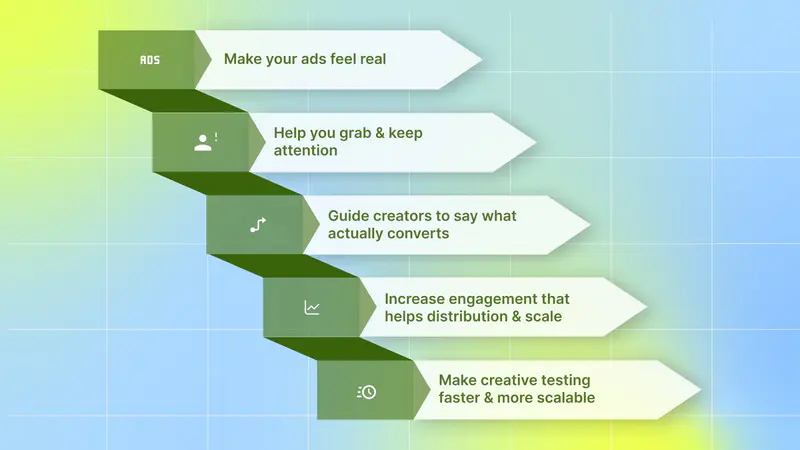
They make your ads feel real: A strong UGC script sounds relatable and natural, which helps your ad feel like a real recommendation instead of a brand message. This builds trust faster and makes users more likely to install, buy, or subscribe.
They help you grab and keep attention in the first few seconds: UGC scripts are designed to hook users immediately with familiar problems or situations. This keeps people watching longer, which directly improves performance in paid acquisition.
They guide creators to say what actually converts: Instead of leaving everything to creator intuition, UGC scripts ensure key benefits, objections, and value points are clearly communicated so every video serves a conversion goal.
They increase engagement that helps distribution and scale: Clear CTAs encourage users to react, comment, or share. This boosts organic signals and helps paid ads reach more people at a lower cost.
They make creative testing faster and more scalable: With scripts, you can test hooks, messages, and angles systematically. That makes it easier to spot what works, double down on winning patterns, and stop wasting spend on underperforming creatives.
The next step is knowing how to structure them for consistent conversions.
6-step Direct Response Formula for Viral UGC Scripts
High-performing UGC scripts aren’t random or improvised. The ones that consistently drive installs, purchases, and subscriptions follow a direct-response structure built to stop the scroll, communicate value quickly, and push action while still feeling authentic. For user acquisition teams, this formula makes creative testing repeatable and scalable.
Here is a Direct Response (DR) formula to create UGC scripts:
Hook → Problem → Solution → Value Prop → Social Proof → CTA
This structure is built to stop the scroll, drive conversions, and still feel authentic.
Here’s how to use each step to drive results:
The Hook (2–3 seconds max)
Your hook decides whether someone keeps watching or scrolls past. In user acquisition, those first 2–3 seconds are where installs, purchases, or subscriptions are won or lost. A strong hook works because it feels instantly relatable, highly relevant, or slightly unexpected.
Here is how to create hooks that stop the scroll:
Auditory hooks
“Stop scrolling if you struggle with…”
“This is what most people get wrong about…”
“Most people fail this level on the first try.”
Visual hooks
Before/after results are shown immediately.
Instant gameplay fail vs success.
Split-screen comparisons that show contrast upfront.
Word hooks
“POV: you finally found the solution to…”
“Things TikTok made people buy (that actually worked).”
“Players are obsessed with this level.”
Pro tip: Always design hooks that work visually too. Use captions and clear on-screen text, where many users watch without audio.
2. Problem Identification (Make it Personal)
Once you’ve stopped the scroll, the next job is to make the viewer feel personally understood. This is where relevance is locked in. A strong problem statement should make your audience think, “That’s exactly the issue I’m dealing with.” In user acquisition, this step decides whether people keep watching or drop off.
Here is how to clearly frame the problem so it feels personal and relatable:
Struggle-based problem framing
This is where you call out the repeated effort your audience has already made with no real results. This works because it validates their experience and lowers resistance. When users recognize their own struggle in the script, they’re far more likely to keep watching.
Here is how to frame the struggle clearly:
“If you’ve tried multiple options but keep running into the same issue…”
“After testing different tools or products, the result still feels disappointing…”
This works because it validates the user’s struggle and keeps them watching.
Pain point amplification
Show the cost of the problem if nothing changes. In user acquisition, this isn’t about fear-mongering; it’s about making the pain real. Highlight wasted time, lost money, poor results, or missed opportunities.
Here is how to amplify the pain point:
“Most people dealing with this problem waste hours every week without seeing improvement.”
“The longer this goes unsolved, the more effort and budget get burned.”
This step makes the problem feel too expensive to ignore.
Frustration-driven framing
This is about emotional contrast. You show the gap between what your audience wants and what they’re currently experiencing.
Here is how to highlight frustration naturally:
“When the goal is [desired outcome], but there’s no time to [current workaround] every day…”
“When results matter, but the process feels too complicated or inconsistent…”
This step works best when the problem is specific, familiar, and emotionally frustrating, not generic or exaggerated.
Pro tip: To find high-converting problems fast, research your audience before writing scripts. Use tools or AI prompts like:
“What are the biggest frustrations with [product category]?”
“What stops users from getting results with [X]?”
“Why do people switch from [X] to alternatives?”
“What trends are shaping user expectations in [category]?”
The clearer the problem feels to your audience, the easier it becomes to position the solution as the obvious next step.
3. Solution Presentation (Natural Transitions Win)
Once the problem feels real, the transition to the solution must feel smooth and believable. In UGC, hard product pitches break trust and kill performance. The goal is to introduce the product as a natural next step, not a sudden ad. Strong solution transitions sound like discovery, not selling.
Natural solution transition examples,
“This is where [product name] comes in…”
“That’s when [product name] started making a difference…”
“After seeing this everywhere, [product name] finally made sense…”
“This is what actually helped fix the problem…”
The solution should feel like a relief, not a pitch. Keep the focus on how it fits into real life, not on brand claims or feature lists. When the transition feels natural, viewers stay engaged, and that’s what helps to acquire more users.
4. Value Propositions (What Makes This Different?)
This is where you explain why this solution is better than the alternatives. In high-performing UGC scripts, value props are clear, specific, and focused on outcomes. Limit this to 2–3 key differentiators to keep the message sharp and easy to remember.
Here is how to highlight value propositions that actually convert:
Time and convenience: “Set up in minutes, not hours.”
Speed of results: “Noticeable results after a few uses.”
Quality and trust: “Smooth gameplay with no forced ads.”
Value and price: “Skincare product made with high-quality, tested materials.”
Strong value props help users quickly understand why this is worth trying. When benefits are clear and relevant, it becomes easier for viewers to take the next step and convert.
5. Social Proof (Build Credibility Without Being Obvious)
Social proof is what turns interest into trust. In user acquisition, UGC works because it shows that other people already believe in the product. The key is to make credibility feel natural, not forced. Obvious bragging or hard claims reduce believability and hurt performance.
Here is how to add social proof without breaking the authentic UGC feel:
Implied credibility: Show proof visually instead of saying it out loud. Use green-screen effects or background overlays to display reviews, ratings, app store badges, awards, or press mentions while the creator talks naturally.
Authority signals: Borrow trust from someone with relevant expertise. Reference recommendations from professionals, specialists, or experienced users who are credible for that specific problem.
Viral validation: Reinforce that the product is already popular. Highlight that it’s trending, frequently shared, or commonly seen across channels without sounding promotional.
Community proof: Show that many others are using it. Highlight user volume, repeat usage, or widespread adoption through comments, reactions, or community mentions.
When social proof feels casual and visual, it builds confidence without breaking trust, which helps push users toward installs, purchases, or subscriptions.
6. Call-to-Action (Drive Action, Create Urgency)
The call-to-action is where attention turns into installs, purchases, or subscriptions. In user acquisition, even a great UGC ad fails if the CTA doesn’t clearly tell users what to do next and why now.
Here is how to create high-converting CTAs:
Create urgency: Give users a reason to act now rather than save it for later.
“Get yours today before they sell out again.”
“Limited availability, don’t wait.”
Use time-based incentives: Tie the action to a deadline so delaying feels costly.
“Use code SAVE20 before it expires.”
“Offer ends tonight.”
Reduce friction: Make the next step feel quick and easy to complete.
“Link in bio to get started in seconds.”
“Download now setup takes less than a minute.”
Set clear expectations: Tell users exactly what happens after they click.
“Delivered by Friday.”
“Start seeing results today.”
A strong CTA removes hesitation and closes the gap between interest and action, turning UGC views into real acquisition results.
Even the best UGC script can underperform if it isn’t adapted to the platform it runs on.
Platform-Specific Ad Strategies That Work
UGC scripts don’t perform the same way across platforms. Each channel has different user behavior, attention patterns, and creative expectations. To drive consistent installs, purchases, or subscriptions, your scripts must be adapted per channel.
Here are UGC script strategies that consistently work for user acquisition across major channels:
1. TikTok UGC Scripts
TikTok is a fast-moving, sound-on platform where users decide in seconds whether to keep watching. UGC scripts here must feel native, casual, and trend-aware to blend into the feed and avoid looking like ads.
Here are the key strategies that work on TikTok:
Audio-first approach: Write scripts that sound natural and conversational when spoken.
Trend integration: Use trending sounds, formats, or challenges to increase relevance.
Quick pacing: Keep transitions fast and information dense to hold attention.
2. Instagram & Facebook UGC Scripts
On Instagram and Facebook, many users scroll with sound off, especially in feeds and Stories. Visual clarity and on-screen messaging play a much bigger role in driving engagement and conversions.
Here are the key strategies that work on Instagram and Facebook:
Visual-first strategy: Make sure the message is clear even without audio.
Caption and text overlays: Use on-screen text to highlight hooks, benefits, and CTAs.
Aesthetic focus: Clean visuals and good framing improve performance.
3. YouTube Shorts UGC Scripts
YouTube Shorts competes with highly polished creator content, not just ads. Users expect value quickly, whether that’s education, insight, or entertainment.
Here are the key strategies that work on YouTube Shorts:
Strong hooks: Capture attention immediately to compete with high-quality content.
Educational framing: Position the script around learning or discovery.
Series potential: Test Part 1 / Part 2 formats to drive repeat views.
When your UGC scripts are tailored to how each platform is actually consumed, performance improves naturally. Instead of forcing the same concept everywhere, adapting scripts by platform helps you hold attention longer, reduce drop-offs, and drive more consistent installs, purchases, or subscriptions. This is where UGC stops being trial-and-error and starts becoming a repeatable acquisition channel.
To consistently scale results, UGC scripts also need to evolve with data, testing, and performance insights.
Advanced Strategies to Improve Your UGC Scripts
Advanced strategies help you extract more value from the same product, audience, and creators, while keeping results stable as spend increases.
Here are a few advanced strategies to improve your UGC scripts for user acquisition:
Multi-angle testing
Instead of testing one script at a time, create multiple script variations for the same product. Each angle speaks to a different motivation, pain, outcome, objection, curiosity, or urgency.
Feature-focused scripts highlighting specific benefits.
Lifestyle-focused scripts showing daily use.
Comparison scripts positioning against alternatives.
Story-driven scripts sharing transformation journeys.
For UA teams, multi-angle testing reduces risk. When one angle fatigues, another can be scaled immediately without starting from scratch. It also gives clearer signals on why users convert, not just that they converted.
2. Emotional storytelling
Emotions drive action, even in performance ads. High-converting UGC scripts tap into clear, relatable emotions that make users feel something quickly, without dragging the story or sounding scripted. The goal is to create emotional recognition that pushes users closer to action.
The most effective UGC scripts tap into emotions like:
FOMO: “Everyone is talking about this, and now it’s clear why.”
Relief: “This finally solved a problem that kept coming back.”
Pride: “This makes it easier to feel confident about the result.”
Curiosity: “This needed to be tested to see if it actually works.”
When emotions are used intentionally and briefly, they increase watch time, trust, and conversion without hurting authenticity or performance.
3. Data-driven script optimization
The strongest UGC scripts are built from performance data, not opinions or gut feel. To scale user acquisition, you need to understand which parts of your scripts actually lead to installs, purchases, or subscriptions.
Data-driven script optimization includes:
Tracking which hooks consistently stop the scroll.
Identifying problem statements that hold attention longer.
Measuring which value props correlate with higher conversion rates.
Testing CTAs that drive action without hurting retention.
Use these insights to guide what you write next. When scripting decisions are based on real performance signals, UGC becomes a repeatable acquisition system instead of a creative guessing game.
But how will you actually know which hooks, messages, and creative elements are driving results at scale?
This is where Segwise helps. It connects creative elements (hooks, visuals, formats, etc.) directly to business outcomes (ROAS, CPA/CPI, LTV, IPM, conversion rates), so teams stop guessing what works and start scaling creatives with data-backed confidence. Moreover, with tag-level creative element mapping, you can see which specific creative elements drive performance. You can discover patterns like "this hook appears in 80% of top-performing creatives."
Even with advanced strategies in place, UGC scripts can still underperform if a few common mistakes slip in.
Common UGC Script Mistakes That Lower Conversions
Even small scripting mistakes can quietly hurt installs, purchases, and subscriptions. Fixing these issues early helps UGC perform more consistently for user acquisition.
Here are common UGC script mistakes and how to fix them:
Sounding too scripted: If your script feels rehearsed or overly polished, performance drops. So, write in simple, conversational language that sounds natural when spoken.
Weak hooks: Failing to capture attention in the first 2–3 seconds wastes time. So, test multiple hooks and lead with immediate relevance.
Generic value props: Listing features without benefits doesn’t convert. So, connect every value prop to a clear outcome your audience cares about.
Passive CTAs: Unclear or soft CTAs reduce action. So, use direct, urgent next steps that tell users exactly what to do.
Also Read: Recommended AI Tools for UGC Video Ad Creation
Conclusion
Writing viral UGC scripts that convert isn’t about luck or trends; it’s about structure, clarity, and intent. High-performing UGC scripts follow a proven direct-response framework, use strong hooks, speak to real problems, and guide users smoothly toward action. When done right, UGC scripting helps you move from guesswork to consistently driving installs, purchases, and subscriptions at scale.
As these scripts are applied, the next challenge becomes understanding exactly which hooks and creative elements are actually driving performance. This is where an AI-powered platform like Segwise fits naturally into the process.
Segwise helps UA and growth teams go beyond surface-level creative analysis and understand what actually drives performance inside UGC ads. Its AI-powered creative tagging automatically identifies and tags creative elements like hook dialog, visuals, characters, colors, and audio across videos, images, text, and playable ads, then connects those elements directly to metrics like IPM, CTR, and ROAS.
With tag-level performance insights, you can clearly see which creative themes, formats, and elements are driving results across campaigns and apps. This makes creative iteration data-backed instead of instinct-led, helping you scale winning UGC scripts faster and cut underperforming ones with confidence. Segwise also tracks creative fatigue, so you can catch performance decline before it impacts budget allocation and campaign results.
So why wait? Start your free trial and see exactly which creatives drive real performance!