
The best creative optimization tool depends on your channels and spend, but three stand out in 2026: Segwise, Motion, and GetCrux. Segwise is an AI creative analytics and creative generation platform, and the strongest pick for mobile app and game teams that buy on gaming networks, run playable ads, and rely on MMP data. Motion suits DTC brands analyzing Meta and TikTok creative, and GetCrux suits larger brands that want insights, competitor intel, and ad generation in one workspace. This guide compares 12 creative optimization tools and platforms, with pricing, key features, and limitations for each.
Creative optimization used to mean split-testing headlines. In 2026 the category spans four jobs that used to need four separate tools: measuring which creative elements drive performance, catching creative fatigue before spend is wasted, generating new on-brief variations, and tracking what competitors are running. Use the quick picks below to match a tool to the job that is slowing you down, then read the full reviews.
TL;DR
Creative optimization tools now cover four jobs: creative-level analytics, fatigue detection, AI creative generation, and competitor tracking. Few tools do all four well, so match the tool to your biggest bottleneck and your monthly ad spend.
Segwise stands out for mobile UA: it connects gaming networks such as Axon (AppLovin), Unity Ads, and Mintegral, plays and tags playable ads, works with five MMPs, scores new creatives before launch, and helps generate statics, video, AI UGC-style video, and playables.
Motion and GetCrux are strong creative analytics platforms for brands, covering Meta, TikTok, YouTube, and LinkedIn (Motion) or Meta, Google, TikTok, and LinkedIn (GetCrux); Hawky pairs AI media-buying agents with creative analysis; Madgicx and AdCreative.ai cover Meta automation and high-volume generation.
Singular Creative IQ and AppsFlyer Creative Optimization tie creative data to their own attribution, so try them first if you already pay for that MMP. Vidmob, CreativeX, and Smartly serve enterprise creative operations; Foreplay covers ad research and briefs.
MagicBrief closed on July 31, 2026 and points its users to Canva Grow.
Creative Optimization Tools at a Glance (2026)
Capability Matrix: Which Tool Does What
"Not listed" and "Not documented" mean the vendor's own public pages did not describe the capability when we checked them in October 2026, not that it can never be done.
Methodology: each tool was reviewed in October 2026 against its own public product pages, help docs, and pricing pages, focusing on creative-level analytics, tagging, fatigue detection, pre-launch scoring, and generation for paid acquisition. Prices are as listed by each vendor and can change.
Quick Picks by Spend, Channels, and Setup
These picks use each vendor's own published spend bands and plan limits.
When you do not need a new tool yet
You run fewer than about 20 live creatives on one network. The network's own reporting (for example Meta Ads Manager breakdowns) is usually enough to spot winners and losers.
You already pay for AppsFlyer or Singular. Try their creative module before adding another platform, then move up if you hit its limits (for example no fatigue alerts or no playable analysis).
Your bottleneck is production capacity, not insight. A generator such as AdCreative.ai may solve it on its own; add analytics once you have enough variants to compare.
What Are Creative Optimization Tools and Platforms?
Creative optimization tools are platforms that help teams measure, improve, and produce ad creative using data instead of guesswork. Depending on the tool, that can mean automatically tagging creative elements, connecting those elements to performance metrics, detecting fatigue, scoring new creatives before launch, or generating new variations. A creative optimization platform usually bundles several of these jobs in one product, so user acquisition (UA) teams and marketers can spend their time on strategy instead of spreadsheets.
Top 12 Creative Optimization Tools in 2026
The list starts with Segwise for app and game UA teams, then brand-focused creative analytics (Motion, GetCrux, Hawky), Meta automation and generation (Madgicx, AdCreative.ai), MMP creative modules (Singular, AppsFlyer), enterprise suites (Vidmob, CreativeX, Smartly), and research (Foreplay).
1. Segwise - Best for mobile UA creative intelligence
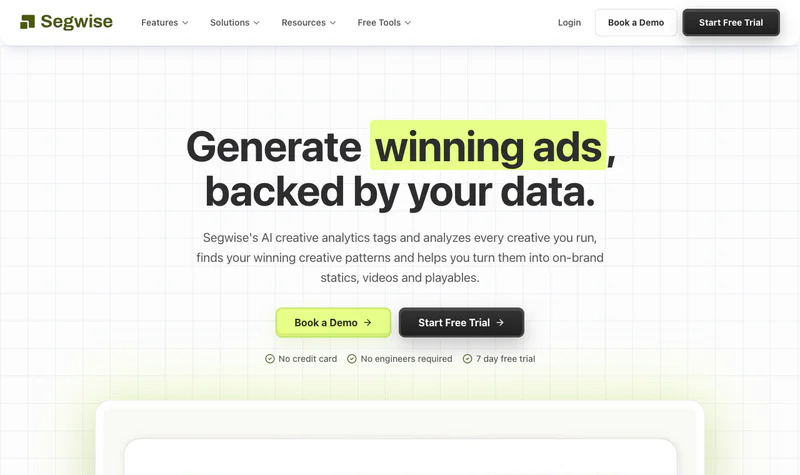
Best for: Mobile app and game studios, and the agencies that run their UA, buying across several networks with MMP data and needing creative-level intelligence tied to business outcomes, plus help producing the next round of ads.
Segwise helps UA, performance, and creative teams 10x their creative output. It unifies creative data from 15+ ad networks and MMPs, tags every creative element with multimodal AI, surfaces the patterns that are winning, and helps the team turn those patterns into new data-backed ads. People stay in charge of strategy, brand, and the final call; Segwise removes the manual work in between.
It connects creative elements (hooks, dialogue, visuals, formats, and more) to business outcomes such as ROAS, CPA/CPI, LTV, IPM, and any custom metric you track. Customer results are on the record: Influence Mobile reported a 10% lift in D7 ROAS (case study), and WGT reported a 5x faster early concept-to-test cycle, from 2 to 3 weeks down to 2 to 3 days (case study). Both figures are customer-reported.
Key Features
AI Creative Analytics: Unified creative-level analytics, including ROAS, CPA, LTV, conversion rates, and custom metrics, from Meta, Google (including YouTube), TikTok, Snapchat, Axon (AppLovin), Unity Ads, Mintegral, Moloco, and more in a single dashboard.
Creative Tagging: Multimodal AI tags hooks, characters, colors, on-screen text, audio, and visuals, with 20+ standard tags, custom tags, and tags pulled from the naming conventions you already use. For playable ads, Segwise's agents play each playable end to end and tag the core mechanic, tutorial, hook scene, end card, and CTA.
Creative Generation: Helps your team generate net-new, data-backed creatives as statics, video (up to 30 seconds), AI UGC-style video, and playables (playables are a managed service), plus storyboards and briefs, grounded in your winning patterns. Generated video can be edited by hand, and exports are built to each network's specs. AI UGC here means AI-generated UGC-style video, not a marketplace of filmed creators.
Pre-flight Testing: Upload up to 10 new creatives and get a score out of 100, a run-or-hold verdict, and a placement eligibility check, benchmarked against the ads already winning in your account, before any spend.
Creative Strategy Agent (AI Chat) and Fatigue Tracking: Ask anything about your creative performance in plain language and get briefs and concepts back, with email and Slack alerts when a creative starts to fatigue.
Competitor Tracking: Follow competitor ads on Meta, tagged with the same multimodal AI, to find gaps in your own creative mix.
Segwise MCP: On request, query your Segwise creative data from Claude, ChatGPT, Cursor, or Codex through a read-only MCP server.
No-code integrations: Connects to ad networks and five MMPs (AppsFlyer, Adjust, Branch, Singular, and Kochava) in minutes, with no engineering work.
Pricing: Segwise starts at $499/month for advertisers spending up to $250K/month, with a special 50% discount for startups spending under $50K/month. Segwise has a 7-day free trial, no credit card needed.
Limitations: Competitor tracking covers Meta only today, while Hawky and GetCrux cover more ad libraries. Playable and CTV generation are managed services run with the Segwise team rather than self-serve tools. Pre-flight Testing needs connected ad network and MMP data to benchmark against, and the free trial imports up to 14 days of history (paid plans import up to 3 months). Segwise does not buy media or set bids and budgets.
2. Motion - Best for DTC creative analytics on Meta and TikTok

Best for: DTC and ecommerce brands whose spend sits on Meta and TikTok and whose creative strategists want visual reports and an AI agent in Slack.
Motion is a creative analytics platform used by about 2,100 teams. It connects Meta, TikTok, YouTube, and LinkedIn, shows creative performance in visual reports and leaderboards, and includes Runneth, an AI creative strategy agent, in every paid plan.
Key Features
Creative Analytics and Reports: Leaderboards, comparative and launch reports, video drop-off and audience retention analysis (Meta and TikTok), and shareable Snapshot links.
AI Tagging: Tags Meta creatives across eight categories, including asset type, visual format, hook or headline tactic, messaging theme, offer type, and intended audience. Tags can be edited by hand.
Runneth AI Agent: Answers questions in the app and in Slack, writes briefs and hooks, makes static image ads, and runs scheduled routines such as weekly reports, iteration finders, and alerts.
Inspo and MCP: Competitor and inspiration research from the Meta Ad Library, plus a read-only MCP server (Meta data) for Claude, ChatGPT, or Cursor.
Pricing: Starter $750/mo for up to $50K monthly ad spend, Pro $1,200/mo above $50K, and a custom Growth plan, with a 14-day free trial and no credit card (see motionapp.com/pricing).
Limitations: AI tagging works on Meta ads only. Motion lists no MMP integration (its attribution integrations are Google Analytics 4 and Northbeam, on Pro and up), no mobile gaming networks such as AppLovin or Unity, and no playable ad support, and it documents no dedicated fatigue alert (you build a fatigue report or set a routine).
3. GetCrux - Best for insights, competitor intel, and generation in one workspace

Best for: Brands and agencies spending up to $100K a month (Starter) or more (Professional) that want creative insights, broad competitor monitoring, and ad generation together.
GetCrux calls itself a "Creative OS" for creative insights, competitor intel, and ad generation. It labels every ad with AI, supports your own custom labels and rule-based tags, reports on fatigue with thresholds you set, and generates static, video, and carousel ads from Starter up.
Key Features
AI Tagging and Custom Labels: AI labels creative attributes across video, static, carousel, and ad copy, with custom taxonomies and deterministic rules on top.
Fatigue Reporting and Alerts: Flags likely fatigued ads with severity and likely cause, with alerts by KPI, channel, and threshold.
Generation and Publishing: Creates static ads, video ads, carousels, scripts, and storyboards (1,000 credits on Starter) and can publish to Meta, Google, and TikTok.
Competitor Insights and Copilot: Monitors competitor ads on Meta, TikTok, Google, YouTube, LinkedIn, X, and Snapchat, with an AI Copilot on every plan. MCP, Slack, and Creative Pre-Flight Testing are on Professional.
Pricing: Starter $1,500/mo for up to $100K monthly ad spend and up to 2 ad accounts; Professional ($100K to $1M spend) and Enterprise ($1M+) are custom (see getcrux.ai/pricing). No free trial is listed; access starts with a founder call, and a free one-off "Scan" report is available.
Limitations: Starter covers Meta, Google, TikTok, and LinkedIn; AppLovin and MMP integrations (AppsFlyer, Adjust, Singular) start on Professional. GetCrux does not list Unity Ads, Mintegral, Branch, Kochava, or playable ad tagging.
4. Hawky - Best for AI media-buying agents plus creative analysis

Best for: Brands spending roughly $50K to $5M+ a month on Meta, Google, and TikTok that want AI agents to help run paid media alongside creative analysis.
Hawky sells itself as an agentic performance marketing platform: two always-on agents plus a Copilot. It tags every hook, frame, and CTA, scores draft creatives before launch, flags element-level fatigue, tracks competitors in the Meta and Google ad libraries, and its Creative Studio generates images and video. The main difference from Segwise is the job: Hawky's agents buy media, while Segwise is the creative layer that sits alongside whatever buying tool you use.
Key Features
Element-Level Analysis: Decodes video, image, copy, voiceover, on-screen text, and audio, and ties elements to revenue through connected CRM, MMP, and GA4 data.
Pre-Launch Scoring and Fatigue Alerts: Scores draft creatives element by element, with fatigue alerts on every tier.
Creative Studio: Generates images and video and launches to Meta, Google, and TikTok.
Competitor Tracking: Follows competitors through the Meta and Google ad libraries, with alerts.
Performance Agent: Manages bids, budgets, and pauses inside guardrails you set (Auto-pilot tier).
Pricing: No published price. Three tiers (Dashboards, Ask, Auto-pilot), each through sales; pricing is per brand and scales with usage.
Limitations: No self-serve free trial. Its public pages list Meta, Google, and TikTok rather than mobile gaming networks such as AppLovin or Unity, name AppsFlyer as the only MMP, and do not list playable ads.
5. Madgicx - Best for automated Meta ad optimization

Best for: Brands and agencies running Meta ads that want automated ad management and creative optimization.
Madgicx describes itself as an agentic Meta ads management platform. It helps brands and agencies automate campaign optimization, generate ad creatives, launch them, and see where budget is and is not working. Its focus is Meta, so it suits teams whose spend sits mostly on Facebook and Instagram.
Key Features
AI Ad Management: Audits your account and recommends optimizations inside your Meta campaigns.
Meta Ad Creative Optimizer: Generates ad creatives, and the Automated Ad Launch Tool deploys them across campaigns.
Creative Insights: AI visual recognition labels the creative elements and attributes in your ads, including video, and ties them to performance.
Ad Fatigue Detector: Flags Meta ads that are wearing out.
Ad Intelligence and Performance Analysis: Cuts through Ads Manager data to highlight where budget is working and where it is not.
Pricing: One main plan, Madgicx Pro Complete, priced by monthly ad spend. From $45/month (billed monthly, under $1K ad spend); the price rises with ad spend, for example $99/month at $1K to $2.5K. 7-day free trial. An optional Tracking Pro add-on is $49/mo (see madgicx.com/pricing).
Limitations: Meta-first, so teams buying across mobile gaming networks such as AppLovin, Unity, or Mintegral will need another tool for those channels.
6. AdCreative.ai - Best for AI ad generation at scale

Best for: Teams that want to generate a high volume of ad creatives quickly with AI.
AdCreative.ai is a generative ad-creative platform that produces ad images, banners, product videos, and ad videos in minutes, with a creative score that estimates how each variation may perform before you launch. It is built for speed and volume, which makes it a strong fit for DTC and SMB teams that need many variations fast.
Key Features
Generative Ad Creatives: Produce ad images, banners, product videos, and ad videos from a brand kit and product inputs.
Creative Scoring AI: Ranks generated variations by predicted performance before spend.
Ad Creative Insight AI and Competitor Insights: See which creatives perform and what competitors are running.
Compliance Checker AI: Checks creatives before they go out.
Pricing: Starter from $39/mo billed monthly (10 credits a month), or $20/mo billed yearly, with Professional and Ultimate tiers above it and a free trial on each plan (see AdCreative.ai pricing).
Limitations: Its strength is volume generation with predictive scoring. Teams that need element-level analysis of their live ads against MMP data usually pair it with an analytics tool. Generation is unlimited, but credits cap how many creatives you can download each month.
7. Singular (Creative IQ) - Best for cross-channel creative ROI

Best for: UA and performance teams already on Singular that want AI creative tagging tied to cross-channel ROI.
Creative IQ is Singular's AI creative analytics suite, sold as a package inside Singular's marketing analytics platform. It tags every video and image with 17 out-of-the-box AI tags, lets you add custom AI tags, and slices creative performance by any tag combination against installs, ROAS, retention, and LTV.
Key Features
AI Creative Tagging: 17 default AI tags across visual and audio elements, up to 20 custom AI dimensions, and hook tags for the opening seconds of video.
Cross-Channel ROI: Compare each creative's performance across networks, with cost data from 1,200+ networks.
Creative Clustering: Groups identical or near-identical creatives across networks using image recognition.
Alerts, AI Assistant, and MCP: Build threshold alerts on creative metrics, ask questions in the app or in Slack, and query creative and tag data through Singular's MCP.
Pricing: Creative IQ pricing is not published; the Creative IQ page offers a 14-day free trial.
Limitations: Singular names no dedicated fatigue feature (you build threshold alerts yourself), documents no creative generation, and no Singular doc says its AI tags analyze what happens inside playables. Creative ROI may be limited for analytics-only customers who do not use Singular attribution.
8. AppsFlyer (Creative Optimization) - Best for attribution-led creative analysis

Best for: Teams already on AppsFlyer that want creative-level data tied to their attribution.
AppsFlyer Creative Optimization is a separate subscription inside AppsFlyer. It imports creatives from partner integrations such as Meta, Google, TikTok, AppLovin, Unity Ads, Mintegral, and Moloco, matches the same creative across networks, and links creative performance to AppsFlyer metrics. It backfills 90 days of creative data when you add a partner, and dashboards refresh once a day at 10:00 UTC.
Key Features
AI Video Breakdown: Splits video creatives into scenes, elements, and on-screen text, each with performance data (Advanced and Premium plans).
Discovery AI Search and Smart Tags: Search creatives in plain language and save any search as a tag, alongside CSV custom dimensions and naming-convention tags.
Creative Similarity: Groups near-identical variants (for example a different orientation or language) so you can compare them.
Creative Management: Syncs creatives from Google Drive or Dropbox, scores new ones before launch, and uploads them to networks.
Pricing: Not published. Full AppsFlyer cost data such as ROAS also needs an ROI360 subscription.
Limitations: It runs on AppsFlyer attribution data, so it is an option only for AppsFlyer customers. Fatigue is spotted manually by reading dashboard trends rather than through an automatic alert, and no AppsFlyer doc describes generating new ads.
9. Vidmob - Best for enterprise creative analytics

Best for: Enterprise brands that want creative data scored against performance and brand standards across many markets.
Vidmob is an AI creative data and analytics platform. It identifies which creative factors drive media outcomes, checks assets against platform specs and brand guidelines before spend, and gives brands an AI analyst to query their creative library. It covers 13 channels, including Meta, Google Ads, DV360, Amazon, Pinterest, and LinkedIn.
Key Features
Performance Intelligence: Identifies which creative factors drive media outcomes.
Pre-Flight Quality: Checks that every asset meets platform specs before spend begins.
Brand Signal: Surfaces brand guideline deviations across every market.
AI Analyst: An on-platform AI agent to ask questions and run reports across your creative library.
Pricing: Three packages priced per brand; request pricing from Vidmob (see vidmob.com/pricing).
Limitations: Built and priced for brand portfolios at enterprise scale, with no self-serve plan listed. It analyzes and governs creative rather than generating finished new ads.
10. CreativeX - Best for creative quality and governance

Best for: Large brands that need creative quality, consistency, and governance measured at scale.
CreativeX is a creative-data platform for global brands. Its Creative Quality product checks every ad against platform best practices and your own brand guidelines, such as aspect ratio, safe zones, sound on, early branding, on-screen text, and video length, and rolls the results into a single Creative Quality Score (CQS). CreativeX's Nestlé case study reports 66% ROI on Meta for ads with a high CQS (vendor-reported).
Key Features
Creative Quality Score (CQS): One score per asset, built from the platform checks above plus any custom guidelines you add.
Pre-flight evaluation: Automatically checks new content before it goes live, so agencies and production partners know the bar before spend.
In-flight evaluation: Keeps live and past ads in one place, with quality and media efficiency broken down by market, brand, platform, and agency.
Benchmarks and other modules: Compares your creative quality with your industry or the global average; separate Creative Salience, Creative Lifecycle, and Inclusive Representation products cover brand distinctiveness, content usage, and representation.
Pricing: Not published; talk to CreativeX's sales team.
Limitations: CQS measures execution quality and guideline adherence, not which hooks or concepts drive installs and ROAS in your MMP data. CreativeX lists no creative generation, no playable-ad analysis, and no self-serve plan.
11. Smartly - Best for enterprise creative and media automation

Best for: Enterprise brands and agencies that want creative production, media buying, and reporting in one platform across many channels.
Smartly is an AI advertising platform that combines creative production, media buying, and reporting for large advertisers running high volumes of ads. Its platforms page lists Meta, TikTok, Snapchat, Pinterest, Google, YouTube, LinkedIn, Amazon, Reddit, Spotify, and Roku, and the brands named on its site include Samsung, Spotify, Uber, and Tripadvisor.
Key Features
AI Studio and templates: Generates and enhances images and video, generates from product feeds, assembles video ads, and adapts one ad across channels, formats, and audiences with AI-powered templates.
Creative Insights and Creative Predictive Potential: Cross-channel reporting on which creative works, plus an AI forecast of how a creative is likely to perform before launch.
Automated buying: Builds and updates ads from a data sheet or feed, runs Optimization Triggers that pause underperformers or scale budget on winning creatives, and offers Predictive Budget Allocation across channels.
Catalog and dynamic creative: Dynamic Product Ads templates for Meta, TikTok, Snapchat, and Pinterest, and dynamic creative optimization across Google channels.
Pricing: Not published; talk to Smartly's sales team.
Limitations: Sales-led, with no self-serve plan, and built for teams running large ad volumes across many channels. Its public pages do not list mobile gaming networks such as AppLovin or Unity, MMP integrations, or element-level tagging mapped to installs and ROAS.
12. Foreplay - Best for ad research and briefs

Best for: Creative strategists and media buyers who want to research winning ads, track competitors, analyze their own ads with Lens, and turn what they learn into briefs.
Foreplay is an ad research and creative workflow platform. Teams save and organize ads into swipe files, search a large ads database, track competitor ad libraries with Spyder, analyze their own ads with Lens, and turn references into briefs.
Key Features
Swipe File and Discovery: Save, tag, and organize ads into shareable boards, and search a large database of ads.
Spyder: Track and analyze competitor advertising around the clock (Workflow tier and up).
Lens: Creative analytics on your own ads (Workflow tier and up).
Briefs and AI connections: Turn inspiration into briefs, and connect Foreplay to Claude or ChatGPT through its MCP (Workflow tier and up).
Pricing: Basic from $59/mo billed monthly ($49/mo billed annually), with higher Workflow and Agency tiers and a 7-day free trial (see foreplay.co/pricing).
Limitations: Built around research, briefs, and analytics rather than producing finished ads. Spyder competitor tracking and Lens analytics start on the Workflow tier ($175/mo billed monthly, $149/mo billed annually), not on Basic.
Related tools for catalog ads and attribution
These two often appear in creative optimization roundups but do a narrower job, so they are not ranked above:
Marpipe now focuses on catalog (dynamic product) ads: it turns your product feed into designed catalog ads, adds product-level video, and handles SKU optimization and feed management. Pricing: free plan, Startup from $199/mo (500 SKU cap), and Enterprise from $999/mo (marpipe.com/pricing). Useful for ecommerce brands with many SKUs.
ThoughtMetric is an ecommerce attribution platform with five attribution models and creative-level performance, from $99/mo at 25,000 monthly pageviews with a 14-day free trial (thoughtmetric.io/pricing). It is an attribution tool, not a creative tagging or generation tool.
MagicBrief shut down: what to use instead
MagicBrief, a popular creative research and briefs tool, closed on July 31, 2026. MagicBrief was acquired by Canva, and its team spent the past year building Canva Grow, a creative analytics and ad-performance product inside Canva. MagicBrief offered its customers 6 months of Canva Business to move over (codes had to be redeemed by September 30, 2026). Canva Grow currently supports Meta and TikTok only. Teams that want an alternative outside Canva, or need more channels, can look at Foreplay or Hawky for research and analysis, or Segwise for creative analytics and generation across more ad networks.
Also Read:AI Tools to Create UA Ads for DTC Brands
How Creative Optimization Works

Data ingestion: The tool pulls creative and performance data from ad networks, Mobile Measurement Partners (MMPs), and sometimes creative management or BI tools into one place.
Automated analysis: Computer vision, speech, and text models tag each creative's elements, and the tool links those tags to results such as ROAS, CPI, or IPM.
Insight generation: Dashboards, reports, and alerts show which elements win, which creatives are tiring, and where competitors are moving.
Actionable recommendations: The tool suggests what to change, and the strongest tools help you brief, score, or generate the next round from what is working. You launch it, and the loop starts again with fresh data.
How to Choose the Right Creative Optimization Tool
The quick picks above match common situations. To compare the tools on your own shortlist, check these features first, then ask each vendor the questions below.
Key Features to Look For
Creative-Level Analytics: Performance data (impressions, clicks, installs, CPI, ROAS, CTR, CVR) for each individual creative across networks, not just per campaign.
Element-Level AI Tagging: Automatic tags for hooks, characters, colors, on-screen text, CTAs, and visual styles, each mapped to performance. Check which networks and formats the tagging actually covers.
Fatigue Detection: Alerts when a creative's performance and spend share decline for a sustained period, ideally on thresholds you set.
Pre-Launch Scoring, Generation, and Testing: Score new creatives against your past winners, generate on-brief variations (static, video, and interactive formats), or run structured tests.
Competitor Tracking: See which creatives rival brands are running, and on which ad libraries.
Integrations: Ad networks, MMPs, and warehouses, so creative data flows into one place.
Also Read:Creative Optimization: Actionable Insights Report
Questions to ask before you buy
Does it connect to your whole stack? Check every ad network and MMP you use. This is where tools differ most, for example Motion covers Meta, TikTok, YouTube, and LinkedIn, while GetCrux adds AppLovin and MMPs on its Professional plan.
Which networks and formats does the AI tagging cover? Some tools tag only Meta ads, and few analyze what happens inside playable ads.
What happens after the insight? Some tools stop at reports; others alert you to fatigue, score new creatives before launch, and help generate the next round.
What does it cost at your spend, and can you trial it? Pricing models vary: spend bands (Segwise, Motion, GetCrux, Madgicx), per brand (Vidmob, Hawky), credits (AdCreative.ai), or a module on top of your MMP (AppsFlyer, Singular). Use free trials to test with your own data.
Can it show results from teams like yours? Ask for named case studies and benchmarks from your industry to set realistic expectations.
For deeper dives on single jobs, see our guides to creative testing tools, creative fatigue detection tools, creative tagging solutions, dynamic creative optimization (DCO) tools, and AI ad generation tools.
Our Verdict: Which Tool to Pick
Several tools on this list now tag creative elements, flag fatigue, and generate ads, so choose on channels, formats, and data access. Mobile app and game teams that buy beyond Meta and Google, or run playable ads, will get the most from Segwise. If you are a DTC brand on Meta and TikTok, Motion or GetCrux may fit better; if you want AI agents buying media, look at Hawky; and if you already pay for AppsFlyer or Singular, start with their creative modules.
Frequently Asked Questions
What is the best creative optimization tool in 2026?
It depends on your channels and spend. Segwise is the strongest fit for mobile app and game advertisers, Motion for DTC brands on Meta and TikTok spending up to $50K a month, GetCrux for brands that want broad competitor monitoring, and Madgicx for Meta-only automation. Pick the creative optimization platform that covers your networks and MMP first, then compare features.
How is Segwise different from Hawky and other creative intelligence tools?
The biggest difference is the job. Hawky runs AI agents that manage bids and budgets alongside its creative analysis, and Vidmob and CreativeX focus on creative analytics and governance for large brands. Segwise does not buy media; it is the creative layer, built to sit next to whatever buying tool you use, with coverage of mobile gaming networks that Hawky's public pages do not list, and four MMPs (Adjust, Branch, Singular, and Kochava) beyond the AppsFlyer integration Hawky names.
Segwise vs GetCrux: which is better for creative optimization?
Both tag creatives with AI, flag fatigue, and generate ads. GetCrux monitors competitors across more ad libraries and offers custom labels and rule-based tags; its Starter plan is $1,500/mo for up to $100K monthly spend, with MMP integrations and AppLovin from the Professional plan. Segwise includes MMP data (AppsFlyer, Adjust, Branch, Singular, and Kochava) and networks such as Unity Ads and Mintegral on every plan, and tags and generates playable ads, which GetCrux does not list. App and game studios usually lean to Segwise; brands that need wide competitor monitoring may prefer GetCrux.
How is Segwise different from AdCreative.ai?
AdCreative.ai is built to generate a high volume of ads quickly and rank them with a predictive creative score. Segwise starts from your own results: it tags the creatives you are already running, maps each element to metrics from your ad networks and MMP, and then helps you generate new ads from the elements that are winning in your account. Teams that care most about volume often start with AdCreative.ai; teams that want generation grounded in their own data tend to choose Segwise.
Which creative optimization tool is best for mobile game studios?
Look for coverage of the networks games actually buy on and support for playable ads. Segwise connects Axon (AppLovin), Unity Ads, Mintegral, and Moloco, and its agents play each playable ad and tag the mechanic, tutorial, and end card against IPM and ROAS. If you already pay for Singular or AppsFlyer attribution, their creative modules are also worth a trial.
How much do creative optimization tools cost, and are any free?
Entry prices range from about $39/mo billed monthly (AdCreative.ai), $45/mo billed monthly under $1K ad spend (Madgicx, rising with spend), and $59/mo billed monthly (Foreplay), up to $750/mo (Motion, up to $50K spend) and $1,500/mo (GetCrux, up to $100K spend). Segwise starts at $499/month for advertisers spending up to $250K/month, with a special 50% discount for startups spending under $50K/month. Hawky, Vidmob, CreativeX, Smartly, Singular Creative IQ, and AppsFlyer Creative Optimization do not publish prices. Free options: Marpipe has a free plan for catalog ads and GetCrux offers a free one-off Scan report, and half of the 12 ranked tools offer a free trial (Segwise, Madgicx, and Foreplay 7 days; Motion and Singular Creative IQ 14 days; AdCreative.ai free to try).
What happened to MagicBrief?
MagicBrief shut down on July 31, 2026 after being acquired by Canva. Its team built Canva Grow, Canva's creative analytics and ad-performance product, which currently supports Meta and TikTok, and existing customers were offered 6 months of Canva Business to move over. Teams that want a tool outside Canva can look at Foreplay or Hawky for research and analysis, or Segwise for creative analytics and generation across more ad networks.
What is the difference between creative analytics and creative optimization tools?
Creative analytics tools measure and explain which creative elements drive performance. Creative optimization platforms go further by acting on that data through fatigue alerts, pre-launch scoring, media buying, or AI creative generation. Segwise, GetCrux, and Hawky combine several of these jobs, while Vidmob and CreativeX focus on analysis and governance.
Do creative optimization tools work with Meta, TikTok, and Google?
Almost all of them cover Meta; coverage beyond that varies. Motion covers Meta, TikTok, YouTube, and LinkedIn; Madgicx is Meta-focused; Hawky covers Meta, Google, and TikTok; GetCrux Starter covers Meta, Google, TikTok, and LinkedIn; and Segwise connects 15+ ad networks and MMPs, including Snapchat and the main mobile gaming networks. Always confirm that a tool supports your exact network mix before buying.