
Are your TikTok ads winning early but losing momentum the moment you try to scale?
Updated July 2026.
The most effective TikTok ad strategy in 2026 is to test creatives first, read early performance signals (CTR, video completion, CPA, ROAS), scale only proven creative patterns with gradual 20 to 30 percent daily budget increases, and refresh creatives every 3 to 7 days to beat fatigue. On TikTok, creative quality drives results more than targeting, so the teams that win move from testing to scaling with data, not guesswork.
One week, the installs are cheap, ROAS looks promising, and spend is climbing. The next week, CPIs creep up, creatives stall, and no one on your team can explain why. Early success confuses your TikTok ad strategy. And when you scale without clear learnings, you don't just lose performance, you burn budget, waste creatives, and lose confidence in your UA decisions.
If you're running user acquisition campaigns for mobile games, DTC brands, subscription apps, and scaling feels risky, this blog is for you. This blog breaks down a practical TikTok ad strategy from tips to create, test, and scale what actually works, without guesswork.
What are the benefits of advertising on TikTok?
Advertising on TikTok helps you reach high-intent users at scale, test creatives faster, and drive efficient user acquisition across the funnel. For UA teams, it's a channel where creative performance matters more than heavy targeting and where learnings compound quickly.
Here are the benefits of advertising on TikTok: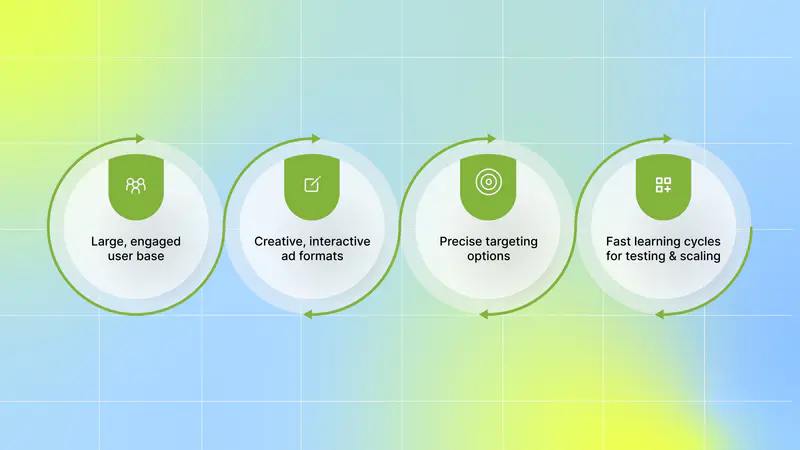
Large, engaged user base: The platform is expected to reach nearly 1.9 billion users by 2029. With this growing user base, TikTok gives you access to a massive, highly engaged audience. Users spend close to an hour a day on the app, which means your ads get real attention, not just impressions.
Creative, interactive ad formats: TikTok is built for video-first storytelling, making it ideal for user acquisition. Formats like Spark Ads, video shopping ads, and branded hashtag challenges help you test hooks, visuals, and messages quickly. This leads to faster creative iteration and clearer signals on what actually converts.
Precise targeting options: TikTok lets you target users based on demographics, interests, behaviors, device types, and engagement signals. You can also build custom audiences from users who interact with similar creators, content, or hashtags. This makes it easier to reach high-intent users and improve traffic quality without overcomplicating your acquisition setup.
Fast learning cycles for testing and scaling: TikTok's algorithm surfaces performance signals quickly, allowing you to understand what resonates without long testing windows. For UA teams, this means faster decisions on what to iterate, scale, or pause, helping you move from testing to scaling with more confidence.
The next step is understanding the ad formats that enable these benefits.
Also Read: Creative Testing Strategies for Mobile UA Campaigns in 2025
What Are the Different TikTok Ad Formats?
TikTok offers multiple ad formats designed to support different user acquisition goals, from driving installs and purchases to boosting engagement and awareness. Choosing the right format helps you align creative, intent, and scale more effectively.
Here are the main TikTok ad formats used by UA teams:
In-Feed Ads: These appear naturally in the "For You" feed and look like regular TikTok videos. They are ideal for driving installs, sign-ups, or purchases because they give you full creative control and scale well for performance campaigns.
Spark Ads: Spark Ads let you boost existing organic posts from your brand or creators (with permission). Because these ads already have likes, comments, and shares, they often feel more authentic and convert better for UA teams focused on trust and engagement.
Branded Takeovers: These full-screen ads appear when users open the app. They are best for major launches or awareness pushes, not always for efficiency-focused UA, due to higher costs.
Effect Ads: Effect Ads involve custom-branded AR filters, stickers, or special effects that users can apply to their videos, encouraging creativity and user interaction. Effect ads focus on brand engagement and creating viral buzz by fostering the ongoing creation of user-generated content.
Live Shopping, Shop Ads, and AR Lenses: These are TikTok's eCommerce-focused ad formats designed to drive purchases directly within the app.
Live Shopping lets brands and creators sell products instantly via video, with purchase links available immediately.
Shop Ads promote products using TikTok's native shopping features.
AR Lenses use interactive filters to showcase branded products in an engaging way.
Together, these formats combine entertainment with seamless in-app shopping to drive conversions.
Ad formats define how your ads appear, but strategy determines whether they actually convert and scale.
Tips to Create a Successful TikTok Ad Strategy
A successful TikTok ad strategy is built around clear goals, fast creative testing, and disciplined scaling. For user acquisition teams, it means knowing what to test, how to read performance signals, and when to scale without burning budget.
Here are the tips for the best TikTok ad strategy:
Set clear goals upfront: Decide what success looks like before you launch. This could be installs, purchases, trials, or ROAS targets. Clear goals keep testing focused and prevent random scaling decisions.
Prioritize creative-first testing: On TikTok, creatives matter more than complex targeting. Test different hooks, visuals, messaging, and CTAs to understand what actually drives user action.
Keep targeting simple in the beginning: Start broad so TikTok's algorithm can learn faster. Over-targeting too early can limit delivery and slow down performance insights.
Use smart bidding to control spend during testing: Use TikTok's automated bidding options to control spend while still giving the algorithm room to learn. This helps you avoid burning the budget too early during testing.
Use performance data to guide iteration: Look beyond surface metrics. Identify which creative elements consistently perform well and iterate on those instead of constantly starting from scratch.
Scale proven patterns, not just winning ads: Once you see stable results, increase budgets gradually and expand variations around what works. This helps you scale without triggering performance drops.
Monitor performance and creative fatigue closely: Watch for early signs of decline and refresh creatives before results fall sharply. Proactive monitoring protects ROAS as spend grows.
This approach helps mobile games, DTC brands, subscription apps, and agencies turn TikTok from a testing channel into a predictable growth engine for user acquisition.
After setting the foundation, the next step is making sure your creatives are built to convert at scale.
Creative Best Practices That Make TikTok Ads Convert
TikTok ads convert best when they feel native, capture attention instantly, and give users a clear reason to act. For user acquisition teams, strong creative execution improves early performance signals, lowers costs, and makes scaling more predictable.
Here are the creative best practices that make TikTok ads convert:
Start with an attention-grabbing hook: The first 1–2 seconds decide whether users stop or scroll. Show gameplay highlights, product benefits, or a clear problem right away to capture attention and improve watch time and CTR.
Opt for a TikTok-native feel: Ads that look like organic TikTok videos perform better. Use vertical video, natural lighting, real people, and simple storytelling instead of polished, ad-like visuals.
Use trending sounds and hashtags: Trending audio and relevant hashtags help your ads blend into the feed and reach active users. This often boosts engagement and gives the algorithm stronger signals during testing.
Leverage user-generated content (UGC): UGC feels authentic and builds trust. Customer reactions, creator demos, or real gameplay clips often convert better than branded ads, especially for DTC brands and subscription apps.
Partner with influencers: Influencer-led creatives come with built-in credibility and attention. They help you test new angles quickly and often deliver stronger early performance signals for UA campaigns.
Provide a compelling offer: Give users a clear reason to act, such as a free trial, a limited-time discount, or an exclusive bundle. Strong offers improve conversion rates and help you hit efficiency targets faster.
Creatives built this way generate stronger early signals, making them easier to test, optimize, and scale without performance drops.
To scale TikTok ads with confidence, you need o test ads that tells you which creatives actually perform and which signals are worth acting on.
How to Test Your TikTok Ad Campaign for Reliable Performance Signals
Testing TikTok ads is about learning fast without wasting budget. For user acquisition teams, the goal is to understand which creatives, messages, and offers drive installs or purchases before you scale spend.
Here's how to test your TikTok ads effectively:
Campaign performance benchmarks
Use these metrics to decide whether your ad should be iterated, scaled, or paused. Focus on signals that reflect real user acquisition performance.
Impressions: Confirms delivery and reach. Use this to ensure your ads are getting enough exposure, not as a success metric.
Click-through rate (CTR):: Indicates whether your hook and creative angle are working. Low CTR usually means your opening seconds are not strong enough.
Conversions and CPA: These are the most important UA metrics. CPA shows how efficiently you acquire users, while ROAS helps you evaluate revenue impact.
Video completion rate: Shows how engaging your ad is. Early drop-offs signal weak hooks or pacing issues.
Engagement rate: Likes, comments, and shares indicate user interest. Strong engagement often improves delivery and lowers costs.
Follower growth (optional): Track this only if community building supports your acquisition strategy.
Instead of focusing only on CTR or CPA, platforms like Segwise offer you creative-level insights that help you understand exactly which creative elements, hooks, or formats are actually driving performance during testing.
Segwise creative analytics connects creative elements (hooks, dialogs, visuals, formats, etc.) directly to business outcomes (ROAS, CPA/CPI, LTV, IPM, conversion rates), so teams stop guessing what works and start scaling creatives with data-backed confidence.
Use split testing to validate what works
Split testing helps you isolate what actually drives performance instead of relying on assumptions. Change one variable at a time while keeping budgets, targeting, and timing consistent.
You should split test:
Hooks and opening scenes.
Visual styles (UGC vs branded).
Messaging and CTAs.
Offers or incentives.
Use the results to identify repeatable patterns, then scale variations of what works. This approach helps you move from testing to scaling with confidence while protecting your budget.
Once testing reveals what truly performs, the next challenge is increasing spend without losing control.
Budget Management During Scaling Phases

Budget management during scaling is about growing spend without losing control. For user acquisition teams, the goal is to scale what works while protecting ROAS and avoiding sudden budget losses.
Here are practical ways to manage budgets safely during scaling phases:
1. Setting scaling budgets and limits
Before you scale, define clear budget rules. Decide how much of your total ad spend to allocate to scaling versus campaigns that are already stable and profitable. This keeps experimentation from putting your core performance at risk.
Set daily spend caps and alerts so you can react quickly if costs spike or performance drops. During active scaling, monitor budgets daily to catch issues early instead of after the spend is already wasted.
2. Performance thresholds and scaling rules
Create clear performance thresholds that guide scaling decisions. Define target CPA, ROAS, and CTR ranges that indicate when a campaign is safe to scale or should be paused.
Wait until you have enough data before increasing budgets. Document these rules, so your team applies them consistently across campaigns and avoids emotional decisions during high-spend periods.
3. Risk management strategies
Scaling increases risk, so spread budgets across multiple campaigns, audiences, and creatives instead of relying on a single winner. This reduces the impact if one campaign underperforms.
Always keep a portion of your budget on stable campaigns to maintain baseline performance. If a scaling attempt fails, roll back spending gradually and reallocate budgets quickly to limit losses.
Strong budget management helps mobile games, DTC brands, subscription apps, and agencies scale TikTok ads with confidence, turning growth into sustainable user acquisition instead of short-term spikes.
Once budgets are under control, the next step is knowing exactly how to scale without breaking performance.
Proven strategies for how to scale TikTok ads successfully
Scaling TikTok ads means growing spend without losing performance. For user acquisition teams, success comes from scaling only what's proven, expanding reach in a controlled way, and protecting ROAS as budgets grow.
Here are proven strategies to scale TikTok ads successfully:
1. Vertical scaling: increase budgets safely
Vertical scaling means increasing budgets on campaigns that already perform well. Start with small increases (20–30% per day) instead of big jumps, and watch performance closely for the next 48 hours.
TikTok's algorithm needs time to adjust to higher spend, so short-term dips are normal and often recover in a few days. If performance keeps declining, pause the increase and reassess. Never scale campaigns that are already showing fatigue or instability.
2. Horizontal scaling: expand audiences and reach
Horizontal scaling focuses on reaching new users without stressing existing campaigns. Duplicate winning campaigns and test:
Broader interest groups
Lookalike audiences based on your best users
New placements or formats
You can also scale by expanding to new regions if your product supports it. Before launching, account for local preferences and time zones so performance stays consistent.
3. Creative scaling: multiply what works
Creative scaling is often the biggest lever on TikTok. Identify patterns in your top-performing ads, such as hooks, formats, or messages, and create multiple variations around those themes.
UGC-style creatives scale especially well. Work with creators or customers to produce authentic variations, and rotate visuals, voices, or music to avoid fatigue. Use A/B testing to refine video length, opening scenes, and CTAs as you scale.
If you want to scale creatives without guessing, a platform like Segwise helps you see which hooks or visuals consistently drive performance across your TikTok campaigns. With Segwise tag-level performance optimization, you can instantly see which creative elements, themes, and formats drive results across all your campaigns.
4. Campaign Budget Optimization (CBO)
CBO lets TikTok automatically distribute budget across ad sets. This often works better than manual control during scaling, but you should still monitor where the budget flows to avoid over-investing in weak segments.
5. Bid strategy optimization
Automatic bidding is useful early on, but as budgets increase, cost caps or manual bids can help protect CPA or ROAS. Test different bid strategies in parallel to find what works best at higher spend levels.
6. Dayparting and schedule optimization
Review performance by time and day to identify when conversions are strongest. Use this insight to focus spending during high-performing windows, especially when scaling across regions. Automation can help, but avoid rules that stop campaigns too aggressively.
This approach helps mobile games, DTC brands, subscription apps, and agencies scale TikTok ads with confidence, turning early wins into sustained user acquisition growth without losing control.
Even with the right scaling strategies in place, small execution mistakes can quickly undo results if you're not careful.
Also Read: Using Cost Caps to Find Winning Ads and Optimize ROI in 2025
Common Scaling Mistakes and How to Avoid Them
Scaling TikTok ads can unlock rapid growth, but small mistakes at this stage can quickly erase your gains. For user acquisition teams, avoiding these errors is critical to protecting ROAS, maintaining performance stability, and scaling with confidence.
Here are the most common TikTok ad scaling mistakes and how you can avoid them:
Scaling too quickly: One of the biggest mistakes is increasing budgets too aggressively. TikTok's algorithm needs time to adjust to higher spend, and sudden budget jumps often cause CPIs to spike and performance to crash. Instead, scale gradually with controlled budget increases.
Ignoring audience overlap: When you scale horizontally, overlapping audiences can cause your campaigns to compete against each other. This internal competition drives up costs and increases ad fatigue for users who see multiple versions of your ads. Keeping overlap under control helps maintain efficiency and ensures each campaign reaches fresh users as you scale.
Neglecting creative refresh: Creative fatigue happens fast on TikTok. If you scale spend without refreshing creatives, performance will drop even if your targeting and bidding are solid. Plan creative refresh cycles before you scale. Rotate new hooks, formats, and variations every 3–7 days.
If you want to catch creative platforms like Segwise help you. With Segwise fatigue detection, you can catch performance decline before it impacts budget allocation and campaign results.
Avoiding these common mistakes helps mobile games, DTC brands, subscription apps, and agencies scale TikTok ads smoothly, turning growth into sustained user acquisition instead of costly setbacks.
To scale with consistency and confidence, you also need the right tools and analytics to guide every decision.
Also Read: How to Overcome TikTok Creative Fatigue
Tools and Analytics for Scaling Success
Scaling TikTok ads successfully depends on having the right data at the right time. For user acquisition teams, tools and analytics help you understand what's working, catch issues early, and make confident scaling decisions instead of guessing.
Here are the tools and analytics that support scaling success:
1. Native TikTok analytics
TikTok Ads Manager is your starting point for scaling decisions. It gives you core metrics like spend, CPA, ROAS, CTR, and video performance, which you should monitor daily during scaling.
Use trends in these metrics to spot when campaigns are ready to scale or when performance is slipping. TikTok's automated rules can also help with basic controls, such as pausing ads if CPA spikes or limiting spend when performance drops. Custom views and dashboards in Ads Manager make it easier to track multiple campaigns at once during high-spend periods.
2. Third-party analytics platform
As spending grows, native reporting is often not enough. Third-party analytics tools give you deeper creative-level visibility across channels.
Platforms like Segwise help UA teams understand which creatives, hooks, and elements actually drive ROAS across TikTok. Segwise integrates with TikTok ads to fetch data, automatically tag creatives, and map performance at the element level, so you can scale proven creative patterns and pause underperforming ads before they waste budget.
Segwise is a fully agentic creative intelligence platform that unifies data from 15+ ad networks and 4 MMPs (AppsFlyer, Adjust, Branch, and Singular), so your TikTok performance sits alongside every other channel in one view. Its multimodal AI is the only one that also tags playable (interactive) ads, and its native fatigue detection flags decline before budget is wasted.
Here is how platforms like Segwise help to scale your TikTok ads:
Creative Tagging: Our powerful, multi-modal AI automatically identifies and tags creative elements like hook dialogs, characters, colors, and audio components across images, videos, text, and playable ads to reveal their impact on performance metrics like IPM, CTR, and ROAS.
Tag-Level Creative Element Mapping: See which specific creative elements drive performance. Discover patterns like "this hook appears in 80% of top-performing creatives" with complete MMP attribution integration.
Track signs of creative fatigue: Track fatigue before it impacts your budget allocation and campaign results. You can also set custom fatigue criteria and monitor creative performance across Facebook, Google, TikTok, and all major ad networks, to catch fatigue before it impacts your ROAS.
Using the right tools ensures mobile games, DTC brands, subscription apps, and agencies can scale TikTok ads with clarity, turning performance data into smarter user acquisition decisions and sustainable growth.
Frequently Asked Questions (FAQ)
What is the best TikTok ad strategy for user acquisition in 2026?
The best TikTok ad strategy in 2026 is creative-first: test many hooks, visuals, and offers with broad targeting, judge them on CTR, video completion, CPA, and ROAS, then scale only the proven creative patterns with gradual budget increases. On TikTok, creative quality drives performance more than complex targeting, so the fastest path to efficient scaling is learning which creative elements work and multiplying them.
How do I scale TikTok ads without losing performance?
Scale in three controlled ways. Vertically, raise budgets on winning campaigns by 20 to 30 percent per day and watch the next 48 hours. Horizontally, duplicate winners into broader interests and lookalike audiences. Creatively, produce more variations of your top-performing hooks and formats. Keep spend caps in place, hold budget on stable campaigns, and control audience overlap so campaigns do not compete with each other.
Which metrics should I track to test TikTok ads?
Use CTR to judge your hook, video completion rate to judge engagement and pacing, and CPA and ROAS to judge efficiency and revenue impact. Treat impressions as a delivery check, not a success metric. Creative-level analytics tools go further by connecting individual creative elements (hooks, dialogs, visuals, formats) to those outcomes.
How often should I refresh TikTok creatives to avoid fatigue?
Plan to rotate new hooks, formats, and variations every 3 to 7 days, and refresh before you scale spend, not after performance drops. Creative fatigue sets in fast on TikTok, so early warning matters. Native fatigue detection in a platform like Segwise flags continuous performance decline before it wastes budget.
What ad format works best on TikTok?
In-Feed Ads and Spark Ads are the workhorses for user acquisition because they feel native and scale well for installs, sign-ups, and purchases. Spark Ads boost existing organic posts (with permission), so they carry real engagement and often convert better. Branded Takeovers and Effect Ads suit awareness and buzz more than efficiency-focused UA.
Can Segwise help scale TikTok ad campaigns?
Yes. Segwise connects to TikTok in a few steps, automatically tags every creative with multimodal AI, and maps tag-level performance to outcomes like ROAS, CPA/CPI, LTV, and IPM across 15+ ad networks and 4 MMPs. That lets UA teams see which creative elements drive results, catch fatigue early with native detection, and scale proven patterns with data-backed confidence.
Conclusion
A strong TikTok ad strategy is built on clear testing, scaling, and creative decisions backed by performance data. When you focus on creative-first testing, track the right performance signals, manage budgets carefully, and scale only proven patterns, TikTok becomes a reliable user-acquisition channel rather than a risky experiment. This approach helps mobile games, DTC brands, subscription apps, and agencies grow spend while protecting CPA and ROAS.
If you want to scale TikTok ads without guessing why performance changes, a platform like Segwise helps you connect creative decisions directly to results.
Segwise integrates directly with TikTok in just a few steps. You just need to go to Segwise Dashboard → Settings → Ad Networks → Connect under TikTok → sign in → select your Account for a complete creative analysis. Once integrated with your TikTok ad account, Segwise helps UA and performance marketing teams understand which creative elements drive performance, when creatives start fatiguing, and where budgets should shift before results drop.
Our AI tagging and creative analytics platform connects creative elements (hooks, dialogs, visuals, formats, etc.) directly to business outcomes (ROAS, CPA/CPI, LTV, IPM, conversion rates), so teams stop guessing what works and start scaling creatives with data-backed confidence. Moreover, with our fatigue tracking, you can catch fatigue before it impacts your campaign results.
So, if you're ready to scale TikTok ads with confidence, start your free trial today and turn creative insights into your user acquisition growth!