
Key Takeaways
Hook Impact: Hook rate shows if your ad can stop the scroll in the first few seconds; if it fails here, nothing else in your funnel matters.
Benchmark Reality: A good hook rate is typically 25-30%, but it varies by platform, so benchmark performance rather than chasing a single number.
Core Problem: Low hook rates usually come from weak openings, unclear messaging, or creatives that don’t match audience or platform behavior.
Winning Strategy: High-performing hooks use clear value, strong visuals, emotional triggers, and are tailored to each platform and audience.
Scale With Data: The best teams don’t guess; they use creative tagging and performance data to identify winning hooks and scale them faster.
Why do some ads grab attention instantly while yours get skipped in seconds?
You spend time and budget creating videos, testing angles, and launching campaigns, but if your hook fails, nothing else matters. Most creatives lose users in the first 3 seconds, and that means wasted spend and poor engagement. Even studies show that 47% of a video campaign's value is delivered within the first three seconds. So, if your hook doesn’t stop the scroll, your entire creative strategy breaks before it even starts.
This blog will help you understand what hook rate really is, why it matters for your ad performance, and how you can improve it with simple, data-backed strategies that actually work.
What Is a Hook Rate?
Hook rate is the percentage of people who stop scrolling and watch at least the first few seconds (usually 3 seconds) of your ad after seeing it. It shows how effective your opening hook is at grabbing attention before users decide to skip.
As a creative strategist, a strong hook rate means your ideas are actually capturing attention, while a low hook rate tells you your concept, opening frame, or message isn’t resonating with your audience.
So, do you want to know which hooks are actually working across your creatives? This is where a creative intelligence platform like Segwise comes in.
With tag-level creative element mapping, you can discover patterns like "this hook appears in 80% of top-performing creatives" with complete MMP attribution integration.
Now that you understand what hook rate is, the next step is to understand what good performance actually looks like.
What Is a Good Hook Rate?
A “good” hook rate isn’t the same across platforms. It depends on how users behave and how each platform measures early engagement. Instead of chasing a single number, you should benchmark performance across each platform.
Ideally, you should aim for at least a 25% hook rate, meaning 1 in 4 users watch at least the first 3 seconds of your video. Top-performing creatives typically reach 30% or higher, which indicates your opening is strong enough to consistently capture attention and stop the scroll.
The next step is understanding how to measure it correctly across different platforms.
How to calculate Hook Rate across platforms
Each platform measures early engagement differently, so you need to use platform-specific metrics to calculate hook rate accurately. Understanding these differences helps you evaluate performance correctly and make better creative decisions across channels.
Here’s how hook rate is calculated across major platforms:
1. Meta Ads (Facebook & Instagram)
On Meta, hook rate is typically calculated as:
3-second video plays ÷ impressions
This means your hook is evaluated based on whether users stay for at least 3 seconds. Since Meta is more feed-driven, your opening needs to quickly communicate value and stop the scroll within the first few frames.
2. TikTok Ads
On TikTok, hook rate is usually calculated as:
2-second video views ÷ impressions
TikTok is a faster, more native content environment. Users scroll quickly, so your hook needs to feel organic and capture attention almost instantly, often within the first 1–2 seconds.
As a creative strategist, this means you shouldn’t reuse the same hook across platforms; each platform requires a different opening style to perform well.
Once you know how the hook rate is calculated across platforms, the next step is to understand why it actually means for your ad performance.
Why Hook Rate Matters?
Hook rate matters because it tells you if your ad can stop the scroll and earn attention in a crowded feed. It also acts as an early signal to help you decide which creatives to scale, fix, or replace.
Here are the key reasons why hook rate should be your top priority: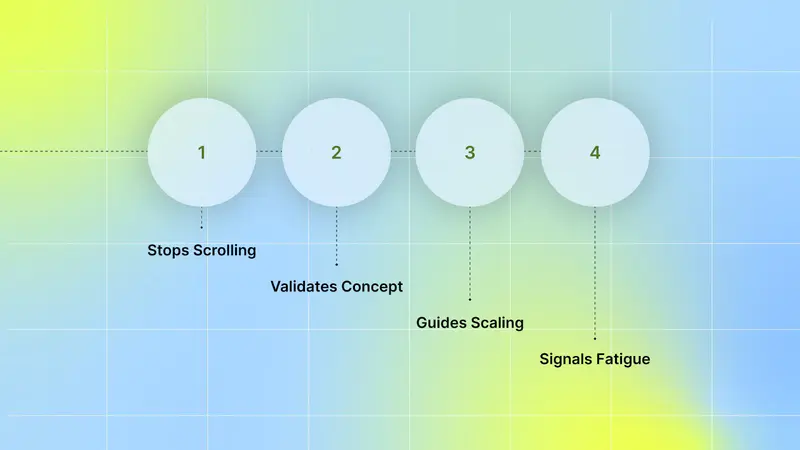
It determines whether users stop scrolling: Your hook is the first battle. If users don’t pause in the first few seconds, your creative is skipped before it delivers any message.
It influences how platforms distribute your ads: Platforms like Meta and TikTok prioritize ads that hold attention. A higher hook rate can improve delivery and reduce wasted impressions.
It validates your creative concept instantly: As a creative strategist, hook rate tells you early whether your idea, angle, or opening resonates without waiting for full campaign results.
It helps you identify what to scale: When multiple creatives are running, the hook rate quickly shows which ones deserve more budget and which ones should be paused.
It signals creative fatigue early: A drop in hook rate is often the first warning that your audience has seen your creative too many times, helping you refresh before performance declines.
However, even when you know its importance, many creatives still struggle to achieve a strong hook rate.
Also Read: How to Identify Creative Fatigue and Fix It in Advertising
Why Hook Rate Is Low?
Your hook rate is low because your creative fails to capture attention immediately or doesn’t give users a reason to keep watching. It usually signals a gap between your creative execution and what your audience expects.
Here are the most common reasons why your hook rate is low:
Your ad looks like typical branded content, so users instantly recognize it as an ad and skip it.
Your opening lacks a clear trigger (problem, result, or curiosity), so it doesn’t create interest.
Your first frame has no strong visual or motion, so it fails to interrupt scrolling behavior.
Your hook doesn’t align with platform behavior (e.g., polished ads on TikTok feel out of place).
Your audience has already seen similar creatives too many times, leading to reduced attention.
The next step is to fix these gaps with the right tips.
How Can You Improve Hook Rate?
Improving hook rate means making your ad strong enough to stop users in the first few seconds. It’s not just about creativity; it’s about understanding what grabs attention and turning that into a repeatable system.
As a creative strategist, your goal is to consistently craft hooks that capture attention, align with platform behavior, and keep users watching.
Here are proven ways to improve your hook rate:
1. Understand Your Audience Deeply
This means knowing exactly who you’re talking to and what matters to them before you create any hook. If your hook doesn’t reflect your audience’s reality, it will get ignored. You need to understand their problems, desires, behavior, and the kind of content they already engage with.
Look at reviews, comments, and competitor ads. Use real phrases your users say. When your hook sounds like the user’s own thought, it performs better.
Different audiences respond to different triggers:
Mobile gamers: Winning faster, unlocking features, beating levels.
DTC buyers: Visible results, savings, solving a specific problem.
Subscription app users: Productivity, ease of use, long-term value.
The more specific your understanding, the more relevant your hook feels.
2. Start With a Question
This strategy uses curiosity to pull users into your ad. A well-placed question makes users pause because it triggers a mental response. It forces them to relate the question to their own situation.
Ask questions that are specific and tied to a real pain point. Avoid generic questions. The sharper the question, the stronger the hook.
For example,
“Why are you still losing matches?”
“Is your skincare routine actually working?”
This works because it,
Highlights a problem.
Feels personal.
Creates curiosity about the answer.
3. Use Strong, Scroll-Stopping Visuals
Users don’t read first; they react visually. If your first frame doesn’t stand out, your hook fails before your message is even seen.
Design your first 1–2 seconds separately from the rest of the ad. Ask yourself: “Would you stop scrolling for this?” If not, it needs improvement.
Strong visuals include:
Movement in the first second.
Bright or contrasting colors.
Close-up shots or unexpected angles.
Fast cuts or dynamic transitions.
4. Trigger an Emotional Response
This strategy works by making users feel something instantly. Emotion is what keeps people watching. If your hook creates curiosity, excitement, or even frustration, users are more likely to stay engaged.
Decide what emotion you want to trigger before creating the hook. Then design your visuals and message around that emotion.
Different emotional triggers you can use:
Frustration: Show a common problem → “Why is your skincare routine still not working?”
Desire/Outcome: Show a result → “Win every level with this simple move.”
Surprise/Curiosity: Show something unexpected → “This app replaced my entire workflow.”
5. Highlight Your Key Value Immediately
This means showing the benefit of your product or service right away. Users don’t want to figure things out. If your value is not clear in the first few seconds, they will scroll.
Focus on outcomes, not features. Don’t explain what your product is, show what it does for the user.
For example:
“Get stronger in 7 days.”
“Clear skin without expensive treatments”
“Automate your work in minutes.”
This works because users instantly understand what they gain.
6. Keep It Short and Clear
This strategy is about delivering your message quickly without confusion. Attention spans are short. If your hook takes too long to explain, users will drop off.
Remove anything that doesn’t add immediate value. If your hook needs context, it’s too complex.
A strong hook,
Focuses on one idea.
Uses simple language.
Gets to the point fast.
7. Use Social Proof Early
Using social proof early means showing real people using or benefiting from your product within the first few seconds of your ad. Instead of starting with brand messaging, you lead with testimonials, user experiences, or creator-style content that feels authentic and relatable.
This improves hook rate because users trust people more than brands. When viewers see someone like them getting results, it builds instant credibility and makes them stop scrolling. It also makes your ad feel less like an ad and more like real content, which increases the chances of them watching longer.
8. Match the Platform Style
This strategy ensures your hook fits how users consume content on each platform. Study top-performing ads on each platform. Adapt your hook style instead of reusing the same creative everywhere.
Each platform has different expectations:
Meta → Clear, direct, benefit-driven.
TikTok → Native, casual, fast-paced.
But what if you want to see how your creatives are actually performing across all platforms in one place? This is where Segwise comes in.
Instead of manually switching between dashboards, Segwise creative analytics gives you a unified view of your creative performance across Facebook Ads Manager, Google Ads, TikTok, and your MMP. You can see creative-level ROAS, CPA, LTV, and conversion rates from all sources in one unified view.
With this, you can instantly compare which hooks, formats, and creative styles are working on each platform, so you can adapt faster and scale what performs best.
9. Use Audio to Grab Attention
This strategy uses sound to make your hook more engaging. Start your ad with a strong audio cue. But also ensure your hook works without sound, as many users watch on mute.
Audio can enhance your hook by:
Reinforcing your message.
Creating emotion.
Making your ad more memorable.
You can use,
Strong opening voiceover.
Sound effects.
Trending audio.
10. Use Challenge or Tutorial Hooks
This works especially well for mobile games and interactive products. Instead of telling users what your product does, involve them:
“Can you solve this?”
“Only 2% can beat this level.”
“Try this before you skip.”
This increases engagement, makes them more likely to continue watching, and turns your ad into a challenge, not just content.
11. Optimize On-Screen Text for Instant Clarity
This strategy ensures your message is understood even without sound. Many users scroll with sound off. If your hook relies only on audio, it may fail. Add 3–5 words that clearly communicate your value or hook.
Strong on-screen text should:
Be short and easy to read.
Use high contrast.
Focus on one key message.
For example, “Real results in 7 days.” This helps users understand your ad instantly and improves your hook rate.
12. Test and Improve Continuously
This strategy focuses on building a system rather than relying on a single creative. You won’t find the best hook in one attempt. You need to test different variations and learn from data.
Track hook rate for each variation. Identify patterns in winning hooks and use them to guide future creatives.
Test,
Different opening lines,
Different visuals,
Different formats,
Then analyze what works.
Improving hook rate is not about guessing—it’s about building a repeatable process.
When you understand your audience, create strong openings, and continuously test, you can consistently produce creatives that capture attention and drive results.
Also Read: Facebook Ad Hooks That Actually Work: A Breakdown of 2024’s Most Engaging Approaches
Conclusion
Hook rate is the first signal that tells you whether your creative is working or not. If users don’t stop in the first few seconds, your ad never gets a chance to drive results. A strong hook rate means your message is clear, relevant, and engaging, while a low hook rate highlights gaps in your creative strategy.
So, how do you consistently identify which hooks actually work? This is where a creative intelligence platform like Segwise helps you go beyond guesswork.
Instead of manually identifying which hooks work, Segwise uses AI-powered creative tagging to automatically identify and tag elements such as hook dialogs, characters, colors, and audio components across images, videos, text, and playable ads. It then connects these elements directly to performance metrics like IPM, CTR, and ROAS, so you can clearly see what’s driving performance.
You also don't need to jump between Facebook Ads Manager, Google Ads, TikTok, and your MMP dashboard. You can see creative-level ROAS, CPA, LTV, and conversion rates across all sources in a single unified view. It also helps you detect creative fatigue early by using fatigue tracking, so you can scale what works and improve faster. Moreover, with tag-level performance optimization, you can instantly see which creative elements, themes, and formats drive results across all your campaigns and apps.
So, why wait? Start your free trial today to understand which hooks or creative elements truly drive performance!