
Key Takeaways
Concept Decay: Creative fatigue goes beyond one ad underperforming; it happens when your core idea loses impact across multiple variations. If you only rotate ads without refreshing concepts, performance will continue to decline.
Early Signals: Falling CTR, declining ROAS, rising costs, and engagement gaps across segments are not random drops. They are early warnings that your hook, angle, or storytelling structure is wearing out.
Strategic Refresh: Solving fatigue requires proactive concept evolution, not last-minute fixes. Diversifying hooks, rotating creatives intentionally, and refreshing assets regularly keep campaigns scalable.
System Over Guesswork: Manual monitoring is not enough in modern cross-network advertising. You need structured testing, concept-level analysis, and data-backed validation to identify fatigue accurately.
Proactive Detection: Creative intelligence platforms like Segwise help you track fatigue patterns across networks, set custom performance criteria, and detect decline before ROAS drops so you refresh strategically.
Why does your winning concept suddenly stop working?
You refined the hook, tested variations, and launched new edits, yet performance still dipped. As a creative strategist, your job isn’t just to launch ads; it’s to build ideas that sustain performance. When creative fatigue sets in, random brainstorming won’t fix it. You need a clear system to identify concept decay and refresh strategically.
Even study shows that after four repeated exposures, the associated likelihood of conversion can drop by about 45%, highlighting how over-repetition without creative refresh can erode performance.
This blog will help you understand what creative fatigue is, how to spot it early, and how to overcome it before your next winning concept quietly fades.
What Is Ad Creative Fatigue?
Creative fatigue happens when your audience sees the same creative idea too many times, and it starts to lose impact. The hook feels familiar. As a result, engagement drops, conversions slow, and performance weakens, even if your targeting and budget remain the same.
As a creative strategist in mobile gaming, DTC, subscription apps, or an agency, this directly affects your creative strategy. When fatigue sets in, your best-performing concepts stop scaling. If you don’t identify it early, you end up producing more variations of a tired idea instead of building fresh concepts that can sustain performance.
However, before you decide how to respond to performance drops, it’s important to understand the difference between fatigue at the ad and creative level.
Creative Fatigue vs Ad Fatigue
Understanding this difference is essential because it tells you whether you need to pause one ad or rethink your entire creative concept. If you misdiagnose the problem, you’ll keep producing more variations of a tired idea instead of fixing the real issue.
Here are the key differences you need to understand as a creative strategist:
If you want your campaigns to scale consistently, rotating ads alone is not enough; you must eliminate creative fatigue at the concept level. When you proactively refresh your hooks, angles, and formats, your creative strategy stays strong, scalable, and ready to perform across every launch.
The next step is understanding what actually causes creative fatigue.
Also Read: How to Combat Creative Fatigue with AI Solutions
What can cause creative fatigue?
Creative fatigue happens when your creative strategy stops evolving while your audience keeps consuming content at high speed. When ideas don’t adapt to changing attention patterns and expectations, performance naturally weakens over time.
Here are the key reasons that cause creative fatigue: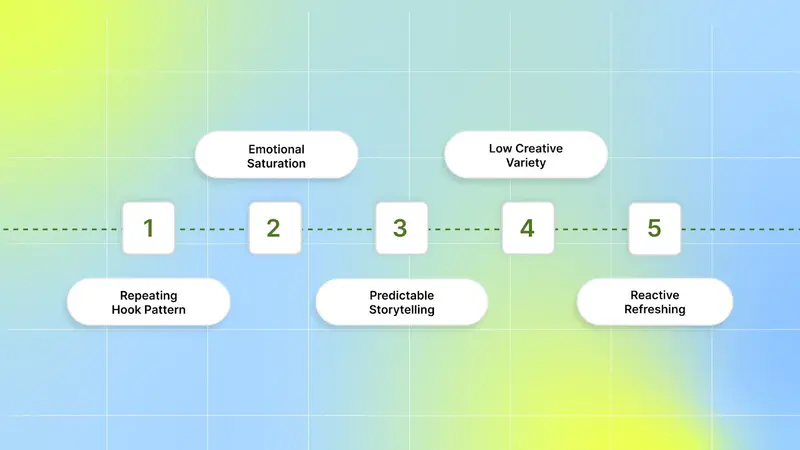
The Same Hook Pattern Repeats: If you keep opening with the same tension style, headline format, or visual cue, your audience quickly learns to ignore it.
Emotional Angle Saturation: When every ad pushes the same emotion, urgency, fear, discount, hype, it loses impact over time.
Repetitive Storytelling Structure: If every ad follows the same narrative formula, viewers anticipate what comes next and disengage early.
Limited Creative Diversity: Testing minor edits instead of new concepts creates surface variation but strategic repetition.
Reactive Instead of Proactive Refreshing: If you only create new concepts after performance drops, you’re always behind. Without a planned refresh system, your creative strategy becomes reactive, and fatigue sets in faster.
When you understand why creative fatigue happens, the next step is to know how to identify it.
How to Identify Creative Fatigue
Creative fatigue is not always obvious at first. It often starts as small performance shifts that compound over time and quietly weaken your creative strategy.
Here are the two main ways you can detect creative fatigue early:
1. Automatic notifications
Some platforms, like Meta, may warn you about potential creative fatigue before or during a campaign. You might see alerts such as “Creative limited” or “Creative fatigue” in Ads Manager, especially in the delivery column. These notifications can help you spot early issues, but they only apply to certain ad types and platforms. That’s why you shouldn’t rely on them alone.
Advanced creative intelligence platforms go further by monitoring performance patterns across networks and sending proactive alerts when engagement, conversion rates, or spend efficiency start to drop. This helps you react before fatigue damages your overall creative strategy.
Are you also searching for a platform to detect creative fatigue before it impacts your campaign performance? This is where Segwise comes in.
Segwise’s fatigue tracking allows you to set custom success criteria, such as ROAS thresholds or spend share goals, and continuously monitor creative performance against them. With cross-platform performance reports, you can monitor creative performance across all platforms in unified tracking reports.
2. Manual diagnosis
Manual diagnosis means reviewing your campaign performance at the concept level, not just at the ad level. If you notice declining impressions or lower ROAS across multiple ads that share the same hook, angle, or format, it’s a strong sign of creative fatigue.
As a creative strategist, you should group ads by idea or narrative style and check whether similar creatives are declining together. When several variations of the same concept weaken at the same time, it signals that the idea itself needs refreshing, not just the ad.
Even when you know how to diagnose fatigue at a strategic level, the real impact shows up in everyday performance signals that are easy to overlook.
What are Some Signs of Creative Fatigue?
Creative fatigue often hides inside campaigns that once performed well. If you don’t actively look for warning signals, you may continue scaling an idea that has already peaked.
Here are five clear signs your creative concept is wearing out:
Your CTR Keeps Dropping: If your click-through rate steadily declines, your hook is no longer capturing attention. This is often the first signal that your audience has seen the idea too many times.
Watch Time or Engagement Falls: When viewers stop watching your video ads earlier than before, or engagement (comments, shares, reactions) drops, it means your creative is no longer emotionally engaging.
Rising Costs and Falling Returns: If CPC or CPA increases while ROAS declines, your creative is losing efficiency. You’re spending more to drive fewer results; it's a clear sign your concept has peaked.
Dropping Impressions: If impressions start declining even though your budget stays stable, platforms may see your creative as less relevant. When engagement drops, algorithms reduce delivery, which signals it’s time to refresh your concept.
Look for Engagement Gaps Across Segments: If certain audience segments stop engaging faster than others, fatigue is likely setting in there first. Segment-level analysis helps you refresh creatives strategically instead of changing everything at once.
Next, let’s look at ways to overcome creative fatigue before it affects your campaign performance.
How to Solve Creative Fatigue
You solve creative fatigue by evolving your ideas before they lose power. As a creative strategist, your role is not just to produce more ads; it’s to build a creative system that keeps concepts fresh, scalable, and aligned with audience behavior.
Here are practical ways to overcome creative fatigue effectively:
1. Refresh Visual Elements Quickly
Visual repetition is one of the fastest triggers of fatigue. When your audience keeps seeing the same color palette, background, framing, or visual style, they develop ad blindness even if the offer is strong.
Instead of rebuilding the entire ad, start with visual shifts:
Change background colors or scenery.
Modify framing (close-up vs wide shot).
Use different product angles.
Show a new gameplay moment.
For mobile games, you can rotate between different levels or characters, or for subscription apps, you can show different app features visually.
Small visual refreshes can extend the life of a winning concept without overhauling your strategy.
2. Diversify Creative Variations Strategically
Many teams create “variations,” but they often change only surface elements. True diversification means changing the emotional angle, hook structure, or value proposition.
Instead of:
One concept with minor copy edits
Build:
Multiple hook styles.
Different emotional triggers (fear, aspiration, proof, urgency).
Alternate storytelling formats.
For example:
A DTC brand can test “problem-focused” vs “transformation-focused” messaging.
A mobile game can test “fail moment hook” vs “win moment hook.”
A subscription app can test “feature demo” vs “outcome storytelling.”
Strategic variation keeps your audience engaged while maintaining conceptual consistency.
3. Establish Frequency Caps
Creative fatigue accelerates when the same audience sees your ad too many times. The right frequency depends on your platform, budget, and audience size, but high repetition within a limited audience pool almost always leads to declining engagement.
To prevent overexposure, implement frequency caps during campaign setup. Frequency caps let you control how many times a single user sees your ad within a given time period. By limiting repeated impressions, you protect your creative from wearing out too quickly and ensure a broader reach within your target audience.
You can strengthen this approach by:
Using automatic rules to pause or adjust ads once they exceed a defined frequency threshold. This helps you avoid oversaturation without constant manual monitoring.
Planning ad rotations so multiple variations run in a structured sequence instead of relying on one winning ad for too long.
Scheduling creatives strategically by running different ads on different days or phases of your campaign to distribute exposure evenly.
Not all platforms offer advanced frequency controls, so use them wherever available. Managing exposure intentionally is one of the simplest ways to extend the lifespan of your creative strategy.
4. Exclude Past Audiences Temporarily
When users have already engaged but not converted, showing them the same creative repeatedly can create frustration rather than persuasion.
For example:
Users who clicked but didn’t purchase.
Installers who didn’t subscribe.
Retargeted users who saw the same discount repeatedly.
Exclude these groups temporarily and reintroduce them later with:
A new hook.
A different value proposition.
A stronger proof angle.
This prevents oversaturation and keeps your retargeting pools fresh.
5. Update Creative Assets Regularly
Creative fatigue often happens because refreshes happen too late. Instead of waiting for CTR or ROAS to collapse, build a refresh cadence into your strategy.
Plan:
Weekly micro-refreshes (hooks, first 3 seconds).
Monthly angle refreshes.
Format diversification every campaign cycle.
You can introduce new gameplay clips regularly, rotate offers and seasonal angles, or highlight different features over time.
Proactive refresh cycles prevent reactive scrambling.
6. Use Dynamic Creative Approaches
Dynamic creative approaches help you reduce repetition without constantly producing entirely new ads. Instead of running one fixed version, dynamic systems automatically mix different headlines, visuals, CTAs, and copy elements to generate multiple variations from a single structured template.
This increases perceived freshness because your audience does not see the exact same combination every time. Even small changes to messaging or visuals can reset attention and extend a concept's lifespan.
As a creative strategist, it allows you to preserve your core idea while introducing controlled variation. You maintain strategic consistency while reducing fatigue by continuously delivering slightly different creative combinations.
7. Optimize and Test Continuously
Creative fatigue cannot be solved without testing. As a strategist, you should consistently validate which elements are declining and which are scaling.
Run A/B tests to:
Compare fresh hooks vs older ones.
Test emotional angles.
Evaluate different storytelling formats.
Also, analyze performance by:
Audience segment.
Device type.
Funnel stage.
Testing helps you identify whether fatigue is concept-level or execution-level.
8. Leverage Creative Intelligence Platforms
Manual monitoring is slow, and by the time performance drops, fatigue has often already drained your campaign budget.
Creative intelligence platforms like Segwise provide an early warning by continuously tracking creative performance and spotting fatigue patterns before they affect results.
With Segwise’s fatigue tracking, you can:
Set custom success criteria by defining ROAS thresholds, spend share goals, or performance benchmarks that align with your optimization strategy.
Detect creative fatigue automatically through continuous monitoring of performance decline and spend share using internal logic.
Track creatives across platforms with unified cross-network performance reports covering Facebook, Google, TikTok, and other major ad networks.
Combine tag-level insights with performance mapping to understand which specific creative elements (hooks, visuals, angles) are driving sustained performance versus early fatigue.
With Segwise, instead of reacting to declining ROAS, you can proactively refresh the right creative elements at the right time, keeping your creative strategy resilient and scalable.
Also Read: Top Creative Intelligence Tools for Creative Success in 2025
Conclusion
Creative fatigue is not just a performance issue; it is a strategy issue. When your hooks repeat, emotional angles saturate, and storytelling loses freshness, even your strongest concepts lose impact. As a creative strategist, your role is to detect fatigue early, understand why it happens, and refresh ideas before performance collapses. By identifying the right signals, rotating intelligently, diversifying concepts, and testing continuously, you can build a creative system that sustains scale instead of constantly chasing recovery.
So how do you detect creative fatigue before it starts hurting your ROAS? This is where creative intelligence platforms like Segwise come in.
With Segwise’s fatigue tracking, you can set custom success criteria, monitor performance across Facebook, Google, TikTok, and all major ad networks, and receive alerts when creative performance starts weakening so you can refresh ideas proactively rather than reactively.
With cross-platform performance reports, you can track your creatives across platforms in unified reports. You can also track performance for individual platforms or get consolidated cross-network insights.
So, why wait? Start your free trial to detect creative fatigue before it impacts performance!