
Updated July 2026.
What if you could identify winning creative patterns before launching your next campaign?
As a creative strategist, your job isn’t just to produce more ads; it’s to develop creatives that actually drive results. But without clear insight into which hooks, messaging, or visual concepts truly work, you’re forced to rely on assumptions. When you can’t identify winning creative patterns, your strategy becomes reactive instead of intentional, and your team ends up producing more creatives without improving performance.
This blog covers how modern ad creative testing helps you identify winning creative elements, turn performance insights into data-backed creative briefs, and build a repeatable creative strategy that helps your team produce high-performing creatives with confidence. You will also get the complete 5-pillar testing framework we recommend for Meta ads, covering campaign structure, budgets, statistical thresholds, and creative lifecycle management.
Updated July 2026.
Key Takeaways (TL;DR)
Creative is the main growth lever: Nielsen research has repeatedly found that creative quality drives roughly 56% of a campaign’s sales lift, far more than media placement or audience selection.
Test elements, not whole ads: Change a single variable (hook, visual, or CTA) per test group so you learn causation, not correlation.
Multivariate testing gives the deepest insight: It shows which combinations of hooks, visuals, and CTAs drive performance, not just which ad won.
Run a 5-pillar framework on Meta: Hypothesis, dedicated testing campaigns (CBO or ABO), high-velocity iteration (15 to 30 new concepts or iterations monthly), element-level analysis, and lifecycle management.
Fund tests properly: Keep 10% to 20% of budget on testing, give each variant enough spend to clear your significance threshold, and define what “winning” means before the test runs.
Automate the data work: Unified analytics plus AI creative tagging compresses analysis from days to minutes and is the biggest unlock for testing velocity.
What Is Ad Creative Testing?
Ad creative testing is the process of systematically testing different creative variations to understand which hooks, messaging, visuals, and creative concepts drive the best performance. Instead of guessing what works, you use performance data to identify which creative elements lead to more installs, purchases, or subscriptions. This helps you make informed creative decisions based on actual results, not assumptions.
As a creative strategist, it gives you clear insight into which hooks grab attention, which messaging resonates with your audience, and which creative concepts are worth scaling. This allows you to build data-backed creative briefs and develop a repeatable creative strategy that consistently produces high-performing creatives.
Now that you understand what ad creative testing is, the next step is understanding why it plays a critical role in building a successful creative strategy.
Also Read: Understanding Creative Intelligence: Examples and Insights
Why Ad Creative Testing Matters
Ad creative testing helps you understand which creative decisions lead to better engagement and performance, so you can build a strategy that consistently produces winning creatives.
Here are five key reasons why ad creative testing matters: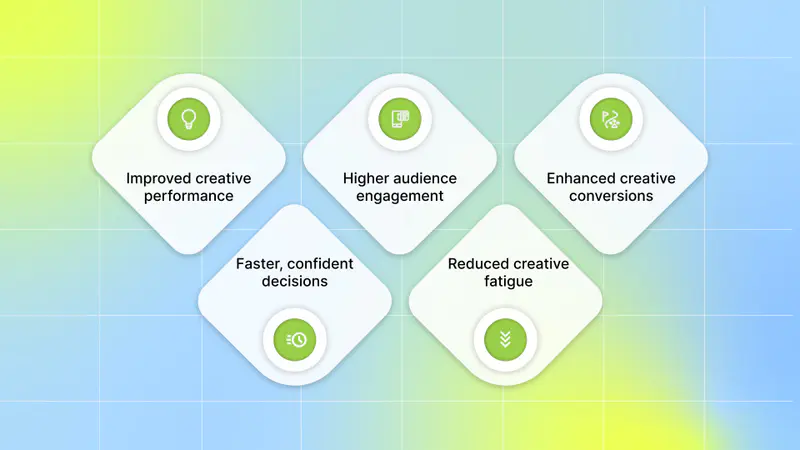
Improved creative performance and campaign efficiency: Creative testing helps you identify the strongest creative concepts before scaling them. Instead of relying on assumptions or subjective feedback, you use real performance data to focus on creatives that are more likely to succeed.
Higher audience engagement and attention: In competitive platforms like Facebook, TikTok, and YouTube, your creative must capture attention within seconds. Creative testing helps you identify hooks, visuals, and messaging that stop users from scrolling and improve engagement.
Better conversion outcomes from your creatives: By testing and refining creative elements, you can improve the effectiveness of your creatives. This helps you produce creatives that drive better results.
Faster and more confident creative decisions: Creative testing removes guesswork from your creative process. Instead of relying on opinions, you can make decisions based on clear performance insights, allowing your team to build stronger creative briefs.
Reduced creative fatigue and stronger iteration cycles: No creative performs well forever. Creative testing helps you identify when performance starts to decline and allows you to introduce new variations. This ensures your creative strategy stays fresh and continues to deliver results.
However, to truly understand why creative testing has become so critical today, you need to understand how the foundation of ad performance itself has changed.
The Shift from Audience Targeting to Creative Performance
Earlier, performance depended heavily on audience targeting. Today, performance depends more on creative quality and testing. As a creative strategist, this shift changes how you build and scale creative strategy.
Before: Audience targeting drove performance
For years, you could rely on precise targeting to reach users who were most likely to install, purchase, or subscribe. Platforms used behavioral data, interests, and tracking to identify high-intent users, which meant even average creatives could perform well if shown to the right audience.
This made your job easier. You didn’t need to fully understand which creative elements drove performance because targeting did most of the heavy lifting. As long as your ads reach the right users, performance follows.
Now: Creative intelligence and testing drive performance
Today, that advantage is no longer reliable. Privacy changes like Apple’s App Tracking Transparency (ATT), GDPR, and CCPA have limited access to user-level tracking. Platforms now have less data to identify high-intent users with the same accuracy as before.
This means your creatives are now shown to broader audiences. You can no longer depend on targeting precision alone to drive performance. If your creative doesn’t capture attention and resonate instantly, performance drops, no matter how much budget you spend.
As a creative strategist, this puts more pressure on your creative decisions. The success of your campaigns now depends more on the quality of your creative strategy than ever before. Now, you need to decide which hooks, messaging, visuals, and creative concepts work for your audience. This makes creative testing and creative intelligence your most powerful lever for improving performance.
A creative intelligence platform like Segwise helps you understand:
Which hooks capture attention?
Which messaging drives conversions?
Which creative concepts scale successfully?
Which creative patterns consistently perform well?
This shift means your ability to identify and scale winning creative concepts is now the most important factor in driving consistent performance.
Next, it’s important to understand why traditional creative testing methods are no longer effective
Why Traditional Creative Testing No Longer Works
Traditional creative testing methods were not designed for today’s fast-moving performance environment. These outdated approaches make it difficult to understand what actually drives performance and slow down your creative strategy.
Here are the key reasons why traditional creative testing no longer works:
1. Testing entire creatives instead of individual creative elements
Traditional testing compares entire creatives, such as testing one video against another. While this tells you which creative performed better, it doesn’t explain why it worked.
For example, if one mobile game ad performs better than another, you won’t know whether the hook, gameplay footage, messaging, or visual style drove the performance. This makes it difficult to replicate winning creative patterns and build a reliable creative strategy.
So what if you want to test individual creative elements?
This is where a creative intelligence platform like Segwise comes in. With tag-level creative element mapping, you can see which specific creative elements drive performance. You can also discover patterns like "this hook appears in 80% of top-performing creatives" with complete MMP attribution integration.
This helps you clearly identify which creative elements drive results, allowing you to make faster, data-backed creative decisions and improve your creative strategy more effectively.
2. Lack of structured creative testing frameworks
Many creative teams test creatives without a clear hypothesis or structured approach. This leads to random testing, where multiple creative elements change at once.
As a result, you cannot isolate which creative element influenced performance. Without structured testing, your creative insights remain unclear, and your future creative briefs rely on assumptions instead of data.
3. Fragmented creative and performance data across platforms
As a creative strategist, your creative performance data is often spread across multiple platforms, such as Meta Ads, TikTok, Google Ads, and attribution dashboards.
This makes it difficult to connect creative elements with performance outcomes. Without a unified view, you cannot easily identify which creative concepts, hooks, or messaging consistently drive installs, purchases, or subscriptions.
So how do you connect creative performance across all platforms in one place?
This is where a creative intelligence platform like Segwise helps. Segwise creative analytics unifies creative and performance data from 15+ ad networks and MMPs into a single dashboard. This means you don't need to jump between Facebook Ads Manager, Google Ads, TikTok, and your MMP dashboard. You can see creative-level ROAS, CPA, LTV, and conversion rates from all sources in one unified view.
4. Slow creative iteration and feedback cycles
Traditional testing often provides delayed or unclear feedback. This slows down your ability to improve creative performance and iterate on winning concepts.
Without clear insights into what works, your team continues producing new creatives without improving the overall creative strategy. This limits your ability to scale high-performing creatives efficiently.
Modern creative testing solves these problems by helping you isolate creative elements, identify winning patterns, and build a structured, data-backed creative strategy.
Next, let’s see which creative elements matter most in effective creative testing.
Which Creative Elements Should You Test?
Every ad you create is made up of multiple elements. Even a small change in one element can significantly impact performance. Creative testing helps you isolate these elements and identify the winning combinations.
Here are the key creative elements you should consistently test:
1. Visuals
Product shots, gameplay footage, or lifestyle visuals
Static vs. video creatives
Different visual styles (UGC, studio, animation, or demo)
Video hooks, opening scenes, and endings
2. Copy and Messaging
Headlines and opening lines
Different messaging angles (benefit-focused vs. problem-focused)
Tone of voice (emotional, direct, or curiosity-driven)
Value propositions and key selling points
3. Calls to Action (CTAs)
CTA variations (“Install Now” vs. “Try Free” vs. “Shop Now”)
CTA placement and timing within videos
Early CTA vs. end CTA
Direct vs. soft CTA approaches
4. Creative Structure and Format
Carousel vs. single image.
Short-form vs. long-form video.
Text overlay vs. clean visuals.
Testing these elements helps you understand exactly what drives performance, allowing you to refine your creatives and develop winning creative concepts more consistently.
The next step is to apply the correct testing methods to accurately measure and validate their impact.
What Are the Most Effective Creative Testing Methods
Using the right creative testing method helps you understand which creative elements drive performance. Different methods allow you to test concepts, isolate variables, and identify winning creative patterns.
Here are the most common creative testing methods:
1. A/B Testing
A/B testing involves comparing two creative variations by changing one specific element, such as the hook, headline, or visual. Both variations are shown under similar conditions, so you can clearly identify which version performs better.
This method is useful when you want to validate a specific creative hypothesis. For example, you can test two different hooks for your mobile game ad or two different messaging angles for your DTC product to see which one drives more conversions.
2. Split Testing
Split testing involves showing completely different creatives to separate audience groups while controlling factors like budget and timing. This helps you compare overall creative performance without overlap between audiences.
This method is helpful for testing different creative concepts, such as gameplay-focused vs. emotional storytelling, or UGC vs. product demo.
3. Multivariate Testing
Multivariate testing lets you test multiple creative elements simultaneously, such as different visuals, headlines, and CTAs. This helps you understand which combination of creative elements delivers the best performance.
This method is ideal when you want to test creative variations at scale and identify high-performing creative combinations faster.
4. Sequential Testing
Sequential testing involves testing creative elements in stages. For example, you may first test different hooks, then test messaging angles, and then test visual styles based on the winning variations.
This method helps you isolate high-impact creative elements and refine your creative strategy step by step.
5. Dynamic Creative Testing
Dynamic creative testing allows ad platforms like Meta and Google to automatically mix and match creative elements such as visuals, headlines, and CTAs. The platform then identifies the best-performing combinations.
This method helps you discover winning creative combinations faster, but your results depend on the quality of the creative assets you provide.
Among all creative testing methods, multivariate testing stands out for providing better insights.
Why Multivariate Testing Is the Most Powerful Method
While methods like A/B testing and split testing help you compare the performance of two or more creative concepts, they only tell you which creative performs better.
Each creative typically includes multiple elements, such as different hooks, visuals, messaging, and CTAs. Because so many variables change at once, it becomes difficult to identify which specific creative element actually influenced performance.
By using multivariate testing, you can measure how every variable works with every other variable, and you are able to understand not only which ads work, but also exactly which variables work the most.
For example, imagine you are testing:
4 hooks
3 visuals
2 background styles
3 CTAs
This creates 72 creative combinations. By testing all combinations, you can discover insights such as:
Which hook drives the highest install rate?
Which visual improves engagement?
Which CTA increases conversion rate?
Which creative combination delivers the highest ROAS?
The real value of multivariate testing lies in the creative intelligence it delivers. If you knew that a certain color, image, or text on a button consistently performed well, you could capitalize on that knowledge until a new winner emerged.
Next, you need a clear framework that helps you test creatives systematically and turn insights into a repeatable creative strategy.
The 5-Pillar Creative Testing Framework for Meta Ads
A creative testing framework is a repeatable system for turning creative ideas into statistically valid performance data, so you can scale winners and retire losers before they waste budget. Without one, testing becomes random and insights get lost. And the cost of sloppy testing keeps rising: blended mobile gaming CPIs have risen about 30% year over year, so every wasted test dollar costs more than it did a year ago.
The framework below has five pillars. Each answers a question your team will hit in practice: what to test, where to test it, how fast to iterate, how to read the results, and what to do with winners and losers. It pairs with our step-by-step creative testing roadmap and our deep dive on creative testing strategies.
Pillar 1: Define the testing hypothesis (the creative brief)
Every effective test begins with a strong, measurable hypothesis. The goal is to move beyond “let’s try this video” and instead iterate on specific, proven elements. Your hypothesis defines what success looks like and how to pick the winning creative in the end. For example:
“Starting the ad with gameplay footage will improve install rate.”
“Using UGC-style visuals will increase engagement for your DTC product.”
“Showing the app interface in the first 3 seconds will improve subscription conversions.”
If you do not know why a winner won, you cannot repeat the success. If you do not know why a loser lost, you will repeat the mistake. Before generating new creative, analyze your top and bottom 10% of historical ads with a focus on elemental breakdown:
A practical way to structure iteration is to run three types of tests:
Concept testing: an entirely new angle (for example, switching from gameplay to cinematic storytelling).
Hook iteration: the same creative body and CTA, but 3 to 5 different opening seconds (different pain points or emotional grabs).
Refinement testing: the proven winning concept with one low-impact element swapped, such as the CTA button color or a headline variation.
Whichever type you run, change only one core variable between creatives in an ad set, and give each variation similar budget and exposure so results stay comparable. For the metrics that most reliably separate winners from losers, see which creative metrics predict ROAS.
Pillar 2: Structure dedicated testing campaigns
On Meta, run testing in a dedicated campaign separate from your scaling campaigns like Advantage+. If new creatives compete inside a scaling campaign, the algorithm quickly prioritizes proven winners and starves untested concepts of data.
Campaign type: a standard Conversions or App Installs campaign on Campaign Budget Optimization (CBO) or, for maximum control, Ad Set Budget Optimization (ABO).
Ad set level: each ad set represents one audience segment (broad, lookalike, retargeting), and every creative within a single ad set tests the same core hypothesis.
Creative quantity: 3 to 5 new, isolated concepts per audience. More than five can starve individual creatives of the data required for effective learning.
Budget allocation. Keep a standing 10% to 20% of total budget dedicated to creative testing. A common working split is 60% to proven scaling creatives, 30% to promising iterations, and 10% to net-new concept bets. It is better to test fewer creatives with adequate budget than many creatives with barely any spend.
When to call a winner. Set the bar before the test runs:
Runtime: a minimum of 7 days, preferably 10, to capture a full weekly behavior cycle (weekdays vs. weekends) and let the algorithm exit the learning phase.
Spend threshold: at least $300 to $500 per creative, scaled to your average CPI or CPA.
Conversion threshold: at least 50 conversion events per variant, and more for high-value events like LTV or 7-day retention.
Confidence level: reach roughly 80% confidence before acting and push toward 95% before committing significant budget behind a winner, with at least 1,000 impressions per variant.
Define what “winning” means (a CPA ceiling, a CTR lift, a ROAS delta) in advance, so the decision is mechanical rather than emotional. For the full measurement layer, see how to measure ad creative performance.
Naming conventions. Standardize a nomenclature so both your team and automated systems can read what each ad tests. Example format: [Date]_[Concept]_[Hook Variable]_[Style]_[CTA Color]_[Iteration Number], as in 20260720_PainPoint_UGCVoice_Cartoon_RedCTA_V01. Platforms with AI nomenclature tagging extract these variables automatically and link them to performance metrics.
Pillar 3: Iterate at high velocity (the production loop)
Velocity is the engine of the framework. A slow cycle means that by the time you validate a winner, the market context may have shifted or a competitor may have saturated the angle. The loop looks like this:
Analyze (day 1 to 7): run the test campaign until your statistical-significance criteria are met.
Brief (day 7): generate clear, element-specific briefs based only on the winning variables. For example: “The fast-paced gameplay hook delivered 40% higher CTR; iterate on this style with 5 new visual variations.”
Produce (day 8 to 10): the creative team executes the data-backed briefs.
Launch (day 11): new iterations enter the testing campaign.
Top-tier teams push roughly 15 to 30 new concepts or iterations into testing every month, rising to about 5 new concepts per week at higher spend. Cadence also depends on the platform: most Meta ad types need refreshing every 7 to 14 days, TikTok closer to every 7 days, and Google or YouTube skippable video every 14 to 21 days. Winning creatives are rare, on the order of 5% of everything you launch, which is exactly why volume plus discipline beats betting on any single concept.
How do you actually produce iterations fast enough to feed this loop?
This is where Segwise’s Creative Generation Agent helps. It generates net-new, data-backed creatives across image, video, and playable formats, plus video storyboards, built around the winning elements identified by the Creative Tagging Agent and Creative Strategy Agent. You can edit outputs by prompting and export in every aspect ratio your ad networks need.
Pillar 4: Analyze elements, not ads
This is where most testing frameworks break down. Ad set or campaign-level analysis tells you which audience or structure worked, not why the winning creative outperformed. Read mid-funnel metrics together:
High CTR (click-through rate): the hook and visual stopped the scroll.
High CVR (click-to-install conversion rate): the messaging and CTA convinced the user to convert.
Low CPI (cost per install): strong audience resonance plus efficient delivery from Meta’s algorithm.
High CTR with low CVR means the hook works but the core message or CTA needs adjustment. High CVR with low CTR means the message is compelling but the hook is not capturing attention.
At 15 to 30 new creatives a month, manually tagging every hook, visual style, emotion, and CTA across ad networks and MMPs is impossible in spreadsheets. Automated tag-to-metric mapping makes element-level analysis practical at scale, and asset clustering groups ads that share the same footage, images, or audio so you can isolate exactly which treatment caused a ROAS difference between two near-identical creatives.
Pillar 5: Scale winners, retire losers (the lifecycle)
A framework must define what happens after a creative wins and how its eventual burnout is handled.
Migrate winners: duplicate 1 to 3 validated finalists into your scaling campaigns, such as Advantage+ App Campaigns (A+AC) or Advantage+ Shopping Campaigns (A+SC).
Maintain freshness: small modifications when migrating (a background music swap, a new thumbnail) create a fresh asset ID for the scaling environment and delay early fatigue flags.
Phase out losers: deactivate losing creatives promptly in the testing environment to prevent skewed data and wasted budget.
Even the best winners fatigue eventually. Watch leading indicators like falling CTR and rising frequency, and rotate creatives out of scaling campaigns before performance crashes. Automated fatigue detection with custom criteria (for example, a 20% ROAS decline over 7 days) keeps this proactive rather than reactive. For the signals to watch, see our guide on how to catch creative fatigue early.
Putting the framework into practice
Use this checklist to move your team from reactive testing to proactive iteration:
Define and document nomenclature: finalize a strict creative naming convention before the first test, and make sure every producer and UA manager follows it.
Establish significance criteria: set the minimum spend, runtime, conversion events, and confidence level required to call a test conclusive for your app or product.
Structure dedicated testing campaigns: isolated Meta campaigns (ideally CBO) with strict budget limits, separate from scaling campaigns, using broad targeting to reduce audience interference.
Automate data unification: connect your ad-network data (Meta, TikTok, Google, and others) and MMP data (AppsFlyer, Adjust, Branch, Singular) in one place, and retire the spreadsheets.
Start with hook iteration: test 5 different hooks against a proven creative body and CTA.
Analyze by tags, not ad IDs: after the test concludes, look at performance by element tags (“UGC voiceover,” “competitive message”), not just by creative.
Generate data-backed briefs: give the creative team specific winning elements to replicate in the next batch.
Archive and deplete: move validated winners to scaling campaigns, deactivate underperformers, and log everything for historical comparison.
Teams running this at scale for games can go deeper with our guide to mobile game UA creative testing at scale.
However, even with a structured framework in place, certain mistakes can lead to misleading insights.
Common Creative Testing Mistakes to Avoid
As a creative strategist, the goal of creative testing is to identify winning creative concepts and build a repeatable creative strategy. However, certain mistakes can lead to misleading results and poor creative decisions. Avoiding these mistakes ensures your testing produces reliable insights that help you scale high-performing creatives.
Here are the most common creative testing mistakes you should avoid:
Ending tests too early: Creative performance needs enough data to produce reliable insights. Making decisions too soon can lead you to scale creatives that may not perform consistently over time.
Not comparing against a control creative: Without a baseline creative to compare against, it's hard to tell whether your new creative is truly better or worse. Always compare new variations against an existing creative.
Focusing only on surface-level metrics: Surface-level metrics do not always reflect true performance. As a creative strategist, you should prioritize metrics that align with your campaign goal to drive engagement and better results.
Using generic or low-quality creative assets: Creatives that rely heavily on stock visuals or do not match your brand identity often fail to connect with your audience. Strong creative concepts and authentic visuals are critical for performance.
Ignoring creative fatigue: Even high-performing creatives lose effectiveness over time as audiences see them repeatedly. Continuous creative testing helps you identify when creatives start declining and when to introduce new variations.
Avoiding these mistakes helps you build a structured, creative testing system and develop a creative strategy that consistently produces high-performing creatives.
Manually managing creative testing can quickly become complex and time-consuming. That’s where a creative intelligence platform helps.
Also Read: Creative Fatigue: Understanding and Managing Ad Performance
How the Creative Intelligence Platform Improves Ad Creative Testing
Manually applying creative testing methods like A/B testing or multivariate testing takes significant time and effort. As a creative strategist, you often have to review performance across multiple platforms, compare creatives manually, and try to identify exactly which hooks, messaging, or visuals drove results. This makes it difficult to quickly understand why certain creatives worked and slows down your ability to build a strong, repeatable creative strategy.
A creative intelligence platform like Segwise simplifies this entire process by automatically tagging your creatives and connecting creative elements directly to performance metrics. Instead of guessing, you get clear insights into which creative elements, such as hooks or visual perform best.
Here is how Segwise improves creative testing to get better creatives:
Creative Tagging: Segwise automatically identifies and tags creative elements such as hooks, dialog, visuals, characters, emotions, and CTAs across your video, image, and playable creatives. Then connects tagged creative elements directly to performance metrics like ROAS, CPA, conversion rate, and engagement. This helps you identify which creative elements consistently drive strong results.
Tag-Level Creative Element Mapping: See which specific creative elements drive performance. You can discover patterns like "this hook appears in 80% of top-performing creatives" with complete MMP attribution integration.
Custom Dashboards and Reporting: You can build dashboards around your specific KPIs and stakeholder needs. Create automated reports that show how creative decisions impact ROAS across all your apps and campaigns.
One Place for All Your Creative Data: Instead of switching between Meta Ads, TikTok, Google Ads, and attribution dashboards, Segwise provides a unified view of creative-level performance across all platforms. This helps you analyze creatives faster and make informed creative decisions.
Data-backed creative iterations: You can generate creative variations based on actual performance data from your campaigns. Segwise’s Creative Generation Agent produces net-new image, video, and playable creatives, plus video storyboards, grounded in the winning patterns its Creative Tagging Agent and Creative Strategy Agent surface from your data.
Creative Strategy Agent (AI Chat): Ask anything about your creative performance, tags, competitors, or custom metrics in plain language. The agent has full context across your account, builds reports on demand, and turns questions into next steps without manual dashboard work.
Fatigue Detection: You cancatch performance decline before it impacts budget allocation and campaign results. You can also set custom fatigue criteria and monitor creative performance across Facebook, Google, TikTok, and all major ad networks, to catch fatigue before it impacts your ROAS.
Conclusion
Modern ad creative testing is no longer optional; it’s the foundation of building a winning creative strategy. By systematically testing creative elements with structured methods and avoiding common testing mistakes, you can move from guesswork to data-backed creative decisions. This allows you to take creative decisions that perform and scale.
But manually testing creatives, analyzing performance across multiple platforms, and identifying winning creative elements takes significant time and effort. That’s where a creative intelligence platform like Segwise helps.
Segwise is an AI-powered creative intelligence platform that helps mobile game studios, DTC brands, subscription apps, and performance marketing agencies optimize their advertising creative performance. We unify creative data from 15+ ad networks and MMPs, automatically tag creative elements using multimodal AI, and provide actionable insights that improve creative ROAS.
With our tag-level performance optimization, you can instantly see which creative elements, themes, and formats drive results across all your campaigns and apps. With fatigue tracking, you can catch fatigue before it impacts your budget allocation and campaign results. And Segwise creative tagging automatically tags your creatives, connects creative elements directly to performance metrics, and shows you which hooks, messaging, and creative concepts drive results. And with the Creative Generation Agent and the Creative Strategy Agent (AI Chat), you can turn those insights into net-new image, video, and playable creatives, and ask any question about your creative data in plain language.
This helps you build a repeatable creative testing system, improve creative iteration speed, and develop a creative strategy that consistently produces high-performing creatives.
Start your free 7-day trial and put a full testing framework, and the data behind it, under every creative decision you make.
Frequently Asked Questions
What is a creative testing framework?
A creative testing framework is a repeatable system for turning creative ideas into statistically valid performance data, so you can confidently scale winners and retire losers. On Meta it usually spans five stages: forming a measurable hypothesis, structuring dedicated testing campaigns, iterating at high velocity, analyzing performance at the creative-element level, and managing the lifecycle of winners as they scale and eventually fatigue.
How long should a creative test run before I declare a winner?
Run a test for a minimum of 7 days to capture full weekly user behavior (weekdays vs. weekends) and let Meta’s algorithm exit the initial learning phase. For lower-funnel events like purchases or subscription starts, extend to 10 to 14 days to accumulate enough statistically significant data (at least 50 conversion events per creative).
What counts as statistical significance for a creative test?
Set the bar before the test runs. As a working guide, wait for at least 1,000 impressions and 50 conversion events per variant, reach roughly 80% confidence before acting, and push toward 95% confidence before committing significant budget behind a winner. Decide in advance what “winning” means (a CPA ceiling, a CTR lift, or a ROAS delta) so the call is mechanical, not emotional.
How much budget should I allocate to creative testing?
A durable rule is to keep a standing 10% to 20% of total budget on creative testing at all times, often split roughly 60% to proven scaling creatives, 30% to promising iterations, and 10% to net-new concept bets. Fund fewer creatives with adequate spend rather than many creatives starved of data.
Should I test new creatives in my scaling campaigns or dedicated campaigns?
Almost always run new creatives in a dedicated testing campaign separate from your main scaling campaigns (like Advantage+). This ensures new creatives get adequate exposure and spend to validate performance before competing directly with proven winners. Segregated CBO campaigns for testing are common best practice.
How many creatives should I test, and how often?
Run 3 to 5 isolated concepts per audience so each gets enough data, and keep a continuous pipeline flowing: most teams push 15 to 30 new concepts or iterations per month, rising to about 5 per week at higher spend. Expect a low hit rate; only a small share of creatives, on the order of 5%, become true scale drivers.
How many variables should I test simultaneously?
Change only one core variable between creatives within a single ad set. If you are testing the hook, keep the visual style, music, and CTA identical. This isolation lets you attribute performance changes to the specific variable you altered. If you want to test many elements at once, use multivariate testing so every combination is measured deliberately rather than mixing changes inside one ad set.
What is the difference between A/B testing and multivariate testing?
A/B testing compares two variations that differ by one element and tells you which version won. Multivariate testing measures multiple elements and their combinations at once (for example, 4 hooks x 3 visuals x 3 CTAs), so it tells you which specific elements and combinations drive performance, not just which single ad performed best.
What is the biggest bottleneck to high-velocity creative iteration?
Data consolidation and analysis. Manually pulling performance data from multiple ad networks (Meta, TikTok, Google) and reconciling it with MMP data (AppsFlyer, Adjust, Branch, Singular) in spreadsheets consumes dozens of hours weekly. Creative intelligence platforms solve this by unifying the data and automatically tagging creative elements for rapid analysis.
How do I manage creative fatigue proactively?
Track leading indicators of decline, such as falling CTR and rising frequency, across your high-spending assets. Segwise offers automated fatigue detection that sends early warnings based on custom criteria (for example, a 20% ROAS decline over 7 days), so UA managers can rotate out burnt-out creatives before they drag down overall ROAS.