
Are your creatives failing because the strategy doesn’t match your game category?
As a creative strategist, you test dozens of concepts, iterate constantly, and follow proven formats, yet some creatives still fail to deliver results. The real problem often isn’t creative quality. It’s creative misalignment. If your creative strategy doesn’t match your game category, you attract the wrong players. What works for a hypercasual game can completely fail for a midcore or casino title.
This blog will explore how creative strategy changes across hypercasual, casual, midcore, and casino games, what creative approaches work best for each category, and how you can design creatives that attract the right players, scale performance, and build a winning creative system.
What Is a Creative Strategy?
A creative strategy is the structured plan that defines how your creatives communicate your game’s value to the right players. It determines which gameplay moments you show, which emotional triggers you use, which hooks capture attention, and which creative formats drive long-term engagement.
As a creative strategist, your creative strategy guides every creative decision you make. Instead of guessing what might work, your creative strategy ensures your creatives attract players who understand your game, engage with it, and contribute to long-term performance.
Next, to make it effective, you must understand why it changes by game category.
Why Creative Strategy Changes by Game Category?
Creative strategy changes by game category because each category attracts players with different motivations, expectations, and install decision behaviors. Your creatives must reflect what players want to experience from that specific type of game.
Here are the key reasons why your creative strategy must adapt based on game category: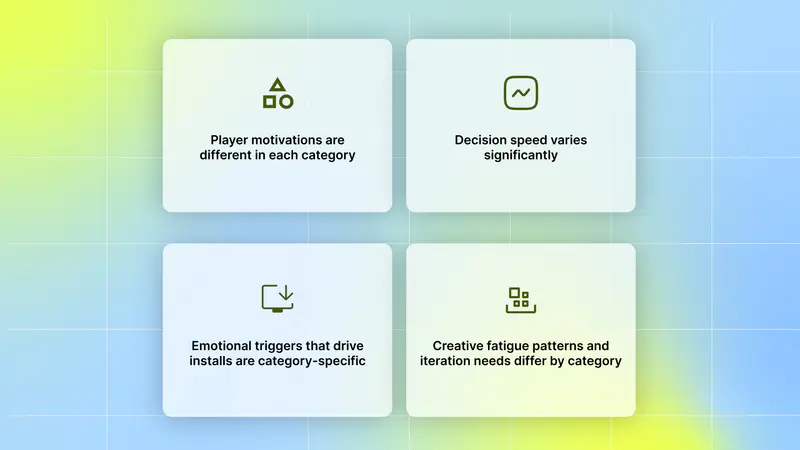
Player motivations are different in each category: Hypercasual players look for instant fun, while midcore players look for progression, mastery, and long-term engagement.
Decision speed varies significantly: Hypercasual players decide in seconds, but midcore and casino players take longer and need more context before taking action.
Emotional triggers that drive installs are category-specific: Casual games rely on satisfaction and progression, while casino games rely on excitement, rewards, and emotional highs.
Creative fatigue patterns and iteration needs differ by category: Some categories require rapid creative volume and constant iteration, while others require deeper concept development and longer creative lifespans.
If your creative strategy doesn’t align with your game category, even well-produced creatives can fail to attract the right players or scale effectively. As a creative strategist, understanding these category-specific differences helps you design creatives that match player expectations, improve performance, and build a more scalable creative system.
To align your creatives with your game category effectively, you need a structured approach.
Also Read: Innovative Gaming Trends Shaping 2025
How to Build a Strong Creative Strategy
A solid creative strategy gives you a clear direction on what creatives to produce, what messages to communicate, and what concepts to test. It helps you move from guessing creative ideas to building a structured system that consistently produces high-performing creatives.
Here are the key steps of a creative strategy:
Analysis of past creative performance and experiments: You need to analyze your past creatives, app store experiments, and performance data to identify what worked and what failed. This helps you understand which hooks, gameplay moments, and creative concepts drive better results.
But how do you turn all that performance data into clear, actionable creative insights? This is where a creative intelligence platform like Segwise comes in.
With Segwise multi-modal AI creative tagging, you can automatically identify and tag creative elements like hook, characters, colors, and audio components across images, videos, text, and playable ads to reveal their impact on performance metrics like IPM, CTR, and ROAS. That turns raw creative history into structured insight.
Competitor creative analysis to identify winning patterns: You should study competitor creatives to understand what concepts, formats, and messaging are working in your market. This helps you identify proven patterns and find opportunities to differentiate your game.
Audience research to understand player motivations and expectations: Your creative strategy must align with your target players. You need to understand what motivates them, what experiences they expect, and what triggers them to engage with your game.
Clear communication message and core value proposition: You must define what your creatives should communicate about your game. This includes highlighting your core gameplay loop, progression, emotional experience, or unique value.
Defined creative directions and concept roadmap: Your strategy should include multiple creative directions to explore. This helps you test different concepts, emotional angles, and gameplay representations to identify scalable winners.
Structured creative testing and iteration plan: You need a clear plan to test, iterate, and evolve creatives based on performance. This allows you to scale winning concepts and continuously improve creative performance.
The next step is recognizing that not every strategy works the same way across all game types.
How Creative Strategy Changes by Game Category
Creative strategy does not scale universally. It scales when aligned with game category expectations. As a creative strategist, your advantage lies in designing category-specific creative systems, not one-size-fits-all creatives.
Here is how creative strategy changes across different game categories:
1. Hypercasual game: optimize for instant clarity, fast hooks, and high-volume iteration
Hypercasual games are built around a single, simple gameplay mechanic that players can understand immediately. These games rely on short gameplay sessions and clear visual feedback.
Popular examples include Helix Jump, Stack Ball, Paper.io, Run Race 3D, and Color Switch.
Key characteristics of hypercasual games
Built around one core gameplay mechanic.
Immediate gameplay understanding.
Short, repeatable gameplay loops.
Fast creative fatigue requires continuous iteration.
Because hypercasual gameplay is simple, your creative strategy must clearly communicate gameplay and continuously evolve creative concepts.
Tips for an effective creative strategy
Your creative strategy should focus on helping players immediately understand the gameplay and engage with the game. High-performing hypercasual creatives communicate the core gameplay clearly and capture attention quickly.
Here are the key design principles you should follow:
Use a strong visual hook in the first second: Hypercasual games depend on instant attention capture. Start with a visually surprising or satisfying gameplay moment.
Highlight the most satisfying and repeatable gameplay moment: Your ad should showcase the core gameplay loop that keeps players engaged. Showing satisfying moments, such as completing challenges or achieving perfect actions, helps players understand why the game is enjoyable.
Use clean visuals with strong contrast and clear focus: Hypercasual creatives perform better when they use bright colors, clear visuals, and focused framing. Clean visuals help players quickly understand what is happening and reduce confusion.
Communicate gameplay quickly with fast-paced creative structure: Hypercasual players make fast install decisions, so your creatives should immediately show gameplay. Short, fast-paced creatives perform better than slow creatives that delay gameplay visibility.
Avoid unnecessary visual complexity or storytelling elements: Overly complex visuals, multiple mechanics, or cinematic storytelling reduce clarity and hurt creative performance. Simple, gameplay-focused creatives help players instantly connect with the experience and improve engagement.
Ad formats that work best for hypercasual games
The most effective creative formats prioritize gameplay clarity and fast communication.
Fail-to-win and challenge-based ads: Creatives that show failure or struggle create curiosity. Players feel motivated and improve their own performance.
Simple UGC-style ads: User-generated style creatives feel authentic and relatable. They help players imagine themselves playing the game and increase engagement.
Hypercasual creative strategy is driven by clarity, engagement, and continuous iteration. By focusing on clear gameplay representation, strong hooks, and rapid creative testing, you can identify winning creative patterns and build a scalable creative strategy.
2. Casual game: optimize for emotional engagement, progression, and satisfaction
Casual games are mobile games built around simple but layered gameplay loops that focus on progression, problem-solving, and rewarding outcomes. These games are easy to start but provide ongoing challenges and visible progress that keep players engaged over time.
Popular casual mobile games include Candy Crush Saga, Gardenscapes, Homescapes, Royal Match, and Toon Blast.
Key characteristics of casual games
Built around progression-driven gameplay loops.
Focus on puzzles, challenges, or transformation mechanics.
Clear sense of advancement through levels, rewards, or upgrades.
Longer engagement cycles compared to hypercasual games.
Because progression and emotional payoff are central to casual games, your creative strategy must highlight how gameplay evolves and what makes the experience rewarding.
Tips for an effective casual game creative strategy
Your creative strategy should focus on clearly communicating gameplay progression and emotionally satisfying moments that define the casual game experience. High-performing casual creatives help players understand how the game evolves and why the progression feels rewarding.
Here are the key design principles you should follow:
Highlight progression and transformation moments: Creatives that show level completion, unlocking features, or transforming environments perform better. These progression moments help communicate how the game evolves and why gameplay remains engaging.
Show emotionally satisfying gameplay outcomes: Creatives should focus on moments such as solving puzzles, completing difficult actions, or achieving successful outcomes. These moments demonstrate the rewarding nature of the gameplay.
Use simulation-style gameplay: Simulation-style creatives show realistic gameplay situations that reflect actual player experiences. These creatives help communicate how the game works and make gameplay easier to understand.
Focus on the reward loop that drives long-term engagement: Your creative should highlight the reward cycle, such as completing levels, unlocking features, or improving environments. This helps players understand the progression system and encourages deeper engagement.
Use visually engaging elements to maintain attention: Bright colors, smooth animations, and clear visual feedback improve creative clarity. Visually satisfying gameplay helps maintain engagement and makes progression easier to follow.
Ad formats that work best for casual games
Interactive Ads: Interactive creatives allow users to engage directly with elements inside the ad, such as playing a short gameplay segment or interacting with core mechanics. This format helps demonstrate the game experience more clearly and increases engagement through hands-on interaction.
Story-driven gameplay creatives: These creatives combine gameplay with a problem-solution scenario or transformation moment. They help show how gameplay leads to progression and satisfying outcomes.
UGC and reaction-based creatives: UGC creatives present gameplay through a relatable, player-like perspective, often including reactions or commentary to highlight satisfying gameplay and progression moments.
Casual game creative strategy focuses on showcasing progression, rewarding gameplay outcomes, and clear gameplay context. By highlighting how gameplay evolves and what makes the experience satisfying, you can build creatives that communicate value effectively and support scalable creative performance.
3. Midcore game: optimize for depth, mastery, and aspirational identity
Midcore games are mobile games built around deeper gameplay systems that involve strategy, progression, and skill development. These games require players to invest time in upgrading characters, unlocking abilities, and mastering gameplay mechanics.
Popular midcore mobile games include Clash of Clans, Rise of Kingdoms, Mobile Legends, and Call of Duty: Mobile.
Key characteristics of midcore game
Built around character upgrades, skills, or resource growth.
Require strategic thinking and player decision-making.
Players invest time to improve skills and unlock new capabilities.
Creatives must clearly communicate depth, progression, and gameplay experience.
Because midcore players seek mastery and long-term progression, your creative strategy must clearly showcase character growth, gameplay depth, and the evolving player experience.
Tips for an effective midcore game creative strategy
High-performing midcore creatives clearly communicate how players evolve and interact with the game world.
Here are the key design principles you should follow:
Show character progression and power growth: Creatives that showcase character upgrades and new abilities help convey long-term growth. These visuals show how players develop and improve over time.
Use character-focused storytelling to build identity: Creatives that introduce characters, their roles, and their progression help players connect with the game world. Character-focused creatives strengthen identity and engagement.
Follow a clear three-act structure to improve creative clarity: Structuring creatives with a beginning, middle, and outcome helps viewers follow the narrative. Start by introducing the character or situation, show the challenge or gameplay progression, and conclude with a clear outcome. This structure improves engagement and makes the progression easier to understand.
Highlight core gameplay systems and strategic mechanics: Creatives should clearly showcase gameplay interactions such as tactical decision-making. Showing how gameplay works helps communicate depth and makes the creative more engaging and informative.
Use immersive visuals and progression cues to reinforce growth: Creatives should include clear visual indicators of progression, such as upgraded characters. These visual cues help communicate mastery and make progression easier to understand.
Ad formats that work best for midcore games
Cinematic gameplay video ads: These ads combine gameplay footage with cinematic presentation to highlight characters, abilities, and progression. This format helps communicate gameplay depth and creates a strong visual experience.
Playable ads: Interactive ads that allow users to experience a short gameplay sequence directly. This format helps communicate gameplay mechanics clearly.
With a midcore creative strategy, you can build creatives that clearly communicate the experience and support scalable creative performance.
4. Casino game: optimize for emotional triggers, excitement, and reward anticipation
Casino games are mobile games built around chance-based mechanics, such as card games and bingo. These games are designed around repeated gameplay loops driven by rewards, bonuses, and progression.
Popular casino mobile games include Coin Master, Jackpot Party Casino, and Bingo Blitz.
Key characteristics of casino games
Built around reward-driven gameplay loops.
Frequent bonuses, jackpots, and progression systems.
Strong emotional feedback through visual and audio effects.
Players repeatedly engage to unlock rewards and progress.
Because reward anticipation drives casino engagement, your creative strategy must visually amplify wins, bonuses, and emotional highs.
Tips for an effective casino game creative strategy
Your creative strategy should focus on visually communicating rewards, gameplay excitement, and immersive experiences. High-performing casino creatives use strong visual cues and authentic gameplay representation to engage viewers and clearly showcase the reward-driven experience.
Here are the key design principles you should follow:
Use rich reward visuals and exaggerated effects: Casino creatives perform best when they prominently feature coins, jackpots, and reward animations. Visual elements such as gold coins, glowing effects, and celebratory animations help reinforce the reward-driven nature of the game.
Showcase unique slot themes and features: Creatives should highlight distinctive slot designs, themes, and special mechanics such as bonus rounds, multipliers, or unique animations. Showcasing unique slot features helps communicate what makes your ad different and more engaging.
Use bold colors and high-contrast visual design: Bright, saturated colors, especially gold, red, and yellow, help casino creatives stand out. Bold fonts, oversized reward numbers, and strong visual contrast improve clarity and make rewards easier to notice.
Show real gameplay moments to demonstrate the experience: Creatives that capture actual gameplay sequences, such as spinning reels or triggering rewards, help communicate how the game works. Showing authentic gameplay improves clarity and strengthens creative engagement.
Use attention-grabbing hooks at the beginning of the creative: Starting with visually engaging gameplay moments helps capture attention and quickly establish the gameplay experience.
But how do you know which hooks actually drive the strongest performance? This is where a creative intelligence platform like Segwise comes in.
With tag-level creative element mapping, you can see which specific creative elements drive performance. You can also discover patterns like "this hook appears in 80% of top-performing creatives" with complete MMP attribution integration.
Ad formats that work best for casino games
Reward-focused video ads: These ads highlight gameplay sequences such as spins, rewards, and bonus activations. This format helps communicate reward systems and gameplay progression clearly.
Playable ads: Playable ads have emerged as a highly effective trend in casino game marketing. This strategy involves presenting potential players with an interactive snippet of actual gameplay, allowing them to experience the game firsthand.
Testimonial and influencer ads: These ads feature real players or influencers sharing their gameplay experiences and reactions to rewards or jackpots. This format helps build trust, adds authenticity, and makes the gameplay experience feel more relatable and engaging.
When your ads clearly communicate anticipation, wins, and immersive gameplay, you build a creative system that consistently drives engagement and repeat play behavior.
However, even when you understand how creative strategy differs by game category, many creative systems still fail due to small mistakes.
Also Read: Creative Ad Strategies from New Mobile Games That Hit 30M+ Downloads
Common Creative Strategy Mistakes to Avoid
Many creative strategies fail not because the ideas are weak, but because they are misaligned with the game category and player expectations. As a creative strategist, avoiding these common mistakes helps you build a more focused, scalable, and high-performing creative system.
Here are the most common creative strategy mistakes you should avoid:
Using the same creative approach across all game categories: What creatives work for hypercasual will not work for midcore or casino. Applying a one-size-fits-all strategy leads to poor engagement and unclear messaging. Check for category-specific creative tips before building concepts.
Focusing only on trends instead of gameplay alignment: Chasing trending formats without ensuring they reflect your actual gameplay experience weakens your creative strategy and confuses players. Use trends only when they clearly represent your core gameplay loop.
Overcomplicating simple gameplay or oversimplifying complex games: If your creatives do not match the true depth of your game, you attract the wrong audience and reduce long-term performance. Match creative complexity to the actual gameplay experience.
Ignoring progression and emotional triggers: Each category relies on specific emotional drivers. If your creatives fail to communicate these drivers, they will not resonate effectively. Identify the primary emotional driver of your category and build creatives around it.
Not iterating based on performance data: Creative strategy is not static. If you do not analyze performance data and evolve your creatives accordingly, your strategy will stagnate.
But how do you generate better creative variations based on actual performance data? This is where a creative intelligence platform like Segwise comes in.
Wth data-backed creative iterations, you can generate creative variations based on actual performance data from your campaigns. Segwise understands which specific creative elements drive ROAS, CPA, and conversion rates via its Creative Tagging and Analytics agents.
Conclusion
Creative strategy does not work the same way across every game category. Hypercasual demands instant clarity and fast iteration, casual requires progression and emotional satisfaction, midcore depends on depth and mastery, and casino thrives on reward anticipation and excitement. As a creative strategist, your job is to align your creative system with the psychology, expectations, and gameplay depth of your specific category.
But to measure your creatives' performance, you need clear, creative-level data. This is where a creative intelligence platform like Segwise comes in.
Segwise creative analytics unify creative data across ad networks. It connects creative elements (hooks, dialogs, visuals, formats, etc.) directly to business outcomes (ROAS, CPA/CPI, LTV, IPM, conversion rates), so teams stop guessing what works and start scaling creatives with data-backed confidence.
With tag-level creative element mapping, you can see which specific creative elements drive performance. With fatigue tracking, you can catch performance decline before it impacts campaign results. Moreover, it also tags playable ad elements and interactive components with its multimodal creative tagging. Also, with data-backed creative iterations, you can generate variations based on actual campaign performance data.
So, why wait? Start your free trial today and see which creative elements truly drive your game performance!