
Key Takeaways
ROAS Reality: The average ROAS for eCommerce is around 2.87:1, but this number alone doesn’t tell you if your campaigns are actually profitable or scalable.
Creative Impact: ROAS is directly influenced by your creatives. The hooks, messaging, and formats you test determine whether you scale or waste budget.
Platform Differences: Each platform delivers different ROAS because of user intent. What works on Google won’t work the same way on TikTok or Instagram.
Industry Variation: ROAS benchmarks vary widely by industry, so you should compare your performance within your category instead of using general averages.
Performance Drop: ROAS declines over time due to creative fatigue, audience saturation, and lack of iteration, not random changes.
ROAS Improvement: To improve ROAS, you need to iterate creatives regularly, test at scale, use platform-native formats, and make data-driven decisions to scale what actually works.
Did you even know average ROAS has dipped 4.3% year over year, putting pressure on every ad dollar?
You keep launching new creatives, testing different angles, and scaling budgets, but the returns don’t match the effort. One week you hit 4x, the next you drop below break-even. And the worst part? You don’t really know why it changed. If you keep relying on guesswork, you’re likely leaving revenue on the table.
This blog breaks down the average ROAS for eCommerce in 2026, what counts as “good,” and more importantly, how creative decisions directly impact your results so you can build ads that actually scale.
What is ROAS & How to Calculate It?
Return on ad spend (ROAS) tells you how much revenue your ads generate for every dollar you spend. It helps you understand whether your campaigns are actually driving profitable growth. The formula is simple:
ROAS = (Revenue Generated ÷ Ad Spend)
For example, if you spend $10,000 on ads and generate $45,000 in revenue, your ROAS is 4.5×.
As a creative strategist, ROAS is more than just a number; it’s feedback on your creative decisions. Every hook, message, and visual you test directly impacts this metric. The better you understand which creatives drive higher ROAS, the easier it becomes to scale what works and stop wasting budget on what doesn’t.
Next, let’s understand how it differs from ROI.
The Difference Between ROAS and ROI in eCommerce?
If you’re confused between ROAS and ROI, here’s the simple answer:
ROAS tells you how much revenue your ads generate, while ROI tells you how much actual profit you keep after all costs.
Here are the key differences:
ROAS helps you optimize creatives and campaigns, meaning you can see which hooks, formats, and messages are driving revenue, while ROI helps you understand if your growth is sustainable, by showing whether you’re actually making money after all costs.
ROAS is used for day-to-day decision making, helping you decide which creatives to scale or pause, while ROI is used for overall business growth, ensuring your brand stays profitable as you grow.
ROAS reflects short-term performance, showing imme
te returns from your ads, while ROI reflects long-term success, helping you understand if your strategy works beyond just ad performance.
For you as a creative strategist, ROAS tells you what’s working right now, but ROI tells you whether scaling those creatives actually makes sense.
The next step is to know what ROAS number actually makes sense for your business.
Also Read: Understanding the Difference between ROAS and ROI in Marketing
What is a Good ROAS?
A "good" ROAS (Return on Advertising Spend) for eCommerce depends on your business type, profit margins, and advertising platform. To understand where you stand, here are the standard benchmarks:
Average ROAS: 2.87:1 (eCommerce industry-wide)
Strong ROAS: from 2:1 to 4:1
The average ROAS across eCommerce is 2.87:1, which means you get $2.87 back for every advertising dollar spent. This number serves as a general benchmark, but it can vary widely depending on the business.
For example, a luxury watch store with 80% profit margins and a dropshipping phone accessory shop can both hit the same ROAS. However, the watch store earns significant profits, while the accessory shop barely breaks even.
So, A good ROAS depends on your business type and growth stage.
If you’re a DTC brand in growth mode, you might accept a 1.5:1 ROAS, knowing profits come later.
If your margins are tight, you’ll likely need a 4:1 or higher ROAS to stay profitable and keep scaling safely.
If your business is seasonal, your ROAS will fluctuate. You might see very high returns during peak months and lower performance off-season.
This means,
Your ROAS target should match your margins, growth stage, and creative strategy, not just industry benchmarks.
Now that you know what a good ROAS is, the next step is understanding why it plays such a critical role in your overall performance.
Why ROAS Matters for E-commerce Profitability?
ROAS matters because it shows whether your ads are actually generating revenue or just spending budget. It helps you understand which campaigns are driving real business impact.
Here are the key reasons:
Better ROAS understanding improves efficiency, because when you clearly see what’s driving returns, you can make smarter decisions on what to scale and what to cut.
Rising costs make ROAS even more critical, especially as ad tracking has become harder post-iOS updates and customer acquisition costs have increased across platforms.
ROAS remains a core KPI for decision-making, even as some teams look at broader metrics, because it provides clear, campaign-level performance visibility.
ROAS needs context to be useful, because not every campaign is meant to drive immediate sales. For example, top-of-funnel creatives may show lower ROAS but still support long-term growth.
For you as a creative strategist, ROAS is your fastest feedback loop. It tells you which creatives deserve more budget, which ones need iteration, and which ones you should stop running before they waste spend.
Since ROAS is influenced by where your ads run, performance can vary widely across platforms.
Latest ROAS Benchmarks by Platform
ROAS varies significantly by platform because each one captures users at a different stage of the buying journey. Platforms with higher purchase intent usually deliver higher ROAS, while discovery platforms rely more on creative quality to convert.
Here are the latest ROAS benchmarks by platform:
Google Ads leads with an average ROAS of 13.76 because it captures shoppers who are ready to buy. For example, someone searching for a specific product, such as “protein powder for muscle gain,” already has clear intent, making this traffic highly valuable.
Facebook averages a 10.68 ROAS and focuses on interruption marketing. It turns casual scrolling into purchases through precise targeting. A lipstick brand might not see the same intent as search traffic, but Facebook’s ability to target interests and behaviors helps drive conversions.
Instagram delivers an average ROAS of 8.83, showing the strength of visual-first platforms. Products that look appealing, like fashion, perform well here. Instagram users are looking for inspiration, not direct sales pitches, which changes how your creatives should be structured.
Amazon Ads generates a 7.95 ROAS by targeting bottom-funnel shoppers. These users are ready to buy, making it ideal for product-focused brands.
Twitter and Pinterest both average around 2.7 ROAS, but for different reasons.
Twitter’s text-heavy, fast-moving environment makes ads feel less native. Pinterest, on the other hand, works like a visual search engine where users look for ideas, so performance depends heavily on creative relevance.TikTok averages a 2.5 ROAS, reflecting its evolving nature. Some brands scale fast, while others struggle to convert attention into revenue. The platform is entertainment-first, so your creatives need to feel native, not like ads.
While platform benchmarks show how ROAS varies based on user intent, your performance also depends heavily on the industry you operate in.
Latest ROAS Benchmarks by Industry
ROAS varies across industries because customer behavior, pricing, and buying intent are different for each category. What works in one industry may not deliver the same results in another.
Here are the latest ROAS benchmarks by industry:
Even if your ROAS looks strong today, it doesn’t stay the same for long.
Why Your ROAS Drops Over Time
Your ROAS drops over time because your ads lose effectiveness and your audience becomes saturated. As performance declines, your cost to acquire customers increases while returns decrease.
Here are the key reasons: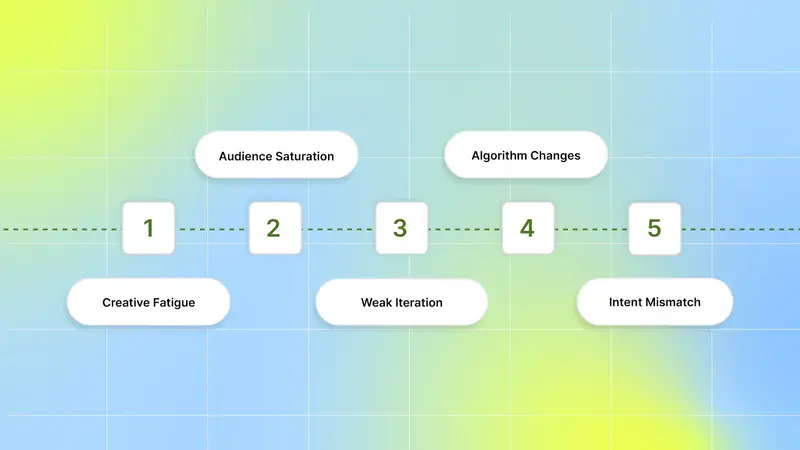
Creative fatigue: When you run the same creatives for too long, your audience stops engaging. Performance drops because people have already seen your ads multiple times.
Audience saturation: If you keep targeting the same audience, you start reaching the same users again and again. This limits growth and reduces conversion rates.
Weak creative iteration: If you’re not testing new angles and formats regularly, your performance will stagnate. What worked last month won’t necessarily work today.
Platform algorithm changes: Changes in how platforms optimize and deliver ads can impact performance, even if your creatives stay the same.
Mismatch between creative and audience intent: As you scale, your ads reach broader audiences. If your creatives are not adapted for different audience segments, conversions drop.
ROAS doesn’t drop randomly; it drops when your creatives stop matching your audience and market conditions.
Now that you understand why ROAS drops, the next step is knowing how to improve and maintain it consistently.
Proven Strategies to Improve Your eCommerce ROAS
To improve your ROAS, you need to focus on creative decisions, testing speed, and the alignment of your ads with user intent. The brands that win are not spending more; they are learning faster and scaling what actually works.
Here are proven strategies to improve your eCommerce ROAS:
1. Iterate Your Ads Regularly with Rich Creatives
If you keep running the same creatives for too long, performance will drop. You need to constantly refresh your ads with new hooks, angles, visuals, and messaging. This doesn’t mean creating completely new ads every time; it means building variations based on what you already know works.
Regular iteration helps you avoid creative fatigue and keeps your ads relevant to your audience. When you consistently test new ideas, you increase your chances of finding higher-performing creatives that can push your ROAS up over time.
But how do you know which creatives to iterate on and which ones to stop? This is where a creative intelligence platform like Segwise comes in.
With data-backed creative iterations, you can generate creative variations based on actual performance data from your campaigns. Segwise understands which specific creative elements drive ROAS, CPA, and conversion rates via its Creative Tagging and Analytics agents.
2. Try Platform-Native Formats
Each platform has its own content style and user behavior. Ads that look like traditional promotions often get ignored, especially on platforms like TikTok and Instagram. You need to create ads that blend in with organic content, UGC-style videos, storytelling formats, or quick demos.
When your creatives match the platform’s native experience, users engage more. Higher engagement leads to better click-through rates and stronger conversion signals, which directly improve your ROAS.
3. Increase Your Target Audience with Budget Scaling
If you keep your audience too narrow, your creatives will saturate quickly, and performance will drop. Expanding your target audience while increasing budgets allows you to reach new users and test how your creatives perform at scale.
When you scale budgets alongside audience expansion, you give your winning creatives more room to perform. This helps maintain stable performance, reduces fatigue, and allows you to increase overall revenue without hurting your ROAS.
4. Use High-Volume Creative Testing
Relying on a few creatives limits your ability to learn what actually works. Instead, you should test multiple variations of hooks, messages, formats, and visuals at scale. The goal is to generate enough data to identify clear winners.
High-volume testing helps you quickly find patterns in top-performing creatives. Once you know what works, you can scale those ideas confidently, leading to more consistent and higher ROAS.
5. Leverage Automation Tools
Managing creatives, tracking performance, and analyzing results manually can slow you down. Automation tools help you organize your creatives, track performance across campaigns, and surface insights faster.
When you reduce manual work, you can focus more on strategy and decision-making. Faster insights mean faster iterations, which allows you to scale winning ads sooner and improve ROAS more efficiently.
6. Leveraging an Optimum Platform Mix
Relying on a single platform limits your growth and increases risk if performance drops. You should distribute your budget across multiple platforms based on where your creatives perform best and where your audience is most active.
An optimal platform mix helps you balance high-intent and discovery channels. This reduces dependency on one source, improves overall efficiency, and allows you to maintain stable and scalable ROAS across your campaigns.
7. Landing Page Optimization for Higher Conversions
Your ad is only one part of the journey. If your landing page doesn’t match the message or experience of your creative, users will drop off before converting.
A well-aligned landing page improves the chances of conversion after the click. When more users complete the purchase journey, your overall ROAS increases without needing to spend more on ads.
8. Run Dynamic Ads for Broad Audience
Dynamic ads allow you to reach a broader audience while automatically showing the most relevant products or creatives based on user behavior and preferences.
This improves efficiency by matching the right creative to the right user. Greater relevance leads to higher engagement and conversions, directly increasing your ROAS.
9. Analyze Data
Looking at overall campaign performance is not enough. You need to go deeper and understand what’s actually driving results behind the numbers.
When you analyze data at a deeper level, you can make more informed creative decisions. This reduces guesswork and helps you focus on what actually improves performance, leading to better ROAS.
But how do you connect your creative decisions directly to performance without spending hours manually analyzing data? This is where a creative intelligence platform like Segwise comes in.
Segwise connects creative elements (hooks, dialogs, visuals, formats, etc.) directly to business outcomes (ROAS, CPA/CPI, LTV, IPM, conversion rates), so teams stop guessing what works and start scaling creatives with data-backed confidence. Moreover, with tag-level creative element mapping, you can discover patterns like "this hook appears in 80% of top-performing creatives" with complete MMP attribution integration.
10. Setting Up Remarketing Campaigns
Most users don’t convert on their first interaction. Remarketing helps you reconnect with people who have already shown interest in your product or brand.
By targeting warmer audiences with tailored creatives, you increase the likelihood of conversion. This lowers wasted spend and improves the overall return you get from your ad budget.
Also Read: Mobile Ad Targeting Best Practices for 2025
Conclusion
ROAS is not just a benchmark number; it’s a reflection of how well your creatives perform in the market. In 2026, average ROAS varies widely across platforms and industries. The brands that win are the ones that understand what drives performance. From platform benchmarks to industry differences, one thing is clear that ROAS is not random. It is directly influenced by how well your creatives match audience intent and how quickly you iterate on what works.
As creative volume increases and performance becomes harder to track across platforms, relying on manual analysis and guesswork is no longer enough. This is where AI-powered tools like Segwise become essential.
Segwise is an AI-powered creative intelligence platform that helps DTC brands to optimize their advertising creative performance. Segwise unifies creative data from multiple ad networks and MMPs with creative analytics, automatically tags creative elements using multimodal AI creative tagging, and provides actionable insights that improve creative ROAS.
With tag-level performance optimization, you can instantly see which creative elements, themes, and formats drive results across all your campaigns and apps. Moreover, with fatigue tracking, you can catch fatigue before it impacts your budget allocation and campaign results.
So, start your free trial today to stop guessing and start scaling what actually works to improve your ROAS!