
Key Takeaways
Ad Optimization: Ad optimization means continuously improving creatives, targeting, and campaign setup based on performance data to increase conversions and reduce wasted ad spend.
Traditional Challenges: Many teams struggle because data is fragmented across ad platforms, creative insights are unclear, and creative fatigue often goes unnoticed.
Data Matters: Fragmented data across platforms makes optimization difficult; unified performance insights help you understand which ad creatives truly drive ROI.
Optimization Framework: A structured process that reviews campaign setup, tests creative variations, analyzes cross-platform performance, and implements improvements helps identify what actually drives results.
Winning Strategies: Align KPIs with goals, use first-party data, test creatives with A/B testing, adapt creatives for each platform, leverage AI insights, and use AI to optimize ad performance for better ROI.
Are your ads getting impressions but failing to drive the ROI you expected?
You launch new campaigns, test new creatives, and increase budgets, yet performance still feels unpredictable. One week, a creative performs well; the next week, CPA spikes and conversions slow down. Soon, your team ends up managing too many creatives, scattered performance data, and no clear signal on which ads actually drive conversions.
If you’re a creative strategist working on mobile games, DTC brands, subscription apps, or growth campaigns, and optimizing ad performance feels like guesswork. This blog is for you. In this guide, you’ll learn how to optimize ad performance for better ROI and discover proven strategies to identify winning ad concepts faster.
What is Ad Optimization?
Ad optimization is the process of continuously improving your ad creatives, targeting, and campaign setup to get better results from your ad spend. The goal is to increase conversions and revenue while lowering wasted budget. Instead of running ads and hoping they work, you use performance data to identify what drives better results and refine your campaigns accordingly.
As a creative strategist, it means understanding which creative hooks, visuals, messages, and formats actually drive engagement and conversions. When you analyze creative performance and iterate on winning concepts, you help your team scale ads that convert and stop spending on creatives that don’t deliver ROI.
Now that you understand ad optimization, it’s important to see why it plays a critical role in improving campaign results.
Why Ad Campaign Optimization Is Important
Ad campaign optimization allows your team to scale high-performing campaigns faster while preventing budget from being wasted on underperforming ads.
Here are the key reasons why ad campaign optimization matters: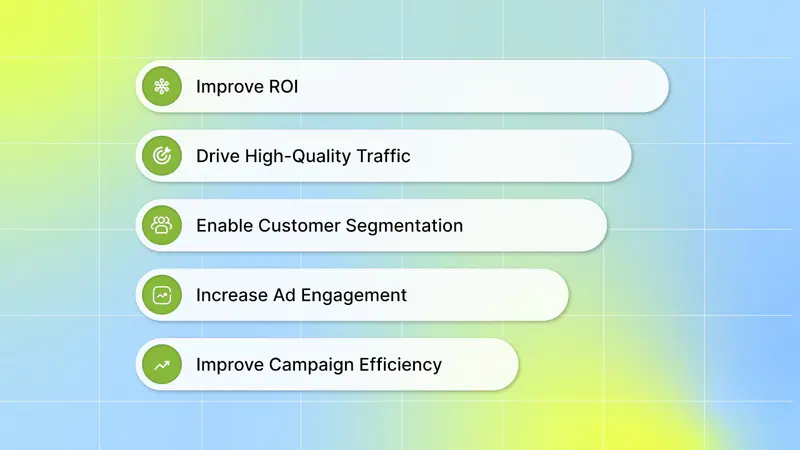
Improve return on investment (ROI) by identifying which creatives, audiences, and campaigns drive the most installs, purchases, or subscriptions.
Increase the right traffic by attracting users who are more likely to engage with your ads and convert.
Enable better customer segmentation by understanding how different audience groups respond to your creatives and campaign messaging.
Increase engagement by identifying which ad formats, hooks, and visuals capture attention and drive interaction.
Improve campaign efficiency by reducing wasted budget and creating smoother ad experiences that lead to higher conversions.
Despite its importance, many teams still struggle to optimize campaigns effectively due to limitations in traditional ad optimization methods.
Also Read: The Ultimate Guide to Understanding Different Types of Target Audiences
The Challenges of Traditional Ad Optimization
Traditional ad optimization often focuses on targeting, bidding, and placements while overlooking the role of creatives in driving performance. This approach makes it harder to identify which ad concepts actually work and where budgets are being wasted.
Here are the key challenges teams face when relying on traditional ad optimization methods:
1. Targeting Problems
Many campaigns rely on broad audience targeting, which often misses the nuances of real user behavior. Your ads may reach thousands of people, but without the right creative message, they fail to convert.
Even worse, audience data becomes outdated quickly. As user preferences change, your campaigns keep showing the same creatives to audiences who no longer respond to them.
2. Poor Ad Placement
Ad placement also affects campaign performance. When ads appear in the wrong environment, they lose impact and credibility.
Ads may appear on low-quality or low-traffic websites.
Poor placement can damage brand perception and reduce engagement.
Low visibility means many impressions bring little real value.
For example, imagine a premium product ad appearing on a low-quality website. Even if the creative is strong, the context reduces its effectiveness.
3. Tracking and Attribution Issues
The performance data often lives across multiple platforms:
Meta Ads.
TikTok Ads.
Google Ads.
Attribution platforms (MMPs).
Because these systems do not always communicate with each other, it becomes difficult to understand which campaigns or creatives actually drive conversions.
So how will you collect and analyze data from all these platforms in one place? This is where Segwise comes in.
With Segwise creative analytics, you don't need to jump between Facebook Ads Manager, Google Ads, TikTok, and your MMP dashboard. You can see creative-level ROAS, CPA, LTV, and conversion rates from all sources in one unified view.
4. Limited Creative Performance Insights
Traditional ad optimization focuses mostly on metrics such as CTR, CPA, or ROAS. However, these metrics do not explain why an ad performs well.
As a creative strategist, you need deeper insights into creative elements such as:
Hooks and opening scenes.
Visual storytelling and concepts.
Messaging and dialog.
Call-to-action styles.
Without this level of insight, teams often end up guessing which creative ideas to test next.
5. Creative Fatigue Goes Unnoticed
Creative fatigue is another major challenge. A creative might perform well at first, but its effectiveness gradually declines as audiences see it repeatedly.
If fatigue is not detected early, your team continues spending budget on declining creatives. Over time, this increases CPA and reduces overall campaign ROI.
These challenges make it clear that improving ad performance requires a more structured and data-driven approach.
A Practical Framework to Optimize Ad Performance for Better ROI
A clear framework helps you understand what’s working in your campaigns and where performance is breaking down. It also gives your team a repeatable process for analyzing results and making better campaign decisions.
Here is a simple framework you can use to optimize ad performance and identify winning creative strategies:
Step 1: Review Campaign Structure and Audience Targeting
Start by reviewing how your campaigns are organized and who your ads are reaching. If campaigns are poorly structured, it becomes difficult to identify which audiences or creatives drive results.
Look at questions like:
Are campaigns grouped by audience segment or creative concept?
Are your naming conventions clear enough to track performance?
Are your ads reaching the right customer segments?
For example, a mobile gaming campaign may perform differently across casual gamers, strategy players, and high-value spenders. Segmenting campaigns properly helps you understand where performance comes from.
Step 2: Test Multiple Creative Variations
Creatives play a major role in ad performance. Instead of relying on one or two ad concepts, test different creative variations.
As a creative strategist, you should experiment with:
Different hooks and opening scenes.
Various visual styles or formats.
Different messaging angles.
Multiple call-to-action styles.
Testing multiple creative approaches helps you identify which ad concepts resonate most with your audience.
Step 3: Analyze Performance Data Across Platforms
Once campaigns start running, analyze performance data carefully. Look beyond surface metrics and understand which creatives actually drive conversions across platforms.
This helps you identify patterns in high-performing creatives and understand which audience segments respond best.
Step 4: Implement Improvements and Monitor Results
After identifying what works and what doesn’t, start applying changes to your campaigns. Increase budget for high-performing creatives, pause ads that are underperforming, and launch new variations based on winning concepts.
At the same time, monitor campaign performance regularly. Tracking results helps you detect creative fatigue early, adjust strategies quickly, and ensure your campaigns continue delivering strong ROI.
While a framework helps structure your optimization process, applying the right strategies ensures your campaigns consistently improve performance and ROI.
8 Strategies to Optimize Ad Performance for Better ROI
Improving ad performance requires more than increasing budgets or adjusting targeting settings. As a creative strategist, you need to combine creative insights, audience understanding, and performance data to understand results.
Here are eight proven strategies that help you optimize ad performance and achieve better ROI:
1. Align KPIs with Campaign Goals
Your ad campaigns should support your campaign objectives. Instead of focusing only on clicks or impressions, align your KPIs with outcomes that matter, such as installs, purchases, subscriptions, or revenue.
Clicks alone can be misleading. A campaign may generate high traffic but still fail to convert. For example, a mobile gaming campaign might attract many clicks but only a few installs. In this case, optimizing only for clicks wastes budget.
As a creative strategist, you should define clear goals before launching campaigns and track metrics that reflect real performance. When your KPIs match campaign outcomes, you can clearly identify which creatives drive meaningful conversions and scale those winning ads to improve ROI.
2. Use First-Party Data to Improve Targeting
With privacy regulations increasing and third-party cookies declining, first-party data has become essential for effective advertising. First-party data includes information collected directly from your users, such as website behavior, purchase history, and CRM data.
This data helps you understand what your audience actually wants. For example, a subscription app can analyze user activity to identify people who are more likely to upgrade to a paid plan. These insights help you craft messaging and visuals that better match your audience’s needs.
3. Adjust Budget Based on Performance Trends
Ad performance is constantly changing, so your budget strategy should evolve as well. Regularly monitoring campaign performance allows you to detect trends such as declining engagement, rising CPA, or improving conversion rates.
For example, if a DTC brand notices that certain video creatives start driving more purchases, increasing the budget for those ads can help scale results faster. At the same time, campaigns that show declining performance should receive less budget until new creatives are introduced.
By continuously adjusting your budget based on real performance trends, you ensure that your ad spend supports the creatives that generate the best results. This approach helps your campaigns remain efficient and improves ROI over time.
4. Craft Compelling Ad Copy
Ad copy plays a major role in capturing attention and driving engagement. Your headlines, hooks, and messaging should clearly communicate the value of your product and speak directly to your audience’s needs.
As a creative strategist, test different messaging angles such as:
problem-solution hooks.
benefit-focused headlines.
curiosity-driven openings.
strong calls-to-action.
Small changes in copy can significantly affect how users respond to your ads.
When your ad copy clearly communicates value and connects with your audience, your creatives generate more engagement and conversions.
5. Test Creatives and Messaging
Creative testing is one of the most effective ways to improve ad performance. What works today may stop working next week, especially on fast-moving platforms like TikTok, Meta Ads, or YouTube.
The most common testing method used in ad optimization is A/B testing (split testing). In A/B testing, you run two variations of an ad while changing only one element at a time to see which version performs better.
Testing allows you to discover which creative concepts resonate most with your audience. By identifying and scaling winning creatives, you continuously improve campaign performance, which ultimately increases ROI.
6. Optimize Creative Elements for Platform Performance
Different advertising platforms reward different creative styles. A creative that performs well on TikTok may not work the same way on Meta Ads or YouTube.
As a creative strategist, you should adapt creative elements such as:
video length.
storytelling style.
pacing and editing.
captions and text overlays.
visual design and layout.
Optimizing creatives for each platform helps your ads blend naturally into the user experience. When creatives are tailored to platform behavior and audience expectations, they capture attention more effectively.
7. Use AI to Improve Ad Optimization
AI tools help simplify this process by analyzing large amounts of campaign data and identifying patterns in ad performance that are difficult to detect manually.
For creative strategists, AI can reveal which creative elements, such as hooks, visuals, messaging styles, or formats, drive the strongest engagement and conversions. These insights enable your team to test creative ideas faster and focus on concepts more likely to perform well.
By using AI to analyze performance data and guide creative decisions, your team can produce stronger ad concepts, reduce testing time, and improve campaign ROI.
But how does AI actually identify which creative elements drive performance across different platforms and campaigns? This is where a creative intelligence platform like Segwise comes in.
With tag-level creative element mapping, you can see which specific creative elements drive performance. You can also discover patterns like "this hook appears in 80% of top-performing creatives" with complete MMP attribution integration.
8. Optimize Landing Pages
Your ad campaign does not end when someone clicks the ad. The landing page experience plays a major role in whether users convert or leave.
Make sure your landing pages continue the same story and messaging shown in your ad. When your landing page supports the creative message of your ad, users experience a smoother journey from click to conversion, improving campaign performance and ROI.
Strong landing pages should:
Load quickly.
Match the ad messaging and visuals.
Clearly explain the value of your product.
Provide a simple and clear path to conversion.
Even with the right strategies in place, certain common mistakes can still prevent campaigns from delivering strong results.
Common Mistakes That Hurt Ad Performance and ROI
Many ad campaigns underperform due to common optimization mistakes that limit how effectively your creatives reach and convert the right audience.
Here are five common mistakes that hurt ad performance and ROI:
Poor audience targeting: Targeting too broadly or too narrowly misses high-intent users; fix this by using retargeting, lookalike audiences, and testing specific demographics.
Stale creatives and lack of testing: Running the same ads for too long leads to creative fatigue; rotate creatives regularly, and A/B test new hooks, visuals, and messaging.
Neglecting mobile optimization: Slow-loading pages and poor mobile design reduce conversions; optimize mobile page speed and design creatives for mobile-first formats.
Weak landing pages: Sending traffic to generic pages lowers conversions; create dedicated landing pages that match the ad message and include a clear CTA.
Ignoring data and tracking: Without proper tracking, you cannot measure performance; implement conversion tracking and optimize campaigns based on real results.
Also Read: Best Ad Tech Platforms for Creative Optimization in 2026
Conclusion
Optimizing ad performance for better ROI requires a combination of clear goals, data-driven decisions, and continuous creative testing. By refining audience targeting, testing multiple creatives, monitoring campaign performance, and optimizing landing pages, you can improve your ad performance across platforms. When you consistently scale winning creatives and stop spending on underperforming ones, your campaigns become more efficient, and your ROI improves over time.
However, managing large volumes of creatives and performance data across platforms like Meta, TikTok, and Google Ads can quickly become overwhelming. This is where platforms like Segwise help optimize campaigns more effectively.
Segwise creative analytics unifies creative and performance data from multiple ad networks such as Facebook Ads Manager, Google Ads, TikTok, and attribution platforms (MMPs) into a single dashboard.
Its AI-powered creative tagging automatically identifies and tags important creative elements such as hook dialogs, characters, colors, concepts, and audio components across images, videos, text ads, and playable ads. By connecting these tags directly to performance metrics like IPM, CTR, ROAS, and CPA, Segwise helps you understand which creative elements actually drive results.
With tag-level performance optimization, you can quickly identify winning patterns across your campaigns and scale creatives that perform best. Segwise also provides fatigue tracking, allowing you to catch performance decline before it impacts budget allocation and campaign results.
So, why wait? Start your free trial to identify winning creatives faster and improve campaign ROI with data-backed insights!