
Key Takeaways
Budget Control: ABO gives you full control over how the budget is distributed, so every creative and audience gets a fair chance to perform.
Clean Testing: Use ABO to run structured tests without algorithm bias, helping you identify true winners faster.
Smart Usage: Choose ABO for testing and clarity, then switch to CBO when you’re ready to scale proven winners efficiently.
Avoid Mistakes: Poor structure, low budgets, and early decisions can ruin your results. Discipline in testing is key to success.
Creative Focus: With a proper budget, you also need to know which creatives are driving results so you can allocate spend effectively and improve ROAS.
Why do some of your ads get all the budget while others barely get a chance to prove themselves?
This usually means your budget is being allocated to the wrong place, leaving strong creatives under-funded and weak ones draining your spend. One small budget decision can slow down your learning phase, target the wrong audience, distort performance signals, and stop you from spotting winning creatives early.
As a creative strategist, you need reliable signals, not guesswork. In this blog, you’ll learn what Ad Set Budget Optimization (ABO) really is, how it works, when to use it over CBO, and tips for Better ad set budget optimization so your best creatives consistently receive the budget they deserve.
What is Ad Set Budget Optimization (ABO)?
Ad Set Budget Optimization (ABO) means setting your budget at the ad set level, not at the campaign level. Each ad set gets exactly the budget you assign. For example, if you create five ad sets and give each one $50 per day, each ad set will spend $50, no more, no less. Meta can optimize delivery within each ad set, but it cannot move budget between them.
As a creative strategist, you have full control over how your budget is distributed across different creatives, audiences, or concepts. If you’re testing multiple video ads, hooks, or messaging angles, ABO ensures each one gets a fair chance to generate results.
The next question is, why does it actually matter for your campaigns?
Also Read:How to Test Creative Angles on Meta Ads Without Wasting Budget
Why Ad Set Budget Optimization (ABO) Matters?
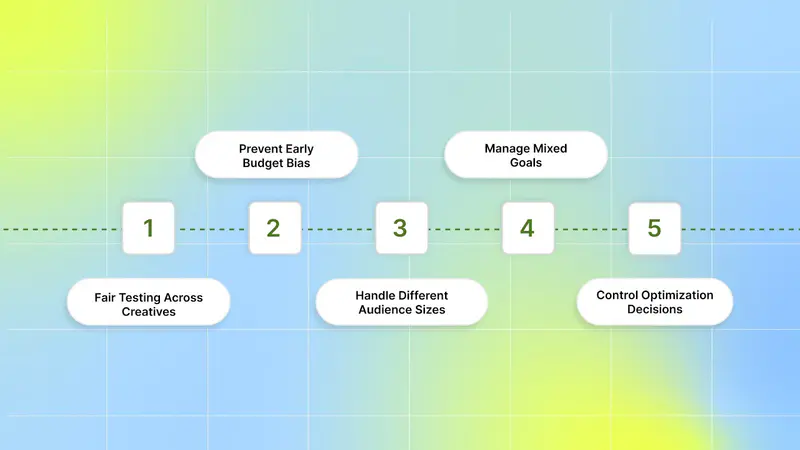
ABO matters because it gives you full control over how your budget is distributed across ad sets, especially when you're running campaigns for mobile games, DTC brands, or subscription apps. It helps you run structured tests so every creative, audience, or messaging angle gets a fair chance to perform.
Here are the key reasons why ABO is important:
You ensure fair testing across creatives and audiences: Each ad set gets its own budget, so your video creatives, hooks, or audience segments are tested without bias.
You prevent early budget bias toward one ad set: ABO stops the algorithm from pushing most of the budget into one ad set too early, which helps you discover true winners.
You can handle different audience sizes and strategies better: Whether you're testing broad vs niche audiences or different targeting approaches, ABO keeps each setup properly funded.
You manage mixed goals and strategies better: If you’re testing different optimization goals or bid strategies, ABO keeps them separated and measurable.
You stay in control of optimization decisions: With ABO, you need to manually monitor and adjust budgets if an ad set is underperforming or wasting spend. For creative strategists, this means you can make decisions based on actual performance instead of relying fully on automation.
The next step is to set it up correctly so your testing delivers clear and reliable results.
How to Set Up an ABO Campaign
Setting up an ABO campaign is simple; you just need to control the budget at the ad set level and structure your tests properly. Here’s how to do it:
Create a new campaign in Ads Manager
Turn OFF “Advantage+ campaign budget.” This ensures you’re using ABO instead of CBO.
Create separate ad sets with individual budgets. Assign a fixed daily budget to each ad set based on your testing plan.
Set a minimum viable budget per ad set. As a rule of thumb, use ~2x your target CPA per day to generate meaningful data.
Keep targeting consistent when testing creatives.
Monitor performance and optimize after enough data. Let tests run for a few days, then pause underperformers.
Once your ABO campaign is set up, the next step is understanding how it compares to CBO.
How ABO Differs from CBO
ABO and CBO differ in how the budget is controlled and distributed across your campaigns. ABO gives you manual control, while CBO uses the algorithm to allocate budget based on performance.
Here are the key differences between ABO and CBO:
The key difference between ABO and CBO comes down to control vs automation.
CBO is more flexible because it reallocates budget based on performance, while ABO requires manual adjustments. CBO can also exit the learning phase faster by concentrating spending, whereas ABO gives you more consistent and reliable insights by distributing the budget evenly.
The differences are clear, but the real question is when you should use ABO instead of CBO.
When to Choose ABO Over CBO
Choose ABO when you want to test audiences equally, have strict budget caps, or require clear, reliable insights before scaling. Here are the times when you should choose ABO over CBO:
When you’re testing new creatives: If you’re testing multiple video ads, hooks, or messaging angles, ABO ensures each creative gets enough budget to prove its performance.
But how do you know which creative elements are actually driving results? This is where a creative intelligence platform like Segwise comes in.
With tag-level creative element mapping, you can see which specific creative elements drive performance. Also, you can discover patterns like "this hook appears in 80% of top-performing creatives" with complete MMP attribution integration.
When you’re testing different audience segments: ABO works well when your audiences are very different. It makes sure each segment gets proper spend so you can compare results fairly.
When you’re entering new markets or geographies: If you're launching in a new region, ABO helps you guarantee minimum spend even if performance is slow at the start.
When you need full control over budget decisions: As a creative strategist, you can decide where to allocate budget based on your testing strategy instead of relying only on the algorithm.
When your campaign setup is complex: If you’re testing multiple creatives, formats, or strategies at the same time, ABO helps you keep everything structured and measurable.
When you can actively monitor and optimize campaigns: ABO requires manual adjustments, so it works best when you have the time to track performance and make decisions regularly.
When you don’t want to miss potential winning creatives early: ABO ensures every ad set gets a fair chance, so strong creatives aren’t ignored just because they didn’t perform immediately.
In simple terms, use ABO for testing and clarity, and switch to CBO when you’re ready to scale winners.
To improve your results with ABO, focus on these key tips for better budget control and testing.
Tips for Better Ad Set Budget Optimization
To get strong results from ABO, you need a clear testing structure and disciplined budget control. Your goal is to generate reliable signals to confidently identify and scale winning creatives.
Here are practical tips to improve your Ad Set Budget Optimization:
1. Set a realistic budget for each ad set
Don’t underfund your tests. If your budget is too low, your ad sets won’t exit the learning phase properly. As a creative strategist, this means you won’t get clear signals on which videos, hooks, or messages are working. Make sure each ad set has enough budget to generate consistent data.
2. Avoid creating too many ad sets at once
When you run too many ad sets in one campaign, your budget gets split too thin. This slows down learning and makes it harder to identify winners. Keep your structure focused, test only a few creatives or audiences at a time.
3. Give your tests enough time to run
Don’t make decisions too early. Many creatives need time to stabilize and show real performance. Let your ad sets run for a few days with consistent spend before making changes.
4. Act quickly on clear underperformers
While you shouldn’t stop tests too early, you also shouldn’t keep wasting budget on ad sets that clearly aren’t working. If performance is consistently low, pause or reduce spend and reallocate budget to better-performing tests.
5. Structure ad sets based on clear audience segments
Separate your ad sets by audience type, such as broad, interest-based, or lookalike. This helps you understand which audience group responds best to your creatives instead of mixing signals.
Even with the right setup, small mistakes can still impact your results.
Also Read:Facebook Ad Budget Strategies: How to Allocate Your Daily Spend Effectively
Common Mistakes to Avoid
Most issues with ABO come from poor structure and rushed decisions during testing.
If you don’t manage budgets and creatives carefully, you’ll end up with unclear signals and wasted spend.
Here are common mistakes to avoid:
Setting budgets too low for each ad set: If your budget is too small, your ad sets won’t gather enough data. This makes it hard to understand which creatives or audiences are actually working.
Mixing multiple variables in one ad set: If you test different creatives, audiences, and messaging together, you won’t know what drove performance. Always isolate one variable per ad set.
Making decisions too early: Pausing or scaling ad sets too quickly can lead to wrong conclusions. Give your creatives enough time and spend before judging performance.
Ignoring creative performance signals: Focusing only on spend or top-level metrics can mislead you. You need to understand which specific creatives, hooks, or messages are driving results before making budget decisions.
Ignoring fatigue while allocating budget: With ABO, you control where the budget goes. If you keep allocating spend to the same creatives without refreshing them, performance will drop due to fatigue.
But how do you know when a creative is actually starting to fatigue? This is where a creative intelligence platform like Segwise comes in.
With fatigue tracking, you can catch performance decline before it impacts budget allocation and campaign results.
Avoiding these mistakes helps you get cleaner insights and make better decisions.
Conclusion
Ad Set Budget Optimization gives you the control you need to run structured and reliable tests across your campaigns. Instead of relying only on automation, you can ensure every creative, audience, and messaging angle gets a fair chance to perform. From understanding how ABO works to knowing when to use it over CBO, the key is to use ABO for testing and clarity.
But, as a creative strategist, your biggest advantage comes from knowing which creatives actually drive performance, so you can allocate budget to winning ads instead of guessing. This is where a creative intelligence platform like Segwise helps.
With AI-powered creative analytics and AI creative tagging, Segwise connects creative elements (hooks, dialogs, visuals, formats, etc.) directly to business outcomes (ROAS, CPA/CPI, LTV, IPM, conversion rates), so teams stop guessing what works and start scaling creatives with data-backed confidence.
Moreover, with tag-level performance optimization, you can instantly see which creative elements, themes, and formats drive results across all your campaigns and apps.
So, stop guessing where your budget should go. Start your free trial and start finding your winning creatives with confidence!