
Key Takeaways
Testing Bottleneck: Creative testing feels slow, not because of volume, but because of manual workflows, fragmented data, and unclear insights that delay decisions.
Creative Shift: With limited targeting, your creative is now your biggest lever, so testing must focus on elements like hooks, messaging, and formats, not just full ads.
Structured Framework: Speed comes from a structured process: define hypotheses, test focused variations, interpret signals correctly, and iterate continuously.
AI Advantage: AI-powered analysis helps you identify winning patterns, detect fatigue early, and turn creative data into actionable insights much faster.
Scale Faster: When you centralize data, automate workflows, and test in batches, you reduce guesswork and consistently scale high-performing creatives.
Are your creative tests taking too long to show results while your ad budget keeps burning?
You launch multiple creatives, but by the time you figure out what’s working, performance has already dropped. Meanwhile, competitors are scaling faster, testing smarter, and capturing the audience you’re trying to win. Even studies show that up to 65% of sales lift comes from creative quality. And if your testing cycle is slow, you’re not just losing time; you’re losing revenue, momentum, and winning opportunities.
This blog breaks down how you can speed up creative testing with proven best practices, so you can test faster, learn quicker, and scale winning creatives without guesswork.
What Is Creative Testing?
Creative testing is the process of systematically evaluating different ad versions to determine which creatives perform best. Instead of guessing what works, you use data to compare variations and identify what improves outcomes like ROAS, CTR, or conversions.
As a creative strategist, this means you’re not just launching ads, you’re running structured experiments. You test different angles, learn what resonates with your audience, and use those insights to create better-performing creatives faster.
Now that you understand what creative testing is, the real question is, why does it play such a critical role in driving performance?
Why Creative Testing Matters?
Creative testing matters because your ad creative now drives performance more than targeting. If you don’t test properly, you risk wasting budget and missing what actually converts.
Here are the key reasons why creative testing is critical:
With privacy changes like iOS 14.5 and the loss of third-party cookies, you can’t rely on precise audience targeting anymore. Your hooks, messaging, and visuals are what decide whether users engage or scroll past.
As a creative strategist, your role has evolved. Now, you’re testing for relevance, emotional connection, and purchase intent. Creative testing helps you understand what actually drives conversions and long-term value.
Since you can’t depend on hyper-specific audiences, your creatives have to perform across broader segments. Without structured testing, you can’t prove what works or build a repeatable strategy to scale winning creatives.
Today, creative testing isn’t optional; it’s the foundation of a high-performing growth strategy.
The next step is to see how it directly impacts your performance.
Also Read: The Creative Testing Roadmap: Strategies to Drive High-Impact Ad Campaigns
The Key Benefits of Creative Testing
Creative testing helps you make faster, smarter decisions. It turns your creative process from guesswork into a repeatable system that drives better performance.
Here are the key benefits of creative testing:
Maximize ROAS by scaling only the ad creatives that actually perform.
Reduce wasted spend on ineffective ads that don’t convert.
Shorten learning cycles by giving you faster feedback on what works.
Reveal real audience preferences based on actual performance data.
Extend campaign life cycles by continuously refreshing winning creatives.
Enable dynamic creative strategies by giving you proven building blocks to reuse.
When done right, creative testing becomes a growth engine for your campaigns, not just another task in your workflow.
Despite these benefits, many teams still struggle to move fast with creative testing. Let's explore the reasons.
Why Creative Testing Feels Slow?
Creative testing feels slow because your process is not designed for fast learning. Most delays don’t come from a lack of creatives; they come from how slowly you extract and act on insights.
Here are the main reasons why creative testing slows down: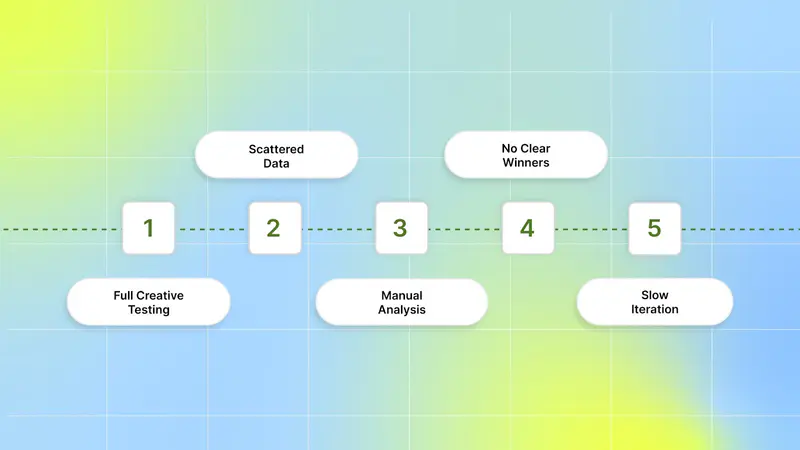
You’re testing full creatives instead of individual elements: As a creative strategist, you often test entire ads instead of breaking them into hooks, visuals, or messages. This makes it harder to understand what actually worked, slowing down your ability to iterate.
Your data is scattered across multiple platforms: You’re jumping between Meta Ads, TikTok, and Google dashboards. Without a unified view, it takes more time to analyze performance and make decisions.
Manual tagging and analysis take too much time: If your team is manually tagging creatives or reviewing performance one by one, you lose valuable time. By the time insights are ready, the opportunity to scale may already be gone.
There’s no clear definition of a “winning creative”: If you don’t define success criteria before testing, your team ends up debating results instead of acting on them. This delays scaling and slows your entire workflow.
Creative insights don’t translate into quick iterations: Even when you find what works, turning those insights into new creatives takes time. This gap between insight and execution slows down your testing cycle.
To speed up creative testing, you need to fix these bottlenecks and build a system that helps you learn and act faster.
This is exactly where a structured framework becomes necessary.
The 4-Step Framework for Powerful Ad Creative Testing
If your testing feels slow, it’s not because you lack ideas; it’s because you lack a structured system. The faster you move through this loop, the faster you find winning creatives.
Here’s a simple 4-step framework for powerful creative testing:
Step 1: Define a clear hypothesis (before you launch)
Don’t start testing randomly. As a creative strategist, you should always define what you’re testing and what success looks like.
For example:
“Does a stronger hook in the first 3 seconds improve conversions?”
“Do UGC-style creatives outperform polished brand ads?”
This speeds up testing by removing guesswork and focusing only on what matters.
Step 2: Create focused variations (test one key element)
Instead of changing everything at once, isolate one variable, such as hook, messaging, or format, while keeping everything else consistent.
Make sure:
Each variation gets an equal budget.
Audience overlap is minimized.
This speeds up testing by providing clear, reliable insights faster.
Step 3: Run the test and interpret the signals
Once your test is live, focus on reading the right signals instead of rushing to conclusions. Treat performance data as indicators, not absolute answers.
Always align your analysis with your goal:
High engagement doesn’t always mean high conversions.
A creative may drive installs but not long-term value.
This speeds up testing by avoiding false conclusions and making smarter decisions based on what actually matters.
Step 4: Iterate and scale based on insights
Once you identify what works, quickly create new variations using those winning creatives. If a test fails, move on to the next hypothesis without delay.
Think in loops:
Test → Learn → Iterate → Scale
This speeds up testing by turning insights into action immediately and keeping your testing cycle continuous.
Creative testing is not a one-time process; it’s a loop. The faster you move through this loop, the faster you scale winning creatives.
Even with a structured framework in place, execution can still slow you down if your process relies heavily on manual work.
Why Creative Testing Needs to Be Automated
Creative testing needs to be automated because manual processes can’t keep up with the speed, scale, and complexity of modern campaigns. If your workflow depends on manual effort, your insights will always lag behind performance.
Here are the key reasons why automation is critical for creative testing:
Manual workflows can’t scale with creative volume: Whether you’re running mobile game ads, DTC video campaigns, or subscription funnels, you’re handling a high volume of creatives. Automation helps you manage this scale without overwhelming your team.
Automation brings consistency to decision-making: Manual analysis often depends on who is reviewing the data. Automation ensures every creative is evaluated using the same logic, so your decisions stay consistent across campaigns and teams.
You learn faster and act sooner: automation helps you detect performance changes within hours. This allows you to scale winners and stop underperformers before they waste budget.
You can analyze performance at scale: Automation allows you to process thousands of data points across creatives, platforms, and campaigns. You can identify winning patterns, detect early signs of fatigue, and understand what drives performance without manual effort.
It enables high-velocity testing: With automation, you can continuously launch, monitor, and evaluate tests. This creates a faster testing cycle where you’re always learning and iterating without delays.
It turns creative data into a long-term asset: Automated testing doesn’t just help with current campaigns. The insights you gather help you create a much stronger creative brief that guides your future creative strategy, improving messaging, positioning, and overall growth decisions.
To truly speed up creative testing, automation isn’t optional; it’s what allows you to move faster without losing control.
The next step is using AI to speed up your creative testing.
How AI-Powered Solutions Speed Up Creative Testing
AI-powered solutions help you move faster by turning unstructured creative data into clear, actionable insights. Instead of relying on manual effort, you can quickly understand what’s working, why it’s working, and what to test next.
Here are the ways AI helps you speed up creative testing:
1. AI-powered creative analysis
AI analyzes your creatives by breaking them down into specific elements like hooks, first 3 seconds, messaging angles, visuals, CTAs, and formats. Instead of looking at performance at the ad level, you start to see patterns across creatives, such as which hook style or narrative consistently drives better results.
This speeds up creative testing by moving from “which ad worked” to “what inside the ad worked.” You don’t need to manually review each creative or rely on assumptions. You can quickly identify high-performing elements and reuse them across new variations, accelerating your iteration cycle.
So how do you know exactly which creative element is actually driving performance? This is where Segwise comes in.
With tag-level creative element mapping, you can see which specific creative elements drive performance. You can also discover patterns like "this hook appears in 80% of top-performing creatives" with complete MMP attribution integration.
2. Use batch testing instead of one-off tests
Instead of testing one creative at a time, batch testing allows you to test multiple variations simultaneously, such as different hooks, formats, or messaging angles in one structured experiment. As a creative strategist, this helps you compare performance across multiple variables within the same timeframe.
This speeds up creative testing by generating more insights in less time. Rather than waiting for one test to finish before starting another, you accelerate learning cycles and quickly identify which variations are worth scaling.
3. Gain a competitive edge
AI enables you to analyze competitor creatives at scale, identifying trends in messaging, formats, creative angles, and storytelling styles that are performing well in your category. This gives you visibility into what your competitors are testing and scaling.
This speeds up creative testing by reducing trial-and-error. Instead of guessing what might work, you start with informed hypotheses based on real market signals. This allows you to test smarter from the beginning and reach winning creatives faster.
4. Proactive fatigue detection
AI continuously monitors your creatives and detects early signs of performance decline, such as drops in engagement or conversion rates. It flags creatives that are starting to fatigue before they significantly impact results.
This speeds up creative testing because you can refresh or replace creatives at the right time. You don’t wait for performance to crash, you act early, keeping your testing cycle continuous and preventing wasted spend.
So, how do you know when a creative is starting to fatigue? This is where Segwise comes in.
With fatigue tracking, you can detect performance decline before it impacts your budget allocation and campaign results. Also, you can set specific performance targets for NEW creatives you want to monitor.
5. Multi-format testing
AI standardizes how you analyze different creative formats, whether it’s UGC, video ads, or static creatives. It evaluates performance across formats using the same framework, making it easier to compare results and understand which format works best for your audience and campaign goals.
This speeds up testing because you can run and evaluate multiple formats in parallel without adding complexity to your workflow. You don’t need separate processes for each format, which helps you scale testing across channels while maintaining speed and consistency.
6. Centralize your creative and performance data
When your creative data and performance metrics are spread across multiple platforms, it becomes harder to get a clear picture of what’s working. Centralizing this data into one unified view allows you to analyze performance across all campaigns and channels together.
This speeds up creative testing by eliminating the need to switch between tools and manually combine data. You can quickly compare creatives, identify trends, and make faster decisions without delays caused by fragmented reporting.
So, how do you bring all your creative and performance data into one place without spending hours manually pulling reports? This is where Segwise comes in.
Segwise creative analytics unifies your ad network and attribution data into a single dashboard. So, you don't need to jump between Facebook Ads Manager, Google Ads, TikTok, and your MMP dashboard. You can see creative-level ROAS, CPA, LTV, and conversion rates from all sources in one unified view.
Even with the right strategies in place, a few common mistakes can quietly slow down your testing process and limit your results.
Common Creative Testing Mistakes That Slow You Down
Even if you’re testing regularly, a few common mistakes can quietly slow down your entire process and delay results.
Focus on avoiding these:
Concluding results too early (or too late): Stopping too soon gives false winners and waiting too long delays scaling, so define clear success criteria before launching tests.
Not testing against a clear control: Without a baseline creative, you can’t measure real improvement, so always compare new creatives against a proven control.
Optimizing for vanity metrics instead of outcomes: High CTR doesn’t guarantee conversions, so focus on metrics like ROAS, CPA, or LTV that reflect actual business impact.
Ignoring creative fatigue signals: Performance drops over time, so monitor trends closely and refresh creatives as soon as you see early signs of decline.
Inconsistent creative direction: Random creatives make it hard to find patterns, so maintain a consistent structure and strategy across your tests.
Also Read: Creative Fatigue Explained: Why Paid Ads Burn Out Than Ever Today
Conclusion
Speeding up creative testing is about building a system that helps you learn faster and act on what works. When you move from testing full ads to testing elements, define clear hypotheses and follow a structured framework, your entire process becomes more efficient. Combine that with automation and AI, and you can reduce manual work, identify winning patterns faster, and continuously iterate without delays.
So how can an AI-powered platform actually help you speed up creative testing and make better decisions? This is where Segwise comes in.
Segwise is a creative intelligence platform that automatically identifies and tags creative elements like hook dialogs, characters, colors, and audio components across images, videos, text, and playable ads using AI-powered creative tagging. So you can clearly see how each element impacts performance metrics like IPM, CTR, and ROAS.
With tag-level performance optimization, you can instantly see which creative elements, themes, and formats drive results across all your campaigns and apps. Also, with creative analytics, you can get a unified view of ad network and MMP data, eliminating the need for manual data collection across multiple platforms. Moreover, with fatigue tracking, you can catch performance decline before it impacts budget allocation and campaign results.
So, it’s time to move beyond manual workflows, start your free trial today, and start building creatives that actually drive results!