
The shift in Meta’s advertising ecosystem is no longer incremental—it’s existential. By the end of 2026, Meta aims to fully automate campaign execution across creation, targeting, budget, and optimization through advanced AI, creating a "goal-only" ad system.
For the performance marketer, UA manager, and creative strategist, this evolution forces a radical strategic realignment. The primary lever for control and profitability is moving away from manual audience segmentation and bidding to one core input: Creative.
In an automated, AI-driven environment, the entire process of identifying what works and iterating on it must become as automated and precise as the Meta auction itself. The key to maintaining a competitive edge is shifting your focus from campaign management to creative intelligence—automating the deep insights that inform better creative production. This deep dive explores why manual analysis is obsolete, the pain points that automation solves, and the new strategic framework required to master Meta Ads in the highly automated landscape of 2026.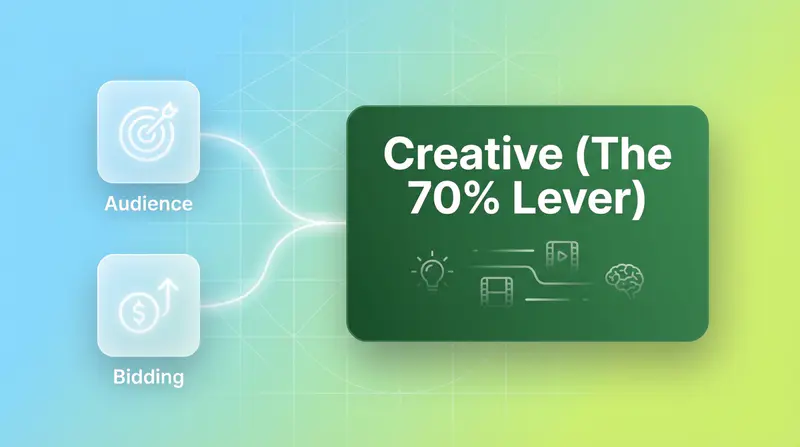
TL;DR: Key Takeaways for the Automated Ad Era
Creative is the Last Lever: By 2026, as Meta fully automates targeting and bidding (via Advantage+ and generative AI), creative quality and strategy will become the single most important controllable input, accounting for up to 70% of campaign results.
Manual Testing is Obsolete: Traditional, manual creative testing leads to wasted spend, premature "winner" calls, and an inability to diagnose why a creative failed.
AI Tagging is the Foundation: Automating creative insights requires breaking down ads into elemental components (e.g., hooks, CTAs, visual styles, audio tone) using multimodal AI tagging to map specific creative attributes to performance metrics (e.g., ROAS or CPA).
Focus on Element-Level Metrics: Move away from judging a test by overall ROAS; instead, focus on leading indicators like CPM, CTR, CVR, total spend at target CPA, and Frequency to understand Meta’s algorithm signal.
The Velocity Mandate: Successful creative teams must drastically increase their production velocity. This is only possible by closing the feedback loop—using AI-generated performance insights to inform and generate new creative iterations, which can halve creative production time.
Why Creative Insights Are the New Targeting in 2026
For years, the performance marketer’s job was about balancing three core levers: Audience, Bid, and Creative. In 2026, AI is removing two of those from human control.
The Shift to Goal-Only Advertising
Meta's core strategy, backed by their advanced AI models (like Meta Lattice), is to consolidate campaign complexity into high-performing, automated products like Advantage+ Shopping Campaigns (ASC). By the end of 2026, Meta is expected to enable a "goal-only" ad system where an advertiser provides a business URL or a goal, and the AI handles the rest.
In this environment, the platform’s algorithm is a black box handling the critical functions of media buying:
Targeting: Identifying the best users in real-time, regardless of manual audience segments.
Bidding: Dynamically adjusting bids across placements and audiences to hit the lowest Cost Per Acquisition (CPA).
Optimization: Learning and allocating budget across the entire ad set based on real-time engagement and conversion signals.
This move simplifies campaign setup but dramatically increases the stakes for campaign performance.
Creative Is Now the Primary Controllable Lever (The 70% Rule)
With the algorithm managing targeting and bidding, your ad creative becomes the most powerful signal you send to the Meta system. Your creative is, in effect, the new targeting.
Creative Drives Engagement: A high-performing creative receives better engagement (CTR, CVR) and avoids audience fatigue. These positive signals tell Meta's algorithm the ad is relevant, which, in turn, rewards the ad with better delivery and lower costs (CPM).
Creative Sets the ROAS Ceiling: Research consistently shows that creative accounts for up to 70% of campaign results. In an automated world, optimizing the other 30% (targeting and bidding) is handled by AI, making creative optimization the sole domain where human strategic intelligence can drive exponential returns.
Creative Defines Audience Quality: The content of your ad inherently screens your audience. A creative featuring a specific product angle will attract users interested in that angle, effectively self-selecting the high-intent, converting audience for the algorithm.
The Crisis of Manual Creative Testing on Meta Today
Before AI-powered creative intelligence became necessary, manual creative testing was the norm. However, this approach is fundamentally broken for the scale and speed required in 2026.
Wasted Spendand the 'Premature Winner' Problem
The traditional method of creative testing—launching numerous ad sets with dedicated, small budgets to "force" spend—is a drain on budget. An expert highlights that brands using this method waste 80-90% of their test campaign budget on creatives that flop because it prevents Meta's algorithms from efficiently optimizing.
The Small Sample Trap: Many marketers call an ad a "winner" after only $50 to $100 in spend, which is a snapshot that does not translate to performance at scale and volume.
The Sunk Cost Fallacy: Marketers often resist killing an underperforming creative, switching to automatic bidding or lowering cost controls to force spend, despite the algorithm signaling the ad is a bad fit for the target CPA.
In 2026, the cost of flying blind with creative testing will be magnified by the sheer velocity of AI-generated creative variations. You must be able to fail fast, learn instantly, and iterate precisely.
The Inability to Diagnose the Why
A major limitation of relying solely on the Meta Ads Manager is the inability to understand the cause-and-effect relationship between a creative's elements and its performance.
When an ad underperforms, the marketer needs to know which part failed:
Attention (The Hook): Did the ad stop the scroll? (Low CTR/High CPM)
Engagement (The Messaging): Did the content compel a click? (Strong engagement but weak clicks)
Conversion (The Offer/Match): Was there an expectation mismatch on the landing page? (Strong clicks but poor CVR)
In the manual workflow, this diagnosis requires hours of spreadsheet analysis and subjective visual review. This process is too slow to feed real-time insights back into the creative production pipeline.
The Creative Intelligence Gap
Most performance teams manage creative performance manually in spreadsheets, relying on file naming conventions and tribal knowledge to correlate creative attributes with ROAS. This creates three critical issues:
Fragmented Data: Performance data (ROAS, CPI) is in Meta Ads Manager, while creative data (file type, hook, character) is in a design team's folder or a spreadsheet, leading to a reporting lag and a single source of truth problem.
Subjective Tagging: Manual tagging is inconsistent, time-consuming, and prone to human error, making it impossible to identify granular patterns at scale (e.g., the performance difference between a "green background with a fast hook" versus a "red background with a slow hook").
Cross-Platform Blindness: Creative teams cannot compare performance for the same core creative concept across Meta, TikTok, Google, or other channels because the data is siloed.
How AI Automates Creative Insights: The 3-Step Framework for 2026
The strategic response to Meta’s full automation must be the adoption of an external AI-powered Creative Intelligence (CI) platform. This technology closes the intelligence gap, automating the diagnostic and feedback process to match the speed of the algorithm.
Step 1: Automated Multimodal Tagging
The first step in automating insights is replacing subjective, manual naming conventions with objective, machine-generated tags. Modern CI platforms achieve this using multimodal AI.
Instead of a human manually reviewing an ad, the platform’s AI analyzes the creative asset holistically:
Video & Image Analysis: Detects visual styles (UGC, high-production, animation), objects (hands, QR codes, products), colors, text overlay, and emotional tone.
Audio Analysis: Transcribes spoken dialogue, identifies key hook lines, and classifies background music type and emotional tone.
Playable Ads: For mobile game studios, the most advanced platforms analyze and tag playable (interactive) ads, which no internal ad network tool can do effectively.
This automated process generates hundreds of granular, objective tags per creative asset, saving UA teams up to 20 hours per week of manual data consolidation and tagging work.
Step 2: Performance-Based Pattern Identification (Tag-to-Metric Mapping)
Automated tagging is only half the battle; the real value lies in connecting those granular tags directly to the bottom-of-the-funnel KPIs. This is known as Tag-to-Metric Mapping.
A high-level view might show that "UGC Video 3" has the highest ROAS. The AI, however, will reveal:
"Creatives tagged with [Upbeat Audio] and [Problem/Solution Hook] consistently deliver a 50% higher ROAS."
"The element [QR Code] generates a 36% higher CTR but drags down CVR by 5% due to an expectation mismatch".
By mapping thousands of tags to metrics like CPI, ROAS, and retention, the system identifies the statistically significant winning and losing elements, not just the winning ad. This approach allows marketers to pinpoint specific creative leverage points, leading to measurable performance improvements, such as a 50% ROAS improvement by identifying winning patterns and catching fatigue early.
Step 3: Insight-Informed Creative Generation
The final step in the automation loop is closing the distance between insight and production. With the winning creative DNA clearly identified (e.g., "The best-performing ads use the character 'Max' in a comedic tone with a call-to-action placed at 3.5 seconds"), the AI can then recommend new, data-backed iterations.
This capability dramatically speeds up the creative iteration cycle, which is essential to keep pace with Meta's demand for fresh assets. Instead of waiting days for a designer to develop a new concept based on a vague brief, performance marketers can leverage AI—like the generative capabilities within the Segwise platform—to halve creative production time by providing clear, data-driven briefs focused on repeating proven elements and eliminating underperforming attributes.
Strategic Implementation: Retaining Control in a Goal-Only World
As Meta's AI absorbs more of the campaign control, the performance marketer's role evolves into an external, strategic intelligence officer. Your primary job is now to ensure your creative input is superior to your competitors' and that you are reacting faster to market dynamics.
Proactive Fatigue Detection (Beyond Frequency)
Creative fatigue—the point where audience exposure drives performance metrics off a cliff—is a major cost driver. While manual marketers watch the Frequency metric, Automated Fatigue Detection uses proprietary algorithms that monitor performance decline against custom criteria, providing an Early Warning System before performance tanks.
For example, an AI creative intelligence platform like Segwise can track not just the overall performance of a campaign but also the performance of specific asset clusters that use similar/identical assets. This Asset Clustering allows teams to quickly compare different treatments of the same asset and identify which assets to reuse or retire based on granular performance—a level of precision impossible to maintain manually at scale.
Competitor Creative Benchmarking
In an automated environment, your ad is competing primarily on quality and relevance. Knowing what your competitors are testing, and which of their concepts are performing, is more critical than ever.
External CI platforms unify competitive tracking, allowing performance marketers to track and analyze their competitors’ ads on Meta (Facebook and Instagram)—the only currently supported network for this feature. Crucially, the same multimodal AI that tags your ads can be applied to competitor creative, providing Tag Count Reports to identify messaging patterns, hook usage, and visual styles that are gaining traction in the market. This allows for proactive Competitor Gap Analysis to avoid oversaturated angles and find white-space opportunities.
Unified Cross-Platform Creative-Level Reporting
Meta’s automation is powerful, but it's siloed. The modern growth leader runs campaigns across multiple major platforms: Meta, TikTok, Google, Snapchat, AppLovin, Unity Ads, Mintegral, and IronSource.
An external AI Creative Intelligence platform acts as the single source of truth by unifying creative data from all 10+ ad networks and major MMPs (AppsFlyer, Adjust, Branch, Singular). This unified view allows a performance marketer to validate whether a winning hook on TikTok will also perform on Meta, or if a specific visual style that drives low CPI on Unity Ads is also relevant to a YouTube audience. This cross-platform intelligence is the key to scaling efficiently and reducing the risk of launching unproven creative concepts.
Conclusion: The Creative Automation Mandate
By the end of 2026, the performance marketing playbook will be dramatically simplified on the media buying side, yet exponentially more complex on the creative strategy side. The shift toward a "goal-only" Meta Ads environment elevates creative intelligence from a tactical function to the central strategic pillar for profitable growth.
Success in this automated era will depend not on how you manage your campaigns, but on how fast you can translate performance data into better creative assets. Marketers must embrace AI-powered creative intelligence tools to automate the three critical steps: element tagging, performance diagnosis, and creative iteration. This automation is the only way to deliver the volume of data-backed, high-performing creative required to satisfy Meta's hungry algorithms and maintain a sustainable Return on Ad Spend (ROAS).
If you’re looking to eliminate manual data work and accelerate your creative iteration cycles—gaining the precise, element-level insights that drive a 50% ROAS improvement—it is time to evolve beyond spreadsheets.
Want to see how multimodal AI tagging and proprietary fatigue detection can save your team up to 20 hours per week and help you maintain control over your most valuable ad input on Meta and all other networks? Segwise connects to major ad networks like (Meta, Google, TikTok, Snapchat, YouTube, AppLovin, Unity Ads, Mintegral, IronSource, plus MMPs including AppsFlyer, Adjust, Branch, and Singular)? [Book a demo to explore the Segwise AI creative intelligence platform].
Frequently Asked Questions
What is Meta's goal-only ad system, and when will it be fully implemented?
Meta's goal-only ad system is the company's vision for full AI automation, where an advertiser only needs to set an objective (like sales) and a budget. The AI will then handle ad creation, targeting, bidding, and optimization. Meta aims to fully automate advertising, powered by AI, by the end of 2026.
Will AI replace human creative strategists in the automated era?
No. AI is designed to automate data consolidation, pattern detection, and iteration, but it does not inherently understand brand identity, nuanced messaging, or positioning. The human role shifts from manual execution and data wrangling to higher-level strategic intelligence: defining the brand narrative, formulating high-impact hypotheses, and interpreting AI-generated insights to guide the creative process.
What is multimodal AI tagging, and why does it matter for Meta Ads?
Multimodal AI tagging involves using machine learning to analyze the full spectrum of a creative asset—visual elements, on-screen text, and audio components—to automatically generate performance tags. This matters because it allows performance marketers to move beyond surface-level metrics and connect specific, granular creative elements (e.g., "fast-paced music," "product shot at 2 seconds," "comedic tone") directly to bottom-of-funnel KPIs like ROAS, which is essential for diagnosing performance.
How do I prevent creative fatigue when Meta’s algorithms are automatically showing my ads?
Preventing creative fatigue requires moving beyond simple Frequency monitoring. In 2026, the best approach is using AI-powered platforms that provide Automated Fatigue Detection. These platforms monitor performance decline against custom criteria at the asset level. Additionally, using Asset Clustering helps identify when similar core assets are oversaturating the audience, allowing you to proactively retire or refresh the asset clusters before performance drops critically.
Which ad performance metrics should I focus on for creative testing in an automated world?
While Return on Ad Spend (ROAS) is the ultimate goal, it is a lagging indicator during testing. Experts recommend focusing on leading, asset-level indicators like CPM (Cost Per Mille/Impression), Click-Through Rate (CTR), Conversion Rate (CVR), CPA (Cost Per Acquisition), and Total Spend (at target CPA) during the testing phase. These metrics tell you if the Meta algorithm is successfully finding and efficiently serving your creative to the right audience, which is the key signal in an automated system.
How does cross-platform creative intelligence help my Meta campaigns?
Creative intelligence that integrates data from all ad networks (Meta, Google, TikTok, etc.) and MMPs (AppsFlyer, Adjust, Branch, Singular) allows you to validate creative concepts faster and cheaper. A winning creative idea on TikTok can be used to inform a data-backed creative brief for Meta, reducing the risk and cost of testing unproven concepts, and leading to more efficient scaling across all platforms.