
Does Facebook keep spending your budget on campaigns that don’t convert or retain users?
You tweak audiences, refresh creatives, and increase budgets, yet results remain unstable or quietly get worse. The problem is often not your targeting or your ads. It’s your bidding strategy working against you. The wrong Facebook bidding setup can slowly drain your budget, push spend toward low-quality users, and make profitable campaigns look broken before you even realize what’s happening.
If you’re running user acquisition for mobile games, DTC video ads, or subscription app campaigns, bidding mistakes get expensive fast. This blog breaks down Facebook ad bidding strategies and explains how to avoid common bidding decisions that hurt campaign results instead of improving them.
What is a Facebook Ad Bidding Strategy?
A Facebook ad bidding strategy defines how Facebook spends your budget in auctions to acquire users at a specific cost or return. It tells Facebook whether your priority is to maximize volume, control CPA or CPI, or protect ROI and user quality.
For advertisers and user acquisition teams, bidding directly impacts who sees your ads, how often they’re shown, and whether Facebook optimizes toward cheap volume or high-value users. Choosing the right bidding strategy helps you scale campaigns without sacrificing ROAS, retention, or lifetime value.
Once you understand what a Facebook ad bidding strategy is, the bigger question becomes why it matters so much to your campaign results.
Why Is Having a Bid Strategy So Important?
Your bid strategy decides how Facebook spends your budget to acquire users and drive results. For user acquisition teams, it directly impacts campaign efficiency, user quality, and whether you can scale without hurting ROI. A strong bidding strategy helps you control costs while letting Facebook find the right users for your goals.
Here are the three critical aspects a bid strategy controls:
How many people see your ads: Your bid determines how aggressively Facebook enters auctions, which affects reach, delivery speed, and scale.
Who sees your ads: The bidding method influences whether Facebook prioritizes cheap clicks and installs or higher-quality users who are more likely to convert, subscribe, or retain.
The cost to deliver your ads: Your bid strategy directly impacts CPA, CPI, and ROAS, especially when you scale budgets or launch new creatives.
The right ad bidding method = lower cost per acquisition = more sales and installs.
Without a clear bid strategy, you risk either overpaying for low-quality users or under-spending and missing growth opportunities that could have been scaled profitably.
To make the right bidding decisions, it’s important to understand how Facebook actually decides which ads get shown.
How Facebook Ad Bidding Works
Facebook’s (Meta’s) ad bidding uses an auction system to determine which ads to show users whenever an ad placement becomes available. For user acquisition teams, this system decides which campaign gets delivery, how often your ads are shown, and how efficiently you acquire installs, purchases, or subscribers.
Here are the key factors Facebook uses to decide which ad wins an auction: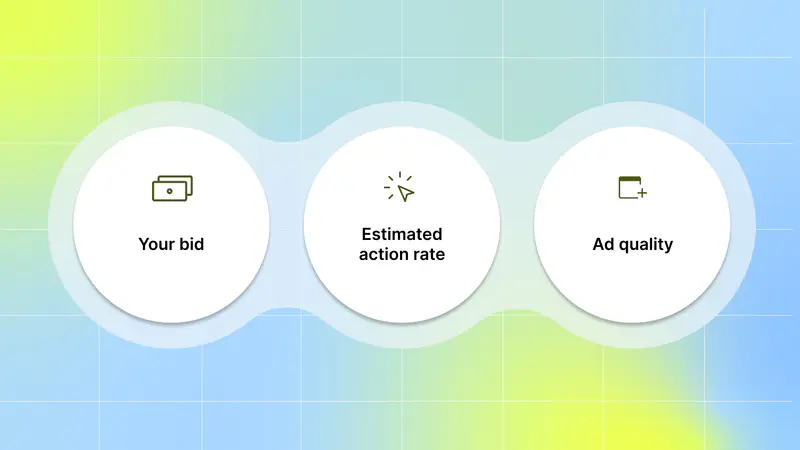
Your bid: This is how much you’re willing to pay for the result you want, such as an install or purchase. Your bidding strategy controls how aggressively Facebook enters auctions on your behalf.
Estimated action rate: Facebook predicts how likely a user is to take your desired action based on past behavior and your campaign’s performance. Consistent conversion data helps Facebook optimize delivery.
Ad quality: This reflects how users respond to your ad. High-quality, relevant creatives get rewarded with better delivery, while poor experiences increase costs.
Facebook combines these signals into an overall ad relevance and quality score. More relevant ads are often rewarded in auctions, which means Facebook may deliver them at a lower cost and with better reach. In simple terms, an ad that feels relevant to a user can win an auction even against ads with higher bids.
To understand how your ads are resonating with users, you can review Ad Relevance Diagnostics in Ads Manager. These diagnostics include:
Quality Ranking
Engagement Rate Ranking
Conversion Rate Ranking
Each metric is marked as “Below Average” or “Average or above,” helping you quickly assess whether your creative and messaging align with your target audience.
When an auction happens, Facebook standardizes all these factors and combines them into a single total value score. The ad with the highest total value wins the auction and gets delivered to users’ feeds.
Once you understand how Facebook’s auction system works, the next step is choosing the bidding approach that best supports your campaign goals.
Also Read: Actionable Tactics to Increase Facebook Ad Relevance Score in 2026
Facebook Bidding Strategies You Should Know
Facebook offers different bidding strategies designed for specific user-acquisition goals, such as scale, efficiency, or profitability. Understanding how each strategy works helps you choose the right one and avoid wasting budget as you grow.
Here are the Facebook bidding strategies you should know:

1. Automated Bidding (Lowest Cost)
An automated or lowest-cost bidding strategy allows Facebook’s algorithm to automatically bid for ad placements at the lowest possible cost while maintaining your campaign objectives. This strategy benefits advertisers who want to achieve cost-efficient results. It requires minimal manual intervention and is ideal for campaigns with limited budgets.
How It Improves ROI
Helps you capture cheap inventory quickly, lowering acquisition costs at scale.
Allows Facebook to learn faster and stabilize delivery without manual bid errors.
Works well when paired with frequent creative testing to surface efficient winners.
Use Case
Ideal for campaigns that aim to quickly reach a wide audience and generate brand awareness or engagement. It's also suitable for advertisers who are testing new strategies or are less experienced with Facebook Ads.
2. Highest Value (Uses Automated Bidding)
Highest-value bidding uses Facebook’s automation to prioritize users likely to generate higher revenue or value. Instead of focusing on cost per action, it optimizes for total conversion value. This strategy works well for DTC and subscription apps focused on revenue quality.
How It Improves ROI
Shifts spend toward users more likely to generate higher revenue or LTV.
Reduces wasted budget on low-value conversions that inflate volume but hurt returns.
Supports long-term profitability by aligning delivery with conversion quality.
Use Case
Ideal when you want to acquire users who drive higher LTV. This strategy works best when your team is optimizing beyond installs or purchases and prioritizing user quality and long-term value.
3. Cost Cap
Cost cap bidding allows you to set a target cost per conversion while Facebook optimizes delivery. Facebook aims to keep your average CPA or CPI within your cap, even as you scale. This helps balance cost control with consistent delivery.
How It Improves ROI
Prevents acquisition cost from drifting upward during scaling phases.
Maintains efficiency while still allowing Facebook to explore auctions.
Helps protect margins when performance fluctuates due to creative or audience changes.
Use Case
This strategy is commonly used in performance-focused campaigns where hitting efficiency targets matters as much as delivery volume, especially during budget scale-ups.
4. Minimum ROAS
Minimum ROAS bidding tells Facebook to deliver ads only when it expects to achieve a specific return on ad spend. It prioritizes users likely to generate higher value purchases or subscriptions. This strategy is best for revenue-driven campaigns with strong conversion data.
How It Improves ROI
Filters delivery to users more likely to meet revenue return thresholds.
Reduces spending on conversions that don’t justify their acquisition cost.
Keeps campaigns aligned with profitability instead of pure volume.
Use Case
Valuable for advertisers looking to maximize revenue and profits. Use this strategy when your team needs to protect profitability and ensure spend is directed only toward users likely to generate strong returns.
5. Bid Cap
Bid cap bidding lets you set the maximum amount you are willing to bid in an auction. Facebook will not bid above this limit, giving you strict cost control. This strategy requires close monitoring and is best for advanced UA teams with clear cost benchmarks.
How It Improves ROI
Eliminates overbidding in competitive auctions, which erodes margins.
Forces discipline in high-cost segments or premium audiences.
Protects ROI when you clearly understand your maximum acceptable cost.
Use Case
Suitable for advertisers who require precise control over their ad spend and want to set specific bid limits for each ad spot. You can use this strategy when running campaigns with strict budget constraints or targeting high-value audiences.
Even the best bidding strategy can fall apart if the creatives behind it don’t perform well.
How Creative Performance Supports Bidding Decisions
Creative performance plays a major role in how well your bidding strategy works. Even the best bidding setup can fail if your ads don’t resonate with users. For user acquisition teams, strong creatives make bidding more efficient and help Facebook deliver better results at lower costs.
Here are the key ways creative performance supports bidding decisions:
Improves auction competitiveness: High-performing creatives get better engagement and relevance signals, helping your ads win auctions even with lower bids.
Stabilizes costs during scaling: When creatives maintain performance, bidding strategies like cost cap or minimum ROAS hold up better as budgets increase.
Helps Facebook optimize delivery faster: Consistent creative performance provides clearer signals, enabling it to find the right users more efficiently.
Reduces the impact of creative fatigue: Fresh, high-performing creatives prevent sudden drops in performance that can disrupt bidding efficiency and hurt ROI.
When creative performance and bidding strategy work together, you get more predictable costs, better user quality, and stronger campaign ROI.
If you want to see which specific creative elements are driving performance, Segwise’s tag-level creative element mapping shows exactly which creative elements, themes, and formats drive results across all your campaigns. Moreover, fatigue tracking helps you catch performance declines before it affect budget allocation and campaign results.
The next step is deciding which bidding strategy fits your campaign goals.
How to Choose the Right Facebook Bidding Strategy
Choosing the right Facebook bidding strategy depends on what you’re trying to achieve with your user acquisition campaigns. The goal is to align bidding with your growth stage, data availability, and the type of users you want to acquire. When bidding aligns with your objective, scaling becomes more predictable, and ROI stays protected.
Here are the key factors to consider when choosing a Facebook bidding strategy:
Your campaign goal: If you’re focused on scale and volume, automated bidding works better. If efficiency or profitability matters more, cost cap or minimum ROAS is usually a safer choice.
Your funnel stage: Prospecting campaigns often benefit from flexible bidding, while retargeting and bottom-funnel campaigns perform better with stricter cost or ROAS controls.
Your conversion data volume: Strategies like minimum ROAS and bid cap require consistent conversion data. With limited data, simpler automated bidding performs more reliably.
Your tolerance for cost fluctuation: If stable CPAs matter, choose cost cap. If you can accept volatility to gain scale, automated bidding may work better.
Your creative performance: Strong, fresh creatives allow more aggressive bidding. If creatives are fatiguing, tighter bidding helps protect costs.
If you want to clearly see which creatives are starting to fatigue, Segwise’s fatigue tracking gives you that visibility. It helps catch performance declines early, before they impact budget allocation and campaign results.
Matching your bidding strategy to these factors helps you acquire higher-quality users while keeping acquisition costs under control.
Selecting the right bidding strategy sets the foundation, but optimization is what drives consistent results.
How to Optimize Your Facebook Ad Bidding Strategy
Optimizing your Facebook ad bidding strategy is an ongoing process, not a one-time setup. For user acquisition teams, the goal is to help Facebook spend your budget more efficiently while acquiring the right users at the right cost. When bidding, targeting, and creatives work together, ROI becomes easier to scale and sustain.
Here are practical ways to optimize your Facebook ad bidding strategy:
Set clear campaign objectives: Start by choosing the Meta campaign objective that matches your real goal; installs, purchases, or subscriptions. Your bidding strategy should support that outcome.
Use Campaign Budget Optimization (CBO): Campaign Budget Optimization allows Facebook to automatically distribute budget across the best-performing ad sets. This helps scale results while keeping acquisition costs under control, especially when performance varies across audiences or creatives.
Monitor key performance metrics regularly: Track metrics such as CTR and conversion rate to understand how bidding affects delivery. Sudden changes often signal bidding or creative issues that need quick adjustment.
Run A/B tests and iterate: Test different bidding strategies alongside creative and audience variations. Even small changes can impact auction performance and user quality. Continuous testing helps you find the most efficient setup.
Respect the learning phase: When launching new campaigns or changing bids, Facebook enters a learning phase. Avoid frequent edits during this time. Give campaigns enough data before judging performance or making adjustments.
Optimizing bidding this way helps you maintain stable performance, reduce wasted spend, and improve ROI as your user acquisition campaigns grow.
When bidding is optimized correctly, its impact shows up directly in how your ads deliver and perform.
How a Good Strategy Directly Affects Ad Performance
A good bidding strategy helps Facebook deliver your ads to the right users at the right cost. When bidding is aligned with your goals, performance becomes more stable and predictable.
Here are the key ways a strong bidding strategy affects ad performance:
Ad impressions on Facebook: The right bidding approach improves your chances of winning auctions, helping your ads get consistent visibility without overspending.
Click-through rate (CTR): When Facebook delivers ads to users more likely to engage, CTR improves. Higher engagement also signals relevance, which supports better auction outcomes.
Conversion rate: Choosing the correct bid strategy and optimization event helps Facebook prioritize users who are more likely to install, purchase, or subscribe.
Average CPM: A smart bidding setup keeps CPMs competitive, especially when combined with good creatives, controlled frequency, and focused targeting.
Together, these improvements help you acquire users more efficiently while protecting ROI as you scale.
Also Read: Using Cost Caps to Find Winning Ads and Optimize ROI in 2025
Conclusion
Facebook bidding plays a bigger role in campaign ROI than most teams realize. The right bidding strategy helps you control costs, reach the right users, and scale without sacrificing performance. From understanding how Facebook’s auction works to choosing the right bidding method and aligning it with creative performance, every decision you make affects acquisition costs, user quality, and long-term returns, especially as creative fatigue sets in.
But how do you know which creatives are starting to fatigue and hurting Facebook campaign performance?
This is where Segwise comes. It is an AI-powered platform that helps UA and performance marketing teams understand which creative elements drive performance and when creatives start to fatigue. Once integrated with your Facebook account, our creative analytics and AI tagging connect creative elements (hooks, dialogs, visuals, formats, etc.) directly to business outcomes (ROAS, CPA/CPI, LTV, IPM, conversion rates), so teams stop guessing what works with data-backed confidence.
With fatigue tracking, you can catch fatigue before it impacts your budget allocation and campaign results. With custom success criteria tracking, you can also set specific performance targets for new creatives you want to monitor. Moreover, with cross-platform performance reports, you can track performance for individual platforms or get consolidated cross-network insights.
So, why wait? Start your free trial today to see exactly which creatives to scale, refresh, or pause before ROI drops!