
Updated July 2026.
Key Takeaways
Budget Control: ABO gives you full control for testing audiences or creatives, while CBO lets Meta's algorithm automatically allocate budget to scale what is already working.
Testing First: Use ABO when you want clean, unbiased data, especially for testing new creatives, hooks, or audience segments.
Scaling Smart: Use CBO once you have found winning creatives so Meta can push more budget toward what drives conversions efficiently.
The 2026 Shift: Meta now runs CBO as its Advantage+ campaign budget and defaults new campaigns to it, so knowing when to force ABO control matters more than ever.
Winning Strategy: The best approach is still to test with ABO and scale with CBO, so you move from ideas to high-performing creatives without wasting budget.
ABO vs CBO comes down to one decision: who controls your Meta budget, you or Meta's algorithm.
Ad Set Budget Optimization (ABO) fixes spend at the ad set level, so every creative or audience gets an equal, unbiased test. Campaign Budget Optimization (CBO), which Meta now runs as its Advantage+ campaign budget, sets one budget at the campaign level and lets the algorithm move money in real time toward whatever converts cheapest. The 2026 rule of thumb is simple: test with ABO, then scale with CBO.
This decision has become more consequential this year. In early 2026 Meta merged its manual and Advantage+ campaign flows into a single setup and made AI-driven budget optimization the default for new campaigns, so choosing between ABO and CBO is now about when you override that default, not whether the option still exists.
As a creative strategist, you do not get enough data from your campaigns if your budget is not structured correctly. Without strong signals, it becomes harder to identify which creatives are actually working and worth scaling.
This blog breaks down ABO vs CBO in Meta ads, shows you exactly when to use each one, and helps you build a smarter strategy for 2026 that actually supports how your creatives scale.
What is ABO (Ad Set Budget Optimization)?
Ad Set Budget Optimization (ABO) is a Meta Ads setup where you control the budget at the ad set level. This means you assign a fixed daily or lifetime budget to each ad set, and Meta spends that budget only within that specific ad set.
For example, if you are testing three different ad sets, each with a different creative concept, you can assign $20 per day to each one. Meta will spend that $20 strictly within its assigned ad set, even if another ad set is performing better.
As a creative strategist, ABO gives you clear control during testing. You can allocate equal budgets across different creatives, audiences, or concepts, making it easier to compare performance without bias.
Pros of ABO
Total control over spend: You decide exactly how much budget each ad set or creative concept receives.
Best for testing creatives and ideas: Since the budget is evenly distributed, it becomes easier to compare different creatives, audiences, or offers without bias.
Predictable spend and data flow: Meta will not ignore any ad set, so every test gets enough data to evaluate performance properly.
Cons of ABO
Requires manual management: If one ad set performs well and another underperforms, you need to manually adjust budgets to avoid wasting spend.
Slower optimization at scale: It does not fully leverage Meta's algorithm to automatically push more budget toward the best-performing creatives.
While ABO gives you full control for testing, there is another approach where Meta takes over budget decisions to improve efficiency at scale.
What is CBO (Campaign Budget Optimization)?
Campaign Budget Optimization (CBO) is a Meta Ads setup where you set one budget at the campaign level, and Meta automatically distributes that budget across your ad sets. Instead of controlling spend manually, the algorithm shifts more budget toward the ad sets that are performing best at the lowest cost. In 2026, Meta runs this as its Advantage+ campaign budget, and it is now the default on most new campaign types.
For example, if you set a $100 daily budget for a campaign with three ad sets, Meta might allocate $70 to one ad set, $20 to another, and only $10 to the third, based on which creatives or audiences are performing best.
As a creative strategist, CBO helps you scale what is already working. Once you have identified strong creatives and clear performance signals, CBO allows Meta to push more budget toward those winning ideas. This means your best-performing creatives get more reach without you manually adjusting budgets.
Pros of CBO
Automated Efficiency: Meta does the heavy lifting by automatically shifting budget toward high-performing ad sets.
Lower Cost Per Action (CPA): By finding the cheapest conversions across all ad sets, CBO generally delivers better overall ROI.
Easier Scaling: It is much easier to scale a single campaign budget than manually adjusting multiple ad set budgets without disrupting performance.
Cons of CBO
Uneven Spend: Meta might spend most of your budget on one ad set while ignoring others, making it a poor choice for controlled testing.
Requires Historical Data: CBO works best when your pixel already has enough data and Meta understands what kind of users convert for you. Each ad set generally needs about 50 optimization events within 7 days to exit Meta's learning phase and stabilize.
Understanding both models individually is helpful, but the real clarity comes when you compare them side by side.
Also Read: Facebook Ad Budget Strategies: How to Allocate Your Daily Spend Effectively
What Are the Key Differences: ABO vs CBO in Meta Ads
The main difference between ABO and CBO comes down to who controls the budget: your team or Meta's algorithm. ABO gives you full control for testing, while CBO uses automation to scale what is already working.
Here are the key differences at a glance:
Now that you understand how ABO and CBO differ, the next step is setting them up correctly.
How to Set Up ABO vs CBO Campaigns in Meta Ads
Setting up ABO vs CBO campaigns in Meta Ads depends on whether you want full control for testing or automation for scaling. The right setup helps you generate clear signals and allocate budget more effectively.
Setting Up an ABO Campaign
Here are the steps to set up an ABO campaign:
Create a new campaign in Meta Ads Manager
Turn off the "Advantage+ campaign budget" at the campaign level. This ensures your budget is controlled at the ad set level (ABO).
Assign a fixed budget to each ad set, so every creative gets equal spend.
Set your daily budget at around 2x your target CPA per ad set (e.g., $40/day if your CPA target is $20). This helps you generate enough data quickly.
Use the same targeting across ad sets if testing creatives
Let your creatives run for at least 3 to 5 days, then pause underperformers once you have enough data.
Pro tip: Name your ad sets clearly. For example: "Broad - Creative A - $50/day" so you can quickly track performance and budgets.
Setting Up CBO with Minimum Spend
Here are the steps to set up CBO with minimum spend:
Create a new campaign and turn ON "Advantage+ campaign budget".
Set your campaign's daily budget. This will be distributed across all ad sets.
Create your ad sets.
Set minimum spend for each ad set. Go to Budget & Schedule > Ad Set Spend Limits and assign a minimum daily spend (around 10 to 20% of the total campaign budget per ad set). This ensures every creative gets initial exposure.
Run the campaign for about one week. Allow enough time for the algorithm to gather data and identify performance patterns.
Remove minimum spend limits after one week. Let Meta optimize freely and push more budget toward the best-performing creatives.
Now that your campaigns are set up correctly, the next step is deciding how to use each budget strategy.
How to Choose Between ABO and CBO in Meta Ads?
Choosing between ABO and CBO depends on whether you are testing new ideas or scaling what is already working. As a creative strategist working on DTC, mobile game, or subscription app campaigns, your goal is to get clear signals from your campaigns.
Here are some scenarios where each might be the better choice: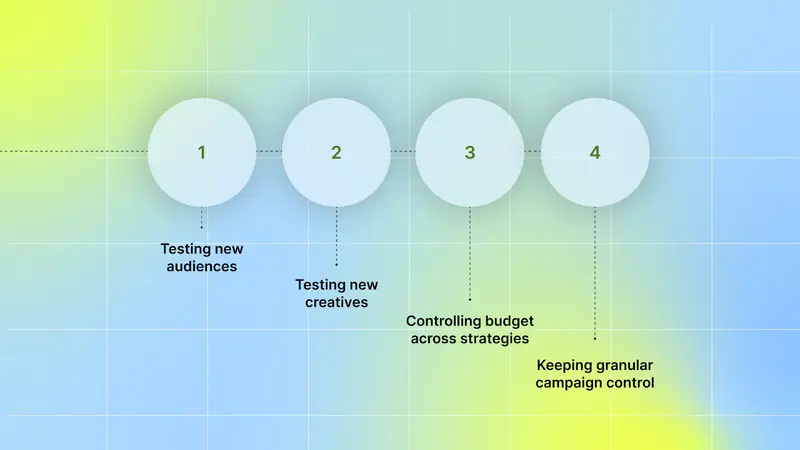
When to Use ABO
1. Testing new audiences
If you are experimenting with different audiences like broad vs lookalikes for a DTC product, or different player segments for a mobile game, ABO ensures each audience gets equal exposure. By assigning a fixed budget to each ad set, you prevent Meta from favoring one audience too early, helping you clearly identify which audience actually converts.
2. Testing new creatives
ABO is ideal when you are testing different video ads, product angles, or gameplay creatives. For example, if you are testing multiple hooks for a skincare product or different gameplay clips for a mobile game, assigning one creative per ad set ensures each one gets equal budget. This gives you clean data on which creatives actually drive purchases, installs, or subscriptions.
But how do you know which part of the creative is actually driving performance? This is where a creative intelligence platform like Segwise comes in.
With tag-level creative element mapping, you can see which specific creative elements drive performance. You can also discover patterns like "this hook dialog appears in 80% of top-performing creatives" with complete MMP attribution integration.
3. Maintaining specific budget allocations across strategies
If you are running different campaign strategies like prospecting vs retargeting for a DTC brand, or user acquisition vs re-engagement for an app, ABO lets you control how much budget goes into each. You can assign budgets based on your priorities, such as pushing more spend toward high-value audiences.
4. You prefer granular control over campaigns
If you like to closely monitor and adjust campaigns, ABO gives you full control. You can manually shift budgets, pause underperforming ad sets, and scale winning ones without affecting the rest of your setup. This is useful when you want to control how each creative or audience performs.
When to Use CBO

1. Running broad or full-funnel campaigns
Use CBO when you are targeting broad audiences or running large campaigns with similar ad sets. Meta distributes budget to explore what works best. This helps you quickly identify which ad sets drive the most conversions without manual adjustments.
2. Scaling successful audiences or creatives
If you have already found winning creatives like a high-converting product video or a strong gameplay concept, CBO helps you scale faster. Meta automatically shifts more budget toward the best-performing ad sets, helping you drive more purchases, installs, or subscriptions without manual adjustments.
3. Managing multiple ad sets efficiently
If you are running multiple ad sets across different audiences or creatives, managing budgets manually can become time-consuming. CBO simplifies this by automatically optimizing spend across ad sets, so you can focus more on creating and testing new creatives.
4. You want a simpler, automated setup
If you do not want to micromanage budgets, CBO makes campaign management easier. It automatically handles budget distribution, allowing you to launch campaigns quickly and focus on learning what works without spending time on technical details.
Pro tip: Many teams find success by combining both strategies. A common approach is to start with ABO to test creatives and generate clear performance signals. Once you identify winning creatives or audiences, you can move them into CBO to scale efficiently and maximize results.
The next step is to measure how well it is actually performing.
How to Track ABO vs CBO Campaign Performance
Tracking performance helps you understand which creatives are actually working and where your budget is being wasted. Making the right changes at the right time ensures you scale winning ads without disrupting performance.
Here are the best ways to track and optimize your campaigns:
For ABO Campaigns
After launching your campaign, consistent monitoring is key. For ABO campaigns, check performance weekly, focusing on metrics like click-through rates, conversions, and cost per acquisition. Use Meta Ads Manager to guide your decisions instead of relying on guesswork.
As a creative strategist, your goal is to identify which creatives are generating strong signals. Let new creatives or audience segments run for at least 7 to 14 days before making changes, so you get enough data to compare performance properly. After making major edits, give campaigns 3 to 5 days to stabilize before evaluating results again.
For CBO Campaigns
For CBO campaigns, focus more on overall campaign-level performance instead of individual ad sets. Track total conversions and average cost per result to understand how the algorithm is distributing budget across your creatives.
When scaling, increase budgets gradually, by around 10 to 20% every few days, to avoid disrupting performance. You can also set up automated rules to pause underperforming ad sets or shift budget toward better-performing ones, so your best creatives continue to get more spend.
Tracking helps you understand performance, but avoiding common mistakes is what protects your budget and improves results.
Common Mistakes to Avoid
Most budget strategy problems do not come from choosing ABO or CBO; they come from how you use them. As a creative strategist, avoiding these mistakes helps you get clear signals and scale creatives without wasting budget.
Here are the most common mistakes:
Running ABO with a Low Hit Rate: If most of your creatives do not perform, ABO will still spend equally across all ad sets, forcing budget on weak creatives, so if your hit rate is low, switch to CBO.
Forcing Spend Indefinitely in CBO: Keeping minimum spend limits active for too long stops CBO from optimizing properly, so use them only for the first week and then remove them to let Meta allocate budget freely.
Mixing Strategies Without a System: Switching between ABO and CBO based on guesswork leads to inconsistent data, so define clear rules for testing, scaling, and pausing creatives before launching campaigns.
Expecting CBO to Fix Bad Creatives: CBO cannot turn weak creatives into winners; it only scales what works, so focus on improving creative quality first before relying on automation.
Making Frequent Changes: Constantly editing budgets or pausing ad sets resets learning and hurts performance, so let campaigns run for at least a week before making major changes.
Also Read: How to Test Creative Angles on Meta Ads Without Wasting Budget
Frequently Asked Questions
Is ABO or CBO better in 2026?
Neither is universally better. Use ABO when you are testing new creatives, hooks, or audiences and need clean, equal-budget data. Use CBO when you already have winning creatives and want Meta to scale spend toward them automatically. Most strong 2026 accounts test with ABO and scale with CBO.
Is CBO the same as Meta's Advantage+ campaign budget?
Yes. Meta rebranded Campaign Budget Optimization as the Advantage+ campaign budget. You set one budget at the campaign level and Meta's algorithm distributes it across ad sets in real time based on performance.
Can I still use ABO after Meta's 2026 Advantage+ changes?
Yes. Even though new campaigns now default to Meta's Advantage+ budget flow, you can still turn off Advantage+ campaign budget and control spend at the ad set level. That manual control is exactly what makes ABO useful for testing.
How much budget does CBO need to work well?
Give the algorithm enough conversions to learn. Each ad set generally needs around 50 optimization events within 7 days to exit Meta's learning phase, so size your campaign budget against your target cost per action before expecting stable results.
Conclusion
Choosing between ABO and CBO is about understanding when to use each. ABO helps you test audiences and creatives and generate clear performance signals, while CBO helps you scale what is already working. As a creative strategist, your success depends on how well you move from testing to scaling without losing data clarity.
Meta shows you which creatives are working, but it does not tell you which exact creative elements are driving that performance. Is it the hook, the messaging, or the visual? This is where Segwise helps you go deeper.
Segwise is an AI-powered creative intelligence platform that helps mobile game studios, DTC brands, subscription apps, and performance marketing agencies optimize their advertising creative performance. Segwise unifies creative data from multiple ad networks, including Meta and MMPs, and provides actionable insights that improve creative ROAS.
With creative analytics and AI creative tagging, Segwise connects creative elements (hooks, dialogs, visuals, formats, etc.) directly to business outcomes (ROAS, CPA/CPI, LTV, IPM, conversion rates), so teams stop guessing what works and start scaling creatives with data-backed confidence. With this data, you can test smarter and scale confidently without wasting budget on guesswork.
So, why wait? Start your free trial today to see what is actually driving your creative performance and make better budget decisions!