
Are you scaling campaigns but struggling to keep your creatives under control?
As the user base grows, creative complexity increases fast. More campaigns mean more versions, more formats, more approvals, and more pressure to move fast. Suddenly, your team is reusing tired creatives, missing winning variations, and pushing budgets behind ads that should’ve been paused weeks ago. The result? wasted spend, slower iteration, and unpredictable results.
If you’re a UA manager, growth lead, creative head, or agency leader, this blog is for you. Here, you’ll explore how a creative management platform helps you scale ad campaigns without burning budget and turn creative execution into a growth lever rather than a bottleneck.
What is a Creative Management Platform?
A creative management platform (CMP) is software that helps teams create, manage, scale, and distribute digital advertising more efficiently. It brings together creative automation, workflow management, and asset organization into a single central system.
Instead of manually managing dozens of versions across ad networks, you use a single platform to keep creatives structured, consistent, and ready to scale. Here are the main teams that use creative management platforms:
In-house brand marketers managing multichannel campaigns.
Creative teams producing and versioning content at scale.
Performance marketers optimizing ad output across platforms.
Agencies serving multiple clients with varied campaign needs.
Next, let’s look at the common problems a creative management platform solves.
Also Read: Creative Optimization in 2025: Dynamic Creative Optimization (DCO) Playbook for Mobile UA
Problems a Creative Management Platform Solves
A creative management platform solves the biggest execution problems that slow user acquisition as campaigns scale. It brings structure and speed back into execution. So, instead of reacting to creative issues after performance drops, you fix them at the process level.
Here are the key problems it solves:
Fragmented workflows across tools and teams: Creatives, feedback, and final assets often live in different tools. Centralizing everything improves coordination between UA, creative, and agency teams.
Time-consuming manual asset creation: Rebuilding creatives for every format or channel slows down launches. Reusable structures reduce unnecessary production work.
Bottlenecks in feedback and approvals: Unclear review processes delay launches and testing. Structured approvals keep campaigns moving on schedule.
Brand inconsistency across markets: Without a system, messaging and visuals drift as campaigns expand. Central control helps maintain consistency.
High production costs and long timelines: Scaling campaigns manually increases workload and cost. Streamlined workflows make high-volume execution manageable.
Addressing these challenges requires more than effort; it requires the right capabilities built into how creatives are managed and produced.
Key Features of a Creative Management Platform
Managing creatives at scale requires more than storage or design tools. A creative management platform provides the capabilities needed to support high-volume campaign execution.
Here are the core features that support campaign scale: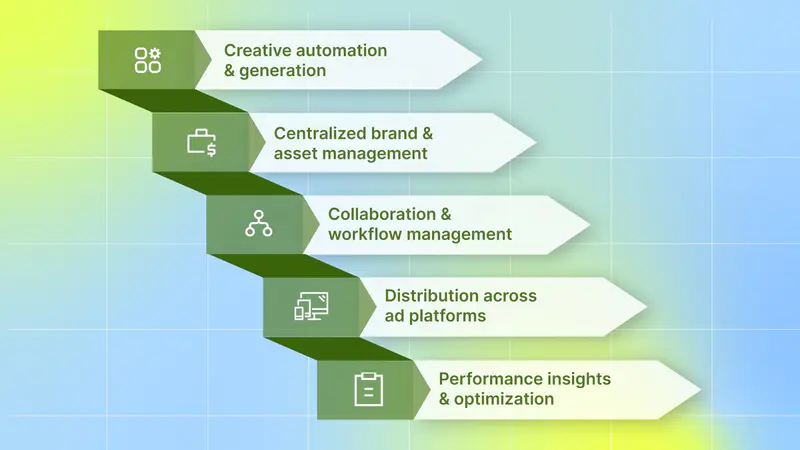
1. Creative automation and generation
You can create multiple ad variations from a single master creative using templates. This makes it easier to produce different sizes, formats, and localized versions for ad networks. Many platforms also use AI to help create variations and automate repetitive creative tasks.
2. Centralized brand and asset management
You store all approved creatives, videos, images, and brand assets in one central library. This ensures your team always uses the right versions and maintains consistent branding across campaigns and markets.
3. Collaboration and workflow management
You manage feedback, reviews, and approvals in a single system. This shortens turnaround time and keeps teams aligned.
4. Distribution across ad platforms
You distribute creatives to multiple ad platforms from a single workflow. This allows you to launch and scale campaigns quickly, even when managing hundreds of assets for global user acquisition efforts.
5. Performance insights and optimization
You track how different creatives and variations perform across campaigns and use that data to inform decisions about what to launch, refresh, or scale next. This helps you focus your budget on creatives that are delivering better user acquisition results.
If you are searching for a platform that offers deeper creative-level insights, platforms like Segwise help teams understand which creative elements are driving results. Our performance data mapping connects creative elements to ROAS outcomes and understands which hook scenes, dialog, and visuals drive the highest returns.
With tag-level creative element mapping, you can discover patterns like "this hook appears in 80% of top-performing creatives".
When these features come together, they directly shape how smoothly and efficiently ad campaigns can scale.
How a Creative Management Platform Scales Ad Campaigns
Scaling ad campaigns increases pressure on creative execution. Without structure, teams struggle to test, refresh, and expand campaigns efficiently. The right creative setup makes scaling smoother, faster, and more controlled.
Here are key ways a creative management platform supports to scale campaign:
1. Supports Rapid Testing During Campaign Scale
As campaigns scale, relying on a small set of creatives becomes risky. A structured workflow lets you launch multiple variations simultaneously, so testing continues even as budgets grow.
For mobile game campaigns, this makes it easier to test different gameplay scenes, hooks, or first-frame visuals without slowing active campaigns.
2. Makes Scaling Across Channels Easier
As campaigns grow, you often expand from one ad network to several. Centralized creative workflows help you adapt the same concept for Meta, Google, TikTok, and other platforms without rebuilding assets.
This is especially valuable for DTC brands running paid video, where the same campaign needs to stay consistent across multiple channels.
3. Enables Dynamic Creative Optimization (DCO)
Preparing multiple creative elements in advance allows campaigns to show more relevant ads to different audience segments. Headlines, visuals, and CTAs can be mixed and matched based on user signals.
For DTC brand campaigns, this helps show different products or offers to different audiences while scaling spend.
4. Reduces Creative Production Bottlenecks
As campaigns scale, creative teams often become overloaded. Automation and reusable templates reduce manual work and speed up production.
This is especially helpful for growth and UA agencies managing multiple client campaigns at the same time.
5. Improves Collaboration Between UA and Creative Teams
Scaling campaigns requires close coordination between UA and creative teams. A shared system for reviews and approvals reduces miscommunication and delays.
This alignment is critical for mobile game studios, where creative output directly impacts campaign performance.
6. Creates Repeatable Systems for Sustainable Campaign Scaling
Successful campaign scaling depends on repeatable execution. Structured workflows make it easier to scale new campaigns using the same proven processes.
Whether you manage one brand or multiple accounts, repeatable systems help agencies and in-house teams scale campaigns without increasing operational complexity.
7. Helps Manage Creative Fatigue at Scale
Creative fatigue increases as spend grows. Having organized creative variations ready makes it easier to rotate ads before performance starts to decline.
In subscription app campaigns, this helps prevent overusing the same feature or benefit message as campaigns scale.
If you want to catch creative fatigue before it impacts results, you can use platforms like Segwise. Our fatigue tracking uses automated monitoring to detect continuous declines in performance metrics and spend share. This helps teams identify fatigue early and take action before it affects budget allocation and campaign performance.
As campaign scale increases, the impact of your creative workflows depends heavily on choosing the right platform.
How to Choose the Right Creative Management Platform
Choosing the right creative management platform is about finding a system that supports how you run and scale ad campaigns. The right choice helps you move faster, stay organized, and avoid creative bottlenecks as campaign volume grows.
Here are the key things to look for when choosing a creative management platform:
Ability to automate and personalize creative content: Make sure the platform allows you to automate creative production using templates and supports personalization for different audiences. This is important when you’re scaling campaigns and need multiple variations without increasing manual work.
Integration with your existing ad stack: Look for strong integrations with the ad networks and tools you already use, such as Meta, Google, TikTok, and other platforms. This ensures creatives move smoothly from production to launch without extra steps.
Collaboration and approval workflows: Choose a platform that simplifies feedback, reviews, and approvals. Clear workflows help teams stay aligned and prevent delays as campaigns scale.
Support for multi-channel creative distribution: Ensure the platform can handle creatives across display, social, and video channels. This makes it easier to scale the same campaign across multiple platforms while maintaining consistency.
Scalability for future campaign growth: The platform should handle increasing creative volume, more users, and more campaigns over time. This is especially important for growing brands and agencies that plan to scale campaigns aggressively.
Even with the right platform in place, scaling ads successfully depends on how well creative volume is managed in practice.
Best Practices for Scaling Ads with High Creative Volume
When ad volume increases, the challenge shifts from producing creatives to managing them efficiently. Teams that scale well focus on clarity, prioritization, and execution discipline to keep campaigns moving without friction.
Here are the best practices for scaling ads with high creative volume:
Set clear priorities for what gets built first: Not every creative idea needs to be produced at once. Prioritizing high-impact concepts helps teams focus effort where it matters most.
Limit unnecessary variations: Too many similar versions slow down decision-making. Build variations with a clear purpose instead of creating volume for its own sake.
Track creative lifecycle status clearly: Make it easy to see which creatives are in production, live, paused, or ready for refresh. This prevents confusion as volume grows.
Separate experimentation from scaling: Keep testing creatives distinct from scaled campaigns so changes don’t disrupt stable performance.
Review creative output regularly: Frequent reviews help teams cut underperforming ideas early and stay focused on what supports campaign scale.
Also Read: Best Ad Creative Management Tools for DTC Brands in 2025
Conclusion
Scaling ad campaigns becomes difficult when creative execution can’t keep up with volume. As campaigns expand across channels, markets, and formats, the difference between smooth scaling and wasted spend often comes down to how well creatives are managed. A creative management platform brings structure to this process, helping teams move faster, stay organized, and scale campaigns without losing control or consistency.
However, as campaigns grow, to scale confidently, teams also need visibility into what’s working, what’s fatiguing, and which creative decisions are driving results. This is where platforms like Segwise come in.
Segwise connects creatives with performance insights so teams know exactly what to scale, refresh, or stop across their campaigns. Its AI tagging and creative analytics connect creative elements (hooks, dialogs, visuals, formats, etc.) directly to business outcomes (ROAS, CPA/CPI, LTV, IPM, conversion rates), so teams stop guessing what works and start scaling creatives with data-backed confidence.
With our fatigue tracking, you can catch a drop in performance before it impacts your budget allocation and campaign results. Moreover, you can also set custom fatigue criteria and monitor creative performance across Facebook, Google, TikTok, and all major ad networks, to catch fatigue before it impacts your ROAS. Moreover, with tag-level creative element mapping, you can see which specific creative elements drive performance.
So, if you’re ready to scale campaigns with more confidence and less wasted spend, start your free trial today!