
Key Takeaways
Platform Difference: Facebook is better for conversions and scaling, while Instagram is stronger for engagement and discovery.
Creative Impact: The same creative won’t perform equally across both platforms because user behavior and content consumption differ.
Cost Efficiency: Facebook typically delivers lower CPC and higher CTR, making it more cost-efficient, while Instagram requires stronger creatives to justify higher costs.
Ad Formats: Both platforms offer similar formats, but Instagram excels in immersive formats like Reels and Stories, while Facebook offers more flexibility with formats like playable and slideshow ads.
Data Gap: Platforms tell you which ads perform, but not why. Using creative intelligence tools helps you identify winning elements and make faster, data-backed decisions.
Are you still trying to figure out whether Facebook Ads or Instagram Ads actually drive better results for your creatives?
You launch the same ad on both platforms, but the performance looks completely different, and you don’t know why. Your budget keeps getting split without clarity, your winning creatives stop working faster than expected, and scaling starts to feel like guesswork. If you keep relying on platform-level metrics instead of understanding what’s really driving performance, you’ll keep wasting spend and missing out on real growth.
If you’re a creative strategist, working on mobile games, DTC brands, or subscription apps, this confusion can slow down your entire iteration process. This blog explores how Facebook and Instagram ads differ in audience behavior, creative performance, and ROI, and how to decide where to invest and what kinds of creatives to build for each platform.
What Are Facebook Ads?
Facebook Ads are paid ads that appear across the Facebook platform, including feeds, stories, videos, and marketplace. They run through the Meta Ads system, allowing you to target specific audiences based on behavior, interests, and past actions.
As a creative strategist, you’ll find Facebook works best when users are in a browsing or consideration mindset. This gives you space to test different messaging angles like value props, testimonials, or feature-led creatives, and understand what actually drives engagement.
Now, let’s understand what Instagram Ads are.
What Are Instagram Ads?
Instagram Ads are paid ads that appear across Instagram placements like feed, stories, reels, and explore. They also use the same targeting and optimization tools, but in a more visual, mobile-first environment.
As a creative strategist, Instagram is where your creatives need to grab attention instantly. Users scroll fast, so your hooks, visuals, and storytelling matter more than anything. This is where you test bold concepts, UGC-style videos, and short-form creatives to see what stops the scroll and drives engagement before pushing users further down the funnel.
At a glance, both platforms share the same backend, but the differences become clear when you compare them side by side.
Also Read: Facebook Ad Copy Best Practices for High-Converting Ads
A Quick Comparison: Facebook Ads vs Instagram Ads
Facebook Ads generally perform better for conversions and retargeting, while Instagram Ads excel at engagement, discovery, and scroll-stopping creatives. The right choice depends on your creative strategy, audience behavior, and where you are in the funnel.
Here are the key differences between Facebook Ads and Instagram Ads:
While this gives you a quick overview, the real differences come from how each factor impacts performance.
Facebook Ads vs Instagram Ads: What Actually Impacts Performance
Facebook Ads and Instagram Ads differ not just in platform, but in how users behave, engage, and convert across each channel. Your performance depends on how well your creatives, targeting, and strategy align with these differences.
Here are detailed differences that impact performance: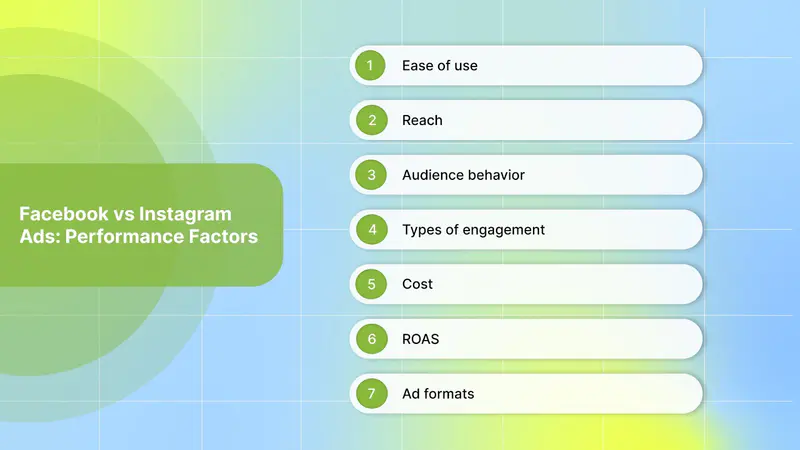
1. Ease of Use
Facebook Ads give you more control, but they can feel complex when you’re managing everything yourself. You have to set up tracking (like pixel), work with dynamic creatives, test different budget strategies, and fine-tune audiences. As a creative strategist, this gives you more room to experiment, but it also means more time spent managing and optimizing campaigns.
Instagram Ads are simpler to get started with. The setup is more straightforward, with fewer options to manage, so you can focus more on testing creatives rather than handling too many settings. If you're quickly iterating on video ads or testing new concepts, Instagram helps you move faster without a steep learning curve.
2. Reach
If your goal is to reach more people and scale your campaigns, both platforms can deliver, but in different ways. Facebook has a larger user base, with around 2.9 billion monthly users compared to Instagram’s 2 billion, giving you a broader reach across markets and campaign types. This makes Facebook strong when you want to scale winning creatives and increase volume.
Instagram, however, offers more attention per impression. Users engage more with visual content, which means your creatives are more likely to be noticed rather than ignored. As a creative strategist, this makes Instagram a strong platform when your focus is not just reach, but getting your creatives seen and interacted with.
3. Audience behavior
Even if a platform has high reach, it won’t matter if your target audience isn’t active or responsive there. As a creative strategist, you need to understand who you’re targeting and how they behave on each platform.
Facebook has a more diverse and mature audience, with a large share of users in the 25-44 age range and a strong presence in older segments. This makes it a reliable platform when you’re targeting users with higher intent, especially for retargeting, subscriptions, or offers that require more consideration.
Instagram, on the other hand, has a younger, more trend-driven audience. Most users are under 34, and they engage more with fast, visual content. For mobile games, DTC brands, or visually driven products, this makes Instagram a better fit, especially when your creatives are built to capture attention quickly and align with trends.
4. Types of Engagement
Engagement tells you whether your creatives are actually working, not just being seen. As a creative strategist, this is where you understand if your hooks, visuals, and messaging are resonating with your audience.
On Instagram, engagement is more visual and attention-driven. The platform prioritizes likes, comments, saves, profile visits, and time spent on content. Saves and watch time are especially important because they signal a strong interest. This is why short videos, reels, and carousel creatives tend to perform better; they keep users engaged longer and encourage interaction.
On Facebook, engagement is more action-driven. The platform focuses on reactions, comments, shares, link clicks, and time spent. Shares and clicks matter more here because they show intent and deeper interaction with your content. For you, this means creatives that clearly communicate value, like product demos, offers, or testimonials, tend to perform better.
5. Cost
Most advertisers care about one thing: if you spend $1, how much comes back. To answer that, you need to look at cost per click, cost per thousand views, and how well you can target.
Both Facebook and Instagram run on the same Meta Ads Manager. The difference comes from how users behave and how your creatives perform, which directly impacts cost efficiency.
Here are the key numbers to understand:
Facebook average CPC: ~$0.49
Instagram average CPC: ~$1.09
Facebook average CPM: ~$7–$9
Instagram average CPM: ~$9–$12
Facebook CTR: ~3.06%
Instagram CTR: ~0.68%
So, this means,
Facebook gives you cheaper clicks and higher CTR, making it more cost-efficient for driving traffic and conversions.
Instagram costs more per click, but can deliver strong top‑of‑funnel awareness. So your creatives need to work harder to justify the spend.
6. ROAS
ROAS (return on ad spend) shows how much revenue you generate for every dollar you spend, making it one of the most important metrics for evaluating your campaigns.
Facebook generally delivers higher ROAS than Instagram. This is because users on Facebook are more intent-driven and more likely to convert, especially in retargeting or bottom-funnel campaigns. Instagram still performs well, but it often plays a bigger role earlier in the funnel, helping you attract and engage users before they convert elsewhere.
7. Ad Formats
Both Facebook and Instagram offer similar core ad formats, so you can run almost any type of creative on both platforms. The real difference is how these formats perform based on user behavior and content consumption style.
Common ad formats on both platforms:
Image ads → best for simple, clear messaging
Video ads → ideal for storytelling, demos, and hooks
Carousel ads → showcase multiple features, products, or steps
Collection & shopping ads → drive product discovery and purchases
Immersive formats (stronger on Instagram):
Stories ads → full-screen, quick-impact creatives
Reels ads → short, scroll-stopping videos for high engagement
Explore ads → great for discovery and reaching new audiences
These formats work best when your creatives are fast, visual, and trend-driven.
Additional formats on Facebook:
Slideshow ads → lightweight video-style creatives
Playable ads → interactive ads (especially effective for mobile games)
These give you more flexibility to test different creative types and formats.
But how do you analyze playable ads? This is where a creative intelligence platform like Segwise comes in.
Segwise Creative Tagging automatically tags playable ad elements and interactive components, helping you understand which parts of the experience actually drive performance.
As a creative strategist, both platforms give you the same building blocks but not the same results. Instagram rewards immersive, fast-paced creatives, while Facebook gives you more room to test different formats and messaging styles.
While these differences help you compare both platforms, the real impact shows up in how your creatives perform.
How Creative Performance Differs Between Facebook and Instagram Ads
The biggest mistake you can make as a creative strategist is assuming a winning creative will work the same across both platforms. In reality, performance differences don’t come only from audience, formats, or cost; they come from how your creative elements behave.
What matters here is which parts of your creative actually drive results on each platform. Instead of looking at ads as a whole, you need to break them down into elements:
Hook (first 2–3 seconds)
Visual style (UGC, polished, product-focused)
Messaging (emotional vs value-driven)
Format (short vs slightly longer storytelling)
The same ad can fail or win depending on how these elements align with the platform.
But how do you actually know which creative elements, like hook or dialog, are driving performance across Facebook and Instagram? This is where a creative intelligence platform like Segwise comes in.
With tag-level creative element mapping, you can see which specific creative elements drive performance. Also, you can discover patterns like "this hook dialog appears in 80% of top-performing creatives" with complete MMP attribution integration.
On Instagram, performance is driven by
Hooks that stop the scroll instantly.
Visual patterns that feel native (UGC, trends, fast cuts).
Short, high-energy storytelling.
Content that blends in with organic posts.
On Facebook, performance is driven by
Clear messaging and structured storytelling.
Creatives that explain the product or value clearly.
Familiar formats like testimonials or demos.
Content that builds trust before action.
This is why a creative that performs well on Instagram may lose momentum on Facebook, and vice versa.
The next step is deciding where to actually invest your budget.
How to Choose Between Facebook Ads vs Instagram Ads
There’s no single “better” platform; your choice depends on your audience, creative strategy, and campaign goals. The right approach is to match the platform with how your creatives perform and where your users are in the funnel.
Here are simple ways to decide which platform to prioritize:
1. Choose Facebook Ads If:
You want to scale campaigns to a broader audience.
Your goal is conversions, retargeting, or driving purchases.
Your creatives focus on value, product benefits, or detailed messaging.
You need more control over targeting, optimization, and budget.
You are running subscription offers or high-intent campaigns.
Facebook works best when you already know what’s working and want to scale your reach.
2. Choose Instagram Ads If:
You want to attract new users and drive discovery.
Your target audience is younger or more trend-driven.
Your creatives are visual-first (UGC, reels, short videos).
You are testing new hooks, concepts, or creative ideas.
You are promoting visually appealing products like DTC or mobile games.
Instagram works best when your goal is to capture attention and test high-performing creatives.
For most teams, the best results don’t come from choosing a single platform; they come from using both. Use Instagram to test and discover what grabs attention, and use Facebook to scale and convert those winning creatives.
Also Read: Complete Guide to Instagram Ad Sizes and Specs 2025
Conclusion
Choosing between Facebook Ads and Instagram Ads is about understanding how each platform drives results differently. Facebook helps you scale and convert with more intent-driven users, while Instagram helps you capture attention and test new creative ideas. As a creative strategist, your success depends on how well you align your creatives with platform behavior. When you focus on your hooks, visuals, and messaging, you can build a more scalable ad strategy.
When you’re checking creative performance, Facebook and Instagram tell you which ads are working, but not why. And manually analyzing hundreds of creatives to identify patterns can be time-consuming, inconsistent, and error-prone. This is where a creative intelligence platform like Segwise comes in.
Segwise automatically analyzes your creatives with creative analytics and AI creative tagging. It connects creative elements (hooks, visuals, formats, etc.) directly to business outcomes (ROAS, CPA/CPI, LTV, IPM, conversion rates), so teams stop guessing what works and start scaling creatives with data-backed confidence. So you know exactly what’s driving results and what to scale next.
Moreover, with Segwise creative analytics, you don't need to jump across major ad networks and MMPs dashboards to see creative-level ROAS, CPA, LTV, and conversion rates from all sources in a single view. And also tags playable ad elements and interactive components.
So, why wait? Start your free trial to see exactly which creatives drive performance!