
Key Takeaways
Scroll Attention: Facebook users spend only seconds on each post, so your hook must instantly grab attention and stop the scroll.
Clear Messaging: High-converting Facebook ads rely on a simple structure, a strong hook, clear body copy, relevant creative, focused headline, and a clear CTA that guides the user’s next step.
Single Focus: Each ad should communicate one clear value or outcome. Trying to highlight too many benefits at once can confuse users and weaken engagement.
Audience Relevance: The best ad copy speaks directly to specific audience motivations. Tailoring messaging for different user segments improves relevance, CTR, and conversions.
Creative Insights: Testing multiple hooks and messaging angles is essential. Tools like Segwise help creative strategists analyze which creative elements actually drive performance so teams can scale winning ads faster.
What if you knew that the average Facebook ad CTR across industries is only around 0.90%? This shows how hard it is to capture attention on the feed and why strong ad copy can make all the difference.
Many creative strategists spend hours producing new ad creatives, yet the copy fails to stop the scroll. When your ad copy doesn’t instantly connect with the audience, users keep scrolling, CTR drops, and your creative strategy struggles to drive meaningful results. Over time, weak messaging makes it harder to scale winning creatives, forcing your team to test more ads without clear direction.
In fact, Meta shows that people spend about 1.7 seconds viewing a piece of content in the Facebook News Feed on mobile, compared to 2.5 seconds on desktop, making the first line of your ad copy critical for capturing attention.
This blog will explore Facebook ad copy best practices for crafting scroll-stopping hooks, communicating value clearly, and creating high-converting ads that improve campaign performance.
Why Does Facebook Ad Copy Matter?
Facebook ad copy is the text that communicates your message in a Facebook ad. It includes the primary text, headline, and description that explain the value of your product or offer. Strong ad copy helps you capture attention, communicate benefits quickly, and persuade users to take action.
As a creative strategist, your role goes beyond writing lines of text. You shape the message that connects the creative concept with real business outcomes. Whether you are promoting a mobile game, a DTC product, or a subscription app, your ad copy determines whether users stop scrolling, click on your ad, or ignore it.
Here are a few reasons why Facebook ad copy matters:
It stops the scroll: The first line of your ad copy decides whether users pause or keep scrolling.
It communicates value quickly: Users need to understand the benefit of your product or game within seconds.
It supports the creative concept: Copy and visuals work together to deliver a clear message.
It improves key performance metrics: Strong copy can increase CTR, conversions, and overall campaign performance.
It guides creative testing: Clear messaging makes it easier for your team to test different hooks, angles, and offers.
When your ad copy clearly communicates value and aligns with your creative concept, it becomes easier to identify which hooks and messages resonate with your audience. Over time, these insights help you build a winning creative strategy that drives stronger campaign performance.
Strong Facebook ad copy isn’t random; it follows a structure that helps capture attention.
Also Read: AI Tools to Create Winning Facebook Ads
5 Components of High-Converting Facebook Ad Copy
High-converting Facebook ad copy is built from a few key components that help your message stand out in a crowded feed. When you structure your copy with the right elements, it becomes easier for users to understand your offer and take the next step.
Here are the key components of high-converting Facebook ad copy: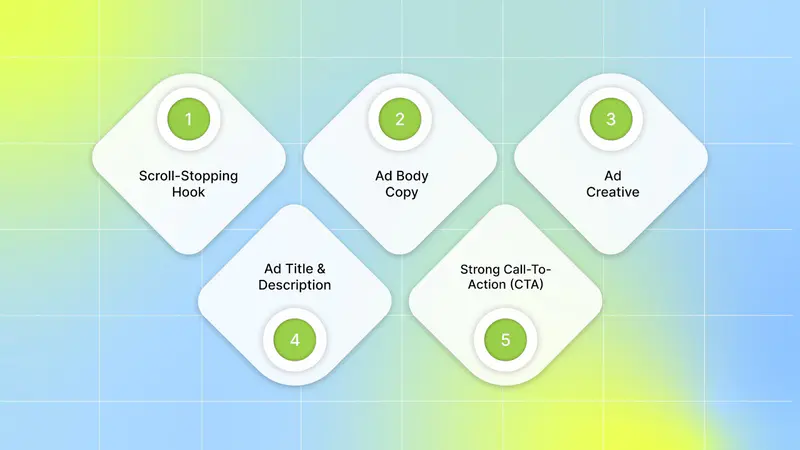
1. Scroll-Stopping Hook
The hook is the first line of your ad copy and the most important part of the message. It is what users see first while scrolling through the feed, so it needs to grab attention instantly.
As a creative strategist, your hook should spark curiosity, highlight a problem, or promise a clear benefit. This part of your copy must quickly convince users to take action.
But how do you know which hooks actually stop the scroll and drive performance across your campaigns? This is where Segwise comes in.
With tag-level creative element mapping, you can see which specific creative elements drive performance. You can also discover patterns like "this hook appears in 80% of top-performing creatives" with complete MMP attribution integration.
2. The Ad Body Copy
The ad body copy is the section where you expand on the hook and explain the value of your product or offer. This is where you connect with the user’s problem and show how your product or app can help solve it.
For creative strategists running campaigns for mobile games, DTC products, or subscription apps, this section should clearly communicate the product's benefit and why users should care.
3. The Ad Creative
Ad creative refers to the visual element of an ad, such as an image or video. It plays a crucial role in how users interpret the message.
For creative strategists, the creative should visually support the ad copy's hook and message. When the creative and copy convey the same idea, users can quickly understand the ad's value.
4. The Ad Title and Description
The ad title and description appear below the creative and help reinforce the message of the ad. These sections provide additional context and highlight the offer or benefit.
Creative strategists should use the title and description strategically. The title can communicate the main offer, while the description can emphasize a key benefit or incentive that encourages users to click.
5. Strong Call-to-Action (CTA)
Your ad copy should guide users on what to do next. Clear CTAs like “Play Now,” “Shop Now,” “Start Free Trial,” or “Learn More” help drive clicks and conversions.
Once you understand the core components of Facebook ad copy, applying the right writing practices helps turn them into ads that capture attention.
10 Best Practices for Winning Facebook Ad Copy
Writing effective Facebook ad copy requires a clear approach that communicates value quickly and encourages users to take action.
Here are 10 best practices to help you write Facebook ad copy:
1. Align Your Copy With the Creative Concept
Your ad copy should reinforce the story your creative is telling. When the text and the visual convey the same idea, users can quickly understand the ad's message.
If the copy introduces a different message than the visual, users may become confused and lose interest. Strong alignment between copy and creative ensures that the hook, message, and visual work together to deliver a clear and compelling idea.
For example, imagine you’re running a video ad for a skincare product that shows the transformation of someone’s skin over time. If the video focuses on visible results, your ad copy should reinforce that transformation story. A hook like “See clearer, healthier skin in just 7 days” immediately connects with the visual and makes the message easier to understand.
2. Write Different Ads for Different Audience Segments
Not every user responds to the same message. Different audience groups often have different motivations, behaviors, and expectations.
Creating multiple ad variations for different audience segments allows you to deliver messaging that feels more relevant to each group. This approach improves engagement and helps your team discover which messaging resonates most with specific audiences.
For example, imagine you’re promoting a mobile puzzle game. Some players enjoy difficult challenges, while others prefer relaxing gameplay. Messaging that challenges competitive players might say, “Can you solve this puzzle in under 30 seconds?”, while casual players may respond better to messaging that emphasizes fun and relaxation.
3. Speak Directly to the User
Facebook ads perform better when the messaging feels conversational and personal. Writing in a direct tone helps your ad feel more relatable and encourages users to engage with the message.
Instead of sounding like a formal brand announcement, your copy should feel like a conversation with the user scrolling through their feed. This approach makes the message easier to understand and more engaging.
For example, imagine you’re promoting a subscription productivity app. Instead of describing the app’s features in a generic way, you can address the user’s everyday challenges. A message like “Tired of forgetting tasks? Organize your entire week in one place” speaks directly to the user’s frustration and immediately feels more relevant.
4. Keep Your Copy Short and Easy to Scan
Users typically scroll quickly through their social media feeds. If your message takes too long to understand, users may skip the ad entirely.
Effective Facebook ad copy focuses on short, clear sentences that communicate the key message quickly. Keeping your copy concise helps users understand the value of the product within seconds.
For example, suppose you’re promoting a mobile puzzle game through a video ad. Instead of writing a long description about gameplay features and mechanics, a short line like “Train your brain with the ultimate puzzle challenge” quickly communicates the experience and encourages users to keep watching.
5. Focus on One Clear Message Per Ad
Trying to convey multiple ideas in a single ad can make the message confusing. When too many benefits or features are mentioned at once, users may struggle to understand the main point of the ad.
Instead, each ad should focus on one core idea or value proposition. This makes the message easier to understand and also helps your team analyze which creative concepts perform best.
For example, imagine you’re promoting a fitness subscription app that offers workout plans, meal tracking, coaching support, and community challenges. Instead of highlighting all these features in one ad, you could focus on a single benefit with a message like “Get personalized workout plans designed for your goals.”
6. Use a Clear and Actionable Call-to-Action
Your ad copy should guide users toward a specific next step. A strong call-to-action helps users understand exactly what they should do after seeing the ad.
Without a clear CTA, users may feel uncertain about what action to take. A single, focused call-to-action improves clarity and encourages users to engage with the ad.
For example, imagine you’re promoting a fitness subscription app that helps people stay consistent with their workouts. After explaining the benefits, adding a clear CTA like “Start your free trial today” makes it obvious what users should do next.
7. Highlight the Outcome Early
The first few words of your ad copy play a critical role in capturing attention. This is the moment when users decide whether to continue reading or scroll past the ad.
Leading with the outcome or benefit helps users quickly understand why the ad is relevant to them. Communicating the value early increases the chances of capturing attention and driving engagement.
For example, if you’re promoting a subscription productivity app, most users care more about the result than the technical features.. A line like “Plan your entire week in under 5 minutes” immediately highlights the outcome and shows users why the product is valuable.
8. Mention the Price When Relevant
For certain products or offers, mentioning the price can help users evaluate the value of the offer quickly. Price transparency can reduce hesitation and encourage users to take action.
However, price should only be included when it strengthens the overall message or highlights a promotion.
For example, if you’re promoting a DTC skincare product, potential customers often want to know whether the product fits their budget. A headline like “Premium skincare starting at $19” helps users quickly evaluate the offer and decide whether they want to learn more.
9. Add Time-Based Urgency
Urgency can motivate users to take action immediately instead of delaying their decision. When users believe that an offer may expire soon, they are more likely to click on the ad.
Adding time-based messaging can create a sense of scarcity and encourage faster engagement.
For example, imagine you’re promoting a limited-time event in a mobile game. A message like “Download today to unlock exclusive rewards” encourages players to act quickly rather than postpone the download.
10. Continuously Test Different Ad Copy Variations
Even experienced creative strategists cannot always analyze which messaging will perform best. Testing multiple creative variations lets your team experiment with different hooks, messaging angles, and calls to action.
Over time, these experiments reveal patterns in high-performing ads. These insights help your team refine messaging and develop stronger creative strategies that drive consistent campaign performance.
But how do you quickly identify which hooks, messages, and creative angles actually drive results across dozens of ad variations? This is where Segwise comes in.
With Multi-modal AI creative tagging, you can automatically identify and tag creative elements like hook dialogs, characters, colors, and audio components across images, videos, text, and playable ads, and connect them with performance metrics like IPM, CTR, and ROAS, helping you quickly discover which creatives in your ads are truly driving campaign success.
When you apply these strategies consistently, it becomes easier to identify which hooks, messages, and creative concepts resonate most with your audience. These insights help you refine messaging, improve creative testing, and scale ads that drive stronger CTR and ROAS.
Even when you follow best practices, certain mistakes in ad copy can still reduce engagement and limit campaign performance.
Common Facebook Ad Copy Mistakes
Even well-designed ads can underperform if the copy is unclear or poorly structured. As a creative strategist, avoiding common copy mistakes helps ensure your ads communicate value quickly and drive better engagement.
Here are some common Facebook ad copy mistakes to avoid:
Weak Hooks: Starting your ad with a generic opening line instead of using a curiosity-driven question, problem statement, or clear benefit to stop the scroll.
Too Many Messages in One Ad: Trying to highlight multiple features or benefits in a single ad instead of focusing on one clear value that users can understand quickly.
Ignoring Audience Intent: Writing copy that speaks broadly to everyone rather than tailoring the message to the specific needs of your target audience.
Long or Hard-to-Scan Copy: Using lengthy or complex text instead of short, clear sentences that communicate the value quickly.
Not Testing Copy Variations: Running campaigns with only one version of ad copy instead of testing different hooks, messaging angles, and CTAs.
Also Read: 2026 Facebook Ads Trends: A Comprehensive Guide to AI-Driven Scale
Conclusion
For writing effective Facebook ad copy, you need to craft messages that stop the scroll, communicate value quickly, and guide users toward action. Strong Facebook ads rely on clear hooks, focused messaging, compelling benefits, and consistent testing. When these elements work together, it becomes easier to identify which creative ideas resonate with your audience and scale ads that deliver stronger performance.
However, writing great ad copy is only part of the process. To consistently improve results, creative strategists need to understand which hooks, messaging angles, and creative elements actually drive performance. This is where Segwise helps.
Segwise is an AI-powered creative intelligence platform that analyzes ad creatives across networks. The platform unifies data from ad networks, including Facebook and MMPs, to eliminate manual data collection across multiple platforms. Segwise creative tagging automatically tags creative elements like hook dialogs, characters, colors, and audio components across images, videos, text, and playable ads to reveal their impact on performance metrics like IPM, CTR, and ROAS.
The platform direct integrate with your Facebook ad account to analyze which creative elements perform best. Moreover, with tag-level performance optimization, you can instantly see which creative elements, themes, and formats drive results across all your campaigns and apps.
This ultimately turns your Facebook ad insights into a data-driven creative strategy that helps you scale winning ads faster.
So, why wait? Start your free trial today and discover which hooks, messages, and creative elements actually drive performance!