
Are your best-performing ads suddenly losing delivery even when your strategy hasn’t changed?
For a performance marketer or UA manager, the Facebook algorithm is quietly working against you. When your ad relevance score drops, Facebook immediately pushes your ads out of the auction. The result? It slowly kills performance, shrinks your reach, reduces installs or purchases, and forces you to spend more just to stay in the game.
This guide breaks down the most actionable tactics to increase your Facebook ad relevance score in 2026, so you can improve delivery, lower costs, and keep your user acquisition engine performing, whether you’re scaling mobile games or launching DTC campaigns.
What Is Facebook Ad Relevance Score?
Facebook ad relevance score shows how well your ad matches what your audience wants to see. Instead of an old single score from 1 to 10, the platform now uses metrics such as quality ranking, engagement rate ranking, and conversion rate ranking. These signals tell you whether your creative, message, and targeting are resonating with users.
For you as a UA manager or performance marketer, it’s a quick way to understand how your ad performs with your target audience and whether it’s strong enough to win auctions efficiently.
Once you know what relevance score means, the next step is understanding why improving this really matters.
Why Improving Facebook Ads Relevance Score Matters?
A strong relevance score makes it easier for you to scale campaigns without wasting budget. When your ads feel more relevant to users, the platform rewards you with better delivery, lower costs, and a higher chance of reaching the right audience.
Here are the key reasons why it matters:
You get lower CPMs, helping you stretch your UA budget further.
You win more auctions, improving reach and daily delivery.
You drive higher engagement on your creatives, boosting conversion signals.
You avoid early creative fatigue and keep performance steady.
You scale winning campaigns faster across mobile games, DTC, and subscription apps.
To take the right actions, you need clarity on how Facebook measures relevance at the metric level.
Also Read: Creative Fatigue: Understanding and Managing Ad Performance
How Facebook Scores Your Ads Using Relevance Metrics
Facebook uses relevance metrics to understand how users respond to your ad. These signals help the system decide whether your creative deserves more delivery, cheaper impressions, or fewer chances in the auction.
Before Facebook calculates your relevance diagnostics, your ad must cross 500 impressions. Once it does, Meta compares your ad against others targeting the same audience and assigns one of the following rankings:
Above Average (Top 55% and above)
Average (Middle 35%–55%)
Below Average (Bottom 35%
Below Average (Bottom 20%)
Below Average (Bottom 10%)
The higher you move in these rankings, the easier it becomes for your ads to win auctions, maintain delivery, and reach users most likely to install, purchase, or subscribe.
Here are the three relevance metrics the platform uses to score your ads: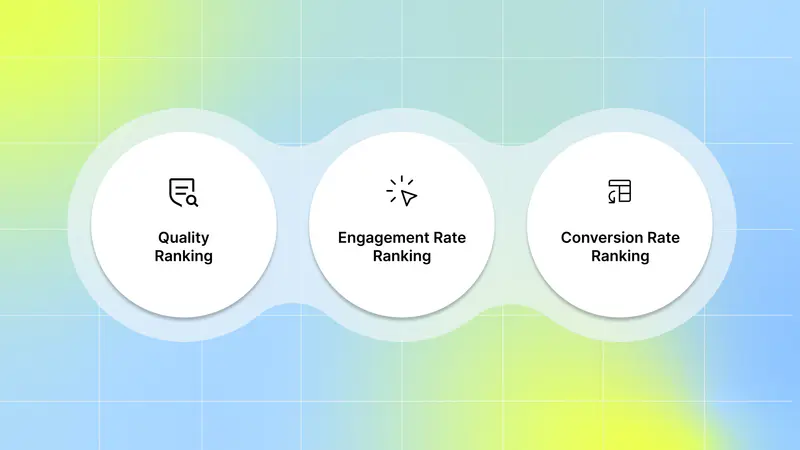
1. Quality Ranking
This compares the overall quality of your ad (visuals, clarity, user feedback) with that of other ads competing for the same audience. Facebook looks at:
Positive signals (watch time, reactions, click-throughs).
Negative signals (people hiding your ad, skipping fast).
User experience issues (clickbait, engagement bait, misleading visuals, broken landing pages).
If users find your ad low-quality or irrelevant, your ranking drops. For you as a UA or performance marketer, this metric tells you if your creative is strong enough to keep your cost per result stable.
2. Engagement Rate Ranking
The engagement rate ranking examines your ad’s expected engagement rate against other ads competing for your audience. Engagement includes:
Watching the video.
Clicking or tapping.
Swiping.
Sharing.
Commenting.
This is a solid metric for assessing how compelling your ad design is to a specific audience and should help you as you seek to fine-tune your targeting efforts.
3. Conversion Rate Ranking
This shows how likely your audience is to install, purchase, or subscribe after seeing your ad. If your ad matches the intent of your audience, you’ll get a higher conversion ranking.
Together, these metrics tell you if your ad is strong enough to win auctions, hold delivery, and drive consistent results across mobile games, DTC brands, and subscription app campaigns.
And while these metrics shape how your ads are scored, their performance heavily depends on the audience you choose to target.
The Importance of Target Audience Selection
Choosing the right audience is one of the fastest ways to improve your Facebook ad relevance score. When your ad reaches users who are genuinely interested in your app, product, or gameplay, Facebook sees stronger engagement and conversion signals. This helps you scale faster, spend less, and keep delivery stable across mobile games, DTC brands, and subscription apps campaigns.
Here are the key areas to focus on when selecting your target audience:
1. Optimal Audience Size Considerations
Larger audiences usually give Facebook more room to learn, optimize, and find people who match your ideal user profile, with a broader pool. The system can identify patterns faster, whether it's finding players who enjoy a certain game genre or shoppers with specific buying behaviors.
Bigger audiences lead to stronger engagement and lower auction pressure, which improves your relevance diagnostics. When Facebook has enough data to match your creative to the right people, you earn better placements, lower CPMs, and higher relevance scores.
2. Warm vs. Cold Audience Targeting Strategies
Warm audiences, like past purchasers or app visitors, already know your brand. They naturally respond better to ads and deliver higher conversion signals. For cold audiences, it's better to start with value-first creatives like strong hooks, social proof, or benefit-led messaging to build interest before pushing for a direct install or purchase.
Targeting warm users improves conversion rate ranking, while smart cold-audience strategies boost engagement ranking. Both help Facebook understand that your ad is relevant, increasing your relevance score and lowering your cost per install or purchase.
3. Audience Segmentation Techniques
Refining your targeting helps you reach the users most likely to take action. For UA marketers, custom audiences let you retarget people who've already shown intent. Lookalike audiences help you find new users who are similar to your best customers or highest-LTV segments. You can also segment by interests, behaviors, or motivations like puzzle fans, beauty shoppers, fitness seekers, or productivity explorers.
Better segmentation improves engagement and conversion signals by reaching people who care about your message. When Facebook sees higher relevance between your audience and your creative, your relevance metrics improve, your CPM goes down, and your campaigns scale with less effort.
Once you know who your ads should reach, the next step is applying the right tactics to strengthen your relevance signals.
Actionable Tactics that actually Work in 2026
Improving your relevance score in 2026 isn’t about random tweaks; it’s about making your ads more aligned with what your audience wants to see. Facebook’s algorithm rewards ads that hold attention and match user intent. If you fix these core areas, delivery will improve naturally without increasing the budget.
Here are the strategies that actually work:
1. Start With a Strong Hook (Optimize the First 3 Seconds)
Your hook decides whether users stop scrolling or skip your ad. A strong hook speaks directly to the player, shopper, or subscriber you’re trying to reach. It can be a bold visual, a quick product benefit, a gameplay moment, or a problem users want solved.
A stronger hook improves your quality ranking because users stay longer, watch more, and engage more. As watch time and interactions increase, your engagement ranking rises. When your hook speaks clearly to the right audience, Facebook sees positive signals early and rewards you with more delivery at lower CPMs, directly boosting your relevance score.
If you want a platform that automatically identifies hook patterns from your top-performing creatives, Segwise does exactly that. Once you integrate your Facebook account, its tag-level creative element mapping reveals insights like: “this hook dialog appears in 80% of top-performing creatives.”
2. Match Your Creative to Audience Intent
Audience intent depends on where users are in their journey. Someone seeing your ad for the first time needs a different message than someone who already installed or added to cart. Matching intent means adjusting visuals, hooks, and messaging to what each user cares about at that moment. This helps you build creatives for prospecting, mid-funnel, and retargeting.
When your creative matches user intent, engagement and conversion signals increase. Facebook sees your ad as more useful for that audience, which lifts your conversion rate ranking. Better relevance between creative and audience means cheaper delivery and a higher relevance score across UA campaigns.
3. Improve Your Storytelling Flow
A good ad tells a clear story, whether you’re showing gameplay, highlighting product benefits, or explaining why your app solves a real problem. This means using clean visuals, simple text, and a fast-moving sequence that keeps users engaged.
Strong storytelling improves both quality and engagement rankings. Users watch longer, swipe up less, and don’t hide your ad as often. These positive signals raise your relevance score and give Facebook confidence that your ad delivers a good experience.
4. Refresh Creatives Before Fatigue Hits
Creative fatigue occurs when the same users repeatedly see the same ad. This increases CPM, lowers CTR, and reduces conversion signals. Refreshing creatives doesn’t require a full rebuild; you can simply swap the hook, opening scene, colors, or angle.
Refreshing early prevents negative signals like fast skips, low watch time, and low engagement. When your creatives stay fresh, your quality and engagement rankings remain high. This helps maintain a strong relevance score and stable delivery across UA campaigns.
You can integrate with tools like Segwise to detect creative fatigue early before it affects your budget allocation or campaign results. With its custom success criteria tracking, you can set clear performance targets for new creatives and monitor how these perform from day one.
5. Use Clear, Benefit-Driven Messaging
Whether you’re selling a skincare product, a puzzle game, or a fitness subscription, users need to understand the value in the first few seconds. Benefit-driven messaging means telling users what they gain, not just what you offer.
When users understand the benefit quickly, they stay longer and click more. This improves engagement rate ranking and conversion rate ranking. Facebook rewards ads that create clear value, which lifts your relevance score and improves delivery.
6. Align Creative With Landing Page Experience
Your landing page must match your ad’s message. If your ad promises a feature, discount, or benefit, the landing page must show it instantly. Any disconnect, slow load, mismatched visuals, or confusing layout hurts your UA funnel.
Facebook tracks post-click behavior. If users bounce or exit quickly, your conversion rate ranking falls. A smooth landing page experience sparks stronger conversion signals, increasing your relevance score and lowering your cost per result.
7. Use High-Intent CTAs Based on Funnel Stage
Not every user responds to “Install Now” or “Shop Now.” High-intent CTAs match where the user is in their journey. Prospecting audiences respond better to curiosity-led CTAs (“Try the challenge,” “See the gameplay”), while retargeting audiences respond better to direct CTAs (“Complete your trial,” “Unlock your offer”).
Matching CTAs to intent improves your engagement and conversion rankings. Users click when the CTA aligns with their mindset, not when it feels forced. This leads to stronger signals for Facebook, which helps your ad earn a higher relevance score.
8. Monitor Feedback and Optimize Continuously
Monitoring performance signals daily helps you understand how users are responding to your ad. This includes reading comment sentiment, checking drops in watch time, and spotting negative feedback patterns.
Continuous monitoring prevents negative signals from building up. If users start hiding your ads, skipping instantly, or leaving negative comments, your quality ranking drops fast. By catching these issues early and improving the creative angle or message, you directly boost your relevance score and stabilize delivery.
9. A/B Test Creatives, Audiences, and Formats
A/B testing helps you discover what your audience truly responds to. You can test different hooks, visuals, CTAs, formats, and even pacing styles. For mobile games, this might mean testing gameplay moments; for DTC brands, different product angles. Testing helps you find the versions that are naturally more engaging.
A/B testing shows you which creative combinations drive the best engagement and conversion signals. When you scale the winning variants, Facebook gets stronger positive signals, higher watch time, higher CTR, and better conversions. These signals boost your engagement and conversion rankings, raising your relevance score and lowering your CPMs over time.
Even with the right strategies in place, certain mistakes can quietly drag down your relevance score and limit your results.
Common Mistakes That Hurt Relevance Score
Many Facebook ads fail not because the product is weak, but because the creative, targeting, or user experience sends the wrong signals to the algorithm. As a UA manager, avoid these mistakes to save money, protect your delivery, and keep your campaigns scalable.
Here are the most common mistakes that lower your relevance score and how to fix them:
Using a Weak or Confusing Hook: A slow or unclear opening makes users scroll past your ad instantly. Start with a strong visual, a clear benefit, or a moment that grabs attention.
Targeting the Wrong Audience: If your ad reaches users who don't care about your product or app, engagement drops and negative signals rise. Target segments that match your ideal player or buyer profile.
Overcomplicating Your Message: Too much text or unclear benefits cause users to lose interest quickly. Keep your message simple, benefit-driven, and easy to understand at a glance.
Ignoring Negative Feedback: Hidden ads, negative comments, and fast skips signal poor quality to Facebook. Monitor comments, remove spam or negativity, and adjust creatives that receive frequent hide/report actions.
Using One CTA for All Audiences: One CTA doesn’t work for every funnel stage.
Use CTAs that align with your audience's intent.
Also Read: The Ultimate Guide to Understanding Different Types of Target Audiences
Conclusion
Improving your Facebook ad relevance score in 2026 comes down to understanding user intent, creating stronger creatives, and targeting the right audience. By using better hooks, clearer messaging, fresher creatives, and smarter segmentation, you help Facebook see your ads as more relevant. This leads to lower CPMs, stronger delivery, and more stable conversions across mobile games, DTC brands, and subscription apps.
If you’re searching for an AI-powered platform that integrates with Facebook to get performance data, Segwise is built for you.
You just need to go to Segwise Dashboard → Settings → Ad Networks → Connect under Meta. From there, sign in, select your Facebook Ad Accounts, and enable them for full creative analysis across your campaigns.
Once integrated, our multi-modal AI creative tagging automatically identifies and tags creative elements such as hook dialogs, characters, colors, and audio components across images, videos, text, and playable ads, revealing their impact on performance metrics such as IPM, CTR, and ROAS. With fatigue detection, you can catch performance decline before it impacts campaign results.
With tag-level creative element mapping, you can instantly see which creative elements, themes, and formats drive results across all your campaigns. Moreover, with data-backed creative iteration, you can make creative decisions based on actual performance data from both ad networks and MMPs to scale winners.
So, why wait? Start your free trial now and see exactly which creative elements drive performance across your Facebook campaigns!
FAQs
1. How do the ad relevance diagnostics impact ad costs and delivery?
Relevance diagnostics influence how often your ad wins in auctions. Higher rankings mean better delivery and lower costs, while below-average rankings often increase CPM and reduce impressions.
2. Can changes in creative format (e.g., video vs image) affect relevance diagnostics?
Yes, video ads and interactive formats can improve engagement signals compared to static images, leading to stronger engagement rate rankings. More engaging formats often hold viewer attention better.
3. Does reducing text in ad images improve relevance score?
Ads with less than 20% text in images often get better reach and relevance because Facebook prefers visuals that aren’t cluttered with heavy text, improving perceived quality and engagement.