
Why do your competitors ads keep scaling while your creatives stop performing after a few weeks?
Segwise is an AI creative-analytics platform that auto-tags your own and competitor ad creatives across 15+ networks and ties each element to performance, so you can read what makes rivals win instead of guessing.
You see their ads across Meta, TikTok, and YouTube, but you don’t know what exactly is making them win. As a creative strategist, if you keep guessing instead of analyzing their creative strategy, you’ll waste budget testing ideas that were never going to scale. Meanwhile, your competitors will keep refining proven creative patterns and capturing the users you were trying to acquire.
This blog will show you how to analyze competitor ads the right way, uncover the creative insights behind their performance, and use those insights to build better creatives, iterate faster, and improve your campaign results with confidence.
Why Analyzing Competitor Ads Matters?
The digital ad space for mobile games, DTC brands, and subscription apps is highly competitive, and every failed creative wastes your budget and slows your campaign growth. When you don’t analyze competitor ads, you miss proven creative patterns your competitors already use to scale profitably.
Here are the key reasons why analyzing competitor ads is critical for improving your creative strategy and campaign performance:
Avoid wasting budget on low-performing creative concepts: When you study competitor ads, you see which hooks, formats, and messaging are already working. This helps you avoid launching creatives that are likely to fail.
Speed up your creative testing and iteration cycle: Instead of starting from scratch, you can build on validated creative ideas. This allows you to launch stronger creative variations faster and scale campaigns more confidently.
Reduce your acquisition costs with stronger creatives: When your creatives align with proven audience triggers, your campaigns perform more efficiently and help you acquire users or customers at a lower cost.
Understand what messaging and creative angles resonate with your audience: Competitor ads reveal which emotions, value propositions, and storytelling approaches drive engagement and conversions.
Identify untapped opportunities to improve your creative strategy: Competitor analysis helps you spot creative patterns and concepts you haven’t tested yet, giving you new directions to strengthen and scale your campaigns.
To turn these benefits into real creative improvements, you need to integrate competitor ad research directly into your creative strategy workflow.
Also Read: Tired of Guessing? Top 10 Competitor Analysis Tools That Deliver Insights in 2025
Where Competitor Ad Research Fits Within Your Creative Strategy
As a creative strategist, competitor ad research is not a one-time activity; it’s part of your ongoing creative workflow. You use competitor insights to inform decisions before launching new creatives, creating briefs, or planning iterations. This ensures your creative strategy is based on real market signals instead of assumptions.
Competitor analysis helps you make better decisions at every stage of creative development, from concept planning to creative iteration and scaling.
You should use competitor ad research when:
Planning new creative concepts based on market patterns.
Creating stronger, data-informed creative briefs.
Launching new creative tests with validated directions.
Refreshing fatigued creatives using new competitor insights.
Scaling winning creatives with proven iteration patterns.
Competitor ad research helps you build creatives with a clear strategic direction, instead of relying on trial and error.
The next step is knowing where to access your competitor's ads.
Where to Find Competitor Ads
You can’t improve your creatives if you don’t know what your competitors are running. The good news is that you don’t need expensive tools to start. Free ad libraries and platform transparency tools let you see the exact creatives your competitors are using for better results.
The key is not just finding competitor ads but identifying patterns in their hooks, formats, and messaging. These platforms give you direct visibility into what is actively being tested and scaled in your category.
Here are the most important places to find competitor ads: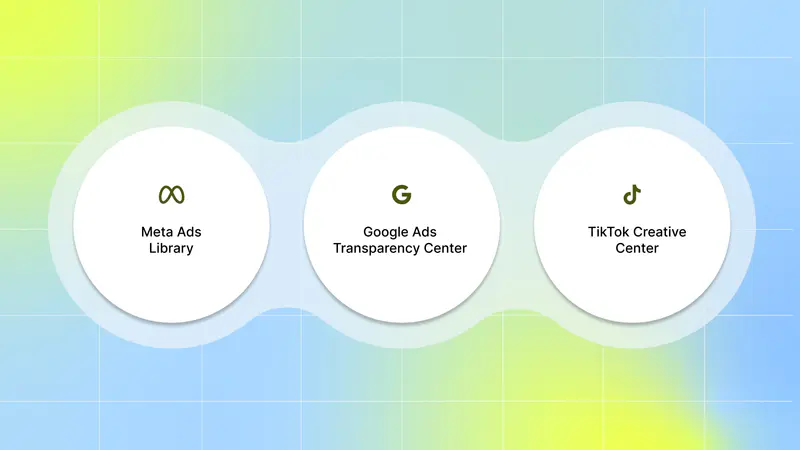
1. Meta Ads Library
Meta Ads Library is one of the most valuable free tools for analyzing competitor ads, especially if you run campaigns for mobile games, DTC brands, or subscription app campaigns on Facebook and Instagram.
You can search for any competitor brand and see all their active ads. This includes video creatives, image ads, ad copy, and different creative variations they are testing.
You can find:
Active video and image ads.
Creative formats like UGC, gameplay videos, product demos, and testimonials.
Ad copy, messaging, and headlines.
Multiple creative variations of the same campaign.
Platform placement (Facebook, Instagram, Messenger, Audience Network).
Ad start date, which helps you identify long-running, high-performing creatives.
This helps you understand which creative concepts your competitors are actively scaling. If a creative has been running for several weeks or months, it’s likely performing well. Competitors rarely keep low-performing creatives live.
2. Google Ads Transparency Center
The Google Ads Transparency Center is a free tool from Google that lets you view competitor ads across YouTube, Google Search, and the Display Network. This helps you analyze videos and display creatives used in acquisition campaigns.
You can find:
YouTube video ad creatives.
Display banner ads and visual creatives.
Ad copy and messaging.
Video storytelling structure and creative format.
Creative positioning and product messaging.
This helps you understand how competitors structure their video and visual creatives across Google’s ecosystem. You can use these insights to improve your video hooks, messaging, and creative formats to build stronger, more competitive campaigns.
3. TikTok Creative Center
TikTok Creative Center helps you discover trending ads and creative formats that are performing well on TikTok. This is especially valuable for mobile games and DTC brands that rely heavily on short-form video creatives.
You can find:
Top-performing ads in your industry.
Competitor video creatives.
Hook styles and storytelling formats.
Trending creative formats and concepts.
Popular creative themes and engagement patterns.
This helps you identify emerging creative trends and build creatives that align with current platform performance patterns.
Note: Find Your Top 3-5 Competitors: Don't try to track everyone. It's too much. Start with your closest rivals who target the same audience.
Finding competitor ads is only the first step. The real value comes from analyzing these creatives closely to understand the patterns and creative decisions that drive their performance.
Also Read: Meta Ads Library vs Segwise Competitor Tracking: Creative Visibility With Performance Intelligence
6 Creative Insights to Extract When Analyzing Competitor Ads
To truly understand why a creative performs, you need to break it down into its core building blocks. High-performing creatives are not random; every hook, visual, script, and transition is intentionally designed to drive better results.
Instead of guessing what makes a competitor creative successful, you should analyze it systematically. By studying competitor ads, you can identify patterns, understand what drives engagement, and apply those learnings to improve your own creative strategy.
Here are the six most important creative insights you should extract when analyzing competitor ads:
1. Creative concept: What is the core idea behind the ad?
The concept is the foundation of any creative. It defines the main message, the problem being addressed, and the value being communicated to the audience. Strong concepts are often repeated across multiple creative variations because they deliver consistent performance.
Identifying competitor concepts helps you understand which creative directions are already validated in your market.
When analyzing competitor ads, try to understand:
What is the main message or idea of the creative?
What problem or pain point is the ad addressing?
What benefit or outcome is being highlighted?
What angle are they using (problem-solution, testimonial, gameplay demo, transformation, etc.)?
These repeated concepts usually indicate strong performance. Use these insights to build creative briefs around proven angles and test improved variations of those concepts.
2. Hook: How do they capture attention in the first few seconds?
The hook is the most critical part of the ad because it determines whether users stop scrolling or ignore the creative. Competitors often test multiple hook variations to find the most effective one.
Understanding competitor hooks helps you build creatives that capture attention faster and improve engagement.
When analyzing the hook, focus on:
What visual appears in the first 3 seconds?
What text or headline is shown first?
What audio or dialog is used to capture attention?
What emotion does the hook create (curiosity, surprise, urgency, relatability)?
After analyzing, build a hook library based on competitor creatives. Test variations of proven hook styles with your own product, messaging, and visuals. Even small changes in hooks can significantly improve creative performance.
But once you create multiple ad variations using the best hooks your competitors are using, how will you know which hooks are actually driving the best performance in your ads? This is where a creative intelligence platform like Segwise comes in.
With tag-level creative element mapping, you can see which specific creative elements drive performance. Also, you can discover patterns like "this hook dialog appears in 80% of our top-performing creatives" with complete MMP attribution integration.
3. Script structure: How is the creative story organized?
High-performing ads follow a clear structure that guides users toward action. This structure is usually built using specific blocks such as problem, solution, demonstration, and call to action.
This helps you understand how competitors build persuasive narratives that drive conversions.
When analyzing competitor ad structure, look for:
How many sections or blocks are in the creative?
What sequence do they follow (problem → solution → demo → CTA)?
How smoothly does the creative move from one section to another?
How do they introduce and reinforce the product value?
Use competitor script structures as a reference when building your own creatives. Instead of creating random scripts, follow proven storytelling flows that guide users toward conversion.
4. Visual strategy: What visual elements make the ad effective?
Visual execution plays a critical role in engagement and performance. Competitors carefully choose visuals that resonate with their audience and communicate value quickly.
These visual elements help you understand which creative styles perform best in your category.
Pay attention to:
Type of visuals used (UGC, gameplay footage, product demo, influencer content).
Camera angles, framing, and presentation style.
Text overlays, captions, and visual emphasis.
Transitions, animations, and editing style.
Platform-native elements like TikTok-style formats or social UI.
Once you identify the visual formats your competitors use most often, test similar formats in your own creatives while improving clarity, storytelling, and differentiation. This allows you to build on proven visual structures while making your creatives more effective and scalable.
5. Creative pacing: How fast or slow does the ad progress?
Pacing affects how easily users can consume and understand the creative. Different audiences and platforms respond to different pacing styles.
Understanding pacing helps you create creatives that align with your audience’s content consumption behavior.
When analyzing pacing, observe:
Speed of visual transitions.
Speed of messaging delivery.
The number of ideas presented in the creative.
Overall flow and rhythm.
Match your creative pacing with your target audience and platform. For example, fast pacing works well on TikTok, while slightly slower pacing may work better for YouTube or Meta video ads.
6. Creative congruency: Does the ad align with the landing experience?
Creative performance doesn’t depend on the ad alone; it also depends on how well the ad connects with the landing page or app experience. Strong congruency improves trust and conversion rates.
This helps you understand how competitors create a seamless user journey from ad to conversion.
When analyzing competitor ads, check:
Where the ad directs users (landing page, product page, app store page).
Whether the messaging in the ad matches the landing page.
Whether the landing page reinforces the creative’s value proposition.
What features or benefits are emphasized after the click?
When creating your strategy, ensure your creatives closely align with your landing page or app store experience. Consistent messaging improves user confidence and increases conversion rates.
By analyzing competitor ads through these six insights, you move beyond surface-level inspiration and uncover the creative patterns that actually drive performance. As a creative strategist, this helps you build stronger creative briefs, develop better concepts, and build a strategy with a higher probability of scaling.
Also Read: Emerging Trends in Creative Strategy: What’s Shaping the Future of Advertising?
Conclusion
Analyzing competitor ads is one of the most effective ways to improve your creative strategy and build ads that scale. Instead of relying on guesswork, you can break down competitor creatives into core elements like concept, hook, script structure, visuals, pacing, and congruency. These insights help you understand what messaging resonates with your audience, which creative formats perform best, and how competitors structure high-performing creatives.
However, once you identify winning patterns from competitor ads, how do you know which of your own creative variations actually perform best? Competitor analysis gives you direction, but you still need visibility into which hooks, visuals, and messaging drive the highest ROAS and conversions in the creatives you build based on those insights. This is where a creative intelligence platform like Segwise helps.
With tag-level creative element mapping, you can see which specific creative elements drive performance. You can discover patterns like "this hook appears in 80% of top-performing creatives" with complete MMP attribution integration. With AI-powered creative tagging, Segwise automatically identifies and tags creative elements like hook dialogs, characters, colors, and audio components across images, videos, text, and playable ads to reveal their impact on performance metrics like IPM, CTR, and ROAS.
This allows you to identify which creative variations are truly driving results, iterate faster on winning patterns, and make data-backed creative decisions with confidence.
So, why wait? Start your free trial to identify your top-performing creatives and scale your campaigns with confidence!