
Are your paid social ads getting clicks but not turning into revenue?
You’re launching new videos, testing fresh hooks, and increasing budgets, yet ROAS stays unpredictable, and your best ads stop working just when you try to scale. CPMs keep rising, creative fatigue hits faster than expected, and every “winner” feels temporary. If you don’t understand why an ad performed well or when it’s starting to decline, your paid ad performance can drop suddenly with just one bad week.
This blog breaks down how winning DTC brands run paid social campaigns, from practical tips to realistic benchmarks. So you can acquire users more efficiently, spot creative fatigue early, and scale campaigns with confidence rather than gut feel.
Why Paid Ads are Essential for DTC Brands
Paid ads for DTC brands are paid campaigns run on platforms like Meta, TikTok, and Google to acquire new customers at scale. These ads are not just about traffic; they are about acquiring quality users who convert and generate revenue.
Here are the key reasons paid ads are essential for DTC brands: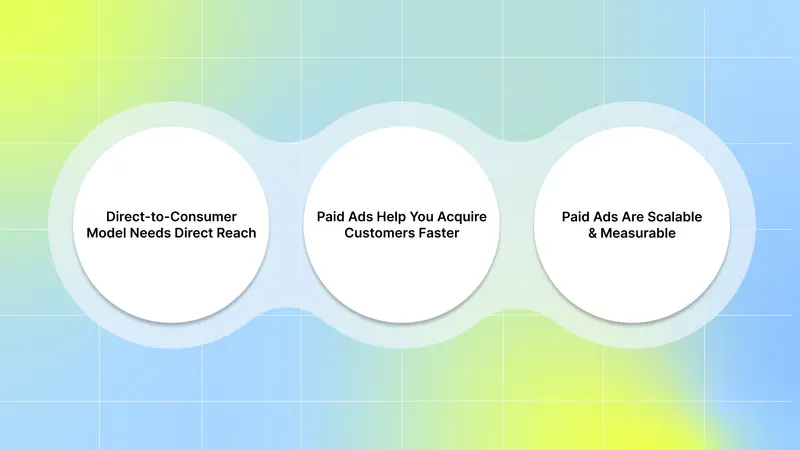
1. Direct-to-Consumer Model Needs Direct Reach
As a DTC brand, you don’t sell through marketplaces or retailers. You grow only when you can reach your future customers directly and convince them to buy from you. Paid ads make that possible by putting your brand in front of highly targeted audiences across social and search platforms.
With paid video ads, you can reach users based on interests, behaviors, and intent without waiting for them to find you organically.
For example, if you run a skincare brand, you can use paid Instagram or TikTok ads to target users interested in clean beauty or eco-friendly products. You’re not just driving awareness, you’re building a direct relationship with potential customers from the first touchpoint.
2. Paid Ads Help You Acquire Customers Faster
Organic channels like SEO or content are important, but they take time to show results. Paid ads fill this gap by helping you reach the right audience almost instantly. As soon as your campaign goes live, your ads can start driving traffic, installs, and purchases.
This speed matters a lot for user acquisition. If you’re launching a new product, running a seasonal sale, or testing a new offer, paid ads let you validate demand quickly. You don’t have to wait weeks or months to see if something works.
For example, a DTC apparel brand can use Google Shopping or Meta video ads to show a new collection to users already searching for similar products. This shortens the path from discovery to purchase and helps you convert users faster.
3. Paid Ads Are Scalable and Measurable
Paid ads give you control. You can increase spending on campaigns that acquire customers efficiently and pull back when performance drops. This flexibility is critical for DTC brands that need to grow without overspending.
Just as important, paid ads are measurable. You can track metrics such as ROAS, CPA, and conversion rates to understand how effectively your campaigns are acquiring users. These data enable a brand to refine its strategies, ensuring that campaigns remain cost-effective and drive maximum impact.
Once you understand why paid ads matter for DTC growth, the next challenge is choosing the right platforms to run them effectively.
Platforms That Matter for Paid Ads in DTC Brands
For paid campaigns in DTC brands, you need to be where your customers already spend time and where ad tools help you efficiently scale user acquisition. The platforms below offer strong reach, conversion-friendly formats, and automation that support growth across the funnel.
Here are the platforms that matter most for paid ads in DTC brands:
1. Google Ads
Best for: High-intent conversions (Search, Shopping, YouTube)
Google Ads works best when you want to capture users who already show buying intent. As a DTC brand, this is where you convert existing demand instead of creating it from zero.
You can run YouTube video ads across in-stream and in-feed placements, or use Performance Max campaigns that automatically optimize across Search, Shopping, Display, YouTube, and Discover to drive purchases. Smart bidding and audience signals help you reach users more likely to convert.
2. Meta Ads
Best for: Broad prospecting and retargeting (Facebook, Instagram)
Meta Ads remain a core acquisition channel for DTC brands running paid ads. Facebook and Instagram give you massive scale with strong control over targeting based on interests, behaviors, and shopping activity.
You can run ads across feeds, Stories, and Reels, all built for mobile consumption. Advantage+ campaigns use automation to test creatives, placements, and audiences together and focus on finding high-value buyers at scale.
3. TikTok Ads
Best for: UGC/Native Video & Impulse Buys
TikTok’s short-form video format drives strong engagement, especially with creative that feels native to the feed. Tools like the creative center help you see trends and top-performing concepts.
You can use automated creative optimization and Smart Bidding to serve the best-performing combinations. TikTok’s interest, lookalike, and custom audiences support reaching both prospects and repeat buyers.
Once you’re on the right platforms, success depends on creating ads that feel native and drive users to take action.
Also Read: How Marketers Use Google Ads Transparency for Creative Wins
How to Roll Out Platform-Native Ads That Convert for DTC Brands
To roll out platform-native ads that convert, you need to match your creative, message, and objective to how users actually behave on each platform. Winning DTC teams don’t reuse the same ad everywhere; they adapt formats, hooks, and campaigns to each channel so their ads feel native and drive efficient user acquisition.
Here are the steps to consistently roll out high-converting paid video ads across platforms:
1. Define Your Target Audience
Every high-performing paid ad starts with clarity on who you’re trying to acquire. You need to know your target user’s age group, interests, behaviors, and main pain points. This helps you shape your creative, messaging, and offer around problems they actually care about.
Start by analyzing your existing customer data to see who converts best. Look at demographics, purchase behavior, and repeat buyers. If you’re entering a new market, define who your product is not for. Even ruling out the wrong audience helps you avoid wasted spend and focus your user acquisition efforts on the right users.
2. Choose the Right Campaign Objective and Platform
Before launching ads, be clear about what you want to achieve. If your goal is to drive purchases, use conversion or sales objectives. These campaigns are designed to find users who are more likely to buy, not just click.
Cheaper objectives like link clicks or add-to-cart may look good on the surface, but they often attract low-intent users. For most DTC brands focused on user acquisition and revenue, sales-focused objectives deliver better long-term results.
3. Choose the Right Platform
Once you’re clear on your audience and campaign goal, choose platforms based on where your target users already spend time and how they discover products.
If you’re targeting Gen Z or discovery-driven users, TikTok is often a strong fit.
If you’re targeting a broader or slightly older audience, Meta tends to perform better.
If you’re targeting high-intent users who are actively searching to buy, Google works best.
Choosing the right platform ensures your ads reach the right users at the right stage of the acquisition journey.
4. Use Platform-Specific Ad Formats and Features
Each platform rewards different creative styles. Ads that perform well on one platform often fail on another because they don’t feel native to the user experience.
Meta (Facebook & Instagram): Use video ads, reels, carousels, and collection ads to showcase multiple products, variants, or benefits in one experience.
TikTok: Focus on short, fast-paced vertical videos that feel organic in the feed. Creator-style content, UGC, and direct product storytelling usually perform better than polished brand ads.
Google (YouTube & Shopping): YouTube video ads are useful for product education, while Shopping ads help capture high-intent users by showing product images, prices, and reviews directly in search results.
Using the right format on each platform helps your ads blend in naturally, capture attention faster, and convert users more efficiently.
5. Study Competitor Ad Concepts, Creatives, and Copy
The best way to get your ad noticed is to study what your competitors are doing and use it as inspiration. Here, you'll want to pay attention to the following:
Ad Concepts: Look at the overall concept behind their ads. Are they pushing product benefits, seasonal offers, or lifestyle outcomes? Try to understand the main idea they’re selling.
Ad Creatives: Next, analyze their creatives. Notice whether they use product demos, lifestyle shots, or user-generated content. Pay attention to colors, pacing, and video length. This helps you see what visual styles resonate with your audience.
Copy and Hooks: Finally, study their hooks and copy. Look at how they grab attention in the first few seconds. Are they asking questions, calling out problems, or making bold claims?
Use these insights to improve your own ads, not copy them directly.
6. Test and Optimize Your Ads Regularly
Once your ads are live, your job isn’t done. You need to monitor performance and optimize continuously. Track key metrics like click-through rate, conversion rate, and cost per acquisition to understand what’s working.
Over time, build a testing loop. Launch new creatives, analyze results, and apply what you learn to future campaigns. This ongoing process enables DTC brands to improve user acquisition and scale paid ads with confidence.
Platform-native execution sets the stage, but consistent results come from following a proven creative structure.
Also Read: The Ultimate Guide to Understanding Different Types of Target Audiences
A Proven Creative Framework for Winning Paid Ads in DTC
Winning paid ads for DTC brands follow a clear creative structure. While formats differ by platform, high-performing ads consistently use the same core elements to capture attention and drive user acquisition.
Here’s the creative element stack that drives DTC performance:
Hook (First 3 Seconds): Grab attention immediately by calling out a problem, outcome, or curiosity trigger that stops the scroll.
Core Value Proposition: Clearly show what your product does and why it matters to the user. Avoid vague branding, focus on a specific benefit.
Proof Mechanism: Build trust using UGC, product demos, testimonials, or before-and-after visuals that show the product in action.
Offer Framing: Explain why now. This could be a limited-time offer, free shipping, bundle, or risk reversal.
CTA & Urgency: Tell users exactly what to do next and give them a reason to act immediately.
When you test and optimize these elements individually, you stop guessing and start building repeatable paid ad wins.
After building the right creatives, you need clear benchmarks to evaluate success.
Benchmarks That Define DTC Brand Success
Benchmarks help you understand whether your campaigns are actually working or just consuming budget. For DTC brands running paid ads, benchmarks give you a reality check on acquisition efficiency and help you spot problems before performance drops.
Here are the key benchmarks to measure success:
Cost per Click (CPC): A CPC typically falls between $0.50 and $2.00. Higher CPCs can be acceptable if the users you acquire convert and generate strong revenue.
Click-Through Rate (CTR): A 1% CTR or higher is a common baseline. If your CTR is consistently below this, your hooks, creative, or messaging may not be resonating with your audience.
Cost per Action (CPA): CPA varies widely by category. On average, around $18.68, though some verticals perform as low as $7.85 or as high as $55.21. What matters most is whether your CPA aligns with your margins and LTV.
Conversion Rate: A strong conversion rate is usually 9.21% or higher. Lower rates can point to weak landing pages, mismatched messaging, or low-intent traffic.
Return on Ad Spend (ROAS): Aim for a 4:1 ROAS, meaning you earn $4 in revenue for every $1 spent on ads.
These benchmarks are a starting point, not a finish line. Performance can vary based on industry, audience, and campaign goals. The most important step is tracking your own data over time and understanding which ads, creatives, and users drive sustainable growth for your brand.
Even when benchmarks are clear, many DTC teams struggle to turn those numbers into consistent wins.
Why Paid Ad Testing Fails for Most DTC Brands
Most DTC paid ad testing fails because teams launch too many ads without a clear testing plan. When performance drops, decisions are made on gut feel instead of data, leading to wasted spend and slow learning.
Here are the main reasons paid ad testing breaks down:
Testing Too Many Ideas at Once: Testing multiple concepts, hooks, and formats together makes it hard to know what actually worked. Data gets mixed, learning slows, and repeatable winners are hard to find.
Killing Ads Without Knowing What Failed: Ads are often paused as soon as results drop without understanding whether the hook, visual, or message caused the decline. This leads to repeated mistakes and poor acquisition efficiency.
Letting Creative Fatigue Drain Budget: Creative fatigue shows up gradually, but many teams react only after CPA or ROAS worsens. By then, the budget has already been wasted.
Reporting Numbers Without Creative Insight: Metrics like CTR and ROAS show what happened, not why. Without creative insight, teams don’t know what to fix or scale, making paid ad testing harder to improve.
Fixing these issues helps you learn faster, scale smarter, and drive more consistent DTC growth. This is where Segwise helps DTC teams to fill the gap. It's a creative analyticsplatform that connects creative elements (hooks, dialogs, visuals, formats, etc.) directly to business outcomes (ROAS, CPA/CPI, LTV, IPM, conversion rates), so teams stop guessing what works and start scaling creatives with data-backed insights.
Tips DTC Teams Should Follow for Winning Paid Ad Success
Winning paid ads for DTC brands come from clear creative decisions, not guesswork. When you understand what parts of your ads drive user acquisition and act on that data, you can scale faster, waste less budget, and keep performance stable as spend grows.
Here are the key tips DTC teams should follow to win with paid ads:
1. Break Creatives Into Elements
Instead of treating each ad as one unit, break it into individual elements. Look at hooks, visuals, product angles, messaging, offers, and CTAs separately. This helps you understand what inside the ad is driving users to click and convert, rather than assuming the entire creative is good or bad.
2. Track Performance at the Element Level
Ad-level metrics only tell part of the story. You need to see how each creative element impacts performance metrics like ROAS and CPA. When you track performance at the element level, you can identify which hooks, messages, or formats consistently acquire better users. This turns creative testing into a repeatable system instead of trial and error.
Platforms like Segwise help DTC teams do this at scale. With our tag-level creative element mapping, you can see which specific creative elements drive performance. You can also discover patterns like "this hook dialog appears in 80% of top-performing creatives".
3. Refresh Only What’s Failing
When performance drops, don’t rebuild everything from scratch. Replace only the elements that are underperforming. For example, keep the same product angle but test a new hook or visual. This saves time, speeds up iteration, and keeps your paid ads learning instead of resetting.
4. Reuse Winning Patterns Across Launches
Once you find elements that work, reuse them. Apply proven hooks, messaging styles, and creative formats to new products, campaigns, and launches. Reusing winning patterns helps you launch faster, reduce risk, and improve user acquisition performance across all future campaigns.
5. Spot Creative Fatigue Early
Creative fatigue usually shows up gradually. If you monitor performance closely, you can catch fatigue early and act before it hurts your acquisition goals. Early signals help you protect your budget and maintain stable growth.
With Segwise fatigue tracking, you can catch fatigue before it impacts your budget allocation and campaign results. You can also set custom fatigue criteria and monitor creative performance across Facebook, Google, TikTok, and 10+ ad networks, to catch fatigue before it impacts your ROAS.
Following these tips helps you move from random testing to a structured paid ad system that scales with confidence.
Conclusion
Winning paid social campaigns for DTC brands isn’t about spending more or launching endless creatives. It’s about choosing the right platforms, using platform-native formats, testing with intent, and tracking performance against clear benchmarks. When you understand what drives user acquisition and spot creative fatigue early, you can scale confidently instead of reacting after performance drops.
If you’re still struggling to understand why some ads scale while others fail, Segwise can help.
Segwise is an AI-powered creative analytics platform that helps UA and performance marketing teams understand which creative elements drive performance. Our fatigue tracking catches fatigue before it impacts your budget allocation and campaign results.
Our powerful, multi-modal AI creative tagging automatically identifies and tags creative elements like hook dialogs, characters, colors, and audio components across images, videos, text, and playable ads to reveal their impact on performance metrics like IPM, CTR, and ROAS. With AI creative generation, you can create multiple new ad creative variations with a click of a button, using your proven winning creative elements like hooks, CTAs, visual style,s etc., that actually drive ROAS and conversions.
Moreover, with creative analytics, you don't need to jump between Facebook Ads Manager, Google Ads, TikTok, and your MMP dashboard. See creative-level ROAS, CPA, LTV, and conversion rates from all sources in one unified view. You can instantly see which creative elements, themes, and formats drive results across all your campaigns and apps with tag-level performance optimization.
So, why wait? Start your free trial to get clear creative insights, protect your ad budget, and build your brand campaigns that grow with confidence!