
Key Takeaways
Testing Shift: Facebook creative testing in 2026 is no longer about picking winning ads; it’s about reducing risk, controlling CPAs, and building a repeatable user acquisition system.
A/B Limits: Traditional A/B testing breaks down at scale because Facebook doesn’t deliver evenly, creative volume is high, and ad-level wins don’t explain why performance changes.
Fair Framework: The 3-phase framework (new vs new, new vs best performing, and controlled scaling) helps you test creatives fairly and scale without wasting budget.
Advance Tactics: Advanced tactics like the 3-3-3 framework, first-3-seconds rule, and AOV-based budgeting reduce noise, improve signal quality, and prevent false creative testing decisions at scale.
Hidden Gaps: Facebook testing alone can’t explain creative drivers, account for audience overlap, or warn you before fatigue sets in, leaving UA teams reactive rather than prepared.
Smarter Scale: Advanced UA teams close this gap by pairing creative testing with an AI-powered platform like Segwise, turning creative insights into confident scaling decisions instead of guesswork.
Are you testing dozens of Facebook ads every week but still can’t clearly explain why some creatives work and others fail?
In 2026, Facebook creative testing is more expensive and more competitive than before. Signals fade faster, winning ads burn out quicker, and a single wrong testing decision can quietly drain weeks of UA budget before you even notice. The result is rising CPAs, unstable performance, and creative fatigue killing your best campaigns early.
If you run user acquisition for mobile games, DTC brands, or subscription app campaigns, this guide is for you. This blog will explore how to approach Facebook creative testing in 2026 with clarity and confidence.
Why is Facebook Creative Testing Important?
Facebook creative testing is the process of systematically testing ad creatives to determine which drive the best user acquisition results. Instead of guessing which ad will work, you test variations with a clear structure.
Here are the key reasons why Facebook creative testing is critical for user acquisition teams today:
Testing helps you identify why a creative works, so you can replicate winning elements across new ads instead of relying on luck.
For mobile games, DTC video ads, and subscription apps, winning creatives fatigue quickly. Testing helps you stay ahead before performance drops.
Without structured testing, poor creatives quietly increase CPAs and burn budget. Testing protects spend by surfacing losers early.
Bidding and targeting matter, but creative quality determines scale. Testing turns creative into a controllable growth lever.
If you manage multiple client accounts, creative testing provides clear data to support decisions, justify results, and retain clients.
When done right, Facebook creative testing turns user acquisition from reactive guesswork into a repeatable, scalable growth system.
As competition increases and creative volume grows, many UA teams find that their traditional testing methods no longer hold up.
Also Read: Creative Testing Strategies for Mobile UA Campaigns in 2025
Why Traditional A/B Testing Doesn’t Always Work
Traditional A/B testing assumes you change one variable at a time and wait for clear winners. In Facebook user acquisition today, that assumption often breaks. Creative volume is high, delivery is algorithm-driven, and performance shifts faster than most tests can reach clean conclusions.
Here are the main reasons traditional A/B testing falls short for Facebook creative testing in 2026: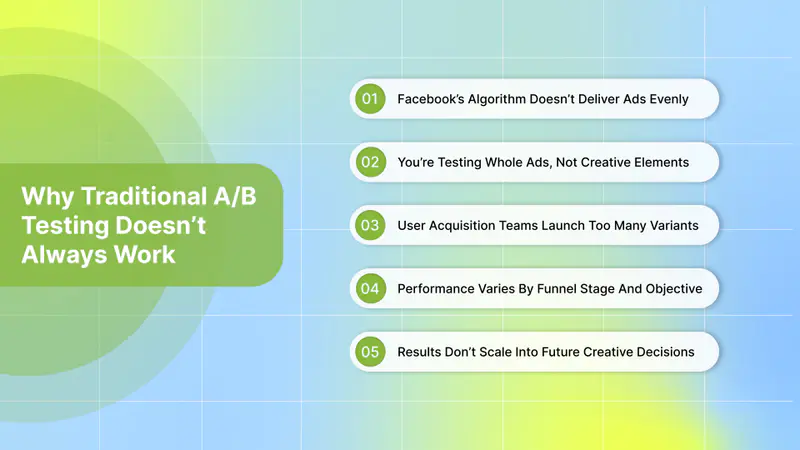
Facebook’s algorithm doesn’t deliver ads evenly: Your ads don’t get equal spend or exposure, which makes clean A/B comparisons unreliable for real-world UA decisions.
You’re testing whole ads, not creative elements: A/B testing tells you which ad won, but not why it won. You don’t learn whether the hook, visual, message, or format drove results.
User acquisition teams launch too many variants at once: Mobile games, DTC brands, and agencies often test dozens of creatives weekly, making one-by-one A/B testing slow and impractical.
Performance varies by funnel stage and objective: A creative that works for clicks may fail for purchases or subscriptions, but A/B tests rarely account for this nuance.
Results don’t scale into future creative decisions: Traditional A/B testing produces isolated winners, not reusable insights you can apply to your next creative batch.
For modern UA teams, Facebook creative testing needs to move beyond simple A/B tests and focus on learning patterns that scale, not just picking short-term winners.
This is why modern Facebook creative testing requires a structured, repeatable framework.
The 3-Phase Testing Framework That Delivers Results
Winning Facebook creative testing in 2026 is not about launching ads randomly and hoping for a winner. It’s about following a clear, repeatable process that helps you find strong creatives, validate them against what’s already working, and scale them without wasting UA budget.
Here are the three phases of a proven creative testing framework that teams use to get consistent results:
Phase 1: Pre-Flight Testing: Which New Creative Is the Best?
One of the biggest mistakes advertisers or UA teams make is testing new creatives directly against old, proven ads. Older creatives already have delivery history, learning signals, and optimization advantages, which makes the comparison unfair from the start.
To get clean results, always test new creatives against other new creatives only. This helps you identify the strongest concept before moving forward.
Here are five common ways to run pre-flight testing effectively:
Scenario 1: ASC+ Campaign
Create an ASC+ campaign with all your creatives, where Meta automatically distributes spend across them. The algorithm quickly pushes the budget toward creatives that show early signs of performance.
You get fast, directional feedback on which creatives Meta prefers and which fail to gain traction. You gain speed and efficiency, but you sacrifice precision and insight into why a creative worked.
Accuracy: ★
Cost-Efficiency: ★★★
Best for: Smaller accounts that need simple testing and strong budget protection.
Scenario 2: CBO Campaign
Run a CBO campaign with each ad set containing 1 creative. Meta controls how the budget is distributed across ad sets based on early performance signals. You see which creatives attract spend and which get deprioritized by the algorithm. Uneven budget allocation can make fair comparisons difficult, especially early in the test.
Accuracy: ★
Cost-Efficiency: ★★★
Best for: Smaller accounts focused on efficiency over precision.
Scenario 3: ABO (Non-CBO) Campaign
Create an ABO campaign with each ad set containing 1 creative concept (+variants). Each creative concept runs in its own ad set with a fixed budget, giving every concept equal opportunity to perform. You get clearer comparisons between creative concepts because spend is evenly controlled. This approach reduces algorithm bias and speeds up learning.
Accuracy: ★★
Cost-Efficiency: ★★
Best for: Medium-sized accounts that want faster learning and better control.
Scenario 4: CBO + Variants
Run a CBO campaign with each ad set containing 1 creative concept (+variants). Each ad set represents a creative concept with multiple variants inside it, while Meta controls the budget across ad sets. You see which concepts Meta favors and which variants within a concept perform best. Meta may over-allocate budget to one ad set, starving others before they fully prove themselves.
Accuracy: ★
Cost-Efficiency: ★★★
Best for: Medium-sized accounts. Use spend rules to prevent one ad set from overspending.
Scenario 5: Cost Cap (Advanced)
Create 1 ABO campaign with 1 ad set for each concept and use "cost cap". Creatives compete under strict cost constraints, forcing Meta to deliver only when performance meets efficiency targets. You identify which creatives can sustain performance without inflating CPAs. This produces the cleanest signal and the highest confidence decisions.
Accuracy: ★★★
Cost-Efficiency: ★★★
Best for: Large accounts spending $500K+ per month and testing high creative volume.
Phase 2: New vs BAU Testing: Is the New Creative Actually Better?
Once you’ve identified your strongest new creative in pre-flight testing, it’s time for the real challenge. Now you need to answer one critical question: Is this new creative actually outperforming the best current ad?
This phase compares your new creative against your current best-performing (BAU) ad. It’s often where teams feel stuck because older ads benefit from historical data, stable delivery, and algorithmic trust. For a new creative to earn scale, it must either outperform your existing winner or deliver similar results with better long-term potential.
Here are three common ways to run this comparison effectively:
Scenario 1: CBO Campaign
You run a CBO campaign with two ad sets: one containing your existing winning creative and one containing the new creative. Meta controls budget distribution based on performance signals, allowing you to quickly see whether the new creative can compete with the established winner.
This approach gives you fast, directional insight into whether the new creative deserves more attention, but uneven budget allocation can limit precision.
Accuracy: ★
Cost-Efficiency: ★★★
Best for: Efficient testing with limited budgets.
Scenario 2: ABO Campaign
You run an ABO campaign with two ad sets, each containing one creative (plus variants). One ad set contains the existing winner, and the other contains the new creative (with optional variants). Because spend is controlled, both creatives get a fair chance to perform.
This setup produces cleaner comparisons and helps you judge whether the new creative can truly match or beat your current best performer.
Accuracy: ★★
Cost-Efficiency: ★★
Best for: Medium-budget accounts seeking balance.
Scenario 3: Cost Cap (Advanced)
Run one ad set with one old and one new creative using cost cap. Both the new and old creatives compete under the same cost cap, forcing Meta to deliver impressions only when performance meets your efficiency target. This removes most algorithm bias and highlights which creative can perform under real scaling conditions.
If a new creative succeeds here, it’s a strong signal that it can replace or scale alongside your current winner without increasing CPAs.
Accuracy: ★★★
Cost-Efficiency: ★★★
Best for: Big accounts testing high volumes of creative and spending over $500K/month on Facebook ads.
Phase 3: Scaling Phase: Maximize the Impact of Winning Creatives
Once your new creative proves it can outperform or consistently match your existing winners, the testing phase is over. This is where Facebook creative testing turns into real user acquisition growth.
This phase is about scaling with control, not rushing changes that break performance. The goal is to increase spend while keeping CPAs stable and momentum strong.
Here’s how to scale winning creatives the right way:
Start scaling immediately after validation: Once performance is confirmed in Phase 2, don’t wait. Delaying scale often means missing the short window when a creative is fresh and efficient.
Use new creatives to refresh fatigued ad sets: Introduce the winning creative into ad sets where performance is declining. This helps recover efficiency without rebuilding campaigns from scratch.
Keep old winners running alongside new ones: Don’t pause your existing top creatives right away. Running old and new winners together stabilizes delivery and reduces performance volatility.
Give CBO and ASC+ campaigns time to rebalance: When you add new creatives, these campaigns may need a short adjustment period. Avoid making rapid changes that reset learning and hurt results.
Scale budget while protecting efficiency: Increase spend in controlled steps and monitor CPAs closely. The goal is to maximize performance quickly for the best overall results.
When done correctly, Phase 3 turns creative testing into a repeatable growth engine, helping you scale user acquisition quickly while staying ahead of fatigue and rising costs.
Once this framework is in place, advanced tactics help teams sharpen signals, reduce wasted spend, and make creative testing work consistently at scale.
Advanced Tactics to Improve Facebook Creative Testing
Once you have a solid testing framework in place, advanced UA teams use a small set of tactical principles to reduce noise, improve signal quality, and avoid false decisions during creative testing at scale.
Here are three advanced strategies top UA teams use in 2026:
1. The 3-3-3 Framework for Structured Creative Exploration
When you test a high volume of creatives, unstructured testing leads to confusing results. The 3-3-3 framework brings order by ensuring you test meaningfully different ideas, not small variations.
You structure your tests across:
3 funnel or intent stages (for example: awareness, consideration, conversion)
3 creative angles or messages (problem-led, benefit-led, social proof)
3 creative formats (UGC video, polished video, static)
This creates intentional creative diversity and gives Facebook’s algorithm clearer signals. Instead of flooding campaigns with similar ads, you generate insights faster and identify strong concepts earlier, especially useful for mobile games, DTC brands, and agencies managing multiple accounts.
2. The First 3 Seconds Rule: Why Visual Hooks Decide Test Results
In Facebook creative testing, the first 3 seconds determine whether a creative gets meaningful delivery or fails early. Ads that don’t stop the scroll immediately rarely recover, which skews test results before the algorithm can learn.
For clean creative tests, the first 3 seconds should include four distinct signals: a visual hook, a text overlay hook, an audio cue (for video), and a clear vibe or emotion. When these signals are distinct, Meta can better differentiate creatives during delivery, leading to more reliable testing outcomes. Without a strong first-3-second hook, creatives often fail tests due to poor early delivery rather than poor concept quality.
3. The Rule of AOV: Spend Enough to Get Reliable Test Results
Your average order value (AOV) should guide how much you spend during creative testing to generate meaningful data. Most Facebook creative tests need 30–50 conversions per variant to separate true winners from statistical noise, which means allocating at least your AOV in spend per concept so the algorithm has enough budget to find the right audience.
When you underspend, you create false negatives. Creatives that could perform well at scale never get enough distribution to prove themselves, while average ads survive simply because they got lucky early, leading to poor testing and scaling decisions.
Even with strong frameworks and advanced tactics, Facebook creative testing still has blind spots that limit how much teams can learn from test results alone.
Also Read: Facebook Ad Bidding Strategies That Improve Campaign ROI
What Facebook Creative Testing Still Can’t Tell You
Facebook creative testing can show you which ad performs better in a controlled test, but it stops there. It doesn’t explain why a creative worked, how long it will keep working, or what to do next as performance starts to change.
Here are the key limitations of Facebook creative testing:
It doesn’t tell you why a creative won: You can see which ad performed better, but not which creative elements, such as the hook, visual, message, or format, actually drove the result.
It doesn’t account for audience overlap and delivery bias: Test ads often compete for the same users. Audience overlap and uneven delivery can skew results, making one creative appear stronger simply because it reached a different audience segment.
It doesn’t warn you before creative fatigue hits: A creative can win a test and still start declining soon after. Facebook creative testing doesn’t surface early fatigue signals, so performance drops before you have time to react.
To solve these limitations, advanced UA teams extend creative testing with deeper analytics.
How Advanced UA Teams Close the Gap
Advanced UA teams don’t rely on Facebook creative testing alone. They understand that testing only shows what worked at a specific moment, it doesn’t explain why it worked, how long it will keep working, or what creative to build next. To close this gap, they pair creative testing with an AI-powered creative analytics platform like Segwise, which connects creative decisions directly to real user acquisition outcomes.
Here’s how advanced teams use Segwise for Facebook creative success:
No code integration with Facebook Ads: With no-code integration, you can start analyzing creative performance without any engineering work. To set it up, go to the Segwise Dashboard → Settings → Ad Networks, click Connect under Meta Ads, sign in, and select your Ads account for full creative analysis.
Tag-Level Creative Element Mapping: Instead of guessing, you can see exactly which hooks, dialogs, visuals, or formats drive results. For example, you might discover that a specific hook appears in 80% of your top-performing creatives backed with complete MMP attribution integration.
Creative Tagging: Our powerful, multi-modal AI automatically identifies and tags creative elements like hook, characters, colors, and audio components across images, videos, text, and playable ads to reveal their impact on performance metrics like IPM, CTR, and ROAS.
Fatigue Detection: You cancatch performance decline before it impacts budget allocation and campaign results. You can also set custom fatigue criteria and monitor creative performance across Facebook and all major ad networks, to catch fatigue before it impacts your ROAS.
In short, by combining Facebook creative testing with an AI-powered platform like Segwise’s, you can scale what works, refresh creatives before fatigue hits, and make confident user acquisition decisions backed by real performance data.
Conclusion
Facebook creative testing in 2026 is no longer about launching more ads and hoping one sticks. As competition increases and signals fade faster, you need a structured approach that helps you test ideas fairly, validate them against proven winners, and scale without breaking performance. By following a clear three-phase framework, you can turn creative testing into a repeatable user-acquisition system rather than reactive guesswork.
To make this process truly effective, advanced UA teams go one step further by using AI-powered platforms like Segwise.
Segwise is an AI-powered creative analytics and generation platform that helps UA and performance marketing teams by directly integrating with your Facebook ads. It helps you understand why creatives work with creative tagging and detects fatigue early across Facebook and other ad networks. This allows you to move beyond ad-level results and build scalable creative strategies backed by real data.
It connects creative elements (hooks, visuals, formats, etc.) directly to business outcomes (ROAS, CPA/CPI, LTV, IPM, conversion rates), so teams stop guessing what works and start scaling creatives with data-backed confidence. With tag-level performance optimization, you can instantly see which creative elements, themes, and formats drive results across all your campaigns and apps.
If you want to scale Facebook creative testing with more clarity and confidence, start your free trial to protect your budgets, beat fatigue, and drive more users.