
Did you know that in 2024, 87% of all search engine results considered UGC (User-Generated Content) the second most influential purchase driver?
Yet many DTC growth teams still struggle to build scalable UGC workflows on Facebook and TikTok. You might be juggling hundreds of creatives, relying on influencers to “just talk about the product,” or hoping that random testimonials will hit the mark. But without a proper script, it’s all guesswork, and guesswork kills performance when you need precision to drive results.
This blog breaks down exactly how fast-growing DTC brands are using structured, repeatable UGC scripts to turn casual scrollers into new customers.
What is a UGC script?
A UGC (User-Generated Content) script is a short, structured set of instructions that guides creators or influencers in producing ad content that looks and feels like a real user sharing their personal experience, not a polished brand commercial. It typically includes specific hooks, key dialog lines, visual directions, and a strong call to action (e.g., “Shop now” or “Download the app”).
Whether you're running a Facebook ad in the feed or stories, or a TikTok ad in vertical full-screen, a solid UGC script ensures that every asset is purpose-built to drive results.
With a clear understanding of what a UGC script is, the next step is knowing how to structure it effectively to drive user action.
Also Read: Effective Strategies and Examples for UGC Ads
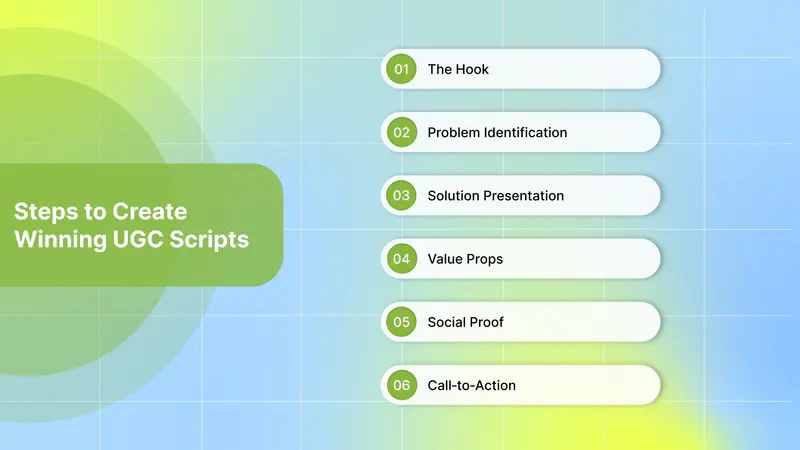
Steps to Create Winning UGC Scripts
A well-written UGC script gives creators a clear flow that captures attention, builds trust, and drives users to act. Here are the key steps to create UGC scripts:
1. The Hook
Start with something strong that grabs immediate attention in 2–3 seconds, such as a provocative statement, a surprising visual, or a question your audience recognizes. You can do this by:
Look at previous ad data to analyze which openings hold attention.
Use an unexpected statement or relatable comment as your opener.
A/B test at least three different hook variations per campaign and compare retention past 3 seconds.
Example:
Auditory Hooks (ideal for TikTok, where sound is often on):
“Stop scrolling if you struggle with…”
“I never thought I’d buy skincare from a reel… but”
Visual Hooks (great for Facebook, where visuals dominate):
Before/after transformation right at the start
Product unboxing with dramatic reveal
Copy Overlay Hooks (for muted autoplay environments like Facebook/IG):
“POV: You finally found the solution to…”
“Things TikTok made me buy #SkinCareEdition.”
Why this step matters: If you lose people here, you’ll never get to the message. On TikTok and Facebook, where users scroll fast, a weak or slow start means you’ve wasted ad spend without converting a single user.
2. Problem Identification
Define a clear pain point or frustration your ideal customer already experiences that your product directly solves. The goal here is to make your viewer instantly think, “Oh, that’s exactly my problem.” This builds instant relevance and keeps them watching. You can do this by:
Surfacing common complaints or frustrations pulled from your product reviews, support tickets, or comment sections.
Using real language, your customers would not use polished marketing terms.
Pairing the pain with relatable visuals.
Example: “You’re spending hours searching for a serum that actually gives glow and still end up disappointed.”
Why this step matters: Your audience won’t care about your product until they feel seen. This step creates empathy and primes the viewer to accept your product as the natural next step. When you reflect their struggle, you earn their attention.
3. Solution Presentation
Show how your product solves the problem in a way that feels real, not scripted. Keep it casual and relatable, just like someone sharing what worked for them. Avoid overproduced visuals or salesy language. This is where your product creates the “wow!” moment in the viewer’s mind. You can do this by:
Using first-person storytelling from a creator who explains what changed after they started using the product.
Show the product in action, use it like a regular person, not a commercial.
Highlighting before/after results visually, without over-explaining.
Example: “Then I found [brand]’s Glow‑Boost Serum, and in 7 days my routine got simpler, and results showed.”
Why this step matters: You’ve grabbed attention + built empathy. Now you must give them the way out, which means a clear route to the result they want, which drives them toward your ad’s objective.
4. Value Props
Highlight the specific benefits that matter most for users, such as what will convince someone to act now. These aren’t just generic features; they’re direct reasons why someone should choose your product today. You can do this by:
Calling out the unique outcomes your product delivers that competitors don’t.
Framing benefits in user-first language like “You’ll get…” instead of “We offer…”
Using visuals or overlays that reinforce each benefit in quick, skimmable moments.
Example: “Clinically shown to boost radiance by 30% in a week. No heavy makeup needed. Ships free today.”
Why this step matters: Users need reasons beyond just “it works” to take action. Focus on what drives them to become a new user or make a purchase, not just general brand vibes.
5. Social Proof
Include real, believable endorsements such as creator voiceovers, UGC-style testimonials, customer reviews, or quick before-and-after shots. Your goal is to validate the product’s effectiveness through someone the viewer can relate to. You can do this by:
Reposting short clips or quotes from actual customers or creators who used the product and saw real results.
Showing visible proof like user-submitted before/after photos or star ratings with captions like “4.9 stars from 3,200+ customers.”
Letting creators speak casually in their own voice instead of using a scripted review.
Example: “I’ve never seen results like this @skincarequeen (3.2k followers)” with a 5‑star overlay.
Why this step matters: Viewers who haven’t heard of your brand need reassurance fast. Social proof builds trust and removes hesitation, especially for first-time buyers. It answers the question: “Does this actually work?
Also Read: Social Proof that works on Facebook
6. Call‑to‑Action (CTA)
End with a clear, simple instruction telling the viewer exactly what to do next. Keep it short, urgent, and 100% action-focused. You can do this by:
Using high-contrast on-screen buttons or text like “Tap to Shop” or “Get Yours Today.”
Adding urgency with limited-time language like “Only a few left” or “Ends tonight.”
Matching the CTA to the platform’s format (e.g., “Swipe Up” on IG Stories, “Click Shop Now” on Facebook Feed, “Link in Bio” on TikTok).
Example: “Tap ‘Shop Now’ and grab your Glow‑Boost Serum before stock runs out.”
Why this step matters: Without a direct CTA, viewers often go even if they liked the ad. Your CTA is what converts attention into action, and it's the final push needed to drive results.
Strong UGC scripts form the foundation of high-performing content, but pairing them with the right creative strategies is what turns good ads into scalable acquisition engines.
Also Read: Recommended AI Tools for UGC Video Ad Creation
UGC strategies that work on Facebook and TikTok

For executing UGC scripts with the right content strategies that turn viewers into users, you need tactics that scale engagement, spark participation, and generate authentic content that performs across platforms. Here are some proven UGC strategies that help brands attract and convert new users effectively:
1. Hashtag Challenge
Launch a branded or trending‑style challenge that encourages your audience to create content around your product. The result: organic reach + user‑generated assets that you can feed into campaigns.
Example

The #NIVEASPLASH campaign is a great example of how brands can turn a simple product moment into a viral UGC wave. NIVEA invited users to show how extra they can make the splash after the 3, 2, 1 countdown. The result? Over 17,000 posts were created by real users, each putting their own spin on the challenge.
This not only boosted awareness, but it also gave NIVEA a massive pool of authentic, creator-style content they could reuse for future ad campaigns. It also demonstrated how a product demo can turn into a shareable, low-effort creative idea that spreads quickly and attracts new users.
2. Run a Giveaway
Offer a reward for users who post content using your product and tag the brand. This not only creates mass UGC but also captures new potential users entering your funnel via engagement with the giveaway.
Example
In this giveaway campaign posted on Facebook, users were invited to film a short video at a specific location and share it using the hashtag #HKvibes. Participants had to follow the brand, tag them, and make their video go viral to win an iPhone 16 Pro Max.
This approach turned a simple incentive into a UGC engine, motivating users to create, share, and promote branded content in hopes of winning. It’s an ideal strategy for DTC brands looking to scale acquisition by leveraging community-driven engagement.
3. Collaborate with Micro‑Influencers
Partner with creators who resonate with your ideal buyer persona but have smaller, more engaged followings. These micro-influencers can produce authentic UGC-style content that feels relatable, trustworthy, and effective for conversion without the high cost or polish of traditional influencer campaigns.
Example

This Facebook post invites UGC skincare creators to collaborate with luxury beauty brand Tatcha. The brand clearly outlines what kind of content they want (vertical, portrait-style videos), who they're targeting (creators in the U.S. beauty and lifestyle space), and how to apply.
The strategy here is smart: instead of chasing mega-influencers, the brand is tapping micro-creators to create native-looking, testimonial-style videos that mirror real user experiences. These types of collaborations are gold for ad campaigns, especially when your goal is to acquire new users who trust what they see.
4. Turn Customers into Creators
Activate real customers to create content showing how your products benefit them. Then repurpose their content as ads. The authenticity of this approach helps first‑time users feel the brand is credible.
Example:
Turn Customers into Creators videp
This Facebook ad by Lakme USA showcases a customer's hair transformation using their K2.0 active treatment. The post highlights how revolutionary the Lakme product is for stylists and lets the transformation visuals do the talking. No polish, no scripts, just a real treatment on a real customer, shown in action.
The video format and genuine tone make the content feel organic. By turning a happy customer’s experience into an ad, Lakme boosts credibility and lets the product’s results speak for themselves.
5. Tutorials
Create short “how-to” style videos that show exactly how your product solves a problem. Tutorials help reduce friction, clearly explain the benefit, and motivate new users to act because they understand the value right away.
Example
In this TikTok ad video, beauty creator @shelbyannbell demonstrates how to use a L’Oréal compact powder. She applies the product directly on camera, showcasing its texture, finish, and immediate effect.
The highlight? L’Oréal Paris actively engages in the comments, reinforcing product benefits and prompting viewers to purchase. This combination of tutorial + brand interaction makes the content highly credible and conversion-friendly.
While these UGC strategies help you attract new users, improving your scripts with advanced strategies ensures your ads stay effective.
Advanced Strategies to Improve Your UGC Scripts
Advanced techniques help you move beyond surface-level storytelling and build variations that truly connect with your audience. Here are two proven methods that top-performing DTC growth teams use to make their UGC scripts more effective and conversion-focused:
1. Multi-Angle Testing
Rather than relying on a single narrative, you should build multiple versions of your UGC scripts for the same product. This allows you to test a range of angles and identify what resonates best with your audience. Some scripts can focus on specific product features and benefits, while others show the product in daily use scenarios.
You can also build comparison-style scripts that position your product against known alternatives, or lean into story-driven approaches that walk viewers through a personal transformation or problem-solution journey.
2. Emotional Storytelling
Emotionally-driven UGC consistently outperforms generic, flat scripts. To truly engage users, you need to tap into the underlying feelings your product evokes. Whether it’s the excitement of discovering a viral product, the relief of solving a long-term problem, or the pride that comes from improved confidence, emotion helps anchor the message and make it memorable.
Emotion builds trust, drives connection, and creates the kind of scroll-stopping relevance that converts new users. The goal is to move beyond product descriptions and speak directly to how someone wants to feel, then match that emotion to the value your product delivers.
Even with the right strategies, small scripting errors can quietly reduce ad performance and stop users from taking action.
Also Read: UGC, Testimonials & Comments: Social Proof Strategies That Win on Facebook
Common UGC Script Mistakes That Lower Conversions

Even well‑produced UGC won’t perform if the script kills authenticity or momentum. To avoid wasted spend and opportunities, you need to watch for pitfalls in your UGC scripts. Here are the most frequent mistakes to avoid:
Sounding too scripted: When creators read lines that feel rehearsed instead of natural, viewers switch off. The result: lower retention and fewer users taking action.
Ignoring platform context: Using a one‑size‑fits‑all script across platforms misses how users consume content differently. If your UGC isn’t optimized for the platform, you’ll lose users before ever converting.
Weak hooks: If you don’t grab viewers in the first few seconds, you’ll lose most of them. Without a strong hook, your acquisition funnel loses momentum before the message lands.
Generic value props: When your script uses vague or surface‑level benefits, viewers don’t feel compelled to act. Clear, meaningful value is what drives users to convert or purchase.
Passive CTAs: A weak or unclear call to action leaves the viewer unsure of what to do next. For acquisition‑focused campaigns, you must guide the new user to act now, not later.
Conclusion
UGC scripts have become essential for DTC growth teams aiming to scale user acquisition efficiently. By combining strong hooks, clear storytelling, real social proof, and action-focused CTAs, you can consistently turn scrollers into buyers. Use UGC ad tactics like challenges, giveaways, and creator content to drive growth.
To scale user acquisition through high-performing UGC ads, you need deep, data-backed insights into what’s truly driving performance across Facebook and TikTok. That’s where Segwise comes in. Segwise integrates directly with both platforms, making it easy to connect your ad accounts.
To integrate with Facebook and TikTok, you need to go to Dashboard → Settings → Ad Networks → Connect under Meta or TikTok. Then sign in, select your Ad Accounts, and enable them for full creative analysis across all campaigns.
By pulling data directly from Facebook and TikTok, Segwise automates creative tagging, links elements from UGC ad campaigns to performance metrics, and shows which ad patterns consistently win. With AI-powered creative analytics, you can scale winning creatives faster and ensure every dollar goes toward ads that convert.
So, why wait? Start your free trial today and see how Segwise can help you scale your UGC ads to acquire more users with confidence!
FAQs
1.What makes a UGC script different from a traditional brand ad script?
A UGC script is designed to feel like a real user’s testimony rather than a polished commercial. It maintains authenticity while using a structured framework (e.g., Hook → Problem → Solution → Value Prop → Social Proof → CTA).
2. Can you reuse the same UGC script across Facebook and TikTok perfectly?
Not exactly. While the core structure can stay the same, you should optimize for each platform’s behavior, format, sound vs. silent auto-play, pacing, and viewer expectations.
3. What should you measure to determine if a UGC script is driving user acquisition?
Focus on key metrics like view-through rate, click-through rate, conversion or purchase rate for new users, cost per acquisition, and qualitative feedback on creator voice authenticity and brand fit. These insights help you iterate and scale winning scripts.