
Do you know which part of your Meta ad is driving performance?
As a creative strategist, you’ve probably launched dozens of creatives hoping one would become the next scalable winner. But without clear feedback on which hooks, messages, or formats actually drive performance, you risk repeating the same creative mistakes. When you can’t identify what works, your iteration slows down, your creative strategy becomes guesswork, and your best opportunities to scale get missed.
This blog covers how to optimize Meta ads creatives, so you can identify winning creative patterns, refine your concepts using performance insights, and build a repeatable system that consistently produces high-performing creatives.
What is Creative Optimization for Meta Ads?
Creative optimization for Meta ads is the process of improving your ad creatives based on performance data to increase scalability and efficiency. Instead of judging creatives only by how they look, you analyze which hooks, messaging angles, visuals, and formats actually drive results and then iterate on those winning elements to improve results.
As a creative strategist, it allows you to build your next creative briefs based on real performance insights, not assumptions. This means you can produce smarter creative decisions and avoid repeating underperforming ideas.
The next step is understanding why it plays such a critical role in improving Meta ad performance.
Why Creative Optimization Matters For Meta Ads?
Creative is now the biggest driver of Meta ads performance. Now, targeting has become increasingly automated through Meta’s AI and Advantage+ systems. This means your creative strategy plays the biggest role in stopping the scroll, capturing attention, and driving installs, purchases, or subscriptions.
If you’re only optimizing targeting but not improving your creatives, your campaigns will eventually plateau. As a creative strategist, your ability to identify winning creative patterns and iterate on them is what determines whether your campaigns scale or stall.
Here are the key reasons creative optimization is essential for improving Meta ads performance:
It helps you identify which creative concepts actually resonate with your audience.
It enables you to scale winning creative patterns faster.
It improves the effectiveness of Meta’s automated delivery system.
It increases your creative iteration efficiency.
It helps you maintain consistent performance as creatives fatigue.
Next, choosing the right Meta ad format is essential for maximizing creative performance.
Also Read: The Creative Strategist’s Guide to Automating Insights for Meta Ads in 2026
What Are the Different Types of Meta Ad Formats?
Meta offers multiple ad formats that help you present your creative concepts in different ways. Choosing the right format is just as important as the creative idea itself. Each format supports different storytelling styles, from showcasing gameplay for mobile games to highlighting product benefits for DTC brands or explaining features for subscription apps.
Here are the different Meta ad creative formats you should test and use based on your creative strategy goals: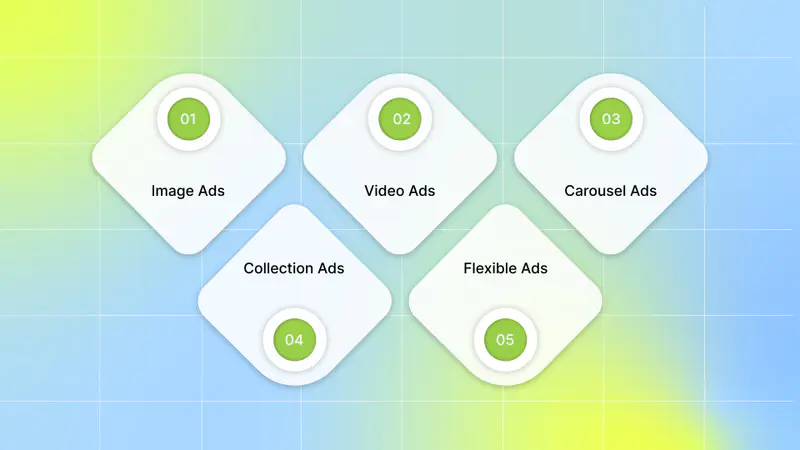
1. Image Ads
Image ads help you drive users to your website, app, or product using a single high-quality visual and clear messaging. This format lets you showcase your product, gameplay, or core value in a simple, focused way, making it easier for users to understand your offer quickly.
Placement: Feed, Explore, Stories
Objective: Awareness, engagement, conversions
Specs:
Image: JPG or PNG
Ratio: 1.91:1 to 4:5
Resolution:
1:1 ratio: 1440 x 1440 pixels
4:5 ratio: 1440 x 1800 pixelsMaximum file size: 30 MB
Minimum width: 600 pixels
Character limits:
Headline: 27 characters
Primary text: 50-150 characters
Use this format to test individual creative ideas and clearly understand which creative concept drives performance.
2. Video Ads
Video ads are Meta ad formats that use motion and sound to capture attention and showcase your product, gameplay, or key features in a more engaging way. You can upload a video you’ve already created or build one directly inside Ads Manager using Meta’s video creation tools.
Placement: Feed, In-stream, Stories
Objective: Awareness, engagement, conversions
Specs:
File type: MP4, MOV or GIF
Ratio: 1:1 (for desktop or mobile) or 4:5 (for mobile only)
Resolution:
1:1 ratio: 1440 x 1440 pixels
4:5 ratio: 1440 x 1800 pixelsVideo captions and sound: Optional, but recommended
Video duration: 1 second to 241 minutes
Maximum file size: 4 GB
Minimum width: 120 pixels
Minimum height: 120 pixels
Character limits:
Headline: 27 characters
Primary text: 50-150 characters
Use the video format in Feed to showcase your product or brand in new ways and capture attention quickly.
3. Carousel Ads
Carousel ads let users swipe through multiple images or videos in a single ad. This format is useful when you want to tell a story step-by-step, showcase different features, or present multiple creative angles. For mobile games, you can show different gameplay moments. For DTC brands, you can highlight product benefits or variations.
Placement: Feed, Messenger, Explore
Objective: Product promotion, engagement, multi-concept storytelling
Specs:
File type: JPG/PNG for images, MP4/MOV/GIF for videos
Aspect ratio: 1:1 or 4:5
Resolution: At least 1080 x 1080 pixels
Max file size: 30 MB for images, 4 GB for video
Video duration: 1 second to 240 minutes
Cards per carousel: 2–10
Character limits:
Headline: 45 characters
Primary text: 80 characters
Description: 18 characters
Carousel ads help you test multiple creative messages and understand which creative angle performs best.
4. Collection Ads
Collection ads are a Meta ad format that combines a main cover image or video with multiple product images shown below it in the news feed. When a user taps the ad, it opens an instant experience, which is a full-screen, mobile-optimized landing page designed to showcase your products or features in an immersive way. This format is highly effective for DTC brands that want to showcase multiple products.
Placement: Feed, Stories
Objective: E-commerce conversions, product discovery
Specs:
File type: JPG/PNG for images, MP4/MOV/GIF for videos
Aspect ratio: 1:1 or 9:16
Resolution: At least 1080 x 1080 pixels
Max file size: 30 MB for images, 4 GB for video
Character limits:
Headline: 40 characters
Primary text: 125 characters
This format helps you present a complete product story and drive stronger purchase intent.
5. Flexible Ads
Flexible ads allow you to upload multiple images and videos, and Meta automatically tests different combinations to find what performs best for each user. This format lets you test multiple variations without launching separate ads for each. This is especially useful when you want to identify winning creative patterns faster across different audiences.
Placement: Feed, Stories, Reels, Marketplace, Audience Network
Objective: Traffic, engagement, sales, app promotion
Specs:
Upload up to 10 images and videos
Supports single image, video, or carousel formats
Using this type gives you more customization. You can group certain media, such as images and videos, with different combinations of texts, allowing you to customize your ads and help prevent ad fatigue.
As a creative strategist, testing different Meta ad formats helps you understand which format best supports your creative concepts. The right format can improve creative performance, increase engagement, and help you scale winning creative ideas more effectively.
The next step is to focus on improving the performance of your creatives to c drive better engagement and results.
Strategies to Optimize Meta Ads Creatives
Optimizing Meta ads creatives means improving how you develop, test, and iterate creative concepts using performance insights and platform capabilities. As a creative strategist, your role is to identify scalable creative patterns, use Meta’s automation, and continuously evolve your creative strategy. 
Here are a few strategies to optimize your Meta ads creatives:
1. Prioritize Hook Optimization
The hook is the first thing users see, and it determines whether they stop scrolling or ignore your ad. Even strong creative concepts fail if the opening does not capture attention immediately. You should test multiple hook variations for the same creative concept.
Optimizing hooks helps you identify which openings instantly capture attention and drive engagement. This improves your ability to develop creatives that consistently attract attention and increases the chances of scaling successful creative concepts.
2. Identify and Scale Winning Creative Patterns
Your goal is to identify patterns across multiple winning creatives, not just individual successful ads. For example, you may notice that UGC-style creatives outperform studio creatives, or gameplay-focused videos perform better than cinematic storytelling. These patterns reveal what resonates most with your audience.
Once you identify these patterns, you can create more variations based on the same winning structure. This allows you to scale performance more reliably because you are building on proven creative directions.
3. Refresh Creatives Regularly to Prevent Creative Fatigue
Creative fatigue happens when your audience sees the same creative too many times. As frequency increases, engagement drops, and performance declines. You should regularly review your creatives to identify performance decline and signs of fatigue.
Refreshing creatives helps you maintain performance by introducing new variations before performance drops significantly. Instead of replacing concepts completely, you can refresh hooks, visuals, or messaging while keeping the core concept. This helps you sustain engagement and keep your creative strategy effective over time.
But how do you know exactly when a creative is starting to fatigue?
This is where a creative intelligence platform like Segwise comes in. With fatigue tracking, you can catch performance declines before it impacts budget allocation and campaign results. You can also set custom fatigue criteria and monitor creative performance across Facebook, Google, TikTok, and all major ad networks, to catch fatigue before it impacts your ROAS.
4. Align Creative Strategy With Platform-Native Behavior
Meta rewards creatives that feel natural to the platform. Ads that look like organic content perform better because users engage with them more naturally. Formats such as UGC videos, vertical videos, and native gameplay creatives align with how users consume content on Meta.
Designing creatives that match platform-native behavior helps improve engagement and creative effectiveness. When your creatives feel authentic and natural, users are more likely to watch, engage, and convert. This improves creative performance and increases your ability to scale winning concepts.
5. Add Text to Improve Creative Clarity and Engagement
Adding clear, concise text to your creatives helps communicate your message quickly and ensures users understand your value immediately. Use on-screen text, headlines, captions, or overlays to highlight key benefits, offers, or outcomes.
This strategy improves engagement by helping users grasp your message within seconds, increasing the chances they stop scrolling and interact with your ad. Clear text reinforces your visual message, strengthens your hook, and generates higher CTR, stronger engagement, and better overall performance.
6. Use Performance Insights to Build Smarter Creative Briefs
Creative briefs should be based on real performance insights, not assumptions. Analyze your winning creatives to identify high-performing messaging angles, hooks, formats, and storytelling approaches. Use these insights to guide your creative team’s production.
This helps your team create creatives with a higher probability of success. Instead of guessing what might work, you are building creatives based on proven performance patterns. This improves creative quality, increases iteration efficiency, and accelerates your creative optimization process.
But how do you know exactly which hooks, or creative elements, are driving performance across dozens or hundreds of ad creatives?
Manually analyzing creatives at this level is time-consuming and often incomplete. This is where Segwise comes in. It connects creative elements (hooks, visuals, formats, etc.) directly to business outcomes (ROAS, CPA/CPI, LTV, IPM, conversion rates), so teams stop guessing what works and start scaling creatives with data-backed confidence.
Moreover, with tag-level creative element mapping, you can see which specific creative elements drive performance. You can discover patterns like "this hook appears in 80% of top-performing creatives".
7. Use Advantage+ Creative to Improve Creative Performance
Meta’s Advantage+ creative enhancements automatically optimize how your creatives are displayed. It adjusts formatting, brightness, and presentation to improve performance across different placements and audiences. This helps ensure your creatives perform effectively in multiple environments.
Using Advantage+ creative helps improve creative delivery and engagement without manual adjustments. This allows you to focus on developing strong creative concepts while Meta optimizes delivery. It improves creative effectiveness and helps your creatives reach their full performance potential.
8. Use Dynamic Creative Optimization (DCO)
DCO automates testing across multiple assets, such as images, videos, headlines, and text, to identify and deliver the best-performing combinations to users in near real time, thereby optimizing ad performance.
This helps you quickly identify which combinations drive performance. Instead of manually testing each variation, you can use DCO insights to develop better creative iterations. This accelerates your learning process and improves your creative strategy.
9. Use High-Resolution Images and Videos
Creative quality plays a major role in capturing attention and building trust. Low-quality visuals reduce engagement and make your creatives less effective. Always use high-resolution images, clear visuals, and properly formatted videos.
High-quality creatives help your ads stand out and communicate value more effectively. Clear gameplay footage, product visuals, or demonstrations improve engagement and make your creatives more compelling. This increases your chances of creating high-performing creatives.
10. Use a Sound-First Approach for Video Creatives
Sound enhances storytelling and helps capture attention. Voiceovers, sound effects, and music improve emotional impact and make your creatives more engaging. Many successful Meta creatives use sound to explain value and strengthen messaging.
Using sound strategically helps make your creatives more engaging and easier to understand. It improves storytelling and increases user engagement. This helps you create more effective creatives that drive better performance.
11. Utilize a Wide Range of Creative Formats
Meta offers multiple creative formats, including image, video, and carousel ads. Each format serves different creative and strategic purposes. Testing multiple formats helps you understand which format works best for your creative concepts.
Using different formats allows you to discover new creative opportunities and scale successful concepts across formats. This improves your creative strategy and increases your chances of developing scalable, winning creatives.
12. Iteration for Long-Term Success
Optimization is an ongoing process. After analyzing your creative performance, use the insights gathered to iterate and improve. Whether it’s tweaking a headline or adjusting an image, even small changes can lead to significant performance improvements.
By committing to constant analysis and iteration, you ensure that your ads remain relevant and effective throughout the campaign. Over time, this will help you build a more efficient and results-driven creative strategy.
But how do you generate new creative variations based on actual performance data?
This is where Segwise comes in. With data-backed creative iterations, you can generate creative variations based on actual performance data from your campaigns. Segwise understands which specific creative elements drive ROAS, CPA, and conversion rates via its Creative Tagging and Analytics agents.
By applying these strategies, you can build a structured creative optimization system that helps you consistently develop stronger creatives, improve iteration speed, and scale Meta ads performance more effectively.
The next critical step is to evaluate their performance to identify winning patterns.
How to Analyze Meta Ad Creative Success
Analyzing creative performance starts with gathering and evaluating the right performance data. These metrics help you understand which creative concepts capture attention, drive engagement, and generate meaningful results.
Here are the key metrics you should analyze to evaluate Meta ad creative performance:
Click-Through Rate (CTR): A high CTR indicates that your creative is successfully capturing attention and motivating users to take action. If your CTR is low, it often signals that your creative is not engaging enough, and you may need to test different hooks, visuals, or messaging angles.
Conversion Rate: Conversion rate shows how effectively your creative drives users to complete the desired action, such as making a purchase, installing an app, or signing up. A low conversion rate may indicate that your creative messaging or value proposition needs improvement
Engagement Metrics: Engagement metrics such as likes, comments, shares, and saves help you understand how your audience responds to your creative emotionally. High engagement indicates that your creative resonates with your audience and encourages interaction.
But even with the right analysis, certain creative optimization mistakes can still limit your Meta ad performance.
Common Meta Ad Creative Optimization Mistakes to Avoid
Creative optimization is not just about launching more creatives; it’s about improving your creative strategy based on performance insights. Avoiding small mistakes helps you develop stronger creatives and build a more effective creative optimization system.
Here are the most common Meta ad creative optimization mistakes you should avoid:
Ignoring hook performance and opening seconds: If your creative does not capture attention immediately, users will scroll past it. Continuously test and improve hooks to increase engagement.
Refreshing creatives too late after fatigue begins: Waiting too long to refresh creatives leads to performance decline. Refresh creatives proactively to maintain engagement and results.
Not testing multiple creative formats: Relying on only one creative format limits your optimization potential. Testing different formats helps identify what performs best.
Making creative decisions based on assumptions instead of data: Creative decisions based on guesswork lead to inconsistent performance. Always use performance data to guide creative strategy.
Ignoring mobile-first creative design: Most Meta users view ads on mobile devices. Failing to design creatives in vertical or mobile-optimized formats, such as 9:16 or 4:5, reduces engagement and performance.
Adding too much text to creatives: Overloading creatives with text makes them harder to consume and reduces engagement. Clear visuals and simple messaging perform better.
Avoiding these mistakes helps you build a structured creative optimization process, improve iteration efficiency, and consistently develop high-performing Meta ad creatives.
However, as your creative volume grows, manual optimization becomes harder to manage at scale.
Also Read: How to Combat Creative Fatigue with AI Solutions
How Creative Intelligence Optimizes Meta Ads Creatives Faster
Optimizing Meta ads creatives becomes more difficult as your creative volume increases. When you are managing dozens or hundreds of creatives across mobile games, DTC products, or subscription apps, it becomes harder to track which hooks, messaging angles, or creative formats actually drive performance.
Creative intelligence platforms like Segwise are designed to help creative strategists analyze, tag, and optimize creatives using performance data. It automatically connects creative elements, such as hooks, messaging, and visuals, to performance data. This allows you to understand exactly what drives results and build creative strategies based on real performance insights, rather than guesswork.
Here are the key ways Segwise helps you optimize Meta ads creatives faster:
Creative Tagging: Our powerful, multi-modal AI automatically identifies and tags creative elements like hook dialogs, characters, colors, and audio components across images, videos, text, and playable ads to reveal their impact on performance metrics like IPM, CTR, and ROAS.
Tag-Level Creative Element Mapping: You can see which specific creative elements drive performance. Also, you can discover patterns like "this hook appears in 80% of top-performing creatives" with complete MMP attribution integration.
Data-backed creative iterations: Generate creative variations based on actual performance data from your campaigns. Segwise understands which specific creative elements drive ROAS, CPA, and conversion rates via its Creative Tagging and Analytics agents.
Fatigue Detection: You cancatch performance decline before it impacts budget allocation and campaign results. Also set custom fatigue criteria and monitor creative performance across Facebook and all major ad networks, to catch fatigue before it impacts your ROAS.
By integrating directly with Segwise, you can analyze creative performance by identifying winning creative patterns faster and build a structured creative optimization system that consistently improves Meta ads performance.
Conclusion
Optimizing Meta ad creatives requires a structured, data-driven approach rather than relying solely on guesswork or creative instinct. Your success depends on identifying which creative elements actually drive performance. By testing different creative formats, analyzing key performance metrics, and continuously iterating on winning creative patterns, you can build a scalable creative strategy.
But if you want to know exactly which creative elements, such as specific hooks, messaging angles, visuals, or formats, are driving performance, manual analysis is not enough. This is where a creative intelligence platform like Segwise comes in.
Segwise integrates directly with your Meta ad account to help you analyze your Meta ad data. You just need to go to the Segwise Dashboard → Settings → Ad Networks, click Connect under Meta Ads, sign in, and select your Ads account for full creative analysis.
Segwise creative tagging automatically identifies and tags creative elements like hook dialogs, characters, colors, and audio components across images, videos, text, and playable ads to reveal their impact on performance metrics like IPM, CTR, and ROAS. With its tag-level performance optimization, you can instantly see which creative elements, themes, and formats drive results across all your campaigns and apps. Moreover, fatigue tracking catches performance decline before it impacts campaign results.
So, why wait? Start your free trial to stop guessing and start building scalable, data-backed Meta ad creatives that actually drive performance!