
Are you launching Facebook ads every week, yet still guessing which hooks, messages, or angles will actually convert?
In user acquisition, guessing is expensive. Every weak headline, unclear hook, or wrong creative angle burns budget, slows learning, and gives your competitors more room to win. When testing cycles move slowly, creative fatigue sets in faster, and scaling what works becomes harder than it should. If you want to win, you need to move faster with stronger ad ideas.
This blog breaks down 10 powerful ChatGPT prompts for Facebook ads, from writing high-converting ad copy to creating sharper creative briefs. These prompts are designed to help you move faster, test smarter, and scale your UA campaigns with confidence instead of guesswork.
Why Teams are Using ChatGPT for Facebook Ads
UA teams are using ChatGPT for Facebook ads because it helps them move faster, test more ideas, and reduce guesswork in creative decisions. Instead of starting from a blank page, you can generate ad copy, hooks, and angles in minutes and focus more on testing and optimization.
Here are key reasons why UA managers and growth teams rely on ChatGPT to scale Facebook ads: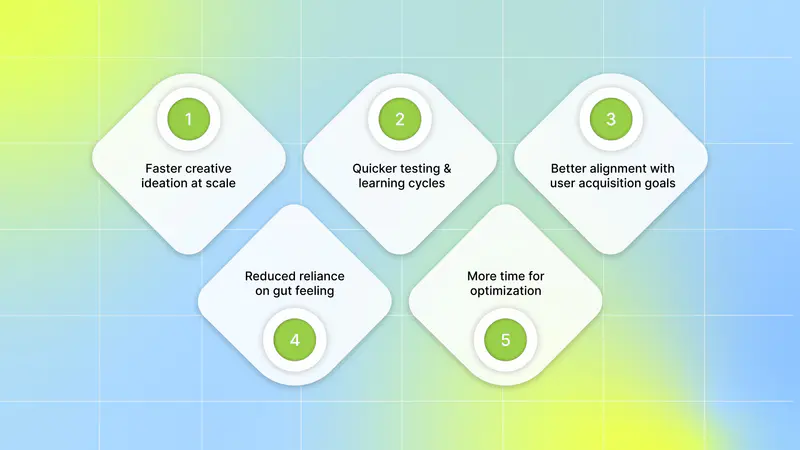
Faster creative ideation at scale: When you’re launching dozens of ads every week, coming up with fresh hooks and angles is exhausting. ChatGPT helps you quickly generate multiple ideas so your team can keep testing without slowing down.
Quicker testing and learning cycles: ChatGPT lets you create many copy variations at once, making it easier to run structured tests and learn what works before creative fatigue kicks in.
Better alignment with user acquisition goals: You can prompt ChatGPT around specific UA objectives like installs, purchases, trials, or subscriptions, helping you write ads that focus on performance.
Reduced reliance on gut feeling: Instead of guessing what might work, ChatGPT helps you systematically explore different messaging angles, value propositions, and audience pain points.
More time for optimization: By cutting down hours spent on manual brainstorming, your team can spend more time analyzing results and improving ROAS across campaigns.
ChatGPT helps you generate ad ideas quickly, but if you want data-backed creative insights to improve Facebook ad performance, you need an AI-powered platform. This is where Segwise comes in. Segwise is an AI-powered creative analytics platform that helps UA and performance marketing teams understand which creative elements drive performance and catch performance drops with fatigue tracking before results drop.
To get outputs that are actually usable for user acquisition, prompts need more structure than a simple request.
A Framework for Writing Successful Prompts
Successful ChatGPT prompts help you get outputs that are actually useful for user acquisition, not generic ad copy. When your prompts are clear and structured, ChatGPT can generate ideas that match your audience, campaign goals, and creative strategy. This makes it easier to test faster and scale winning Facebook ads.
Here are simple steps to write better ChatGPT prompts for Facebook ads:
Role assignment: Start by telling ChatGPT what role it should play. For example, ask it to act like a UA manager, performance marketer, or creative strategist for mobile games, DTC brands, or subscription apps. This sets the right context and keeps the output focused on user acquisition and performance.
Goal: Clearly define what you want to achieve. Whether your goal is more installs, purchases, subscriptions, or a lower CPA, stating this upfront helps ChatGPT align the messaging with your campaign objective.
Context clarity: Share important details such as your product, target audience, platform, and funnel stage. The more relevant context you provide, the more realistic and usable the ad ideas will be for your Facebook campaigns.
Task: Be specific about what you want ChatGPT to generate. Ask for clear deliverables like hooks, primary ad text, headlines, or creative angles. Mention tone, length, and style so the output matches how your ads actually run.
Set output expectations and formatting requests: Tell ChatGPT how many variations you need and how the output should be structured. For example, request bullet points, short lines, or multiple versions that are easy to plug directly into Facebook ad tests.
Using this framework helps you generate better prompts, reduce back-and-forth edits, and move faster from idea to live Facebook ads.
A strong prompt structure lays the foundation, but the impact comes from prompts that map directly to Facebook ad workflows.
Also Read: Creating a Converting Facebook Ad: Practices and Examples
10 ChatGPT Prompts to Boost Your Facebook Ads
ChatGPT can support your Facebook ads by helping you move faster from idea to execution, especially when you’re managing high volume across multiple campaigns. It helps you generate better ad inputs, structure your testing, and reduce time spent on manual brainstorming. For UA teams, this means more tests, faster learning, and stronger performance over time.
Here are 10 practical ChatGPT prompts you can use to improve your Facebook ads:
1. Draft multiple ad copy variations
Generating only one version of ad copy limits how much you can test. ChatGPT helps you quickly create multiple headlines, primary texts, and CTAs for the same offer. This makes it easier to run structured tests and identify which messaging actually drives installs, purchases, or subscriptions.
Here is the prompt
# Prompt: Facebook Ad Copy Variations

## Role
Act as a senior Facebook Ads copy expert for:
UA teams, mobile games, DTC brands, subscription apps, growth agencies, in-house performance teams, creative leads, CMOs, and growth heads.

## Goal
Create **10–12 distinct Facebook ad copy variations** built for testing and scale.
Each version must use a different angle, hook, and framing.

## Inputs (User Provides)
- Product / App name
- Industry / category
- Target ICP (role, team, market)
- Primary goal (installs, sales, subs, ROAS, leads)
- Funnel stage (cold / warm / retargeting)
- Key value props (3–5)
- Main pain points (3–5)
- Differentiators
- Offer or incentive
- Tone preference
- Brand or compliance limits

## Output Format (For Every Variation)
- **Primary Text** (short, scroll-stopping, mobile-first)
- **Headline** (≤ 40 characters)
- **CTA suggestion**

## Angles to Cover
Spread copies across these angles:
- Pain → outcome
- Clear value
- Social proof
- Speed, cost, or scale
- Curiosity hook
- Feature → business impact
- Subtle competitive contrast

## Writing Rules
- Short sentences. Clear logic.
- No fluff or hype.
- Outcome-led language for operators.
- Each variation must sound written by a different strategist.
- No explanations or commentary.

## Final Output
Deliver only the ad copies in a clean, labeled list.
2. Help you build your swipe file
A swipe file gives your team proven hooks and angles to reuse and adapt. ChatGPT can help you organize patterns, themes, and messaging styles based on your past ads or winning concepts. This speeds up future creative ideation and reduces starting from scratch.
Here is the prompt:
# Prompt: Facebook Ads Swipe File Builder

## Role
Act as a senior performance ads strategist for UA teams, DTC brands, subscription apps, growth agencies, in-house performance teams, creative leads, and CMOs.

## Goal
Build a **reusable Facebook ads swipe file** focused on angles, hooks, and structures that teams can pull from for fast testing and iteration.

## Inputs (User Provides)
- Industry / vertical
- Product or app type
- Target ICP (role, team, market)
- Funnel stage (cold, warm, retargeting)
- Business goal (installs, sales, subs, ROAS, retention)
- Key value props
- Core pain points
- Offer or monetization model
- Preferred tone or brand style

## Swipe File Sections
1. **Hook Library**
   Short opening lines grouped by pain, outcome, curiosity, proof, or speed.

2. **Angle Bank**
   - Angle name
   - What makes it work for the ICP
   - Best funnel stage
   - Example positioning line

3. **Primary Text Patterns**
   Repeatable frameworks like problem → outcome, value stack, objection removal, or use-case focus.

4. **Headline Bank**
   Clear, scannable headlines (≤40 characters) across value, outcome, curiosity, or action.

5. **CTA Mapping**
   CTAs matched to discovery, consideration, conversion, or retention intent.

6. **Creative Pairing Notes**
   Best-fit creative types (UGC, demo, gameplay, stats, POV).

## Writing Rules
- Short, direct sentences
- Outcome-focused language
- No hype or generic slogans
- Every swipe must be reusable and test-ready

## Output
Deliver the swipe file in a clean, labeled format.
No explanations or commentary.
3. Brainstorm ad creative concepts
When you’re running out of new ideas, ChatGPT can help unlock fresh creative concepts. It can suggest different angles, emotions, and value propositions to test. This helps you avoid creative fatigue and keep your ad pipeline full.
Here is the prompt:
# Prompt: Brainstorm High-Impact Ad Creative Concepts

## Role
Act as a senior ad creative strategist for UA teams, DTC brands, subscription apps, growth agencies, in-house performance teams, creative leads, and CMOs.

## Objective
Generate **a strong set of ad creative concepts** that can be produced, tested, and iterated across Facebook and Instagram.
Concepts must focus on **the idea behind the ad**, not final copy.

## Inputs (User Will Provide)
- Product / app name
- Industry or category (game genre, DTC vertical, app type)
- Target ICP (role, behavior, awareness level)
- Funnel stage (cold, warm, retargeting)
- Primary goal (installs, sales, subscriptions, ROAS, retention)
- Core value propositions
- Key pain points or objections
- Offer or incentive (if any)
- Creative format focus (UGC, gameplay, demo, founder, stat-led, meme, etc.)
- Brand or compliance constraints

## Output Requirements
Create **10–15 distinct ad creative concepts**.

Each concept must include:
- **Concept Name**
- **Core Insight** (why this would stop the scroll for the ICP)
- **Hook Idea** (first 2–3 seconds or opening frame)
- **Creative Execution** (what happens visually, step by step)
- **Primary Message** (one clear takeaway)
- **Best Format** (UGC, gameplay, demo, POV, text-led video, carousel)
- **Best Funnel Stage**

## Concept Angles to Use
Spread ideas across these angles:
- Problem recognition
- Desired outcome or transformation
- Workflow relief or efficiency gain
- Proof, credibility, or real usage
- Curiosity or pattern break
- Feature translated into business impact
- Comparison or alternative framing
- Objection handling

## Creative Thinking Rules
- Ideas must be realistic to produce
- Focus on clarity over cleverness
- One core idea per concept
- Avoid generic ad tropes
- Each concept should feel test-ready and scalable

## Final Instruction
Present concepts in a clean, labeled list.
No explanations, no meta commentary, no summaries.
4. Turn ad creative ideas into briefs for your designer or agency
ChatGPT can turn rough ideas into clear, structured briefs. This includes the message, intent, visuals, and CTA. Clear briefs reduce revisions and misalignment. Your designers or agencies produce creatives that match your UA goals from the start.
Here is the prompt:
# Prompt: Turn Ad Ideas into Facebook Ad Creative Briefs

## Role
Act as a senior performance marketer writing **clear, execution-ready briefs** for designers or agencies creating Facebook ads.

## Goal
Convert **ad creative ideas** into **structured briefs** that reduce back-and-forth and speed up production.

## Inputs (User Provides)
- Product / app
- Industry or category
- Target ICP
- Funnel stage
- Campaign goal
- Creative idea or concept
- Key value prop
- Main pain point or insight
- Offer (if any)
- Brand tone or visual style
- Platform constraints (format, duration, compliance)

## Output (Per Concept)
Create **1 complete creative brief** including:
- **Brief summary** (what this ad must achieve)
- **Target audience mindset**
- **Core insight**
- **Hook direction** (first 2–3 seconds)
- **Key message**
- **Visual direction** (scenes, on-screen actions, text guidance)
- **Format & specs**
- **Success signal** (what “good” looks like)

## Rules
- Simple, direct language
- One clear idea per brief
- No vague instructions
- Ready for designers or agencies to execute

## Output
Deliver briefs in a clean, labeled format.
No explanations or commentary.
5. Suggest new audiences to target
Scaling often stalls when targeting stays narrow. ChatGPT can help you brainstorm new audience segments based on behaviors, interests, and intent. You expand testing beyond the same lookalikes and interests, unlocking new pockets of scale without sacrificing relevance.
Here is the prompt:
# Prompt: Suggest New Facebook Ad Audiences

## Role
Act as a senior paid growth strategist for UA teams, DTC brands, subscription apps, growth agencies, in-house performance teams, and marketing leaders.

## Goal
Suggest test-ready Facebook ad audiences** to unlock scale, reduce fatigue, or improve efficiency.

## Inputs (User Provides)
- Product / app
- Industry or category
- Business model
- Primary goal
- Core ICP
- Current audiences (if any)
- Funnel stage (prospecting / mid / retargeting)
- Geo focus
- Budget scale

## Output (Per Audience)
- **Audience name**
- **Audience type** (broad, interest, lookalike, behavioral, retargeting)
- **How to build it in Meta**
- **Why it could work**
- **Best funnel stage**
- **Best creative angle**

## Audience Buckets
Cover a mix of:
- Broad or simplified targeting
- Non-obvious interest clusters
- Behavioral or intent signals
- Lookalikes (with source guidance)
- Event or value-based segments
- Lifecycle or usage-stage groups

## Rules
- Each audience needs a clear test hypothesis
- Avoid obvious or redundant ideas
- Keep everything platform-compliant and scalable

## Output
Deliver audiences in a clean, labeled list.
No explanations or commentary.
6. Brainstorm creative campaign ideas
Instead of isolated ads, ChatGPT helps you think in campaigns. It suggests themes and messaging arcs across multiple creatives. Campaign-based thinking improves consistency and makes it easier to test and scale winning ideas across formats.
# Prompt: Brainstorm Creative Campaign Ideas for Facebook Ads

## Role
Act as a senior creative + growth strategist for UA teams, DTC brands, subscription apps, growth agencies, in-house performance teams, creative leads, and CMOs.

## Goal
Generate **5–7 scalable creative campaign ideas** for Facebook / Instagram ads.
Think in **campaign systems**, not single ads.

## Inputs (User Provides)
- Product / app
- Industry or category
- Target ICP
- Funnel stage (prospecting / mid / retargeting)
- Campaign goal (installs, sales, subs, ROAS, retention)
- Core value props
- Key pain points or objections
- Offer (if any)
- Brand tone / visual style
- Creative constraints (formats, duration, compliance)

## Output (Per Campaign)
- **Campaign name**
- **Core insight** (belief or tension driving the idea)
- **Big idea** (unifying theme)
- **Hook directions** (2–3 angles)
- **Creative executions** (how multiple ads would roll out)
- **Primary message**
- **Best formats**
- **Best funnel stage**
- **Why it can scale**

## Angles to Mix
- Problem awareness
- Outcome or transformation
- Proof or real usage
- Efficiency or workflow relief
- Curiosity / pattern break
- Comparison framing
- Objection-led reframing

## Rules
- One clear theme per campaign
- Realistic to produce
- Easy to expand into many variations
- No generic ad concepts

## Output
Deliver campaigns in a clean, labeled list.
No explanations or commentary.
7. Conduct a quick competitive analysis
ChatGPT can summarize common competitor messaging and identify gaps you can target. You avoid copying competitors and instead focus on differentiation, which improves relevance and click-through rates.
Here is the prompt:
# Prompt: Quick Competitive Analysis for Facebook Ads

## Role
Act as a senior performance marketing and creative analyst supporting:
UA teams, mobile game publishers, DTC brands, subscription apps, growth agencies, in-house marketing teams, creative leads, and marketing leadership.

You evaluate competitors the way experienced growth teams do: messaging, angles, formats, and positioning signals.

## Objective
Run a **fast, practical competitive analysis** focused on Facebook / Instagram ads.
The goal is to extract **actionable insights** that can guide creative, messaging, and testing strategy.

## Inputs (User Will Provide)
- Product / app name
- Industry or category
- Business model (game, DTC, subscription, SaaS)
- Target ICP
- Funnel stage focus
- Primary goal (installs, sales, subs, ROAS, retention)
- Key competitors (brand names or “top players in category”)
- Geo focus

## Output Requirements
Analyze **5–8 key competitors** (or category leaders if names are not given).

For each competitor, provide:

### 1. Positioning Snapshot
- Core promise or outcome they lead with
- Target user they appear to speak to

### 2. Messaging Patterns
- Repeated themes or claims
- Emotional vs functional framing
- Common hooks or opening lines

### 3. Creative Patterns
- Dominant formats (UGC, demo, gameplay, stat-led, founder)
- Visual styles or motifs
- On-screen text usage and pacing

### 4. Offer & CTA Signals
- Trials, discounts, bonuses, freemium cues
- CTA styles they favor

### 5. What They Overuse
- Angles, formats, or claims that feel saturated

## Cross-Competitor Insights
After individual reviews, summarize:
- Common patterns across the category
- Clear gaps or underused angles
- Messaging or creative spaces that look less crowded

## Actionable Takeaways
List **5–7 clear ideas** on how to:
- Differentiate messaging
- Shift creative angles
- Test alternatives competitors are not leaning into

## Rules
- Focus on observable ad behavior, not speculation
- Keep insights concise and practical
- Write for teams that want quick direction, not theory

## Final Instruction
Present analysis in a clean, labeled format.
No meta commentary or explanations outside the analysis.
8. Create buyer persona profiles
Clear personas lead to better messaging. ChatGPT can help you build simple, actionable buyer personas focused on acquisition triggers and objections. This improves relevance and ad resonance.
Here is the prompt:
# Prompt: Create Buyer Persona Profiles for Facebook Ads

## Role
Act as a head of growth for UA teams, DTC brands, subscription apps, agencies, in-house marketing teams, creative leads, and CMOs.

## Goal
Create **3–5 actionable buyer personas** to guide Facebook ad targeting, messaging, and creative direction.

## Inputs (User Provides)
- Product / app
- Industry or category
- Business model
- Campaign goal (installs, sales, subs, ROAS, retention)
- Funnel stage (cold, warm, retargeting)
- Core value props
- Key pain points or objections
- Current users or customers (if any)
- Geo focus

## Output (Per Persona)
- **Persona name & role**
- **Core motivation & success**
- **Pain points & frictions**
- **Buying triggers**
- **Messaging that resonates / avoid**
- **Creative format preferences**
- **Targeting signals**
- **Best funnel stage**

## Rules
- Realistic, specific, and actionable
- Clear differences between personas
- Ready for Facebook ad execution

## Output
Deliver personas in a clean, labeled list.
No explanations or commentary.
9. Create a channel strategy
ChatGPT can help you map how Facebook ads fit into your broader UA mix alongside other channels. You align messaging, timing, and budgets across channels, making Facebook ads work more effectively within a unified strategy.
Here is the prompt:
# Prompt: Create a Facebook Ads Channel Strategy

## Role
Act as a **performance marketer** for UA teams, DTC brands, subscription apps, growth agencies, in-house marketing teams, and creative leads.

You develop **channel-level strategies** that optimize audience targeting, creative mix, placements, and funnel alignment for Facebook Ads.

## Objective
Create a **comprehensive channel strategy** for Facebook Ads that guides targeting, creative, placements, bidding, and measurement.
The strategy should align with ICP goals and enable scalable performance campaigns.

## Inputs (User Will Provide)
- Product / app name
- Industry or category
- Business model (game, DTC, subscription, SaaS)
- Campaign goal (installs, purchases, subs, ROAS, retention)
- Funnel stage focus (prospecting, mid, retargeting)
- Target ICP
- Budget range / scale
- Current channel mix (if any)
- Creative formats available (UGC, demo, gameplay, POV, stat-led)
- Geo focus

## Output Requirements
Produce a **channel strategy document** including:

### 1. Channel Overview
- Recommended Facebook placements (feed, reels, stories, in-stream, audience network)
- Suggested audience types (prospecting, lookalike, retargeting, behavioral, value-based)

### 2. Funnel Alignment
- Which placements & audiences are best for cold, warm, and retargeting stages
- Recommended bidding strategies per funnel stage

### 3. Creative Mix
- Formats and messaging best suited for each placement & audience type
- Creative rotation cadence suggestions

### 4. Budget Allocation & Scaling
- Suggested spend distribution across placements & audiences
- Early scaling guidance and testing order

### 5. Measurement & KPIs
- Key metrics per stage & placement
- Signals for optimization or pivot

### 6. Competitive / Market Considerations
- Notes on category benchmarks or trends
- Differentiation opportunities

## Quality Rules
- Strategy must be realistic and actionable
- Clear, structured, and easy to execute
- Aligns targeting, creative, and spend logic
- Avoid generic advice or overly theoretical recommendations

## Final Instruction
Deliver the strategy in a clean, labeled format.
No explanations, commentary, or summaries outside the strategy.
10. Create retention or re-engagement ad messaging
Not all Facebook ads are for new users. ChatGPT can help you craft ads for re-engaging churned users, inactive users, or past buyers. Better re-engagement messaging improves LTV and makes your UA efforts more efficient by extracting more value from existing users.
Here is the prompt:
# Master Prompt: Create Retention / Re-Engagement Ad Messaging for Facebook Ads

## ## Role
Act as a senior performance marketer supporting:
UA teams, DTC brands, subscription apps, in-house performance teams, creative leads, and growth leaders, UA Manager, Growth Lead, Performance Marketing Lead, Creative Lead, CMO).
Focus on **retention and re-engagement campaigns** that bring back inactive users and drive repeat actions.


## Objective
Generate **high-performing retention or re-engagement ad messaging** for Facebook and Instagram that reconnects with lapsed or less-active users and drives measurable actions.

## Inputs (User Will Provide)
- Product / app name
- Industry or category
- Business model (game, DTC, subscription, SaaS)
- Target ICP (user segment, role, behavior)
- User inactivity segment or lifecycle stage
- Funnel stage (retention / re-engagement)
- Primary goal (renewals, repeat purchases, session reactivation, subscriptions)
- Core value propositions
- Pain points or reasons for churn
- Incentives or offers (if any)
- Brand tone and visual style
- Creative format options (UGC, demo, gameplay, POV, stat-led, carousel)

## Output Requirements
Produce **8–12 ad messaging variations**, including:

- **Primary Text** – scroll-stopping, short, and relatable to inactive users
- **Headline** – ≤40 characters, focused on value or urgency
- **CTA Suggestion** – action-oriented, aligned with retention goal
- **Messaging Angle** – rationale for why this resonates with lapsed users

## Messaging Angle Suggestions
Mix variations across:
- Reminder / missed opportunity
- Value reinforcement / benefits recap
- Social proof / community cues
- Incentive or reward offer
- Curiosity / pattern break
- Feature or product update highlights

## Writing Rules
- Focus on lapsed or less-active users
- Outcome-driven, concise, and compelling
- Avoid generic or hype-filled language
- Each variation must feel distinct and testable

## Final Instruction
Deliver ad messaging variations in a clean, labeled list.
No explanations, summaries, or commentary outside the variations.
Next, it’s important to understand what ChatGPT can’t tell you.
What ChatGPT Can’t Tell You About Facebook Ad Performance
ChatGPT can help you suggest better ad ideas, but it can’t tell you why those ads actually perform well or when creatives start to fatigue. For user acquisition teams, performance decisions still need deep data, not just good ideas.
Here are key things ChatGPT can’t tell you about your Facebook ads:
Which ads are truly driving ROAS or CPA: ChatGPT can suggest copy and ideas, but it can’t see which ads are generating profitable installs, purchases, or subscriptions.
When your creatives are fatiguing: Creative fatigue happens gradually. ChatGPT can’t detect declining CTR, rising CPA, or shrinking spend share across time. UA teams need monitoring to catch fatigue before results drop.
Which creative elements are winning: ChatGPT can write hooks and angles, but it can’t tell you whether it’s the first line, visual, dialog, or CTA that made the ad work. That level of insight comes from creative-level analysis.
What to pause, refresh, or scale right now: ChatGPT helps with ideation, not decisions. It can’t tell you which ads are burning budget today or which ones deserve more spend based on live results.
ChatGPT is powerful for speed and ideation, but winning Facebook ads still depend on tracking, testing, and performance-driven decisions across your UA campaigns.
To move from creative ideas to confident decisions, you need visibility into real ad performance. This is where an AI-powered platform like Segwise comes in.
Also Read: Implement and Optimize Facebook Ad Tools for 2025
How Segwise Turns Facebook Ad Ideas into Scalable Results
Once you generate ideas with ChatGPT, Segwise helps you turn those ideas into decisions by showing exactly how your Facebook ads perform at the creative level. Instead of guessing which hooks or angles worked, you can see what actually drove ROAS, CPA, and conversions across your UA campaigns, making it easier to scale winners and cut waste early.
Here is how Segwise helps you scale Facebook ads with confidence:
Creative Tagging: Our powerful, multi-modal AI automatically identifies and tags creative elements like hook, characters, colors, and audio components across images, videos, text, and playable ads to reveal their impact on performance metrics like IPM, CTR, and ROAS. So, you can clearly see which creative elements are driving results.
Tag-Level Creative Element Mapping: Instead of treating each ad as a black box, Segwise shows you which hooks, visuals, or CTAs consistently perform well. You can see which specific creative elements drive performance. Discover patterns like "this hook appears in 80% of top-performing creatives" with complete MMP attribution integration. This helps you reuse what works and build stronger creatives faster.
Creative Fatigue Detection: Automated monitoring detects a continuous decline in performance metrics and spend share using internal logic. You can catch fatigue before it impacts your budget allocation and campaign results.
Save time across UA and creative teams: With automated tagging, unified view, and clear reports, your team spends less time pulling data and more time optimizing Facebook ads that drive growth.
Conclusion
Using ChatGPT for Facebook ads helps you move faster, generate more ideas, and break free from creative blocks. From writing multiple ad copy variations to building swipe files, creative briefs, and campaign strategies, the right prompts help you test more and learn faster. But ideas alone don’t scale campaigns; performance does.
To truly win in user acquisition, you need to know which ideas worked, why they worked, and what to do next. That’s where Segwise fits into your workflow.
Segwise helps you understand how Facebook ads actually perform at a creative level. It directly integrates with Facebook to fetch you campaigns data. To integrate, you just need to go to Dashboard → Settings → Ad Networks → Connect under Meta. From there, sign in, select your Facebook Ad Accounts, and enable them for full creative analysis across your campaigns.
Our creative analytics and AI tagging features connect creative elements (hooks, dialogues, visuals, formats, etc.) directly to business outcomes (ROAS, CPA/CPI, LTV, IPM, conversion rates). So, you can see which hooks, visuals, dialogs, and CTAs drive ROAS, CPA, and conversions, and when creatives start to fatigue.
With fatigue tracking, you can catch a performance drop before it impacts your budget allocation and campaign results. This means with Segwise, you make confident, data-backed decisions that turn good ideas into predictable growth.
If you’re ready to stop guessing and start scaling Facebook ads with clarity, start your free trial today and see exactly what’s driving performance in your UA campaigns!