
Why do some ads instantly convince users to take action while others with the same product fall flat?
If users can’t see a clear benefit in the first few seconds, they scroll. When that happens, your CPA climbs, your ROAS drops, and your entire creative testing cycle becomes unpredictable. In performance marketing, one weak demonstration ad can quietly stall growth across all your campaigns.
This blog provides a complete, simple walkthrough for creating demonstration ads that actually drive conversions, whether you're growing a DTC product or subscription app campaign.
What is a Demonstration Ad?
A demonstration ad shows your product, game, or app in action so users instantly understand the value. Instead of telling people what you offer, you visually prove how it works, why it helps, and what makes it better. In user acquisition, this format reduces confusion, speeds up decision-making, and enables you to attract users who are more likely to install, purchase, or subscribe.
Here’s an example of a demonstration video created by Segwise. This demo reveals demo to free video to a playable ad converter. The demo shows how to convert your MP4 video ads to AppLovin's playable format in just seconds.
Now that you know what a demonstration ad is, it’s important to understand why this format performs so well.
Benefits of Demonstration Ads
Demonstration ads help you show value fast, reduce user hesitation, and drive higher-quality installs or purchases. Here are the key benefits you get from using demonstration videos in user acquisition: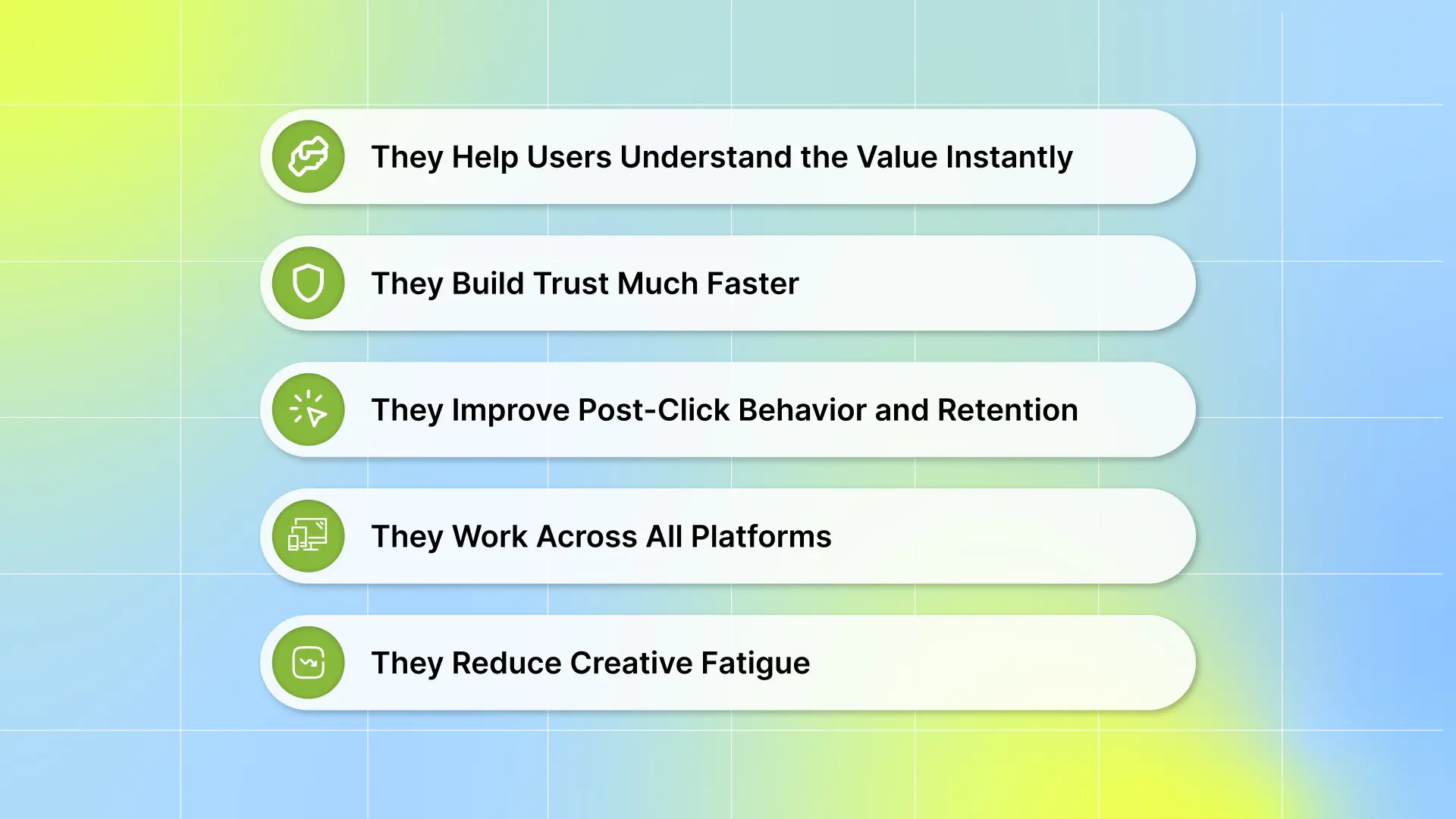
1. They Help Users Understand the Value Instantly
Most users scroll fast, and you don’t get a second chance. A good demonstration video shows the value moment right away, so people clearly understand what your product, app, or game actually does. This reduces confusion and increases clicks from users who already know what to expect.
2. They Build Trust Much Faster
When users see your product working, before/after results, they trust it more. This reduces the skepticism that often leads to low CTR, low install rates, or drop-offs during the consideration stage. Visual evidence is always more convincing than claims.
3. They Improve Post-Click Behavior and Retention
When users know what they’re getting before they click, they’re less likely to churn. Demo-driven traffic often has higher onboarding completion rates because expectations match the post-experience.
4. They Work Across All Platforms
Whether you're running UA campaigns on TikTok, Meta, YouTube, Snapchat, or other networks, demonstration ads fit naturally with platform behavior. The “show and prove” style blends well with native content, helping you capture attention without feeling like a traditional ad.
5. They Reduce Creative Fatigue
Because demo videos highlight real value moments, they stay effective longer. This helps you keep performance stable and avoid sudden drops in CTR, IPM, or ROAS.
And if you want to catch fatigue early before your best-performing demos start slowing down, Segwise’s fatigue tracking can catch fatigue before it impacts your campaign results. It alerts you when performance starts dipping, so you can refresh, iterate, or scale new demo variations without wasting budget.
To make the most of these benefits, it’s important to understand the different types of demonstration ads you can use.
Also Read: Creative Fatigue: Understanding and Managing Ad Performance
Different Types of Demonstration Ads
Demonstration ads come in many styles, and each one helps you show value differently. As a UA leader, you can use these formats to highlight features, prove results, and make users understand your product, game, or app instantly.
Here are the most common types of demonstration ads and what they mean:
1. The Dramatic Demonstration
This format shows your product or app solving a problem in a bold, attention-grabbing way. You exaggerate the moment slightly to create drama, but you still show real value. It works well when you need to hook users fast and make the benefit impossible to ignore.
For example, the LifeVac brand ad is a perfect example of how dramatic demonstrations drive fast engagement and strong action. The brand uses dramatic footage of a man choking to create urgency instantly.
The ad highlights the danger, shows how traditional methods can fail, and then reveals the anti-choking device saving the person. This type of high-stakes visual proof grabs attention within seconds and makes the value of the product extremely clear.
2. The Street Test Demonstration
You take your product into the real world and show real people reacting to it. Their reactions become the proof. For UA, this format works well when you want to highlight trust, ease of use, or authentic outcomes without looking too polished.
For example, Febreze pulled unsuspecting people off the street, blindfolded them, and sat them on a filthy, odor-filled couch inside a dirty room. But after spraying the room with Febreze, participants confidently described it as fresh, clean, and pleasant.
Their reactions are funny, relatable, and completely real, making it a perfect street-test demonstration that proves the product works without any scripted claims.
3. The Problem–Solution Demonstration
You first show the pain point, then instantly demonstrate how your product or app fixes it. This is a high-performing format because it speaks directly to the user’s frustration.
For example, Segwise’s “Stop Guessing What Works!” video starts by highlighting exhausted game characters sitting in the dark, frustrated because they never get credit for the creative elements that drive performance. The video highlights creative teams constantly testing new hooks, backgrounds, characters, and CTAs, but still can’t tell which elements actually drive ROAS.
After showing this struggle, the ad immediately presents the solution; Segwise’s AI Creative Analytics automatically maps creative elements to performance data. This clear “here’s the problem → here’s the fix” flow makes the value obvious within seconds, which is exactly why problem solution demos convert so well.
4. Before-and-After Visual Demonstrations
You show the transformation clearly, what life looks like before using the product, or what it looks like after. This is particularly effective for DTC products, beauty products, and fitness apps, where visible improvement drives conversions.
For example, this VitaGlow ad shows a customer’s face before using the night repair formula and the visible results after 28 days. The difference instantly proves the product works, reducing hesitation and building trust in seconds. This kind of clear, before-and-after transformation is one of the strongest ways to boost CTR and convert high-intent buyers in DTC campaigns.
5. Extreme Testing Demonstrations
You put your product through an “unusual” or “unexpected” test to prove its strength, speed, or reliability. These ads capture attention fast and work well where surprising visuals outperform safe ideas.
For example, the classic American Tourister “Gorilla Test” commercial shows a full-grown gorilla violently throwing, smashing, and jumping on a suitcase inside a zoo cage, and the luggage still doesn’t break.
This extreme torture test instantly proves durability in a way no standard product shot ever could. It’s making it a perfect example of how extreme testing can create high stopping power and strong persuasion in just a few seconds.
6. Influencer Demonstration Partnerships
An influencer shows the product in action, explains how they use it, or walks through the value moment. This combines expert trust with clear proof, making it especially effective for DTC brands and subscription apps targeting niche audiences.
For example, this PROVEN Skincare brand ad features a beauty influencer casually recording herself walking through her full experience, from taking the personalized skin quiz, to unboxing the custom products, to showing how they improved her skin over a few weeks.
The ad feels natural, unscripted, and relatable, which makes viewers trust her results more. Because the influencer demonstrates each step herself, the audience gets both a tutorial and a testimonial, making it a strong converting format for DTC brands.
With the formats in mind, it’s time to create a demonstration ad that delivers real results.
How to Create a Demonstration Ad?
A strong demonstration ad clearly demonstrates your product’s value to keep users interested. Your goal is to make the product or feature so easy to understand that users instantly see why it’s worth trying.
Here are the steps to create a high-converting demonstration ad:
1. Define your objective and audience clearly
Before you plan a demonstration ad, you must be clear about what you want the ad to achieve and who you want to influence. This shapes everything.
Ask yourself,
What is the main goal of this demo? (Install, purchase, subscription, trial, quiz completion)
Who is this ad for?
What does this audience care about the most?
What outcome will make them say “yes” instantly?
This clarity ensures your demonstration feels relevant, targeted, and persuasive instead of generic.
2. Identify the single value moment you want to highlight
Once you know your objective and who you're targeting, choose one clear moment that proves why your product works. This could be the exact point at which a user understands the benefit of using your product or app. This could be a feature that solves a pain, a transformation, a result, or a unique mechanic.
3. Pick the demonstration style that fits best
Different products and apps require different approaches. Each demo type, before-and-after, street test, problem-solution, extreme testing, UGC, or influencer walkthrough, creates a different impact. Choose the format that makes your value easiest to “see”.
Think of your goal: Are you proving speed, simplicity, effectiveness, trust, durability, or personalization? Your goal determines your format.
4. Plan a simple story flow
The biggest mistake teams make is turning demos into complex feature lists. Your ad does not need a script. It needs a clear sequence:
A hook that grabs attention.
The demonstration moment.
The result or payoff.
A clear call-to-action.
When this flow is clear, users stay longer and absorb the value instantly.
5. Capture the demonstration clearly
Record the product, feature, or process clearly. Avoid over-polished shots that feel staged; clarity and authenticity convert better. Your demo should instantly answer, “What is someone looking at?” and “Why should someone care?”
6. Add short on-screen text to guide the viewer
Most users watch ads without sound, so captions matter. Use simple phrases that highlight the benefit or result.
Best practices,
Keep text to 3–6 words per screen.
Use plain language like “Instant results,” “No more lag,” “Brighter skin,” “Try free.”
Use subtitles or captions if someone is talking.
Make sure text is visible on all placements (Reels, Stories, TikTok).
Avoid,
Long sentences.
Over-styling.
Excessive emojis.
Text placed at the edges (may get cut off).
Let the visuals do the heavy lifting and text do the clarifying.
7. Finish with one clear step for the user to take
Tell people exactly what comes next:
“Install now”
“Shop now”
“Take the quiz.”
A confident CTA helps convert users who already believe the demonstration.
8. Produce 3–5 variations for testing
Your first version is rarely the winner. Create quick variations. This helps you discover what resonates without rebuilding the entire ad.
Variation ideas,
Change the hook.
Change the first 3 seconds.
Change the angle (benefit-first vs. problem-first).
Change the setting (bathroom vs. outdoors) for DTC.
Change the CTA style (voiceover vs text-only).
Creatives win through iteration, not perfection.
9. Review performance by creative elements and refine
Once the ad is live, don’t guess what worked; measure it. Look closely at which parts of the demo drove engagement or drop-offs.
Check,
Which hook drove the highest scroll-stop rate?
Which scenes increased IPM or CTR?
Which moments led to drops in retention?
Which demo variation produced the highest ROAS?
Creative success is pattern-driven. If you identify the winning elements, you can use this learning to improve the next version. This is where UA teams get compounding gains.
If you want to know these winning patterns, you need data, and that’s exactly what Segwise gives you. Its creative analytics connects creative elements (hooks, dialogs, visuals, formats, etc.) directly to business outcomes (ROAS, CPA/CPI, LTV, IPM, conversion rates), so teams stop guessing what works and start scaling creatives with data-backed confidence.
Even with a strong process, a few common mistakes can still hurt performance if you’re not careful.
Also Read: Effective Strategies and Examples for UGC Ads
Mistakes to Avoid When Creating a Demonstration Ad
Even the best products or apps won’t convert if the demonstration is unclear, slow, or confusing. Many UA teams lose performance not because of the offer, but because the demo doesn’t show the value fast enough or in the right way. Avoiding these mistakes can save you time, budget, and countless failed tests.
Here are the most common mistakes you should avoid:
1. Taking too long to show the product in action: If your demo waits long before showing the value moment, users will scroll past. You must reveal the action immediately so users understand what you’re offering.
2. Showing too many features at once: A demo filled with multiple angles, benefits, and features becomes overwhelming. Stick to one clear value moment and let the user absorb it without distraction.
3. Over-editing and making the ad look “too polished”: Excessive transitions, heavy graphics, or cinematic shots can make the ad feel unnatural. Demonstration ads convert best when they feel real, simple, and native to the platform.
4. Using unclear or confusing visuals: If users can’t understand what they’re seeing instantly, the ad fails. Your demo should be zoomed in, well-lit, and focused entirely on the action that matters.
5. Adding long explanations or slow voice-overs: Demonstration ads work because they show, not tell. A long introduction or lengthy narration kills attention. Keep explanations short and let the visuals speak first.
6. Not tailoring the demo to the platform: What works on TikTok might not work on YouTube Shorts. Each platform has a different pace, user expectations, and viewing patterns. Your demo should match the style of the feed it appears in.
Conclusion
High-converting demonstration ads are built on clarity, speed, and a strong value moment. When you show the benefits of your product or app in action, users stay engaged longer and convert at a higher rate. By choosing the right demo style, keeping the flow simple, highlighting one core value, and avoiding common mistakes, you can create ads that consistently capture attention and drive stronger results across platforms.
Segwise makes this process even easier by offering the deep insights required to understand what actually works.
With AI-powered creative analytics and automatic tagging, you can scale winners faster and kill losing creatives before they waste budget. Our AI creative tagging automatically identifies and tags creative elements such as hook dialogs, characters, colors, and audio components across images, videos, text, and playable ads, revealing their impact on performance metrics like IPM, CTR, and ROAS.
With tag-level creative element mapping, you can see which specific creative elements drive performance. Discover patterns like "this hook dialog appears in 80% of top-performing creatives" with complete MMP attribution integration. You can also build custom dashboards and automated reports that show how creative decisions impact ROAS across all your apps and campaigns. Moreover, with fatigue detection, you can catch performance decline before it impacts budget allocation and campaign results.
So why wait? Start your free trial today and turn guesswork into data that builds winning demonstration ads.
FAQs
1. How long should a high-converting demonstration ad be?
There’s no one perfect length, but the most effective demo ads grab attention in the first few seconds and keep the total duration concise enough to maintain engagement without losing clarity.
2. Can demonstration ads improve retention after install or purchase?
Yes, when users clearly see what they’re getting before they click, expectations align with experience, leading to better onboarding completion and lower churn.
3. How should you tailor demonstration ads for users at different stages of the funnel?
Top-of-funnel demos can be broader and benefit-focused, while bottom-of-funnel demos should show specific features and clear next steps, helping users ready to convert feel confident taking action.