
Are you still guessing which products, hooks, and messages actually make someone stop scrolling and buy your product?
As a performance marketer, when you’re managing dozens of video variations, a single wrong hook, wrong visual, or wrong message can drain your ROAS. And with competitors using AI to optimize every creative choice, running on instinct isn’t just inefficient, it puts your entire growth strategy at risk.
This blog covers how AI-powered creative insights turn scattered data into clear decisions, helping you personalize every ad for every audience, reduce wasted spend, and finally scale your DTC user acquisition with confidence.
What Hyper-Personalization Really Means?
Hyper-personalization means using customer data such as behavior, browsing patterns, and past actions to shape the ad hooks, visuals, and messages you show at every stage of the journey. Instead of pushing one generic video to everyone, you create versions that match what different audiences actually care about. Each creative feels more relevant, so every impression works harder.
For your DTC brand, this approach helps you deliver the right message to the right audience at the right moment, increasing the chance they stop, engage, and convert. And as your data grows, your personalization becomes sharper, helping you scale DTC performance with confidence.
And once you understand what hyper-personalization actually involves, the next step is to see how it stands apart from basic personalization.
How does it differ from Basic Personalization?
Hyper-personalization goes far beyond showing someone a generic “recommended for you” product or swapping out a headline. It uses ad performance data, user behavior, and audience signals.
Here is how hyper-personalization differs from basic personalization:
Decisions are driven by behavioral and creative performance data, not just demographics or past purchases.
Creative elements adapt proactively as engagement patterns shift, instead of relying on fixed rules.
Every creative decision links back to performance outcomes, making it easier to scale winning patterns and pause underperforming ones.
Hyper-personalization uses advanced AI, machine learning, and predictive analytics to process vast amounts of data. In contrast, basic personalization relies on basic algorithms and CRM tools.
And when personalization depends on accurate, proactive decisions, the role of AI becomes impossible to ignore.
Why AI Creative Insights Matter for Hyper-Personalization?
If you want to personalize your brand ads at scale, you can’t rely on gut feeling. You need to understand why people eventually become loyal customers. AI creative insights reveal those patterns, so your personalization becomes accurate rather than random.
Here are key reasons AI creative insights are essential for hyper-personalization:
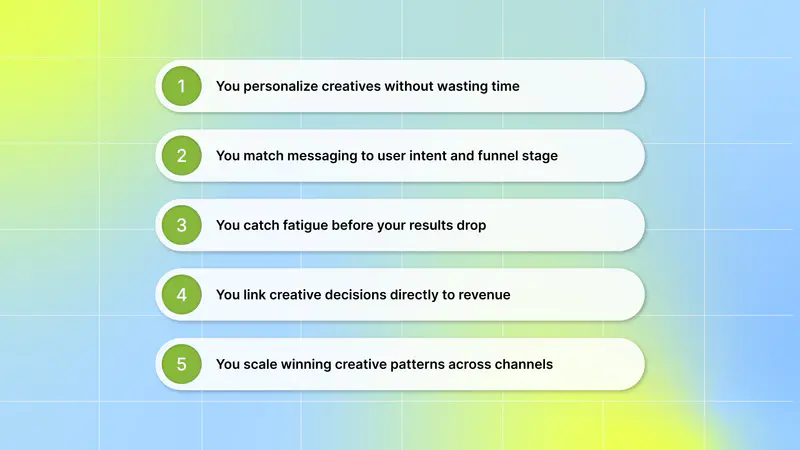
1. You personalize creatives without wasting time
Instead of manually reviewing hundreds of videos, AI tags every hook, visual, and message for you. This gives your team more time to create better ads instead of sorting through files.
2. You match messaging to user intent and funnel stage
AI shows how users react at awareness, consideration, and conversion stages, helping you deliver creatives that feel timely, relevant, and aligned with their intent.
3. You catch fatigue before your results drop
AI detects when a message or creative style is starting to decline, so you can track fatigue and refresh your ads before your ROAS hits.
4. You link creative decisions directly to revenue
AI connects creative elements to ROAS, CTR, CPA, and LTV, giving you clear proof of what’s working and letting you scale winning ideas with confidence.
5. You scale winning creative patterns across channels
AI identifies creative patterns that succeed on Meta, TikTok, and Google, helping you build variations designed to perform on each platform’s unique behavior and algorithm.
Now, it’s time to look at the strategies that turn those insights into scalable growth.
Also Read: How to Combat Creative Fatigue with AI Solutions
AI Creative Insight Strategies That Drive Hyper-Personalization
AI helps you understand exactly why certain creatives work for specific audiences and how to personalize them at scale. With AI, personalization becomes scalable, predictable, and rooted in performance data.
Here are key strategies that help you deliver personalization that actually improves ROAS, performance, and creative efficiency:

1. Creative Tagging at Scale
AI breaks down every creative into components: hooks, emotions, product angles, colors, dialogs, pacing, CTAs, and more. This lets you see exactly which elements top-performing videos share and which elements appear in underperformers.
Without AI, this level of tagging takes hours; with AI, you get instant clarity on what’s driving results. This becomes the foundation for building more personalized, high-impact variations.
With Segwise AI creative tagging, you can automatically identify and tag creative elements like hook dialogs, characters, colors, and audio components across images, videos, text, and playable ads to reveal their impact on performance metrics like IPM, CTR, and ROAS.
2. Creative Clustering to Identify Winning Themes
When you have hundreds of videos, patterns get lost. AI groups similar creatives together and compares how each cluster performs with different audiences. You learn which themes work best for new shoppers, returning buyers, high-intent users, and cold traffic.
This lets you build creative concepts tailored to each mindset instead of recycling the same idea across all audiences.
3. Predictive Insights From Past User Behavior
AI analyzes how users interacted with previous campaigns, scroll depth, watch time, replays, pauses, exits, add-to-cart behavior, and purchase history. It predicts what type of creative each segment is most likely to engage with next.
Instead of testing blindly, you launch campaigns with data-backed confidence, reducing wasted spend and speeding up your learning cycles.
4. Dynamic Creative Optimization (DCO)
DCO helps you create multiple versions of the same video and match them to the right users automatically. AI adjusts headlines, CTAs, overlays, product highlights, or even the sequence of scenes based on user behavior.
It continuously tests and switches to the best-performing version in near real time. This ensures that each user sees the creative with the highest probability of converting.
5. Audience-Level Creative Mapping
AI analyzes data to help you understand what different audiences want to see. Maybe first-time shoppers prefer UGC testimonials, while repeat buyers engage more with product benefits or upgrades.
High-intent users might convert better with offer-based creatives, while window shoppers are more likely to engage with educational content. This data helps you personalize creatives for each audience’s intent and journey stage.
6. Fatigue Detection and Refresh Triggers
Creative fatigue hits fast in DTC, especially on Meta and TikTok. AI detects early signs that your audience has stopped responding, lower watch time, declining CTR, rising CPA, or drop-offs in the first 3 seconds.
Instead of reacting late, you get early signals so you can refresh creatives proactively. This protects your ROAS and prevents campaigns from slowly burning budget.
With Segwise, you can catch performance decline before it impacts budget allocation and campaign results. Moreover, with tag + creative performance mapping, you can combine creative tracking with tagged creative elements to see which specific components drive sustained performance versus early fatigue patterns.
7. Data-Driven Creative Briefs
AI converts performance insights into actionable briefs your creative team can use immediately. Instead of vague instructions like “make it more engaging,” you get specifics:
Which hook to start with
Which product angle to highlight
Which emotion to use
Which CTA converts best
Which scenes correlate with high ROAS
This helps your creative team produce better ads faster, aligned with what your audience actually wants.
With these AI-powered strategies in place, the next step is to ensure a clear, repeatable implementation process.
How to Turn Creative Data Into Hyper- Personalized UA Campaigns
This process helps you turn raw creative data into precise decisions that drive personalized, high-performing UA campaigns. Instead of testing randomly, you follow a clear process to build, personalize, and scale creatives with confidence.
Here are the key steps to implement hyper-personalization in your strategy:

1. Centralize your creative and performance data: Bring all your creative assets and metrics (watch time, CTR, ROAS, CPA) into one place so AI can analyze them together.
2. Let AI tag and break down your creatives: Use AI to identify creative elements so you know exactly what elements appear in top- and low-performing videos.
3. Spot patterns across audiences and channels: AI shows which elements perform for new vs repeat customers, high-intent vs cold traffic, Meta vs TikTok. You finally see why certain videos work.
4. Identify what’s truly driving conversions: Use these insights to understand which hooks, themes, messages, and product angles influence ROAS. This tells you what to prioritize.
5. Build personalized creative variations: Use those insights to create different variations tailored to each audience’s behavior and stage in the funnel. Adjust pacing, format, and storytelling based on how audiences behave on Meta, TikTok, and Google to maximize relevance and results.
6. Monitor performance and detect fatigue early: Use AI to track performance shifts and catch early signs of fatigue so you can refresh creatives before ROAS drops.
7. Optimize and scale high-performing versions: Double down on creative variations that consistently win, and use AI recommendations to guide your next testing cycles.
If you want to do this faster and with more clarity, Segwise can help. With AI-powered creative tagging and creative analytics, you can connect creative elements (hooks, dialogs, visuals, formats, etc.) directly to business outcomes (ROAS, CPA/CPI, LTV, IPM, conversion rates), so teams stop guessing what works and start scaling creatives with data-backed confidence.
Even with the proper process in place, common challenges can limit the impact of your personalization efforts if you're not prepared for them.
Also Read: How to Personalize the Ad Creatives Across Channels?
Common Mistakes DTC Teams Make And How to Avoid Them
Hyper-personalization can significantly increase your ROAS, but only if you execute it the right way. Many DTC UA teams rush into personalization without the right data, which leads to inconsistent results and wasted spend. With AI creative insights, you can avoid these mistakes and build personalization that actually works.
Here are five common mistakes and how to fix them:

1. Personalizing Without Enough Creative Data
Many teams try to personalize without sufficient creative data, leading to random tests that never scale. The solution is to centralize your creative performance data first so AI can reveal patterns before you build variations.
With Segwise creative analytics, you get all your creative data in one place. So, you don't need to jump between Facebook Ads Manager, Google Ads, TikTok, and your MMP dashboard. You can see creative-level ROAS, CPA, LTV, and conversion rates across all sources in a single unified view.
2. Over-Personalization
Some teams create too many personalized variations before they understand what actually works. Instead, start with a few data-backed creative themes and expand only after AI confirms which ones perform. This keeps your testing efficient and your budget under control.
3. Relying on Targeting but Ignoring Creative Personalization
Many UA teams focus on audience targeting but run generic creatives. The solution is to personalize your hooks, visuals, and messages using AI insights so your ads feel relevant to each segment.
4. Using the Same Creative Across All Channels
Teams often push the same creative across Meta, TikTok, and Google, expecting the same results. The better approach is to personalize creatives by channel: adjust pacing, format, storytelling, and hooks based on how people engage on each platform.
5. Catching Creative Fatigue Too Late
Teams often notice fatigue only after ROAS drops. Use AI fatigue detection to spot early signs, such as declining watch time or rising CPA, so you can refresh creatives before performance collapses.
You can use Segwise fatigue tracking to catch fatigue before it impacts your budget allocation and campaign results.
Conclusion
Hyper-personalization with AI creative insights is how leading DTC brands are turning creative chaos into profitable growth. When data shapes every impression, hook, and message, you improve ROAS, reduce wasted spend, and launch ads with confidence. AI brings speed, clarity, and precision to decisions that used to take weeks.
If you're looking to turn your creative data into actual decisions, Segwise is built for you. It's an AI-powered platform that helps performance marketers and growth teams understand exactly what works and why.
With multi-modal AI creative tagging, you can automatically identify and tag creative elements like hook dialogs, characters, colors, and audio components across images, videos, text, and playable ads to reveal their impact on performance metrics like IPM, CTR, and ROAS. Moreover, with fatigue tracking, you can catch a decline in performance before it affects budget allocation and campaign results. With this, you also get daily email reports that keep you informed without constant manual performance checking.
With tag-level creative element mapping, you can see which specific creative elements drive performance. Discover patterns like "this hook dialog appears in 80% of our top-performing creatives" with complete MMP attribution integration. Moreover, with data-backed creative iteration, you can make creative decisions based on actual performance data from both ad networks and MMPs to scale winners and avoid losers.
With AI creative generation, you can generate creative variations based on actual performance data from your campaigns. Segwise understands which specific creative elements drive ROAS, CPA, and conversion rates via its Creative Tagging and Analytics agents. Moreover, with custom dashboards, you can create automated reports that show how creative decisions impact ROAS across all your campaigns.
So, are you ready to turn your data into insights and create hyper-personalized ads with confidence? Start your free trial now!
FAQs
1. Can hyper-personalization help lower my CPA and increase ROAS?
Yes, by tailoring creative and targeting to individual behaviors and intent, hyper-personalized campaigns can improve engagement and conversion efficiency, reducing cost per acquisition and boosting return on ad spend.
2.What challenges should DTC brands expect when adopting hyper-personalization?
Challenges include maintaining data privacy compliance, ensuring data quality, avoiding over-automation that loses brand voice, and balancing AI outputs with human creativity to preserve emotional resonance.
3. Can AI creative insights work across multiple ad platforms?
Yes, AI can analyze and optimize creatives for Meta, TikTok, Google, and other channels simultaneously, revealing channel-specific trends and patterns that help personalize messaging for each platform.