
Why do your top-performing UGC ads on Meta suddenly fall flat on TikTok?
Creative performance doesn’t behave the same across channels. What works on one platform can flop on another. And when you’re not personalizing your ad creatives by channel, you’re silently burning budget, killing ROAS, and slowing down your UA experiments before they even start.
This blog shows you exactly how to personalize ad creatives for each channel from Meta to TikTok, so your UA or creative team can scale with confidence, catch fatigue early, and stop wasting spend on creatives that don’t convert.
What Is Cross-Channel Personalization?
Cross-channel personalization means tailoring your ad creatives to fit the unique behavior, format, and audience expectations of each advertising platform, like Meta or TikTok.
Instead of using the same creative across channels, you adjust creative elements such as hooks, visuals, copy, and CTAs based on how users engage with each channel. This helps your team drive better installs, purchases, and subscriptions by matching the creative to the user journey on every platform.
Here are key reasons why cross-channel personalization is essential for your UA strategy:
It helps you align your creatives with how users interact and consume content on each platform.
You can identify which creative elements perform best on specific channels.
It prevents early creative fatigue by rotating platform-specific variations instead of reusing the same ad.
It gives your team cleaner data on what truly drives installs, sales, or subscriptions across networks.
It lets you scale winning creatives confidently while cutting wasted spend on low-performing channels.
To make cross-channel personalization actually work in your UA strategy, you need the right components in place.
Also Read: Understanding Personalized Marketing: What It Is and Why It Matters
Components of a Successful Cross-Channel Personalization
Whether you’re promoting a mobile game, a DTC brand, or a subscription app, you need a system that keeps your message consistent while adapting your creative to each channel’s behavior.
Here are the key components of a successful cross-channel personalization strategy:
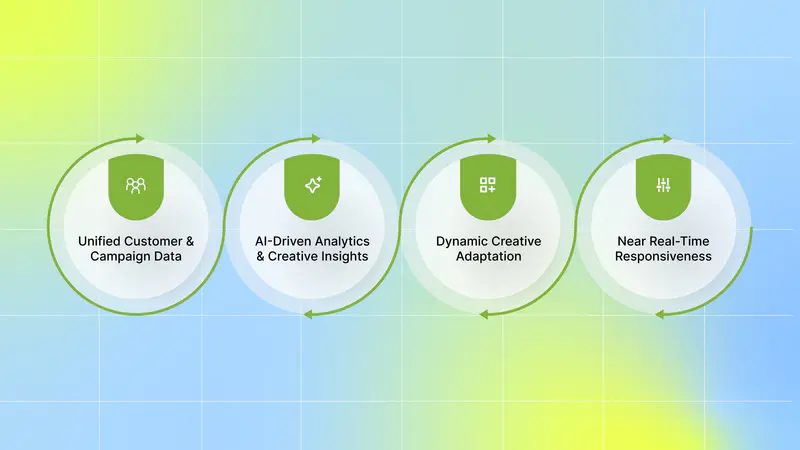
1. Unified Customer and Campaign Data
You can’t personalize effectively if your data lives in silos. Your personalization strategy starts with bringing together performance and behavioral data from all your touchpoints, ad networks, MMPs, CDPs, and analytics platforms. When your data is unified, you can see the full user journey and personalize creatives and offers based on what users actually do, not what you assume they’ll do.
2. AI-Driven Analytics and Creative Insights
Collecting data is one thing, but understanding what it means is where AI adds real value. Use AI-powered analytics tools such as Segwise to find winning creatives. AI helps your team act faster, turning creative performance data into decisions that scale your best ads and fix underperforming ones before they waste budget.
3. Dynamic Creative Adaptation
Personalization isn’t about creating hundreds of different ads; it’s about adjusting your creative dynamically for each channel and audience. Dynamic creative optimization (DCO) tools can help automate this process, ensuring every version of your creative fits both the channel and the user context.
4. Near Real-Time Responsiveness
Your personalization strategy should react as quickly as your users do. When someone installs your app, abandons a cart, or drops off after a trial, your system should automatically trigger relevant touchpoints across multiple platforms. When your system responds instantly to which channels your ad gets more conversions, you reduce wasted spend and scale creatives faster across channels.
A successful cross-channel personalization strategy doesn’t just deliver ads, it builds connected, data-driven experiences that guide users from first impression to conversion.
Building on these core components, the next step is to turn them into a structured strategic framework that your UA team can apply across every channel.
How to Build a Channel-Aware Personalization Strategy Framework
If you want your UA campaigns to perform consistently across channels, you need a clear framework that helps your team decide what to personalize, where, and why. A channel-aware framework removes guesswork and enables you to design creatives that fit the unique behavior and intent of every platform.
Here are key steps to help you build your own channel-aware personalization strategy framework:

Step 1: Define the creative intent per channel
Before creating assets, clarify what each channel is meant to do. Is it for acquisition or retargeting? Upper funnel awareness or lower funnel conversion? Each platform’s algorithm rewards different signals. TikTok favors engagement, while Google UAC focuses on installs or purchases. Knowing this helps you choose the right format and message.
Creative Intent | Format | Channel Examples |
Awareness | Short-form video / UGC | TikTok, Meta reels, YouTube shorts |
Consideration | Explainer or demo | YouTube videos, Meta feed |
Conversion | Offer-driven ad | Google UAC, Meta retargeting |
Step 2: Identify the creative elements to personalize
Every channel has different creative triggers that drive action. This is where your team focuses on creative element mapping to understand what to tweak for each audience and platform, using past ad data.
Elements to customize:
Hooks that grab attention in the first 2 seconds.
Dialog or captions tailored to the platform tone.
Static image, video ads, or UGC testimonials.
Characters or creator presence for authenticity.
Visual pacing and motion design.
Offers and discounts (for DTC brands).
Feature showcases (for subscription apps).
Product storytelling and benefits (for DTC).
End cards with clear CTAs.
With Segwise tag-level performance optimization, you can instantly see which creative elements, themes, and formats drive results across all your campaigns and apps.
Step 3: Map these elements to each channel’s unique behavior
Each platform behaves differently, so your creative must adapt accordingly. To make your creative personalization work, you need to adapt the same concept to fit each platform’s unique style, pacing, and audience intent.
Here’s how your creative approach should change across major ad channels:
Meta (Facebook + Instagram)
Meta users scroll fast, but they also respond to emotional storytelling. Lead with relatable hooks, short intros, or pain-point-driven dialog that makes people stop. Use social proof, testimonials, or real results to build trust early. For mobile games, show quick gameplay moments that feel rewarding; for DTC, highlight transformation or benefit in the first few seconds.
TikTok
TikTok rewards authenticity, not polish. Use creator-style UGC, trending sounds, and vertical framing that feels native. The hook should come within the first 1–2 seconds, ideally opening with someone speaking directly to the camera. Humor, challenges, or storytelling formats work well. For apps and games, showcase real reactions or user experiences; for DTC brands, make the ad look like a natural TikTok post, not an ad.
Google UAC (App Campaigns)
Google’s algorithm optimizes automatically, so your creatives need to be modular and clear. Focus on what drives installs or conversions, like app features, gameplay rewards, or value propositions. Avoid long intros; get straight to the core benefit. The first few frames should visually explain your app or product without relying on text or sound.
YouTube
YouTube users are willing to watch longer videos, but only if your ad feels relevant and engaging. Use strong storytelling and pacing to keep them hooked. For UA campaigns, blend emotional storytelling with product clarity: show why your app or product solves a real problem. End with a clear, spoken CTA since audio is a key driver here.
When mapping creatives across channels, remember:
Keep your brand story consistent, but adapt your visuals, hooks, and CTAs.
Test platform-specific tones (conversational for TikTok, polished for YouTube).
Use your learnings from one channel to inspire, not duplicate, across others.
This way, each platform feels like it’s speaking the user’s language, while your brand stays consistent and performance-focused.
Step 4: Create Channel-Specific Creative Briefs Your Team Can Scale
Instead of relying on generic design templates, build channel-specific creative briefs to guide your team in producing platform-ready assets. A creative brief serves as a blueprint that defines the audience mindset, tone, pacing, hooks, and format required for each platform. It helps your team to understand why a creative works and how to adapt it for a specific channel.
For example, your TikTok Creative Brief could outline:
Open with an emotional hook or a relatable dialog within the first 2 seconds.
Use creator-led content that feels native and unscripted.
Keep visuals fast-paced and sound-led to match TikTok’s energy.
Once these briefs are ready, your creative or production team can generate the ad variations based on these guidelines, ensuring that every asset aligns with the channel's intent, tone, and audience behavior.
Step 5: Track and analyze creative performance
Once your creatives go live, your primary focus should be on measurement, not production. Instead of evaluating ads only at the campaign level, analyze performance by creative level, like hook, visual theme, dialog style, or CTA. This helps you understand why a particular ad is working and which elements are driving installs, purchases, or subscriptions.
Look for trends such as:
Which hook formats drive the highest IPM or ROAS on each channel?
Which visuals or motion styles sustain performance longer before fatigue?
How do CTAs or offers perform across platforms with different audience intent?
Use these insights to create data-backed feedback loops for your UA and creative teams. This ensures every new batch of creatives (from your internal or external teams) is informed by what’s proven to work, not assumptions or gut feel.
Step 6: Refresh and Rotate Creatives Before Fatigue Hits
Creative fatigue is one of the biggest reasons strong campaigns start losing performance. To stay ahead, build a clear system for when to refresh, rotate, or retire creatives across channels. Each platform shows fatigue differently. On Meta, you might notice rising CPIs or dropping CTRs. On TikTok, engagement may dip faster as trends shift.
Set specific rules to guide your team:
Refresh creatives once frequency or spend share crosses your set limit.
Rotate new variations built from the best-performing creative elements.
Replace fatigued assets with fresh hooks, visuals, or storylines without changing your core message.
Keep a pipeline of new creatives ready, so you’re never reacting late.
If you want to automate creative fatigue detection and know exactly when a creative is burning out, use Segwise. It automatically detects a continuous decline in performance metrics and spend share, so you can refresh or rotate creatives before spend goes to waste.
You can also set specific performance targets for new creatives you want to monitor with our custom success criteria tracking. Track ROAS thresholds, spend share goals, or any custom criteria that matter to your optimization strategy.
The best way to understand the value of personalization is to see it in action through real-world brand examples.
Real Examples of Cross-Channel Personalization
Founded in 2018, Sukoshi Mart quickly became a favorite destination for fans of Asian beauty and pop culture. The founders built the brand around high-quality products that celebrate and share Asian culture. With nine stores across Canada and a successful expansion into the U.S. through their first location in New York City, Sukoshi Mart continues to grow rapidly. However, as demand increased, so did the operational and marketing challenges.
Challenge
Lack of Mobile Optimization: Mobile traffic was high, but the website failed to deliver a smooth experience. There was no retention strategy or way to engage users beyond a single visit.
Missing omnichannel link: Without a mobile app, they couldn’t connect in-store and online experiences, limiting repeat purchases.
Low engagement and weak data: Few users signed up or returned. They couldn’t collect enough first-party data to build personalized campaigns or retarget effectively.
Solutions
Launched a mobile app to bridge web, app, and in-store experiences. The app maximizes mobile traffic and improves the user experience.
Integrated Yotpo for reviews and enabled product variants, creating transparency with buyers and building credibility.
Enabled seamless integrations with analytics tools like Meta and Google Analytics to track performance more effectively.
Integrated Klaviyo and loyalty programs for cross-channel personalization, retargeting, and reward campaigns.
Used push notifications and SMS campaigns to re-engage users.
Implemented upsell, cross-sell, and discount features to boost AOV and retention.
Results
3x Conversion Rate: The new app design and features led to higher conversion rates, boosting sales.
1.22x Average Order Value (AOV): Upsell and cross-sell features increased spend per transaction.
40% of Direct-to-Consumer (DTC) Business Through Mobile App: The app became a high-performance sales channel, capturing more than 40% of revenue.
The above example highlights what’s possible when personalization is done right. But consistent performance comes from following certain practices.
Best Practices for Implementing Cross-Channel Personalization
Cross-channel personalization works best when your strategy goes beyond simply running ads on multiple platforms. It’s about understanding your audience, tailoring your creatives to their behavior, and maintaining consistency across every touchpoint.
Here are the best practices to follow:

1. Know Your Personas
Understanding your audience is the first step to cross-channel personalization. Each persona interacts differently across platforms. What works on TikTok may not connect on Meta or YouTube. Identify who your users are, where they spend time, and what creatives drive them to act. When you know what your users care about, your creatives and offers become far more relevant and effective.
2. Build Campaigns Around Journeys
Users don’t think in “channels,” they move between them. Map your creative strategy around the full user journey: from awareness on TikTok or Meta to retargeting on Google or YouTube, and re-engagement via app push. This ensures your message feels connected at every step and your spend drives long-term growth, not just clicks.
3. Test, Learn, Optimize, Repeat
Cross-channel success depends on constant iteration. Test one creative variable (hook, CTA, visual style) at a time and track which elements perform best by platform. Use those insights to update your creative briefs and scale winners. Continuous testing keeps your ads fresh and your ROAS strong.
4. Automate Tagging and Reporting
Manual creative tagging slows you down and limits visibility. Use AI-powered tagging tools to track performance at the element level across channels. Automating your tagging and reporting ensures you always know which creative elements drive installs, purchases, or subscriptions without wasting hours on spreadsheets.
If you want to automate creative tagging, reporting, and see exactly which elements drive ROAS across Meta, TikTok, Google, and more, Segwise does it for you instantly. Our AI creative tagging automatically organizes images, videos, text, and playable ads to reveal which creative elements drive performance.
With our custom dashboards and reporting, you can build dashboards around your specific KPIs and stakeholder needs. Create automated reports that show how creative decisions impact ROAS across all your apps and campaigns.
5. Maintain Consistency in Brand and Messaging
Even when you personalize by channel, keep your brand voice, tone, and message consistent. Each ad should feel like part of the same story, just told differently for each platform. This builds recognition and trust—two essentials for long-term UA performance.
Also Read: How to Overcome TikTok Creative Fatigue
Conclusion
Cross-channel personalization is one of the most powerful ways to improve UA performance. When you tailor creatives to each platform’s behavior and audience mindset, you reduce wasted spend, slow down fatigue, and give your campaigns a much higher chance of reaching their goals.
To put this strategy into action at scale, you need a platform that turns creative data into clear insights, and that’s where Segwise comes in. Segwise automatically tags your creatives, unifies ad network and MMP data, detects fatigue early, and reveals which creative elements drive conversion.
Our powerful AI creative tagging automatically identifies and tags creative elements like hook dialogs, characters, colors, and audio components across images, videos, text, and playable ads to reveal their impact on performance metrics like IPM, CTR, and ROAS. Its tag + creative performance mapping feature combines creative tracking with tagged creative elements to see which specific components drive sustained performance versus early fatigue patterns.
With our creative analytics, you can make creative decisions based on actual performance data from both ad networks and MMPs to scale winners and avoid losers. Our comprehensive dashboard offers a unified view of ad network and MMP data, eliminating the need for manual data collection across multiple platforms. Moreover, with tag-level performance optimization, you can instantly see which creative elements, themes, and formats drive results across all your campaigns and apps.
So, do you want to unlock smarter, faster, and more scalable creative personalization across channels? Start your free trial today!
FAQs
1. Is unified customer data necessary for personalization to work?
Yes, having unified data (from app analytics, ad networks, onsite behavior, CRM, etc.) is foundational. Without a complete view of user touchpoints, it's hard to know which creative element works where and why.
2. How many creative variations should I run when personalizing across different channels?
There’s no one‑size number, but best practice suggests testing a handful of variants (differing in hook, CTA, visuals, or layout) per channel rather than dozens. This allows for clearer insights while avoiding data fragmentation.
3. Can dynamic creative optimization (DCO) help with cross‑channel personalization?
Yes. DCO tools dynamically assemble ad versions by combining different creative elements (images, text, offers) based on data or user attributes, making it easier to scale and test creative variants across channels.