
Key Takeaways
Guesswork Hurts: Ads based on gut feel lead to wasted spend, missed fatigue, and unstable ROAS across platforms.
AI Adds Clarity: AI replaces manual analysis by revealing which creative elements, audiences, and campaigns actually drive acquisition results.
Creatives Matter: Understanding hooks, visuals, messages, and formats at a creative level is key to boosting winners and avoiding low-impact ideas.
Act Early: AI helps detect creative fatigue and performance decline before costs spike, protecting budgets and stabilizing growth.
Platforms Win: AI-powered platforms like Segwise turn fragmented campaign data into actionable creative insights, helping teams optimize faster.
Are you launching more ads yet still unsure which ones actually deserve more budget?
You’re testing dozens of creatives across Meta, Google, TikTok, and DSPs, but performance still feels unpredictable. Some ads spike for a few days, then quietly die. Others burn spend without ever proving value. When decisions rely on gut feel, teams end up scaling the wrong creatives, missing early fatigue, and watching ROAS slip before you even realize what went wrong.
This is where using AI in advertising changes how you make user acquisition decisions. This blog will explore how to use AI in advertising to improve user acquisition results by understanding which creative elements drive performance, catching fatigue early, and making smarter decisions across platforms.
What Is AI in Advertising?
AI in advertising is the use of machine learning and automation to analyze large volumes of ad, creative, and performance data. Instead of relying only on platform-level metrics, AI uncovers patterns across creatives and campaigns that are difficult to spot manually. The goal isn’t to replace your strategy, but to support it with clear, data-backed insights.
It also improves campaign efficiency by automating tasks such as bidding, creative testing, and audience targeting, enabling faster, more consistent execution as scale increases.
As advertising becomes more complex, understanding why AI matters for performance becomes essential.
Why Do You Need AI for Advertising?
You need AI for advertising because user acquisition has become too complex to manage with manual analysis. When you’re running multiple creatives across platforms, AI helps you understand what’s working, what’s wasting spend, and where performance is likely to drop before it impacts your results. It gives you clarity and speed that manual reporting can’t match.
Here are key reasons why AI is essential for advertising: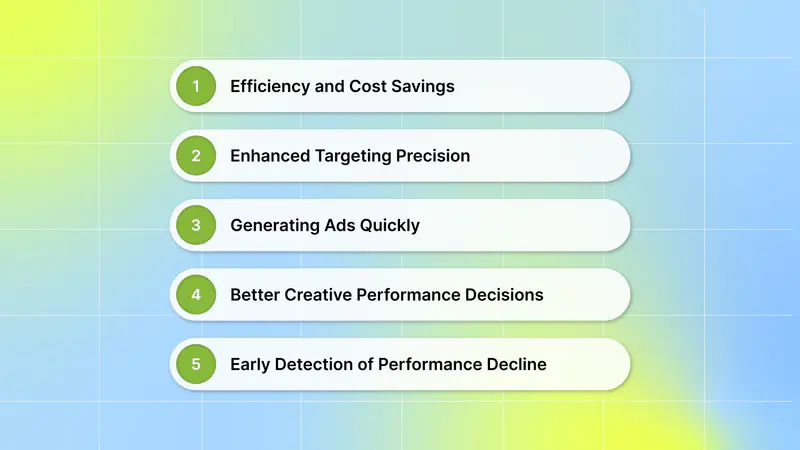
Efficiency and Cost Savings: AI automates time-consuming tasks such as performance analysis, reporting, and optimization, reducing manual effort and preventing wasted budget on underperforming ads.
Enhanced Targeting Precision: AI analyzes user behavior and campaign data to help you reach higher-quality users who are more likely to install, purchase, or subscribe.
Generating Ads Quickly: AI helps speed up creative production and testing by supporting rapid generation and iteration of ad variations, allowing you to test more ideas without slowing down launch cycles.
Better Creative Performance Decisions: AI helps you understand which hooks, visuals, and messages actually drive results, so you can scale winners instead of guessing.
Early Detection of Performance Decline: AI spots early signs of creative fatigue, enabling you to refresh or pause ads before ROAS and CPA are impacted.
The next step is applying it in ways that actually improve campaign performance.
Also Read: Creative Fatigue: Understanding and Managing Ad Performance
How to Use AI in Advertising for Better Campaign Performance
AI is used in advertising to help you analyze performance, optimize spend, and improve creative decisions across user acquisition campaigns. It supports faster learning, better efficiency, and more consistent results as campaign complexity increases.
Here are the top ways to use AI in advertising:
1. Creative Performance Analysis at Scale
This focuses on understanding how each creative performs across platforms and campaigns. AI analyzes performance data to show which hooks, visuals, formats, or messages drive installs, purchases, or subscriptions. Instead of guessing, you get clarity on why some creatives work better than others.
By knowing exactly which creative elements drive results, you can double down on winning patterns and avoid repeating low-impact ideas. This leads to more consistent performance and higher efficiency as spending increases.
An AI-powered platform like Segwise makes this process easier by connecting creative elements directly to business outcomes, so teams stop guessing what works and start scaling creatives with data-backed confidence. Moreover, with tag-level performance optimization, you can instantly see which creative elements, themes, and formats drive results across all your campaigns and apps. This helps you turn creative analysis into faster, more confident optimization decisions.
2. Programmatic Media Buying and Bid Optimization
AI helps manage how and where your ads are bought in near real time across ad platforms and exchanges. It continuously adjusts bids based on competition, placement quality, and performance signals, removing the need for constant manual tuning.
Smarter bid decisions help you win higher-quality impressions at lower costs. This improves reach efficiency and ensures your budget is spent where it’s most likely to drive conversions.
3. Early Detection of Creative Fatigue
AI identifies when creatives start losing effectiveness. AI monitors trends such as declining engagement, rising costs, and reduced conversions at the creative level, often before performance drops.
Acting early allows you to refresh or rotate creatives before ROAS or CPA takes a hit. This protects your budget and helps maintain stable performance, rather than reacting after results decline.
You can use AI-powered platforms like Segwise to automate performance monitoring and detect continuous declines in key metrics and spend share. This helps you catch creative fatigue early, before it impacts budget allocation or campaign results. With custom success criteria tracking, you can also set clear performance targets for new creatives and monitor whether they meet your acquisition goals from the start.
4. Smarter Budget Allocation Across Campaigns
AI analyzes performance across campaigns, ad sets, and platforms to guide budget distribution. It highlights where spending should increase and where it should be reduced based on performance signals.
Shifting budget toward stronger campaigns improves overall returns without increasing total spend. This reduces wasted budget and helps you scale growth more efficiently.
5. Improved Targeting and Audience Segmentation
AI studies user behavior, engagement patterns, and conversion data to refine targeting. It helps identify audiences that are more likely to install, purchase, or subscribe, rather than relying on broad segments. AI considers their specific intent and past behavior to increase engagement and conversion rates.
Reaching higher-quality users improves conversion rates and downstream value. This allows you to achieve better results without relying solely on higher bids or increased spend.
6. Creative Testing and Iteration at Scale
AI enables you to test multiple creative ideas, messages, and formats at the same time across platforms. It tracks how different headlines, visuals, CTAs, and story angles perform, while dynamic creative optimization (DCO) automatically mixes elements to test many variations without manual effort.
Based on these learnings, AI supports the rapid creation of new creative variations using existing assets or performance insights. This allows your team to respond quickly to fatigue or scaling opportunities, keeping campaigns fresh, shortening learning cycles, and ensuring spend stays focused on creatives that drive acquisition results.
7. Faster Ad Copy Creation at Scale
AI uses prompts to guide how ad copy is written, helping generate hooks, headlines, and CTAs that match your acquisition goals. It can produce multiple copy variations without manual rewriting. This supports rapid experimentation while maintaining messaging consistent with the campaign's intent.
Generating copy faster allows you to test more messages and identify what resonates with users sooner. This improves click-through and conversion rates, and ensures your campaigns don’t stall due to slow copy production.
AI can be a powerful advantage in advertising, but common mistakes often prevent teams from seeing its full impact.
Also Read: A Complete Guide to Programmatic Media Buying and Advertising
Common Mistakes Teams Make When Using AI
Teams often struggle with AI in advertising because they treat it as a shortcut instead of a decision-support tool for user acquisition. Relying too much on automation, using the wrong signals, or applying AI without a clear strategy can lead to wasted spend and poor creative decisions. AI works best when it supports your planning, testing, and scaling of campaigns.
Here are the most common mistakes teams make when using AI in advertising and how to resolve them:
Using AI Only for Automation, Not for Insights: Some teams use AI only to automate bidding or creative production, while ignoring performance insights. This leads to faster execution without better decisions, which often increases spend without improving results. Use AI to surface creative and performance insights first, then automate actions based on those learnings.
Optimizing for the Wrong Metrics: AI is only as good as the signals you give it. Focusing on clicks or short-term engagement rather than installs, purchases, subscriptions, or LTV can push AI to optimize for low-quality users. Align AI optimization with the metrics that actually matter to user acquisition outcomes.
Ignoring Creative Fatigue Signals: Teams often rely on AI to scale winners but forget to monitor when creatives start declining. Without paying attention to early fatigue signals, performance drops before action is taken. Continuously tracking creative performance trends allows teams to act before results decline.
Scaling Too Fast Without Enough Learning: Rushing to scale based on early results can cause instability. AI needs sufficient data and testing time to surface reliable patterns, and skipping this learning phase often results in wasted budget. Allow campaigns to collect enough data before making aggressive scaling decisions.
Feeding AI Incomplete or Fragmented Data: When AI only sees part of your performance data, it makes weaker recommendations. Fragmented data leads to misleading insights, causing teams to optimize in the wrong direction and miss the true drivers of user acquisition performance. Connecting creative, campaign, and attribution data into a single view strengthens AI-driven decisions.
Avoiding these mistakes depends on having the right system in place to turn data into consistent, actionable decisions.
How an AI-Powered Platform Boosts Campaign Performance
An AI-powered platform boosts campaign performance by continuously analyzing creative, spend, and performance data to inform better user-acquisition decisions. The right platform should help you understand which creative elements drive results, spot fatigue early, and turn campaign data into clear, actionable guidance, so you can optimize faster and scale with confidence.
If you are searching for an AI-powered platform to boost your campaign performance with deeper creative insights and smarter decision-making, Segwise is built to understand what’s working, catch issues early, and scale campaigns with confidence.
Here is how Segwise boosts your campaign performance:
Automated Creative Tagging: Segwise uses multi-modal AI to automatically tag creative elements like hook dialogs, characters, colors, visuals, and audio across images, videos, text, and playable ads to reveal their impact on performance metrics like IPM, CTR, and ROAS.
Tag-Level Creative Element Mapping: Instead of looking at creatives as a whole, Segwise shows you which individual elements drive results. You can spot patterns such as which hooks, dialogs, or visuals consistently appear in top-performing ads, with full attribution tied to your MMP data.
Unified View of Creative Data: Segwise brings creative-level performance data from Facebook, Google, TikTok, and your MMP into one place. This eliminates manual reporting and helps you see ROAS, CPA, LTV, and conversion rates across platforms without switching tools.
Data-backed creative iterations: Generate creative variations based on actual performance data from your campaigns. Segwise understands which specific creative elements drive ROAS, CPA, and conversion rates via its Creative Tagging and Analytics agents.
Fatigue Detection: Catch performance decline before it impacts budget allocation and campaign results. Set custom fatigue criteria and monitor creative performance across Facebook, Google, TikTok, and all major ad networks, to catch fatigue before it impacts your ROAS.
In short, Segwise shows how AI should be used in advertising to boost campaign performance by turning creative data into clear, actionable insights.
Conclusion
AI has become essential for running effective user acquisition campaigns at scale. From analyzing creative performance and detecting fatigue early to optimizing spend, targeting the right users, and speeding up testing, AI helps you move faster and make better decisions. When used correctly, it replaces guesswork with clarity and allows you to scale what works while cutting wasted spend across platforms.
If you want to use AI in your advertising strategy to get full creative-level analysis and boost campaign performance, a platform like Segwise makes all the difference.
Segwise is an AI-powered creative analytics and generation platform that helps UA and performance marketing teams understand which creative elements drive performance, when creatives start fatiguing, and where budgets should shift before results drop. It connects creative elements (hooks, dialogs, visuals, formats, etc.) directly to business outcomes (ROAS, CPA/CPI, LTV, IPM, conversion rates), so teams stop guessing what works and start scaling creatives with data-backed confidence.
With tag-level creative element mapping, you can discover patterns like "this hook appears in 80% of top-performing creatives." Moreover, with fatigue tracking, you can catch fatigue before it impacts your budget allocation and campaign results.
So, why wait? Start your free trial to see how Segwise can help you boost campaign performance with AI-driven creative insights!