
You need holiday ads that return more than they cost, but the season is short, competition is heavy, and tracking is more limited than it used to be. Shoppers are starting their holiday searches earlier, and mobile is a major part of season spend.
Short video and live shopping drove big sales in 2025, so the places and formats that win have changed. At the same time, AI is speeding up ad production, but it still needs human checks to ensure quality and a strong message.
New privacy and attribution rules mean you will see less real-time, user-level data. That makes clean tests, clear measurement, and strong creative signals the best way to know which ads to scale. Large-scale creative testing and data-led creative choices are now a key driver of higher returns.
In this blog, we’ll share how to set clear goals, shape the right audiences, build and test creative that drives returns, choose channels with smart timing, measure what truly works, and keep improving results through the season.
What High ROAS Holiday Ads Really Mean
High ROAS holiday ads measure how much value you get back from every dollar spent on your holiday ad campaigns.
Put simply, ROAS = revenue attributable to ads ÷ ad spend.
When that number is high, your campaigns are converting ad dollars into real returns, installs, purchases, or in-app revenue more effectively than lower-ROAS campaigns.
Practical example: if an ad drives $5,000 in tracked sales from $1,000 of spend, ROAS = 5.0 (or 500%). This is the single metric advertisers use to decide which holiday creatives and audiences deserve more budget.
What that looks like for you day-to-day: clear tracking, matched conversion events, and quick feedback loops. Without accurate measurement, you can’t tell which messages or placements actually drive the returns you need during the crowded season. Tools and platforms report ROAS differently, so align on reporting across channels before you scale any holiday tactic.
Why High ROAS Holiday Ads Shape Seasonal Performance
Think of the holiday window as a concentrated opportunity and risk. People start searching and shopping earlier each year, and many begin browsing well before Black Friday, so your budget and creative timing must match that behavior. High ROAS ads help you connect early with people who are ready to take action.
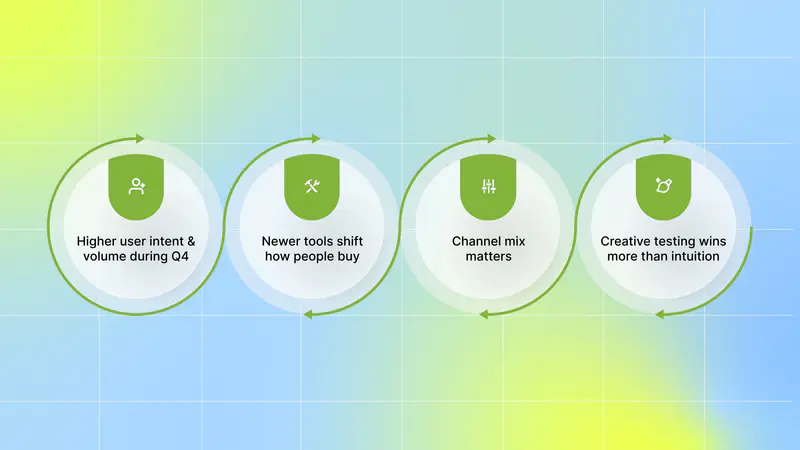
What makes ROAS a deciding factor during Christmas:
Higher user intent and volume during Q4: Search, social, and streaming traffic spikes mean more chances to convert, but also more competition. Winning here means precise targeting and offers that match holiday intent.
Newer tools shift how people buy: AI-driven recommendations and assistants are shaping holiday shopping paths, so personalization and timely creative can lift conversion rates and ROAS. Use signals and creative variants that respond to what people are actually searching and clicking.
Channel mix matters: Search/marketplace ads, social short-form video, and CTV each play a role in diversifying where you run your holiday spend and tune bids by performance instead of guessing. Platform-specific best practices (for example, on app stores or search ads) often change year to year; follow the current guidance and favor ROAS-focused objectives.
Creative testing wins more than intuition: Rapid A/B tests and small-scale creative experiments let you find what resonates during the season. When a creative shows strong early ROAS, scale it when it drops, replace or reframe it quickly. Automation can help, but human review of results keeps you honest.
A high-ROAS holiday approach combines early planning, tight measurement, channel-aware tactics, and fast creative testing. That combination helps you spend smarter during Christmas 2025 and delivers the clear returns your business needs from holiday ad dollars.
Understanding why ROAS leads the conversation is only the first step. Turning that insight into stronger performance requires a practical plan you can execute from the start of Q4 through final delivery dates.
Also Read: Creative Analytics Explained: How To Track, Measure, And Improve Ad Performance
High ROAS Holiday Ads Playbook for Christmas 2025
Holiday demand is strong, but profit only grows when every creative, audience move, and budget shift works together. This playbook lays out the steps to keep ROAS high during Christmas 2025, from the first planning sprint to the final conversion push, so your spend translates into real revenue:

1. Align Business Goals, Audience, and Creative Strategy
Before you build any ads, you need a clear direction. One goal, one target, one reason for the campaign to exist. This helps every creative and budget decision work toward the same outcome.
Key points that guide this step:
Pick one primary goal: more purchases, higher-value users, or better return from paid channels.
Turn that goal into a number, such as a ROAS target or a cost-per-purchase ceiling.
Use past holiday performance to get a realistic idea of your expected ranges for CPA and ROAS.
Split your budget into three parts:
baseline (steady performance)
test (finding new creative or channel winners)
opportunistic (holiday-specific moments)
Keep tracking clean so every creative is tied to your main goal.
With a tight goal and a simple budget framework, you start the season with clarity instead of chaos.
For example, e.l.f. Cosmetics set clear seasonal targets and built holiday campaigns around live promotions and timely product pushes, leading to stronger engagement during Christmas 2025. Their structured planning anchored every creative choice to specific seasonal outcomes.
2. Audience Decisions That Matter
Holiday traffic is high, but not all of it converts. The people you reach and when you reach them can change your ROAS more than any single creative.
Ways to shape high-value audiences:
Start broad early to gather signals and reach people who are just entering holiday shopping mode.
Shift toward warmer groups as you get closer to key dates, people who browsed, engaged, or added items to cart.
Use lookalike audiences built from top customers or high-value segments when you need to scale efficiently.
Retarget small, focused groups with strong intent during peak shopping days.
Match your creative to the audience so each group sees the message that fits their stage in the journey.
These steps help you avoid wasting money and move the budget toward people who are ready to act.
For example, Holiday marketing data for 2025 shows brands shifting spend toward retargeting past buyers and loyalty customers using first-party data, thereby improving ROAS by focusing on high-intent segments rather than relying solely on broad prospecting.
3. Creatives: What to Produce and How to Test It
Creative is often the most significant driver of high ROAS in holiday ads. The right message, delivered fast, can double your revenue from the same spend.
Best practices for strong holiday creative:
Open fast and clear: show the product or value in the first 1–2 seconds.
Build modular assets so you can swap hooks, offers, and CTAs without rebuilding the whole ad.
Create variations with one change at a time to make testing clean and learnable.
Run controlled tests that compare revenue between two matched groups.
Review automated creative outputs before scaling so nothing off-brand slips through.
When creative is modular and testable, finding winners becomes a repeatable process rather than guesswork.
For example, many report highlights that top-performing brands shipped quick creative variations featuring seasonal hooks (“limited holiday offer”, “today only”, “gift-ready item”). They isolated small creative changes in the first frame, the offer line, and the CTA, and tested which version drove better revenue.
4. Media: Channel Mix and Timing
Your ad spend needs to move with the holiday calendar. Each phase of the season rewards different formats and channels.
How to organize your media approach:
Break the season into four parts: early awareness, offer lead-in, peak buying, and final conversions.
Use short-form video to raise awareness and reach new users.
Lean on catalog or feed formats during Black Friday through early December to match shopping intent.
Keep your placement mix flexible so you can shift spend to the channels showing real-time performance.
Watch results more closely during peak days to avoid overspending on declining placements.
This rhythm keeps your ads visible at the right moments, without overspending where returns drop.
For example, TikTok reports show brands using a mix of short-form video plus catalog-linked placements during Black Friday and December saw stronger ROAS. Many advertisers shifted budgets between platforms after noticing that TikTok CPAs dipped during peak shopping hours. This demonstrates why a flexible media plan and phase-based timing matter.
5. Measurement & Attribution: How to Know What Worked
Holiday results move quickly, so your measurement needs both speed and depth.
Ways to stay accurate and confident in your data:
Use platform dashboards for day-to-day adjustments.
Back them up with server-side or aggregated measurement to capture missed conversions.
Run at least one holdout or incrementality test during a major sale period.
Keep your tracking consistent: UTM tags, naming rules, creative IDs.
Compare short-term results with true lift so you understand which ads actually changed outcomes.
With this setup, decisions become clearer because you know what truly caused the revenue.
6. Optimization: what to scale, pause, or tweak
After data starts coming in, the goal is to double down on what drives profit and trim what slows you down.
A simple loop to keep performance strong:
Scale proven winners into similar audiences and channels while watching for early fatigue.
Pause ads that slip on cost or frequency before they drain your budget.
Refresh creative often during peak season; small updates keep engagement high.
Set light automation rules to detect sudden dips and automatically pause ads.
Repeat the learning cycle of testing → reviewing revenue → scaling.
This steady, fast adjustment pattern protects your ROAS across the busiest weeks of the year.
In 2025 holiday campaigns, top retail advertisers refreshed ad creatives weekly and shifted spend toward formats that outperformed during peak days, helping them maintain stable ROAS despite rising competition. Performance improvements came from fast creative swaps and reallocating budget based on real-time results.
To see how these principles show up in practice, here are campaigns that applied them and delivered strong seasonal returns.
Also Read: Creative Optimization in 2025: Actionable Insights Report
Real-World Examples of High ROAS Holiday Ads
Holiday advertisers can learn a lot by studying what actually moved revenue for major brands. Below are real campaigns from recent seasons, why they performed, and the kinds of creative tests that sharpened returns in fast-moving holiday demand:
1. Apple: “A Critter Carol” (iPhone 17 Pro Holiday Film)
A short, handcrafted holiday film starring artisan puppet characters in a woodland set, filmed on iPhone 17 Pro. Apple released the spot alongside a behind-the-scenes package emphasizing practical effects, puppetry, and in-camera craft rather than full generative AI.
Why It Worked:
The spot pairs strong storytelling and tactile detail with a product demonstration: the phone’s camera quality is implicitly validated by showing the puppets recording and interacting with the device. For higher ticket or brand-led holiday buys, this approach raises perceived product value while still feeling warm and shareable. The behind-the-scenes narrative (how it was made on an iPhone) doubles as product proof and earned media fodder, extending reach beyond paid placements.
A/B Testing (What to Test / What Apple Likely Tested):
Test short 2–3-second hooks against longer intros to see which drives more product page clicks.
Test early product close-ups compared to delayed reveals to learn which improves shopping intent.
Test vertical 15-second cutdowns compared to longer 30-second versions across different placements.
Test music styles with higher emotional lift compared to quieter versions to track view-through and add-to-cart lift.
2. Coca-Cola: “Holidays Are Coming.”
Coca-Cola produced a 2025 holiday spot that leaned heavily on generative video tooling and rapid AI pipelines to recreate the classic holiday motif. The production relied on AI studios and tools to assemble many assets quickly; coverage highlighted both the speed and scale, as well as notable visual inconsistencies in some frames.
Why It Worked (And Where It Risked ROI):
AI helped Coca-Cola produce fresh versions of a familiar idea at impressive speed and volume. The strength of the iconic “Holidays are Coming” theme pulled people in. Yet uneven visual polish and odd motion cues sparked jokes more than delight, putting both sentiment and sharing at risk. Performance teams can learn from this: using AI to scale creative is valuable, but every variant still needs quality checks that protect persuasion, credibility, and results.
A/B Testing (What to Test / Safeguards to Run):
Test AI-only versions compared to editor-supervised revisions to measure differences in ROAS and sentiment
Test high-volume micro variants compared to fewer highly polished creatives to find the best ROI approach
Test sentiment filtering by turning off variants that cause negative responses, even if CTR is strong
Test premium visual cues compared to budget-style cues to prevent a mismatch between creative promise and landing experience
3. Amazon: “5-Star Theater” / Benedict Cumberbatch holiday creative (2025)
Amazon’s 2025 holiday ad featured Benedict Cumberbatch, a celebrity, dramatically reading real customer reviews to showcase popular giftable products. It’s part emotional/entertainment spot, part product validation, and links directly to product pages and curated gift lists.
Why It Worked:
This creative ties entertainment (celebrity cameo) to social proof (real reviews). For DTC and app advertisers, that combo reduces buyer friction: the celebrity attracts attention, and the “real review” format conveys authenticity, helping lower hesitation in the purchase funnel. Direct links to product pages and curated lists make the ad a strong driver of direct response during the holiday shopping season.
A/B Testing (What to Test / Practical Variants):
Test UGC-led versions compared to celebrity-led ones to analyze conversion rate differences.
Test “buy now” CTA compared to “save for later” CTA to learn which drives stronger final ROAS during gifting windows.
Test bundled product groupings compared to single-focus creatives to evaluate average basket value.
Test YouTube hero formats compared to short social versions to identify channel-efficient spend.
4. IKEA Canada: “The 12 Days of Christmas” (2025 campaign)
IKEA Canada’s 2025 holiday campaign staged a comedic live-action setpiece riffing on the “12 Days” carol: household chaos meets product solutions. The creative explicitly showcased multiple SKUs (decor, small furniture, gifting bundles) woven into a single narrative, with strong in-store and online calls to action.
Why It Worked:
The spot foregrounds product utility and variety while entertaining; it’s designed to be shoppable and rewatchable. For DTC brands and retailers, this is a model for holiday creatives that convert: show products solving real holiday pain points (wrapping, space, gifting) and make the path to purchase immediate. Omnichannel execution (social cuts, in-store activations) extended reach and enabled measurement across touchpoints.
A/B Testing (What to Test / Conversion Levers):
Test single-product focus compared to multiple-product storytelling to see which drives stronger AOV.
Test interactive shoppable video overlays compared to standard link end cards to reduce steps to purchase.
Test localized availability messaging compared to generic messaging to influence store visits.
Test playful, humorous delivery compared to a cozy, heartfelt delivery to see which drives more completions and conversions.
5. TikTok Shop: Platform Holiday Creatives & Live Commerce (BFCM 2025 Evidence)
TikTok Shop and its merchant ecosystem saw major holiday traction in 2025: platform data and news coverage reported strong GMV during the Black Friday/Cyber Monday weeks, and TikTok promoted holiday creative toolkits and live commerce incentives to sellers. The platform’s winning formats were short native video, creator integrations, and live commerce events that push immediacy and impulse purchases.
Why It Worked:
Short-form native creative paired with live shopping keeps viewers in the moment of interest. They can see a creator use the product, ask questions, and purchase without leaving the app. For mobile UA and DTC teams, that means smoother checkout paths and stronger returns when the offer aligns with impulse-driven behavior, especially for lower AOV goods.
A/B Testing (What to Test / High-Impact Experiments):
Test creator tutorials compared to brand-hosted videos to identify higher ROAS talent.
Test prime-time live streams compared to off-peak streams to learn which sessions deliver more high-value orders.
Test limited-time countdown overlays compared to standard discount tags to monitor urgency-driven lift.
Test short hook-plus-demo formats against mini-stories to identify the shortest conversion-safe duration.
Holiday lifts come from choices backed by performance signals, not hope. Keep learning from what works in the market and move budget toward the ads that prove they can earn.
Also Read: How to Find Winning Creatives and Use AI to Maximize ROA
Conclusion
Finish the season with a sharp focus on measurable profit. Push spend only to creatives and audiences that clearly convert, cut what drains margin, and keep every decision tied to real revenue outcomes. Treat creative details as the lever that moves budget toward predictable returns, keeping high ROAS holiday ads consistent. This profit-first approach protects margin and turns holiday demand into real business growth.
If you want to take that holiday ad plan even further and turn creative testing into a data-driven engine, try Segwise. Its multimodal AI auto-tags every creative element, from hook scenes and first lines of dialog to headlines, characters, influencer traits, CTA text, and audio cues, and connects those details to performance metrics like ROAS, CTR, and IPM so you know exactly which pieces drive profit.
Segwise pulls together ad-network and MMP data in one place, detects creative fatigue, and generates data-backed creative iterations you can scale. So you scale winners, stop losers, and protect profit.
Start a Free Trial to see how your holiday ads perform and make each campaign dollar count.
FAQ's
1. What are High ROAS Holiday Ads?
These are holiday ads that make more money than they cost. Set a clear ROAS target based on past holiday data so you know when an ad is working.
2. How can I find winning creatives for Christmas 2025?
Build small variations, test one change at a time, and scale the versions that bring in the most revenue. Review AI-made assets by hand before using them.
3. Which channels help improve ROAS during the holiday season?
Short video, mobile placements, and live shopping formats performed well in 2025. Use the formats your shoppers already use when searching and buying.
4. How do I track performance with limited data?
Use consistent UTMs and naming, rely on aggregated or server-side tracking, and run at least one holdout test to learn which ads truly drive revenue.
5. What is the simplest way to protect ROAS during peak days?
Scale ads that keep costs low and conversions high, pause slipping ads early, refresh creative regularly, and use light rules to catch sudden drops in results.