
Updated July 2026
Cross-platform ad management is the practice of running, measuring, and optimizing Meta, Google, TikTok, and DSP or app-network campaigns as one connected system instead of separate dashboards, so you can compare creatives, attribute conversions accurately, and shift budget to the platforms that drive quality users.
Do you ever feel like your campaigns across platforms are running you instead of you running them?
As a UA Manager or Performance Marketing Lead, you refresh dashboards all day, watch metrics shift, and worry that you're scaling the wrong creatives or wasting budget on the wrong platforms. And the worst part? By the time you catch a drop in performance, the damage is already done. ROAS slips. CPIs climb. Leadership asks questions you aren't ready to answer.
So, if you are also constantly afraid of missing something across your user acquisition channels, this blog is for you. Here, you explore exactly how to manage campaigns across Meta, Google, TikTok, and DSPs in a unified way, so you can spot what's working, fix what isn't, and scale the channels that actually bring you high-quality users.
What Is Cross-Platform Ad Management?
Cross-platform ad management is how you run, track, and optimize your user acquisition campaigns across platforms such as Meta, Google, TikTok, and DSPs. Instead of managing each channel separately, you manage them as a single connected system.
This helps you see which platforms actually drive quality users, how your creatives perform across platforms, and where your budget should go to hit your UA goals faster and with less guesswork. And because each platform behaves differently, cross-platform management helps you make sense of those differences instead of reacting blindly.
Here are the key factors that make each network act differently:
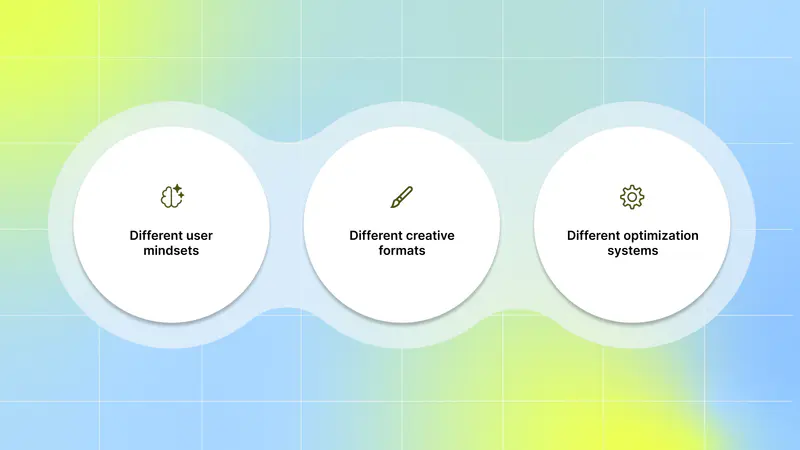
Different user mindsets: TikTok users scroll for entertainment, Google users search with intent, and Meta users browse socially, so their reaction to your ads changes.
Different creative formats: What works as a fast hook on TikTok might fail on Google Display or Meta Feed.
Different optimization systems: Each platform has its own machine learning logic for bids, delivery, and learning phases, requiring specific strategies for optimization.
Once you understand what cross-platform ad management is, the next question is why leading UA teams rely on it to guide their decisions.
Why UA Teams Invest in Cross-Platform Ad Management
When you run campaigns across Meta, Google, TikTok, and DSPs, managing everything separately creates blind spots. Cross-platform ad management gives you a single connected view, enabling you to make faster, smarter decisions that improve ROAS.
Here are the reasons top UA teams rely on cross-platform ad management:

1. Your users don't stay on just one platform: People discover products on TikTok, compare options on Google, and convert on Meta. Seeing performance across channels helps you target smarter and reduce drop-offs.
2. You avoid wasting budget on channels that don't convert: Instead of guessing where budget should go, you see which platforms bring high-value users for your app, game, or DTC product.
3. You get clearer creative performance signals: You can compare the same hook, format, or concept across platforms and identify where each creative actually works best.
This matters more in 2026 than ever. Global social ad spend crossed $280 billion in 2025 and is projected to reach $310 billion by the end of 2026, with Meta holding roughly 39% of social ad spend, Google and YouTube 28%, and TikTok 12%. Spreading budget across these platforms without a unified view is expensive guesswork, and advertisers who coordinate campaigns across three or more platforms consistently outperform single-platform strategies by 25 to 35% through better frequency control and sequential messaging.
The next step is understanding the mechanics behind how each platform optimizes your ads.
Also Read: Understanding ROAS in Google Ads: A Simple Guide
How Campaign Management Works Across Meta, Google, TikTok & DSPs
Each platform runs its own targeting systems, creative rules, and optimization models. That means your campaigns behave differently on every network. Here are the key things you must know about how campaign management works across each major channel:
1. Meta (Facebook + Instagram)
Meta relies heavily on creative performance signals. The algorithm looks at early engagement (watch time, click intent, scroll-stop rate) to decide whether to scale your ad or limit delivery. Creative quality and fast iteration matter more here than complex targeting because Meta's system uses broad audiences and lets the algorithm find the best users.
Best for: Prospecting, remarketing, creative iteration.
2. Google (Search, UAC, Display)
Google is intent-driven. Users show what they want through searches, app behavior, or video interactions. You manage campaigns by matching intent, not just demographics. Google's automation (especially UAC) decides placements, formats, and audiences, so your role is to guide the system with strong signals and clean creative variations.
Best for: High-intent installs, purchase-driven campaigns.
3. TikTok Ads
TikTok rewards fast, native, and high-energy creatives. The algorithm focuses heavily on watch time, engagement, and trending formats. Managing campaigns here means adapting your creative style quickly, tracking performance by hook variations, and refreshing assets often.
Best for: Top-of-funnel reach, viral-style acquisition, creative exploration.
4. DSPs (Demand-Side Platforms)
DSPs let you run ads across large programmatic networks. Unlike Meta, Google, or TikTok, DSPs don't rely on a single feed or algorithm; they pull inventory from thousands of publishers. This means your UA strategy depends on the targeting rules, bidding logic, and supply quality you actively select and manage.
Best for: Scaling app installs, reaching gaming audiences, expanding beyond major social platforms.
For mobile UA in 2026, this programmatic layer increasingly means dedicated app networks such as AppLovin (Axon), Unity Ads, Moloco, and Mintegral, which now sit alongside Meta, Google, and TikTok as durable channels for meaningful spend. Because their bidding and creative rules differ from social feeds, managing spend here means watching network-level ROAS and creative volume closely rather than assuming social-style delivery.
Once you understand how each channel operates, the next step is a structured approach to keep everything aligned.
Also Read: How to Personalize the Ad Creatives Across Channels?
A Practical Framework for Managing Cross-Platform Campaigns
When you manage Meta, Google, TikTok, and DSPs together, your goal isn't just to run ads everywhere; it's to make every channel support the same growth plan. A unified strategy helps you stop reacting to platform-level changes and instead build a system in which each platform has a clear role, metrics, and creative direction. This gives you more confidence in your UA decisions.
Here's how a unified cross-platform approach actually works:

1. One goal across all channels
You set a single metric, such as ROAS, CPI, or LTV, and every channel is measured against the same standard. This keeps your campaigns aligned and makes it easier to see which platforms actually drive quality users.
2. Clear role for each platform
Meta may be your creative testing engine, Google your intent-capture channel, and TikTok your scale driver. When each network has its own purpose, your budgets work harder, and campaign decisions become simpler.
3. Shared creative strategy across platforms
Your hooks, messaging, and concepts stay consistent, but you adapt the format to what works best on each platform. This keeps your brand coherent while still respecting the unique style of each network.
4. Centralized measurement and reporting
Instead of switching between dashboards, review performance in one place to understand:
Which platforms drive quality users?
Which creatives perform across multiple networks?
Where does creative fatigue appear first?
How should budgets shift?
This visibility enables proper cross-platform optimization. With the Segwise comprehensive dashboard, you get a unified view of ad network and MMP data, eliminating the need for manual data collection across multiple platforms. Segwise connects 15+ ad networks and MMPs, including your mobile measurement partner (AppsFlyer, Adjust, Branch, or Singular), so network spend and MMP attribution sit side by side in one place.
5. One budget framework, multiple execution paths
You don't spread money evenly; you shift budget based on performance, quality, and opportunity. A unified strategy lets you scale winners instantly and cut wasted spend before it hurts your targets.
6. Refresh creatives before performance drops
Track creative fatigue across platforms so hooks, intros, or concepts get updated before CPIs rise. Each platform burns through creatives at a different pace, and staying ahead protects performance.
With Segwise customized success criteria, you can set tracking rules that align with your optimization goals and experiment methodology. You get reports when creatives hit targets or show a decline, so you don't have to check manually. With automated reporting, you get daily email reports that keep you informed without constant manual performance checking.
And the best part? With cross-network visibility, you can monitor creative performance across all platforms in these unified tracking reports.
7. Use alerts or rules to catch issues early
Manual monitoring slows teams down. Automated alerts help surface:
Sudden CPI spikes.
Creatives are losing traction.
Conversion drops across networks.
Early signals prevent minor issues from becoming expensive problems.
But even with a solid framework in place, cross-platform campaigns come with their own set of challenges that can disrupt performance if you don't handle them correctly.
Cross-Platform Campaign Management Challenges and Practical Solutions
Running Meta, Google, TikTok, and DSP campaigns at the same time can feel messy because every platform behaves differently and gives you different signals. You end up juggling fragmented data, inconsistent creative results, and KPIs that don't match.
Here are the core challenges you face when managing cross-platform UA:

1. Fragmented Data Across Multiple Dashboards
You jump between Meta Ads Manager, Google Ads, TikTok, and DSP reporting tools, but none of them speak the same language. This makes it hard to understand which channel actually brings the best users or where your ROAS is really coming from.
Bring all performance data into one unified view. This helps you compare channels side-by-side, see which campaigns actually drive quality users, and make faster decisions without jumping between reporting tools.
With Segwise creative analytics, you just don't need to jump between different platforms and your MMP dashboard. You can see all creative-level data and conversion rates from all sources in one unified view.
2. Inconsistent Creative Performance Across Platforms
A hook that wins on TikTok may flop on Meta. Without comparing creatives across all channels, you often scale the wrong ideas or miss winning patterns.
Track creative performance across all platforms using the same tags and metrics. This helps you understand which hooks, dialogues, angles, and formats consistently win and where each creative performs best.
3. Attribution Gaps That Hide True Performance
Every platform takes credit differently. Google uses intent signals, and DSPs rely on impression paths. This makes it hard for you to know which platform actually drove the install or purchase.
Use cross-platform attribution logic or blended metrics. Look at multi-touch performance rather than relying on a single platform's reporting. This gives you a more accurate picture of where your best users come from.
This gap widened in 2026 because each self-attributing network still claims conversions on its own terms, which is why teams treat the MMP as ground truth for app installs and lean on multi-touch attribution. In 2026, multi-touch attribution is no longer optional: last-touch reporting alone underestimates how much upper-funnel platforms like TikTok and YouTube contribute.
4. Budgets Spread Too Thin or Shifted Too Late
When you don't see performance clearly across channels, budgets end up in the wrong places. You overspend on poor channels, underspend on strong ones, or catch issues only after ROAS drops.
Set a unified budget framework and shift spend based on cross-platform performance signals. When you make decisions from a single view, you can scale winners faster and protect spend before it's wasted.
5. Creative Fatigue That Hits at Different Times on Each Platform
TikTok creatives burn out fast. Meta fatigues a bit slower. Without tracking fatigue across all channels, your CPIs rise before you even see the warning signs.
Track fatigue across platforms with consistent rules and alerts. This helps you refresh creatives before performance drops and stay ahead of rising CPIs.
With Segwise fatigue tracking, you can catch fatigue before it impacts your budget. You can also set custom fatigue criteria and monitor creative performance across Facebook, Google, TikTok, and all major ad networks, to catch fatigue before it impacts your ROAS.
Also Read: What is a Demand-Side Platform (DSP)? A Complete Guide
Conclusion
Managing campaigns across Meta, Google, TikTok, and DSPs only works when you stop treating each platform in isolation. A strong cross-platform ad management approach helps you see how users move across channels, understand which creatives and platforms actually drive quality users, and shift budgets before performance drops.
This is where Segwise fits naturally into your workflow. Segwise gives you a unified view of creative and performance data across platforms such as Meta, Google, and TikTok, so you can see which creative elements drive ROAS, spot fatigue early, and make confident budget decisions across platforms.
With Segwise creative analytics, you don't need to jump between Facebook Ads Manager, Google Ads, TikTok, and your MMP dashboard. You can see creative-level ROAS, CPA, LTV, and conversion rates across all sources in a single unified view. The studio view also offers creative analytics for multiple apps, games, or brands from one unified interface.
With fatigue tracking, you can catch performance decline before it impacts budget allocation and campaign results. It also offers cross-platform performance reports that let you track your creatives across platforms in unified reports. With this, you can track performance for individual platforms or get consolidated cross-network insights.
Moreover, with tag-level creative element mapping, you can clearly see which specific creative elements drive performance with complete MMP attribution integration. And performance-connected tags help you map these creative tags directly to performance data for actionable insights. This allows you to scale what's working.
And with the Segwise Creative Strategy Agent (AI Chat), you can ask plain-language questions across all of this connected data, such as which hook drove the most installs on TikTok versus Meta last month, and get an answer instantly without building a report. When you spot a winning pattern, Segwise can also generate new data-backed creatives built around it, so analysis turns straight into production.
If you want to manage cross-platform campaigns with less guesswork and more control, start your 7-day free trial today and see how unified creative analytics can improve your UA performance!
FAQs
1. How can cross-platform retargeting improve user acquisition results?
Retargeting lets you re-engage users who interacted on one channel (like TikTok) with ads on another (like Google Display), deepening touchpoints and increasing conversion chances.
2. Is cross-platform attribution necessary for accurate performance measurement?
Yes, relying on individual platform reporting can mislead UA decisions, so blended or multi-touch attribution gives a clearer picture of what's driving installs or conversions.
3. What role does creative rotation play in managing cross-platform fatigue?
Creative fatigue varies by platform; rotating and refreshing assets based on performance signals can prevent rising CPIs and maintain engagement.
4. How do you manage ad spend across Meta, Google, TikTok, and app networks in 2026?
Set one goal metric (ROAS, CPI, or LTV), give each platform a clear role, and shift budget from a single unified view of network and MMP data rather than moving spend platform by platform. This lets you scale winners and cut waste before performance drops.
5. Which ad networks and MMPs does Segwise connect to?
Segwise unifies data from 15+ ad networks and MMPs, including Meta, Google, TikTok, Snapchat, AppLovin (Axon), Unity Ads, Mintegral, and IronSource, plus the four major MMPs: AppsFlyer, Adjust, Branch, and Singular.
6. Can AI help manage cross-platform campaigns?
Yes. AI now runs bidding and delivery on every major platform, so your edge in 2026 comes from measurement and creative. Tools like Segwise unify creative and performance data across networks, flag fatigue early, and generate new data-backed creatives from your winning patterns.