
Are your Meta ads getting more expensive but bringing fewer results?
In 2026, Meta’s automation and constant algorithm updates are making it more challenging to keep your ROAS stable. The same hooks, videos, and offers that worked last quarter can suddenly drop without warning. This drains your budgets and leaves performance marketers and UA teams scrambling to explain what went wrong.
If you’re still relying on manual testing or instinct to guide your creative choices, you’re already falling behind. This blog explores how to boost Meta ROAS in 2026 with AI-powered creative insights so you can identify what makes your ads convert, catch fatigue before it burns spend, and scale only the creatives that truly work.
What is Meta Ad ROAS and Why Does It Matter?
Meta Ad ROAS (Return on Ad Spend) is the total revenue you earn for every dollar you spend on Meta ads. In simple terms, it shows whether your ad campaigns are actually making money or just burning your budget.
Here are the key reasons why Meta ROAS matters for every performance marketer and UA team:
1. It Tells You What’s Really Working: ROAS reveals which campaigns actually drive profitable results.
2. It Helps You Allocate Budget Smartly: You can shift more spend toward winning creatives and cut the losers early.
3. It Keeps Your UA Strategy Accountable: It shows which ads generate real revenue, not just impressions.
4. It Guides Creative Optimization: Tracking ROAS at the creative level helps you learn which elements influence conversions. With Segwise Tag-Level Performance Optimization, instantly see which creative elements, themes, and formats drive results across all your campaigns and apps.
In short, ROAS isn’t just another metric; it’s the scoreboard for your entire user acquisition strategy.
Once you understand what ROAS is, the next step is to see why Meta has shifted from manual strategies to AI-powered creatives.
Also Read: What Is a Good ROAS Benchmark for Facebook Ads?
Why Meta Shifted to AI-Powered Creatives
Meta’s ad ecosystem has become too complex and data-rich for manual optimization to keep up. With so many ad formats, targeting options, and audience behaviors changing daily, human testing alone can’t process the volume of signals needed to find what truly drives conversions.
That’s why Meta has moved toward AI-powered creatives to help advertisers scale faster, spend smarter, and optimize every creative decision automatically. Here are the main reasons behind this:
1. Speed and Scale: You create, test, and analyze one creative at a time, often taking days or weeks to find winners. AI can test hundreds of variations simultaneously, detect winning patterns in hours, and continuously optimize campaigns without waiting for manual reviews.
2. Data-Driven Precision: Creative decisions are often based on guesswork, experience, or small data samples. Meta’s system analyzes millions of performance signals to predict which creative combinations deliver the highest ROAS.
3. Faster Adaptation to Algorithm Changes: Every time Meta updates its ad delivery or attribution logic, you need to re-learn how to optimize. AI models automatically adjust to new algorithms, platform trends, and privacy restrictions, ensuring your campaigns stay optimized without starting from zero.
4. Smarter Creative Fatigue Management: You only notice fatigue after your metrics drop, higher CPAs, lower CTRs, and wasted spend. AI predicts when a creative will fatigue and refreshes variations before performance dips, protecting your ROAS and keeping campaigns stable.
5. Unified Insights Across Platforms: You jump between Facebook Ads Manager and Instagram dashboards to piece data together. Meta’s AI consolidates performance data into one unified system, making it easier to make quick, data-backed decisions.
In short, Meta’s shift to AI-powered creatives is about helping performance marketers do more with less time, faster testing, deeper insights, and smarter scaling, directly improving ROAS across every campaign.
Building on this shift, Meta’s latest updates reveal how deeply AI now drives creative performance and campaign efficiency.
Latest AI-Powered Trends From Meta
In the past, you could rely on broad targeting to efficiently reach the right users. But now Meta has launched the Andromeda update. Meta’s new algorithm is built to analyze deeper behavioral signals, giving priority to machine learning and automation over manual audience control.
So, what’s changing?
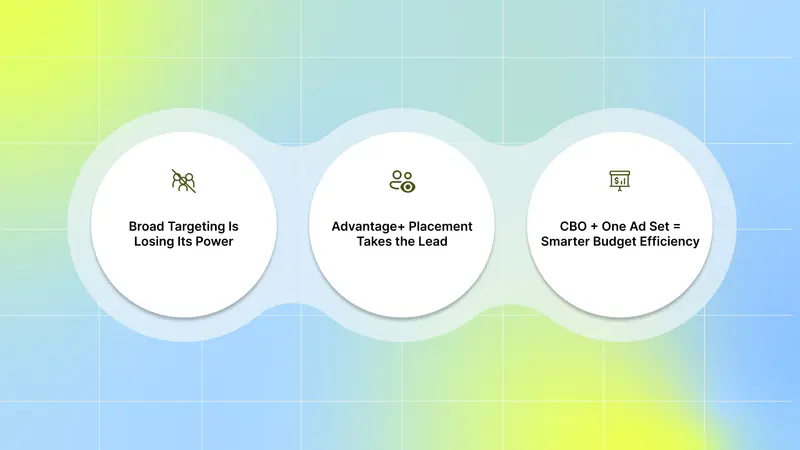
1. Broad Targeting Is Losing Its Power
Meta’s new system no longer depends on wide audience pools. Instead, it optimizes based on creative quality, data consistency, and ad performance signals. Your “spray and pray” approach won’t get the same results anymore.
2. Advantage+ Placement Takes the Lead
Advantage+ placements are now at the center of Meta’s performance model. Meta’s AI uses data across all placements (Feed, Stories, Reels, etc.) to automatically find where your ads perform best. Manual placement adjustments could limit your performance.
3. CBO + One Ad Set = Smarter Budget Efficiency
The Campaign Budget Optimization (CBO) model now works best when you use one ad set with multiple creatives. Meta’s AI tests, learns, and scales your top performers automatically, reducing overlap and improving ROAS.
All these innovations only deliver real value when you know what you’re aiming for. That starts with setting the right ROAS goal.
Also Read: Understanding Meta Andromeda for Next-Gen Ad Strategies
How to Set Your ROAS Goal
Setting a clear ROAS goal helps you understand what success looks like for your campaigns. A good ROAS typically ranges from 2:1 to 4:1 (200%-400%), meaning you generate $2 or $4 in revenue for every $1 spent on advertising. It tells Meta’s system how much return you want for every dollar spent helping AI optimize your budget toward that target.
Here are the best practices for defining your ROAS goal:

1. Start With Historical Data
Look at your past campaigns to find your average ROAS. Use this as a baseline and adjust it based on your new creative strategy or seasonal changes. You can view this data by adding a ROAS column in Meta Ads Manager.
2. Set Realistic, Gradual Targets
If you want to break even with a ROAS goal, set it to 1.00. It is the equivalent of getting a 100% return on ad spend, which means that if you spend USD 100 on your ad set, you'd want to get around USD 100 of value from purchases that happen within your attribution setting.
3. Break Even, Then Scale Profitably
If you want to make a profit on your ad set, you could set your ROAS goal above USD 1.00. For example, you could set a ROAS goal of USD 1.15. That is the equivalent of getting a 115% return on ad spend, which means that if you spend USD 100 on your ad set, you want to get around USD 115 in value from purchases within your attribution window.
Setting your ROAS goal gives you direction now; it’s time to build the system that helps you achieve it efficiently.
Steps to Optimize Meta ROAS with an AI-Powered System
An AI-powered system helps you automate testing, track performance, and scale winning creatives without constant manual work. It learns from your data, optimizes campaigns instantly, and keeps your ROAS growing consistently.
Here are the key steps to set it up:
Week 1: Audit and Setup
Start by reviewing your top-performing creatives from the last 60–90 days. Pick 3–5 strong assets and define clear success metrics, such as ROAS or CPA. Allocate 20–30% of your total budget for creative testing so AI can collect enough data to learn what drives conversions.
Week 2: Let AI Learn and Calibrate
Give the system time to analyze performance and user behavior. It will automatically shift spend toward top creatives and pause weak ones. Avoid manual tweaks; let the AI establish accurate learning patterns.
Week 3+: Scale, Refresh, and Expand
Once performance stabilizes, add new creative variations and fresh hooks. The AI will manage rotation, scaling, and refresh cycles automatically. You’ll spend less time managing ads and more time strategizing creative direction.
With this setup, your campaigns run smarter, continuously testing, learning, and optimizing to deliver stronger ROAS over time.
Once your AI system is set up and running smoothly, the next step is to use AI-powered creative strategies to drive higher ROAS.
AI-Powered Creative Strategies to Boost Meta ROAS
Your creative is now your biggest performance driver. Meta prioritizes ads that keep users engaged. AI constantly studies your data, spots winning patterns, and helps you act faster. It takes the manual work out of testing and replaces it with continuous, data-backed decision-making that improves your Meta ROAS every week.
Here are the key strategies:

1. Video vs. Static: Finding What Drives Engagement
Video ads usually outperform static creatives, but not all videos work the same. AI can identify which formats, hooks, or editing styles drive stronger engagement. For mobile games, it might be short gameplay clips with instant action; for DTC brands, it could be UGC-style product demos rather than polished product shots.
2. Continuous Creative Testing and Learning
AI runs micro-tests across multiple creative elements without exhausting your budget. It learns what works faster and uses those insights to guide your next creative batch. You get a constant feedback loop that turns testing into a repeatable, scalable process.
3. Using UGC and Influencer Content for Freshness
User-generated and influencer content gives your ads an authentic, high-converting edge. AI can analyze which UGC styles perform best for testimonial, unboxing, or lifestyle and suggest when to rotate them. Continually refreshing your campaigns with new creator content keeps them engaging.
4. Seasonal Optimization With AI Predictions
Seasonal shifts can make or break your campaigns. AI helps you predict performance trends before they happen, analyzing past data to suggest when to adjust creatives for holidays, sales, or in-game events.
For example, AI might signal that “giftable” messaging converts better during December or that fitness-related visuals perform best in January. Staying proactive with these adjustments helps you capture demand while keeping ROAS steady.
5. Audience and Funnel Alignment
Not every user is ready to buy or install right away. Align your creatives with funnel stages: awareness, consideration, and conversion. For example, use gameplay teasers or product demos at the top, testimonials and offers at mid-funnel, and urgency or exclusivity near conversion. When each creative serves a specific purpose, your overall ROAS improves.
6. Creative Fatigue Tracking
Creative performance doesn’t stay consistent forever. Monitor your creatives for signs of fatigue, rising CPMs, falling CTRs, or decreasing ROAS. Instead of waiting for a campaign to underperform before taking action, AI systems detect changes in performance within hours. They can automatically pause weak creatives, shift budget to winners, or refresh ad sets before you lose money.
AI-powered tools like Segwise help you automate this process, saving time and preventing wasted spend. With Creative Fatigue Detection, automated monitoring continuously tracks declines in key performance metrics and spend share using intelligent internal logic. It helps you catch fatigue early before it affects your budget allocation or campaign results.
Once your AI-powered strategies are in motion, the next step is understanding how to measure what’s really working and optimize.
How to Measure and Optimize Meta ROAS
As a UA or performance marketer, your goal isn’t to chase metrics like clicks or impressions, but to understand which creatives actually drive profitable results. AI-powered creative optimizers simplify this process by providing precise insights that support consistent ROAS growth. Here is how:

1. Creative-Specific ROAS Tracking
The most valuable metric you can track is creative-level ROAS, which helps you understand exactly which ad creatives generate the highest return on your spend. Instead of looking at campaign averages, zoom in on individual creatives to see which formats, hooks, or visuals are truly driving conversions.
2. Cross-Platform Performance Analysis
If you’re running ads across both Facebook and Instagram, AI can show you how each platform responds differently to your creatives. You might find that video ads perform better on Instagram Reels, while static or carousel ads convert better on Facebook.
By analyzing these differences, AI helps you distribute your creative mix strategically, putting the right content on the right platform to maximize engagement and ROAS.
With Segwise creative analytics, you don't need to jump between multiple ad platforms and your MMP dashboard. See creative-level ROAS, CPA, LTV, and conversion rates from all sources in one unified view.
3. Attribution and iOS Signal Loss
The iOS 14.5+ privacy changes have made attribution more challenging, but Meta's ad creative optimizer technology actually helps here. By focusing on creative-level performance rather than just conversion tracking, you get a clearer picture of what's actually driving results.
While AI can transform your Meta ad performance, avoiding common pitfalls is just as important to maintain consistent, scalable ROAS.
Common Mistakes and How to Avoid Them
Even the most experienced UA teams and performance marketers sometimes make mistakes that quietly drain their ad budgets. Avoiding these common pitfalls can make a big difference in your ROAS.
Here are the most frequent mistakes to watch and how to avoid them:

1. Over-Testing and Budget Dilution
Testing is important, but running too many variations at once can hurt performance. When you test dozens of creatives with small budgets, Meta’s AI doesn’t get enough data to learn which ads actually perform best.
Instead, limit your tests to a few substantial creative variations, give them enough budget to exit the learning phase, and use AI insights to identify winning patterns faster. Fewer, smarter tests deliver cleaner data and stronger ROAS.
2. Ignoring Creative Fatigue Signals
Many teams let their top-performing ads run for too long until results suddenly drop. Creative fatigue builds gradually, CTR decreases, CPMs rise, and ROAS slips without obvious warning.
With Segwise’s Creative Fatigue Tracking, you can spot early signs of decline in performance metrics and spend share using internal logic. Catch fatigue before it impacts your budget allocation and campaign results. Plus, with Custom Success Criteria Tracking, Set specific performance targets for NEW creatives you want to monitor. Track ROAS thresholds, spend share goals, or any custom criteria that matter to your optimization strategy.
3. Platform-Specific Optimization Errors
Not all platforms behave the same way. What performs well on Facebook Feed might underperform in Instagram Reels or Stories. Many marketers make the mistake of using identical creatives across placements.
AI systems can detect these performance differences and suggest adjustments such as adapting visuals, aspect ratios, or hooks per platform. Tailoring your creatives for each placement helps you reach users where they’re most engaged and maximizes your ROAS.
4. Attribution and Tracking Issues
Without accurate tracking, even the best AI can’t optimize correctly. Many UA teams still face data gaps after iOS privacy updates, which means Meta’s algorithm doesn’t see the complete picture.
To fix this, set up your Pixel and Conversions API (CAPI), ensure events are mapped correctly, and monitor signal quality. Clean, reliable data gives AI the insights it needs to allocate budget efficiently and drive measurable returns.
Avoiding these mistakes helps you get the most out of your AI-powered creative strategy, ensuring every dollar you spend on Meta ads works harder to deliver consistent, scalable growth.
Conclusion
Boosting Meta ROAS in 2026 is about working smarter with AI. As performance marketers navigate rising ad costs and shifting algorithms, AI-powered creatives give you the clarity and control to scale profitably. From faster testing and fatigue detection to platform-specific optimization and accurate ROAS tracking, every step you take with AI leads to more efficient ad spend and stronger performance.
If you're looking for an AI-powered platform to enhance your Meta ads ROAS, Segwise is built exactly for that.
To integrate Segwise with Meta, simply go to Dashboard → Settings → Ad Networks → Connect under Meta. Then, sign in, select your ad accounts, and enable them for full creative analysis across all campaigns.
Once connected, Segwise automatically pulls data from your Meta ads. Our powerful AI creative tagging automatically identifies and tags creative elements like hook dialogues, characters, colors, and audio components across images, videos, text, and playable ads to reveal their impact on performance metrics like IPM, CTR, and ROAS. It also detects creative fatigue early, so you can refresh ads before performance drops and budgets are wasted.
Moreover, our performance data mapping connects creative elements to ROAS outcomes and understands which hook scenes, dialogue, and visuals drive the highest returns. With AI-powered creative analytics, you can scale top-performing creatives faster and make sure every dollar is spent on ads that actually convert.
So, why wait? Start your free trial and turn your creative data into Meta ROAS growth!
FAQs
1. How often should I rotate or refresh creatives to avoid ad fatigue in 2026?
A good rule of thumb is to refresh creatives every 2–3 weeks or when performance metrics (CTR, ROAS, CPM) start to decline. Timely refreshes help maintain engagement and prevent performance drops.
2. Should I run many ad sets or keep the structure simple when using AI-driven creatives?
Keep the structure simple. Consolidating ad sets and using automation (such as Campaign Budget Optimization, auto-placements, and dynamic creatives) provides Meta’s AI with sufficient signal volume to learn quickly and efficiently scale winners. Over-segmentation can dilute data and slow learning.
3. Can different ad formats (static images, video, UGC) perform differently depending on platform or audience?
Absolutely. Format performance often varies by platform, audience, and context. For example, short-form videos or UGC-style creatives might perform better on Reels, while images or carousel ads might convert better on Feed. Testing across formats and placements remains crucial.