
Quick answer: the best Motion alternative for ad creative analytics in 2026 is Segwise overall, with Superads the pick for multi-platform paid social reporting and Foreplay the pick for Meta-focused research on a budget. Segwise is an AI creative analytics and generation platform that tags every creative element, including inside playable ads, and maps it to MMP attribution, which Motion does not integrate with.
This guide is about Motion the ad creative analytics platform at motionapp.com, the tool that analyzes your Meta, TikTok, YouTube and LinkedIn ad creatives. It is not Motion the productivity, to-do or calendar app (usemotion.com), which is a different company. If you came here looking for task scheduling or calendar automation, this is the wrong page. Every tool below is a creative analytics or creative intelligence product for advertisers.
TL;DR
Motion (motionapp.com) got more expensive. It now sells as an AI-agent product, with Runneth, an always-on AI agent on a dedicated VM, included in every paid plan. Plans are $750/month (Starter) and $1,200/month (Pro), tiered by ad spend, so there is no cheap entry tier any more.
Segwise is the best all-round replacement for mobile UA, gaming and multi-network performance teams: element-level AI tagging including playable ads, MMP attribution, built-in fatigue alerts, an AI chat creative strategist, and AI creative generation. Segwise starts at $499/month for advertisers spending up to $250K/month, with a special 50% discount for startups spending under $50K/month.
On a budget? Pencil from $11/month (annual) is the cheapest entry point for AI ad generation, and Foreplay from $49/month (annual) for research and briefing at any ad spend. Madgicx starts at $45/month for Meta accounts spending under $1K a month.
Enterprise governance? CreativeX and Vidmob are contact-sales only and measure creative rather than generate it.
MagicBrief is gone. Canva acquired it in 2025 and shut it down on 31 July 2026, so it no longer appears on this list.
Motion alternatives at a glance (2026)
Prices below were read from each vendor's own pricing page. Where a vendor does not publish a price, this table says so rather than estimate.
Tool | Best for | Key feature | Pricing |
Segwise | Mobile UA, gaming, DTC and multi-network performance teams | Element-level AI tagging incl. playable ads, MMP attribution, AI creative generation | From $499/mo (50% off under $50K spend); 7-day free trial |
Motion (the baseline) | DTC and consumer brands advertising on Meta, TikTok, YouTube and LinkedIn | Always-on Runneth AI agent on a dedicated VM, included in paid plans | $750/mo Starter, $1,200/mo Pro, Growth custom; 14-day free trial |
Superads | Multi-platform paid social reporting (Meta, TikTok, LinkedIn, Google) | Creative scores plus AI chat on live ad data | From $125/mo (annual); 14-day trial |
Atria | DTC and growth teams wanting research plus analytics | Ad grading, ad library and the Raya AI strategist | $129 to $959/mo (annual); Enterprise custom |
Vidmob | Enterprise brands piping creative intelligence into AI tools | Vidmob360 MCP and API intelligence layer | Custom (contact sales) |
Hawky | Agencies and performance teams wanting analytics plus agents | Element-level tagging, Copilot and autonomous agents | Custom (contact sales) |
Madgicx | Meta-first ecommerce brands wanting analytics plus automation | Creative analytics with AI ad automation for Meta | From $45/mo (monthly, under $1K ad spend), rising with spend; 7-day trial |
Foreplay | DTC and agency teams focused on Meta and TikTok | Swipe files, Spyder and Lens analytics; not priced on ad spend | $49 to $389/mo (annual); 7-day trial |
CreativeX | Global enterprise brand and creative governance | Creative Quality Score plus DataLink partner data | Custom (contact sales) |
Pencil | Teams wanting AI ad generation with predictive insight | AI static and video generation plus ad launch across 7 platforms | $11 to $44/mo (annual); Pro custom |
Which Motion alternative fits your spend and channels
Start from what you advertise, where you run ads and how much you spend each month. Motion itself costs $750/month for up to $50K of monthly ad spend, $1,200/month above $50K, and a custom Growth quote for the highest spenders, so this is the bar each option is measured against.
If you... | Channels | Price and spend band | Pick |
Run mobile game or app UA and need creative tied to installs, ROAS and LTV | Meta, Google, TikTok plus AppLovin, Unity Ads, Mintegral, Moloco, with an MMP | From $499/mo for up to $250K spend (50% off under $50K spend) | Segwise |
Want one report across web paid social | Meta, TikTok, LinkedIn, Google Ads | $125/mo (annual) covers up to $100K; +$100/mo per extra $100K | Superads |
Want research, grading and generation together | Meta and TikTok | $129 to $959/mo (annual), by plan | Atria |
Need Meta research and briefing on a budget | Meta and TikTok (competitor tracking is Meta) | $49 to $389/mo (annual); not tied to ad spend | Foreplay |
Are Meta-first and want automated bidding and budgets | Meta, with Google and TikTok integrations | From $45/mo under $1K spend; $99/mo at $1K to $2.5K | Madgicx |
Want analytics plus agents that act on your media | Meta, Google (incl. YouTube), TikTok | Quoted per brand; contact sales | Hawky |
Mostly need AI-generated ads, cheaply | Up to 7 launch platforms | $11 to $44/mo (annual); Pro custom | Pencil |
Are a global enterprise enforcing creative governance | Multi-market, multi-channel | Enterprise contract | CreativeX or Vidmob |
Why you need an ad creative analytics tool
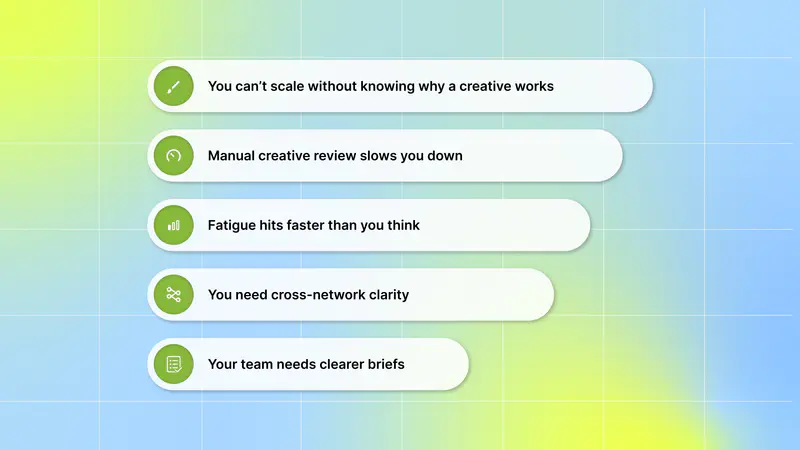
An ad creative analytics tool helps you understand why your ads perform the way they do. It does not just show impressions, clicks or ROAS. It breaks down the exact creative elements driving that performance, so you can see which creatives influence conversions and overall UA efficiency. In user acquisition, guessing is expensive: it burns budget, slows creative iteration and makes every campaign riskier than it should be. Here are the main reasons you need a dedicated tool:
You cannot scale without knowing why a creative works
It is not enough to see that an ad performed well. You need to know which part of it worked. Whether it is the hook, product angle, CTA, gameplay moment or storyline, understanding the exact creative element behind the performance helps you repeat winning patterns instead of guessing.
Manual creative review slows you down
If you are watching videos, tagging elements or checking multiple ad dashboards, you are losing hours every week. A creative analytics tool automates tagging and analysis so you spend less time sorting data and more time producing high-performing ads.
Fatigue hits faster than you think
Whether you run mobile game ads, DTC product creatives, subscription funnels or multi-client agency campaigns, fatigue kills performance quickly. Creative analytics helps you spot decline before it hits ROAS so you can refresh creatives on time.
You need cross-network clarity
Meta, Google, TikTok, Snap and DSPs all show data differently. Creative analytics gives you one unified view across networks, so you no longer jump between dashboards to understand what is happening.
Your team needs faster, clearer creative briefs
Creative teams move faster when they know exactly which elements drive results. A strong analytics tool turns performance into insight, helping you build briefs that actually work instead of relying on gut feeling. For a broader category view, see our guide to ad creative analysis tools.
What is Motion (motionapp.com), and where it falls short

Motion (motionapp.com) is a creative analytics platform that helps you review how your ads perform across Meta, TikTok, YouTube and LinkedIn. It focuses on showing which creatives are winning, why they might be working, and what patterns you can reuse in your next round of production.
Motion repositioned itself in 2026 from a creative-analytics dashboard into an AI-agent product. Every paid Motion plan now includes Runneth, an always-on AI agent on a dedicated VM that pre-watches, tags and analyzes creatives, plus a Slack workflow that ships briefs, hooks, reports and alerts on request. It is not in the free trial by default.
Pricing. Motion's published pricing is a flat monthly fee tiered by ad spend, with unlimited seats on every tier: Starter $750/month (up to $50K monthly ad spend), Pro $1,200/month (over $50K) and Growth, a custom quote for higher spend. There is a 14-day free trial with no credit card.
Motion's key features
Motion is a capable tool, and it is worth being clear about what it does well before looking at the gaps:
Creative grouping and comparative reports: Motion groups ads that share the same creative (on Meta it uses the Creative ID) and can turn your ad naming conventions into variables, so you can compare themes, angles and formats across many ads instead of one at a time.
Filters and breakdowns: filter by naming-convention variables and campaign, and break results down by age, gender and placement. Northbeam and Google Analytics 4 attribution are available on the Pro plan and up.
Frame-by-frame video analysis: video drop-off and audience retention views, plus hook, watch, click and convert scores on Meta and TikTok, show where viewers leave a video so you can fix the next cut.
AI tagging, chat and briefs: AI tags cover eight fixed categories (such as hook tactic, messaging theme, offer and audience) on Meta creatives. Runneth and Motion's agent chat answer questions about your ad data, write hooks, concepts and briefs, and can produce static image ads. Motion also offers a self-serve, read-only MCP server, which covers Meta data for now.
Competitor research: Inspo lets you follow brands and save ads from Meta's Ad Library into boards, and Motion's AI agent tracks rivals' new ads and suggests a plan. Inspo needs a paid plan.
Where Motion falls short
Motion works well for DTC teams on its four supported platforms, and it may be all you need if that describes you (see when to stay on Motion, below). For fast-moving UA and mobile app teams, these are the gaps that matter most:
No MMP integration. Motion's attribution integrations are Northbeam and Google Analytics 4. It has no integration with mobile measurement partners, so if you rely on AppsFlyer, Adjust, Branch, Singular or Kochava, you see platform-level performance, not the full impact of each creative on installs, retention or LTV.
No built-in fatigue alerts. Motion's alerts are routines you set up through its Runneth agent in chat, and its help center shows a fatigue report you build by hand. Without a built-in fatigue alert, you may notice a drop only after ROAS has already fallen. Segwise has fatigue alerts built in, on thresholds you set, across every network.
No playable ad analysis. Motion supports video, static image, dynamic creative and carousel formats, and does not list playable ads. If you run playables, it cannot tag the interactive elements inside them, which matters for the IPM, CTR and install quality of mobile game creative.
AI tagging covers Meta only. Motion's own help center says AI tagging is available for Meta creatives only. Custom tags are added by hand, one creative at a time, and only on some plans.
Only one ad account per platform in each workspace. Motion includes unlimited ad accounts, but each workspace holds only one ad account per platform, so multi-app teams switch between workspaces. If you publish several games or subscription apps, that switching slows down high-volume UA and agency teams that want to monitor everything in one place.
Also read: Segwise vs Motion: choosing the right creative analytics tool
Best Motion alternatives for ad creative analytics
If you want deeper insight than a surface-level dashboard, the 9 tools below each answer part of the "why did this creative work?" question. Segwise is our top pick for performance and UA teams. After that, the list is not a strict ranking: each tool is strongest at a different job, so use its "Best for" line to find your fit. Two of them are adjacent tools that teams often pick instead of Motion: Pencil is generation-first and CreativeX is governance-first. MagicBrief, long a popular Motion alternative, was shut down on 31 July 2026, so it is not included.
1. Segwise: Best for element-level creative analytics with MMP attribution
Segwise is an AI creative analytics and creative generation platform that helps UA and growth teams understand exactly which ad creatives and elements drive performance across Meta, Google, TikTok, Axon (AppLovin) and more. Its multimodal AI automatically tags creative elements such as hooks, characters, scenes, CTAs and audio, and maps each one to the metrics you track, including ROAS, IPM, CTR and CVR. Segwise unifies creative and performance data in one place so your team can make data-backed decisions instead of guessing.
Best for: mobile UA, gaming, DTC and multi-network performance teams that need element-level insight tied to real revenue.
Key features:
Element-level AI tagging: automatic multimodal tagging of video, audio, image, text and playables, mapped to the metric each element moves, with custom tags on top.
MMP attribution: no-code connections to AppsFlyer, Adjust, Branch, Singular and Kochava, so creative tags link straight to installs, retention and LTV, which Motion does not integrate with.
Playable ad tagging: Segwise plays each playable the way a player would and tags the core mechanic, tutorial, hook scene, end card and CTA, which matters for mobile game UA.
Built-in fatigue alerts: thresholds you set, with email and Slack alerts before performance tanks.
Creative Strategy Agent (AI chat): ask in plain language, for example "which hook style drove the most installs last month?", and get an evidence-backed answer, a brief or an on-demand report.
AI creative generation: turns your winning patterns into new data-backed statics, videos, AI UGC-style videos and playables, each auto-tagged and tracked once live, ready for your team to edit and ship.
Studio View: manage multiple apps, games or clients from one dashboard, ideal for studios and agencies.
Segwise MCP: a read-only MCP server, enabled on request, so your team can query Segwise data from AI tools such as Claude or ChatGPT.
Why Segwise is the best alternative: it covers the gaps Motion leaves open: MMP attribution, playable tagging, built-in fatigue alerts across every network, and video, AI UGC and playable ad generation. You get an element-level view of what actually drives ROAS across every channel you run, with Studio View for multi-app teams.
Limitations: Segwise is purpose-built for paid advertising creative, so it is not a general BI or web-analytics suite. Its competitor tracking covers Meta only today, and it does not buy media, so pausing ads and moving budget still happen in your ad manager or an automation tool.
Pricing: Segwise starts at $499/month for advertisers spending up to $250K/month, with a special 50% discount for startups spending under $50K/month. There is a 7-day free trial that automatically imports up to 2 weeks of historical data, and up to 3 months on paid plans.
2. Superads: Best for multi-platform paid social reporting

Superads is a creative analytics and ad reporting platform built by the team at Superside, the creative services company. It connects to Meta, TikTok, LinkedIn and Google Ads and gives marketing and creative teams one place to analyze ad performance at the creative level, with multi-platform reporting across all four channels in a single report.
Best for: teams that want fast, unified paid social reporting across Meta, TikTok, LinkedIn and Google.
Key features:
Creative scores: 0 to 100 scores for every creative across Hook, Hold, Click, Engagement and Conversion, so you can compare ads on more than raw ROAS.
AI tagging and AI chat: automatic creative tagging plus a conversational analyst connected to your live ad data.
Workflow reports and boards: scheduled AI insight reports to Slack (email is listed as coming soon), plus shareable live boards.
Why Superads is a good alternative: Superads reports on Google Ads campaigns, while Motion's Google coverage is YouTube, and it puts AI-generated insight on top, with transparent pricing that is easy to evaluate.
Limitations: Superads supports web ad platforms only. There is no MMP integration, no mobile ad network support and no playable analysis, so mobile UA teams cannot tie creative to post-install data.
Pricing: Professional from $125/month billed annually (up to $100K monthly ad spend, plus $100/month per additional $100K), with a 14-day free trial; Enterprise is custom.
3. Atria: Best for ad research plus analytics in one place

Atria (tryatria.com) is an AI ad platform that combines a large ad library with analytics and generation. It has added Raya, an AI creative-strategist agent, plus Radar ad grading, moving it well past a simple inspiration board. It also offers an MCP server and a REST API.
Best for: DTC and growth teams on Meta and TikTok that want research, grading and generation together.
Key features:
Radar analytics: plain-English grading of live ads with specific fix recommendations, plus proactive alerts when a creative starts declining.
Ad library and research: search and save competitor ads from Meta and TikTok for inspiration and briefs.
Raya AI strategist: auto-tags creatives, monitors competitors and pushes weekly concepts, which Atria says is trained on $9B+ of real ad spend.
Why teams pick it: it brings analytics, research and creation into one workflow with a clean interface, which suits teams that want direction, not just dashboards.
Limitations: Atria's site lists Meta and TikTok integrations and names no MMP or mobile gaming ad networks, and it does not list playable ads, so mobile game UA teams usually pair it with, or replace it by, a tool like Segwise.
Pricing: Core $129/month, Plus $479/month and Business $959/month, all billed annually, plus a custom Enterprise tier.
4. Vidmob: Best for enterprise creative intelligence piped into AI tools

Vidmob is a creative analytics platform that connects creative decisions to business outcomes across audiences, regions and platforms. In 2026 it launched Vidmob360, shifting from a standalone app to a composable intelligence layer delivered through MCP services and APIs, so its creative data can flow into AI assistants and enterprise media workflows.
Best for: large enterprise brands that want creative intelligence delivered into their own AI and media stack.
Key features:
Audience response tracking: measures how messaging, visuals, brand claims and concepts affect results.
Creative-to-business measurement: connects creative decisions to downstream business outcomes.
Predictive creative analysis: media teams can score assets before they run, to avoid spending on likely underperformers.
Why enterprise teams pick it: it adds predictive pre-launch scoring and enterprise-scale creative measurement, and its MCP and API delivery suits teams that want creative data inside their own AI tools.
Limitations: it is enterprise and sales-led with no self-serve tier or free trial, and it does not document playable-ad tagging the way a dedicated mobile analytics platform does.
Pricing: not publicly listed; enterprise contract, contact sales.
5. Hawky: Best for analytics plus autonomous agents

Hawky is an agentic performance-marketing platform that pairs element-level creative analytics with AI agents and a Copilot. It covers Meta, Google (including YouTube) and TikTok, and it can act on creative and media, not just report on it.
Best for: agencies and performance teams that want creative analytics with optional automation on top.
Key features:
Creative analytics: automatic element-level tagging of hooks, frames, copy, audio and CTAs, with fatigue alerts on every tier.
Copilot: plain-language questions and answers about your data, on its Ask and Auto-pilot tiers.
Autonomous agents and Creative Studio: optional performance and creative agents with spend caps and approval gates, plus image and video generation.
Why teams pick it: it adds agentic action and a Copilot over creative analytics, which suits teams that want insight and execution in one place.
Limitations: Hawky names AppsFlyer for revenue attribution, but lists no mobile gaming ad networks (AppLovin, Unity Ads, Mintegral, Moloco) and no playable ads. There is no self-serve free trial.
Pricing: quoted on request across three tiers (Dashboards, Ask, Auto-pilot) with unlimited users; no public price.
6. Madgicx: Best for Meta-first analytics plus ad automation

Madgicx is an all-in-one Meta advertising platform that combines creative analytics with AI-driven ad automation, audience targeting and bidding. It also works with Google Ads and TikTok.
Best for: Meta-first ecommerce brands and agencies that want creative insight plus hands-on campaign automation.
Key features:
Creative analytics: performance breakdowns to find winning creative elements.
AI ad automation: automated bidding, budgeting and audience tools for Meta.
Add-on tracking: a server-side Tracking Pro module at $49/month.
Where it fits: it adds automated bidding, budgets and audience tools for Meta, for teams that want to act on insight inside the same tool.
Limitations: it is Meta-centric and has no MMP-linked mobile attribution or playable tagging.
Pricing: Madgicx Pro Complete is one plan priced by monthly ad spend. From $45/month (billed monthly, under $1K ad spend); the price rises with ad spend, for example $99/month at $1K to $2.5K. 7-day free trial. Billing quarterly or annually lowers it (for example $32/month billed annually under $1K spend), and Tracking Pro is a $49/month add-on.
7. Foreplay: Best for Meta research and briefing on a budget

Foreplay is a creative research, briefing and analytics suite for performance marketers and agencies. You can save ads from the Meta and TikTok ad libraries into swipe files, track competitors automatically, build briefs, and analyze your own Meta and TikTok ad accounts with its Lens module.
Best for: DTC and agency teams focused on Meta and TikTok research and briefing at a price that does not scale with ad spend.
Key features:
Swipe files and discovery: save, tag and organize competitor ads from the Meta and TikTok libraries.
Spyder competitor tracking: round-the-clock tracking of rival Meta ad launches.
Lens analytics: creative-level reporting on your Meta and TikTok ad accounts, with AI tags (such as persona and hook transcription), custom tag rules and benchmarks against 20,000+ advertisers.
Why Foreplay is a good alternative: it targets Motion's core DTC and agency audience, and it bundles research, briefing and analytics affordably, with a public API for pulling its data into your own stack.
Limitations: Lens reports on Meta and TikTok ad accounts only, with no Google reporting, and there is no MMP or post-install data, so it cannot join creative to installs or LTV.
Pricing: Basic $59/month ($49 annual), Workflow $175/month ($149 annual), Agency $459/month ($389 annual), Enterprise custom; 7-day free trial.
8. CreativeX: Best for global enterprise creative governance

CreativeX is an enterprise creative measurement platform that programmatically scores ad creatives against digital best practices via its Creative Quality Score. It evaluates assets before launch and tracks live creative across markets, brands, agencies and channels, and is used by global brands such as Nestlé, PepsiCo and Heineken.
Best for: global enterprise brand and creative-governance teams enforcing quality at scale.
Key features:
Creative Quality Score: automated checks on aspect ratio, branding timing, safe zones, captions, sound and CTA, plus custom brand guideline rules.
Pre-flight and in-flight measurement: score assets before launch and track quality across platforms and markets.
DataLink: connects creative datasets with pre-testing and media performance data.
Where it fits: for global enterprises it enforces creative quality and brand consistency with systematic checks across every market and channel, a governance job Motion does not focus on.
Limitations: it is built for brand governance, not performance-marketer ROAS iteration. There is no MMP integration, no self-serve option, no trial and no AI creative generation. CreativeX measures creative, it does not make it.
Pricing: not publicly listed; enterprise annual contract, contact sales.
9. Pencil: Best for AI ad generation with predictive insight

Pencil is an AI creative platform that generates text, image and video ads and can launch and track them across channels. It leans on brand assets and performance data to produce ads quickly, with predictive scoring to guide what to run.
Best for: teams that want AI ad generation with lightweight predictive analytics attached.
Key features:
AI ad generation: static, image and video ads from briefs and brand assets.
Ad launch and tracking: generate, launch and track across up to 7 platforms.
Predictive insight: AI predictions to help prioritize which variations to run (Pencil's plan table lists these as coming soon, so check before you buy).
Where it fits: it is a generation-first option with an affordable entry tier, useful when your bottleneck is producing creative rather than deeply analyzing it.
Limitations: its strength is generation, not element-level analytics. There is no MMP attribution and no playable tagging, so it does not replace a dedicated analytics platform for understanding why ads win.
Pricing: Core $14/month ($11 annual), Growth $55/month ($44 annual), Pro custom, with a guided free trial.
If you run mobile game or playable ads: what to use instead of Motion
If you run mobile game UA, Motion's gaps are hardest to live with, because it has no MMP integration and does not list playable ads as a supported format. For mobile game studios, Segwise is the clearest pick on this list, for three reasons:
It tags playable ads. Segwise plays and tags the interactive elements inside playables (core mechanic, tutorial style, hook scene, end card) and maps them to IPM, install rate, CPI and ROAS. No other tool on this list documents this.
It connects gaming networks and MMPs. No-code connectors reach Meta, Google, TikTok, Axon (AppLovin), Unity Ads, Mintegral and Moloco, and MMP data from AppsFlyer, Adjust, Branch, Singular and Kochava, so creative tags tie straight to post-install performance.
It closes the loop with generation. Segwise can turn winning gameplay hooks and characters into new data-backed statics, videos and playables, each auto-tagged once live. Its playable generation runs as a managed service across major gaming networks. See the mobile gaming solution for detail.
Among the others, Madgicx is Meta-first and Foreplay focuses on Meta and TikTok, and neither tags playables; Hawky names AppsFlyer but lists no gaming networks, and Vidmob and CreativeX are enterprise creative-measurement tools that do not document playable support. For a mobile game studio, that leaves Segwise as the alternative that covers both the format and the attribution you run on.
When you may not need a Motion alternative
Switching is not always worth it. If you are a DTC or consumer brand that advertises only on Meta, TikTok, YouTube or LinkedIn, spends under $50K a month, does not drive app installs or run playable ads, and already uses Motion's Inspo boards and Runneth briefs, Motion's Starter plan may cover what you need. The case for moving gets strong when you need MMP data, mobile gaming networks, playable ads, AI tagging beyond Meta or built-in fatigue alerts.
Switching from Motion: what to expect
Run both side by side first. Motion has a 14-day free trial and Segwise a 7-day one, so you can compare the same ads in both before you cancel anything.
Your history comes with you on the new tool's side. Segwise imports up to 2 weeks of history on the free trial and up to 3 months on paid plans, and tags it automatically, so you do not start from zero.
Plan for your custom tags. Motion's custom tags are added by hand and are not included in its CSV export, so note the tags your team relies on before you switch. In Segwise, AI tags are applied automatically and you can add custom tags on top.
Setup is quick. Segwise uses no-code connectors, and a full stack of ad networks and an MMP typically connects in 10 to 15 minutes.
The bottom line on Motion alternatives
Motion (motionapp.com) is a capable creative analytics tool that got pricier and more agentic in 2026, but it still has no MMP integration, no playable ad support and no built-in fatigue alert, and its pages describe static ad generation only, not video or playable ads. For most performance and UA teams the strongest all-round replacement is Segwise, which maps every creative element to real revenue across networks, tags playables, flags fatigue and helps your team generate data-backed creative from your winning patterns. Superads is the better pick for unified paid social reporting and Foreplay for affordable Meta research.
A few more reasons UA teams pick Segwise:
Cross-platform integration: no-code connections to 15+ ad networks, including Meta, Google, TikTok, Snapchat, Axon (AppLovin), Unity Ads, Mintegral and Moloco. A full stack typically connects in 10 to 15 minutes with no engineering work.
Creative-level monitoring: impressions, clicks, installs, CPI, ROAS, CTR, CVR, spend and custom events, all at the creative level.
Card View and custom dashboards: a visual mode with creative thumbnails next to their metrics, plus dashboards and reports built around your own workflow.
The 7-day Segwise free trial is the quickest way to see which creative elements drive your ROAS.
FAQs
1. Is this about Motion the productivity or calendar app?
No. This guide covers Motion the ad creative analytics platform at motionapp.com, used by advertisers to analyze Meta, TikTok, YouTube and LinkedIn ad creative. The Motion productivity, to-do and calendar app (usemotion.com) is a separate company. Every alternative here, including Segwise, Superads and Foreplay, is a creative analytics tool for advertisers, not a scheduling app.
2. Which Motion alternative is best for mobile game studios?
Segwise. It is the one tool on this list that documents tagging inside playable (interactive) ads, it connects gaming networks like Axon (AppLovin), Unity Ads, Mintegral and Moloco, and it ties MMP data from AppsFlyer, Adjust, Branch, Singular and Kochava to creative performance. Madgicx and Foreplay are strong on Meta (and, for Foreplay, TikTok) but do not tag playables or link post-install data.
3. How much do Motion alternatives cost?
Published entry prices start at $11/month (Pencil, annual), $49/month (Foreplay, annual), $125/month (Superads, annual) and $129/month (Atria, annual). Segwise starts at $499/month for advertisers spending up to $250K/month, with a special 50% discount for startups spending under $50K/month. Vidmob, Hawky and CreativeX are contact-sales only, and Madgicx starts at $45/month (billed monthly, under $1K ad spend) and rises with spend. Motion has the highest published entry price on this list at $750/month Starter and $1,200/month Pro.
4. Which Motion alternative is cheapest?
Pencil, from $11/month billed annually, is the cheapest paid option, and Foreplay, from $49/month billed annually, is the cheapest research tool whose price does not rise with ad spend. Madgicx starts at $45/month (billed monthly) for Meta accounts spending under $1K a month. Pencil and Foreplay are lighter on analytics than a platform like Segwise, so weigh price against the depth of insight you actually need.
5. Has Motion changed in 2026?
Yes, substantially. Motion now sells as an AI-agent product rather than a reporting dashboard: every paid plan includes Runneth, an always-on AI agent on a dedicated VM, and pricing moved to a flat monthly fee tiered by ad spend ($750 Starter, $1,200 Pro, Growth custom) with unlimited seats. If you last evaluated it in 2025, both the product and the price are different, which is one reason teams compare it against Segwise and Superads again.
6. Can I link creative data to installs and MMP attribution with a Motion alternative?
Yes, but only with a few of them. Segwise connects to AppsFlyer, Adjust, Branch, Singular and Kochava, so creative tags tie to installs, retention and LTV. Hawky names AppsFlyer for revenue attribution. Superads and Foreplay are web and paid-social tools with no MMP integration, and Motion's own attribution integrations are Northbeam and Google Analytics 4.
7. Is MagicBrief still available as a Motion alternative?
No. MagicBrief was acquired by Canva and shut down on 31 July 2026, and its team moved to Canva, which now offers Canva Grow for ad performance. Teams that relied on it need a replacement, and the tools on this list, led by Segwise for analytics and Foreplay for research, are the strongest options.
8. What is the best free or trial option to test first?
Segwise offers a 7-day free trial that backfills up to 2 weeks of history automatically. Motion and Superads have 14-day trials, and Madgicx and Foreplay have 7-day trials. Trialing Segwise alongside one research tool like Foreplay is a quick way to compare depth against breadth.
How we evaluated these tools
Each tool was assessed in 2026 against five criteria: element-level creative tagging depth, ad network and MMP coverage, fatigue detection, creative generation, and published pricing. Every price above was read from the vendor's own pricing page; where a vendor publishes no price, this guide says so rather than estimate. Vendor pricing changes often, so check before you buy.