
Updated August 2026.
Updated 31 August 2026
Quick answer: Segwise (from $499/month) is the stronger pick for performance teams running campaigns across many networks: 15+ ad network and MMP integrations, custom AI tagging, playable-ad tagging, native fatigue detection, and AI creative generation. Motion (from $750/month, unlimited seats) is now an AI-agent product built around its “Runneth AI brain”, and is the stronger pick for DTC and ecommerce teams concentrated on Meta, TikTok, YouTube and LinkedIn who want an always-on analyst answering questions inside Slack.
Research shows that creative quality contributes to 56% of a campaign’s impact, outpacing factors such as media placement, targeting, or frequency.
With such a significant impact, selecting the right tool to enhance your ad creatives and track results is crucial for optimizing your budget. However, with a range of options available, finding the best fit for your business can be a challenge.
Some teams require in-depth, data-driven insights to manage complex campaigns across multiple channels. At the same time, others need quick and simple reporting to stay on top of fast-moving social media ads.
This is where Segwise and Motion come in. Both platforms use AI to improve creative performance, but they approach this task in distinctly different ways. Let’s break down their key differences and determine which one best aligns with your team’s needs.
Key Takeaways
Best For Marketing Teams: Segwise is designed for performance-driven teams managing multi-channel ad campaigns across ad networks and MMPs. Motion is built for DTC and ecommerce teams concentrated on Meta, TikTok, YouTube and LinkedIn who want an always-on AI analyst working inside Slack.
Depth of Creative Insights: Segwise provides in-depth analysis by mapping creative elements like hooks, dialogues, CTAs, and emotions to metrics like ROAS, CTR, and CPA. Motion is no longer a trends-only dashboard. Motion’s AI tagging works on Meta ads. It does not tag playable ads or read MMP data. Its AI tags use 8 fixed categories on Meta ads only, and custom tags are added by hand.
Data-Driven Optimization: With Segwise, you can see exactly how each creative impacts performance and scale winning ads faster. Motion offers iteration finders, benchmarks, and alerts, and will assemble reports on request in Slack. But its analysis stops at the four ad networks it connects to: Meta, TikTok, YouTube and LinkedIn.
Control and Scalability: Segwise delivers enterprise-grade analytics, full control over creative tagging, and actionable insights for scaling campaigns efficiently. Motion includes unlimited seats and unlimited ad accounts on every tier, plus a dedicated CSM on Growth: genuinely strong for large teams, though the entry price is $750/month.
Creative Generation: Segwise goes beyond analysis: its Creative Generation Agent produces new, data-backed static and video creatives from your winning patterns. Motion’s Runneth agent writes briefs and hook lines and can make static image ads. It does not list video, AI UGC or playable generation.
What is Segwise?
Segwise is an AI-powered creative intelligence and generation platform built for performance-driven marketing teams. Its Creative Tagging Agent automates creative tagging at the element level, hooks, dialogues, CTAs, character emotions, benefits, and features, and connects these insights directly to key performance metrics like ROAS, CTR, CPA, and IPM. The Creative Strategy Agent (AI Chat) lets you ask anything about your creative data in plain language, the Creative Generation Agent turns winning patterns into new, data-backed static and video creatives, and the Competitor Tracking Agent monitors and tags competitor ads.
Segwise integrates with 15+ ad networks and MMPs: Meta, Google UAC (including YouTube), TikTok, Snapchat, Reddit, LinkedIn, Amazon Ads, programmatic networks and DSPs such as Axon (AppLovin), Mintegral, IronSource, and Unity Ads, plus MMPs like AppsFlyer, Adjust, Branch, Singular and Kochava. With enterprise-grade dashboards and real-time analytics, it helps teams identify top-performing creatives faster, scale winning ads confidently, and optimize campaigns with precision.
What is Motion?
Motion (motionapp.com) started life as a creative analytics dashboard, and a lot of comparison content still describes it that way. That description is now out of date. Over the past year Motion has repositioned itself as an AI-agent product. Every paid plan now ships with what Motion calls “your own always-on Runneth AI brain”. Runneth is the public name of Motion’s AI agent. It can answer questions about your creatives without you building a report first. Motion’s AI tagging works on Meta ads.
In practice that means you talk to Motion in Slack. It ships briefs, hook lines, and reports on request, runs daily and weekly routines, flags iteration opportunities, and sends alerts. Alongside that sit the original strengths: an ad leaderboard, creative analytics with AI tags and AI tasks, and benchmarks. Motion’s competitor research tool is Inspo (Brand Intel, boards, saved ads). It needs a paid plan. The old Creative Research suite was retired in November 2025. Pro adds attribution integrations with Northbeam and Google Analytics plus first-pass video QA in Slack; Growth adds a dedicated CSM, solutions engineering, closed-loop pipelines, and private Slack support.
Two things worth getting right, because both are commonly mis-stated. First, Motion’s $30M Series B (led by Inovia, bringing total raised to $42M) was announced in September 2024: it is not a recent round, despite some write-ups carrying 2026 dates. Second, Motion’s integration list is narrow by design: its site documents Meta, TikTok, YouTube and LinkedIn ad accounts, plus Google Analytics and Northbeam for attribution. There is no MMP support. If your spend sits mostly on those four networks, that narrowness costs you nothing. If you run Axon, Unity, Mintegral, or IronSource, it is the whole ballgame.
Note that “Motion” is an ambiguous name: usemotion.com is an unrelated AI calendar app. The creative analytics product is motionapp.com.
Feature Comparison: Segwise vs Motion
Segwise and Motion both help marketers analyze creative performance, but they take very different approaches. Here’s a side-by-side breakdown to help you choose the right platform for your workflow:
Feature | Description | Segwise | Motion |
Ad Network Support | Integrations with 15+ ad networks including Google UAC, Axon, Snapchat, Reddit, LinkedIn, Amazon Ads, and more DSPs | ✔️ | Meta, TikTok, YouTube and LinkedIn ad accounts only (plus Google Analytics and Northbeam for attribution) |
Multi-Network Reports | Create reports and dashboards with data flowing in from multiple ad networks and ad accounts | ✔️ | Partial. Unlimited ad accounts, but only across Meta, TikTok, YouTube and LinkedIn. |
Campaign, Ad Group, Country as Dimensions | Create reports with dimensions like Country, Campaign, Ad Group, Creative type, etc. | ✔️ | Motion documents campaign filters and age, gender and placement breakdowns. We did not find country-level reporting. |
Custom AI Tagging | Apart from auto-tagging all your assets with helpful tags out of the box, Segwise can extract any custom creative variable you need by analysing the images, watching the videos, and playing the playable ads | ✔️ | Partial. AI tagging works on Meta ads only, with 8 fixed categories. Custom tags are added by hand. No playable-ad tagging. |
Creative Strategy Chat Assistant | Chat with your creative data using your creative strategy AI assistant: get answers and insights, brainstorm new ideas | ✔️ | ✔️ |
Fatigue Detection Agent | Detect early signs of creative fatigue | ✔️ Native fatigue detection with custom thresholds | Alerts, iteration finders, and daily/weekly routines, but no named fatigue-detection agent |
AI Creative Generation | Agentic, data-backed asset generation for statics and videos | ✔️ Images, video, AI UGC, playables, and storyboards | Briefs, hooks and static image ads. No video, AI UGC or playable generation listed. |
Backend & MMP Data | Integrate MMPs like AppsFlyer, Adjust, Branch, Singular and Kochava with ad network data in one dashboard | ✔️ | ❌: Northbeam and Google Analytics attribution on Pro and above; no MMP support |
Dedicated CSM Support | A single point of contact for onboarding, guidance & check-ins with support on Slack | ✔️ (Pro and Enterprise) | ✔️ On the Growth tier (custom pricing), with private Slack support |
Playable Ad Tagging | Tag interactive/playable ads the same way as video and static: critical for mobile gaming UA | ✔️ | ❌ |
Competitor Ad Tracking | Monitor and AI-tag competitor ads inside the same platform | ✔️ Competitor Tracking Agent (currently Meta) | ✔️ Inspo (Brand Intel, boards, saved ads). Needs a paid plan. |
Seats | How many people can use the platform | Unlimited seats on every plan | Unlimited seats and unlimited ad accounts on every plan |
Entry Price | Lowest published monthly price | $499/month Growth (or $250/month startup rate under $50K monthly spend) | $750/month Starter |
Also Read: Understanding Creatives in Advertising: Importance and Examples.
Which Platform is Right for You?
Choosing between Segwise and Motion depends on how deep you need to go with creative analytics and how many platforms you manage. Both tools help marketing teams understand creative performance, but they solve different problems.
Choose Segwise if you need:
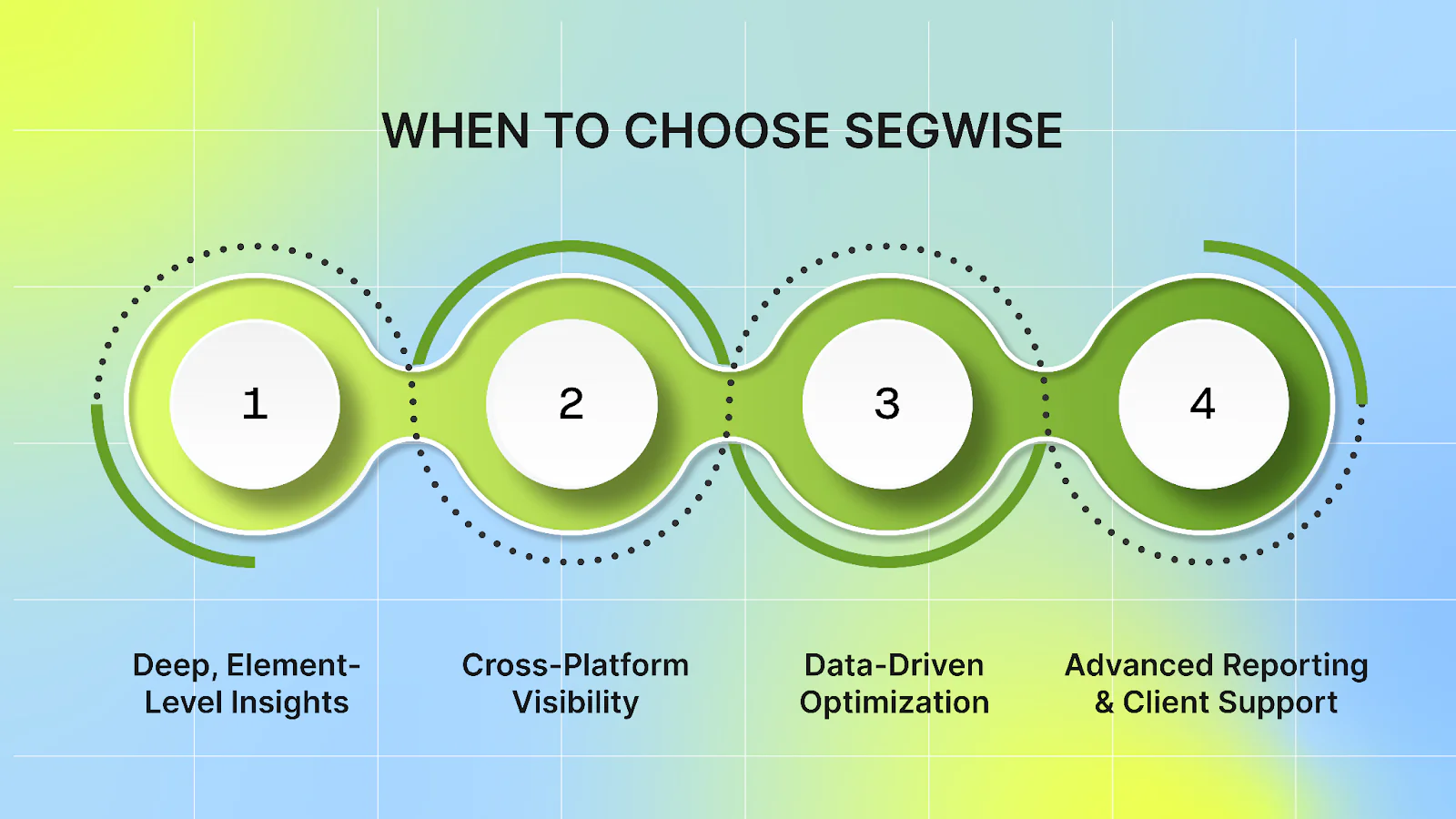
Deep, Element-Level Insights: Automatically tags hooks, dialogues, CTAs, visuals, emotions, and benefits to map performance at a granular level.
Cross-Platform Visibility: Unified creative analytics across Meta, Google, TikTok, Snapchat, and programmatic platforms like AppLovin, Unity, and Mintegral.
Data-Driven Optimization: Links creative elements directly to ROAS, CTR, CPA, and IPM, helping you scale winning ads faster.
Advanced Reporting and Client Support: Offers custom dashboards, white-label reporting, and dedicated CSM support for enterprise teams.
AI Creative Generation: The Creative Generation Agent produces new, data-backed static and video creatives (including playables and video storyboards) built around your winning creative patterns, so insights turn directly into new ads.
Best For: Performance marketers, creative strategists, and agencies managing multi-channel campaigns.
Choose Motion if you need:

An Always-On AI Analyst in Slack: Motion’s Runneth AI agent answers questions, ships briefs and hook lines, and runs daily and weekly routines without you opening a dashboard. Its AI tagging works on Meta ads.
Paid Social Performance Tracking: Best suited for spend concentrated on Meta, TikTok, YouTube and LinkedIn, with Northbeam or Google Analytics attribution layered on top.
Competitor Research: Motion’s competitor research tool is Inspo (Brand Intel, boards, saved ads). It needs a paid plan. The old Creative Research suite was retired in November 2025. Inspo is a real perk if inspiration-gathering is part of your weekly routine.
Predictable Flat Pricing With Unlimited Seats: Every tier is a flat monthly fee with unlimited seats and unlimited ad accounts, so headcount growth never changes the bill. Budget for $750/month at the low end.
Best For: DTC, ecommerce, and consumer-app teams spending on Meta, TikTok, YouTube and LinkedIn who want an AI analyst on call and can absorb a four-figure monthly floor.
Pricing: Segwise vs Motion (2026)
Both platforms price on a flat monthly fee tiered by monthly ad spend, and both include unlimited seats, so the comparison is unusually clean. The difference is where the tiers sit.
Plan | Segwise | Motion |
Entry | $499/month (Growth): up to $250K monthly ad spend, 500 AI tokens/month, chat support. Startups spending under $50K/month qualify for a $250/month rate. | $750/month (Starter): up to $50K monthly ad spend, always-on AI brain, ad leaderboard, Slack integration, full data and MCP access. |
Mid | $1,699/month (Pro): $250K to $500K monthly ad spend, 2,000 AI tokens/month, Slack support and onboarding. | $1,200/month (Pro): over $50K monthly ad spend, adds Northbeam and Google Analytics attribution, first-pass video QA, personalized onboarding. |
Top | Custom (Enterprise): $500K+ monthly ad spend, custom token volume, dedicated CSM. | Custom (Growth): over $125K monthly ad spend, dedicated CSM and solutions engineering, closed-loop pipelines, private Slack. |
Seats | Unlimited on every plan | Unlimited seats and unlimited ad accounts on every plan |
Free trial | 7 days, no credit card. Imports up to 2 weeks of history automatically (up to 3 months on paid plans). | 14-day free trial, no credit card. Its Runneth agent is not in the trial by default. |
Billing basis | Flat monthly, tiered by ad spend; 10% off annual | Flat monthly, tiered by ad spend; no annual pricing published |
The practical read: at the low end Segwise is roughly a third cheaper at entry and covers five times the ad spend before you tier up, and the startup rate takes it to $250/month. At very high spend the two converge. Neither tool charges per seat, so “how many people will use this” is not a cost question for either.
Where Motion Genuinely Wins
A comparison that only lists the other tool’s gaps is not much use when you are actually choosing. Here is where Motion is the better answer:
Depth of adoption and social proof. If you need a category-standard tool that your CFO and your agency have both already heard of, Motion’s track record is real.
The Slack-native workflow. Motion’s AI brain lives where DTC growth teams already work. Asking for a brief in a Slack thread and getting one back, with daily and weekly routines running unprompted, is a genuinely lower-friction habit than opening any dashboard: Segwise’s included.
Unlimited ad accounts on every tier. Agencies running dozens of client accounts on Meta and TikTok can add all of them at the Starter price without a conversation about volume.
Competitor research. Motion’s competitor research tool is Inspo (Brand Intel, boards, saved ads). It needs a paid plan. The old Creative Research suite was retired in November 2025. If your team’s main unmet need is inspiration-gathering rather than measurement, that alone may settle it.
Northbeam and Google Analytics attribution. For ecommerce teams already standardised on Northbeam, having creative analytics read from the same attribution source is a real advantage. Segwise integrates five major MMPs (AppsFlyer, Adjust, Branch, Singular and Kochava), which is the mobile-app equivalent, not the ecommerce one.
The honest summary: if all your spend is on Meta, TikTok, YouTube and LinkedIn and you want an AI analyst in Slack, Motion is a strong, mature choice. The case for Segwise gets stronger the further your spend moves away from those four networks (to Axon, Unity, Mintegral or IronSource), the more you need MMP data joined to creative data, the more playable ads you run, and the more you want the tool to produce the next creative rather than a brief describing it.
Conclusion
Segwise and Motion both help marketing teams analyze creative performance, but they serve different needs. If you manage multi-channel campaigns and need deep, element-level insights, Segwise gives you complete visibility into which creative elements drive ROAS, CTR, and CPA.
With AI-powered tagging, cross-platform tracking, custom dashboards, and AI creative generation, it’s built for performance-driven teams looking to scale faster and optimize with confidence. Motion, on the other hand, is now a capable AI-agent product in its own right. It works best if your spend sits on Meta, TikTok, YouTube and LinkedIn, you want an always-on analyst answering in Slack, and $750/month at entry fits the budget.
Start your free trial at segwise.ai and see how Segwise helps you analyze creatives smarter, optimize campaigns faster, and identify your highest-performing ads.
FAQs
Q. Can I integrate these platforms with other tools?
A. Yes, but the lists are very different in shape. Motion documents Meta, TikTok, YouTube and LinkedIn ad accounts, plus Google Analytics and Northbeam for attribution, and offers full data and MCP access. Segwise connects 15+ ad networks and MMPs, including Meta, Google, TikTok, Snapchat, YouTube, Axon (AppLovin), Unity Ads, Mintegral, IronSource and more, plus AppsFlyer, Adjust, Branch, Singular and Kochava. All are no-code, with a single network live in about 5 minutes and every source connected in 10 to 15.
Q. Which tool is better for creative testing?
A. Both now tag creatives automatically, so the question is granularity and format coverage. Segwise extracts custom creative variables you define, tags audio and on-screen text as well as visuals, is the only platform that tags playable (interactive) ads, and uses asset clustering to isolate which single change between two near-identical ads moved ROAS. Motion’s AI tagging works on Meta ads and uses 8 fixed categories, with custom tags added by hand. Motion surfaces iteration finders but does not tag playable ads.
Q. Which platform scales better as my team grows?
A. Segwise is built for scale. It includes team permissions, project sharing, and custom workflows for large organizations.
Q. Does Motion generate ad creatives?
A. Briefs, hooks and static image ads. No video, AI UGC or playable generation listed. Motion’s Runneth agent writes creative briefs, hook lines, and reports and delivers them in Slack, which is genuinely useful. Segwise’s Creative Generation Agent produces the assets themselves: data-backed static images, video ads, AI UGC-style video, and interactive playables, plus scene-by-scene video storyboards. Every generated creative is automatically tagged and tracked once it goes live, so its performance feeds back into the same intelligence that produced it.
Q. How long does it take to set up Segwise?
A. Setup is no-code: connecting a single ad network takes about 5 minutes, and connecting all your sources takes 10 to 15 minutes. Segwise offers a 7-day free trial (no credit card) that automatically imports up to 2 weeks of historical data (up to 3 months on paid plans), so you get insights from day one.
Q. Does Motion have an AI agent?
A. Yes, and any comparison saying otherwise is out of date. Every paid Motion plan includes Runneth, its always-on AI agent. It is not in the free trial by default. Runneth answers questions about your creatives in Slack, and Motion’s AI tagging works on Meta ads.
Q. How much does Motion cost?
A. $750/month on Starter (up to $50K monthly ad spend) and $1,200/month on Pro (over $50K). The Growth tier, for over $125K monthly spend, is custom-priced. All tiers include unlimited seats and unlimited ad accounts. No annual pricing is published.
Q. How much does Segwise cost?
A. $499/month on Growth (up to $250K monthly ad spend, 500 AI tokens), $1,699/month on Pro ($250K to $500K, 2,000 AI tokens), and custom Enterprise pricing above $500K. Teams spending under $50K/month qualify for a $250/month startup rate. All plans include unlimited seats and the full platform: analytics, tagging, the strategy agent, and generation. Annual billing is 10% off, and there is a 7-day free trial with no credit card.
Q. Is Motion still just a creative analytics dashboard?
A. No. That was an accurate description in 2024 and it is not one in 2026. Motion has repositioned around its AI brain and now sells its tiers as “a 24/7 analyst”, “a real AI-enabled operator”, and “an embedded AI team”. It is worth noting Motion’s $30M Series B was announced in September 2024, not recently: some coverage mis-dates it.
Q. Which tool is better for mobile game UA?
A. Segwise, fairly clearly. Mobile UA spend concentrates on Axon (AppLovin), Unity Ads, Mintegral, and IronSource, none of which Motion connects to, and it depends on MMP data from AppsFlyer, Adjust, Branch, Singular or Kochava, which Motion does not read. Playable ads are also a core mobile-gaming format, and Segwise is the only platform that tags them.
Q. Which tool is better for a DTC ecommerce brand?
A. It is genuinely close. If your spend is Meta-and-TikTok-heavy and you already run Northbeam, Motion’s Slack workflow and attribution integrations are a strong fit. Choose Segwise if you also want the platform to generate the next round of creatives from your winning patterns, or if you are adding networks beyond paid social.
How We Compared These Tools
Pricing, plan limits, and feature claims for both platforms were read directly off each vendor’s own pricing and integrations pages in August 2026, not from third-party summaries: several of which still carry Motion’s older, cheaper positioning and mis-date its Series B. Segwise capability claims are drawn from the live product. Where we could not verify something (for example, whether Motion supports country-level reporting), this comparison says so instead of assuming a gap.
Written by the Segwise team. We build creative intelligence software, so we have an obvious interest in this comparison, which is exactly why every competitor figure above is sourced from Motion’s own pages and why the section on where Motion beats us is in the article rather than left out. If you spot something out of date, tell us and we will correct it.