
The best Madgicx alternatives in 2026 are Segwise, Motion and Smartly: Segwise for element-level creative analytics and AI creative generation across 15+ ad networks and MMPs, Motion for DTC creative reporting with an always-on AI analyst (from $750/month), and Smartly for enterprise-scale creative automation across paid social and CTV.
Segwise is an AI creative-analytics platform: it auto-tags every element of your ad creatives across 15+ ad networks and MMPs, ties each element to performance, flags creative fatigue early, and generates new variations of what's working, which is why it tops this list.
TL;DR: Key Takeaways
Madgicx is not the tool it was in 2025. It now positions as an agentic Meta ads management platform, with a named AI Marketer, Ads Rotation Agent and Creative Refresh Agent, and an AI Ads Generator, so it has moved into AI creative generation.
Its pricing is now gated. The pricing page says “see price inside the app”: you create an account and connect Meta to see your ad-spend tier. Published extras are the Tracking Pro add-on at $49/month and a $29/month early-bird entry offer, with a 7-day free trial. Third-party listings show a Madgicx Pro tier at $99/month, but that is not the vendor’s own page.
The real gap is still creative depth. Madgicx works at the ad level and is Meta-first. Element-level tagging, playable-ad analysis and MMP or CDP joins are what UA teams leave for.
Match the tool to the gap: creative intelligence (Segwise, Motion, Atria, GetCrux), creative automation at scale (Smartly, AdCreative.ai), data unification and reporting (Improvado), or an agent that actually runs the spend (Hawky).
Watch the billing terms. Users praise the automation; the recurring complaints are about billing and cancellation, so read those before you commit.
Madgicx Alternatives at a Glance (2026)
What if the creatives you’re scaling today are the exact ones killing your ROAS tomorrow?
You’ve been launching new ads and tweaking budgets, but the real problem sits deeper in the creative itself. When you don’t know which hooks or visuals drive conversions, you end up scaling blind. Meanwhile, your competitors keep finding winning concepts faster because they use tools built for full creative analysis, not just bid automation.
Are you also relying on platforms like Madgicx and struggling to set custom fatigue alerts? This blog breaks down the best Madgicx alternatives that help UA teams across mobile games, DTC brands, and subscription apps make smarter creative decisions.
Why You Need an Ad Creative & Analytics Tool
An ad creative & analytics tool helps you understand why your ads perform the way they do. It breaks down each creative into components such as hooks, visuals, formats, and shows how these elements impact your ROAS, CPA, installs, and subscriber quality. Instead of guessing what works, you get clear performance insights that guide which creatives to scale, refresh, or replace.
Here are the key reasons you need Ad Creative & Analytics Tool: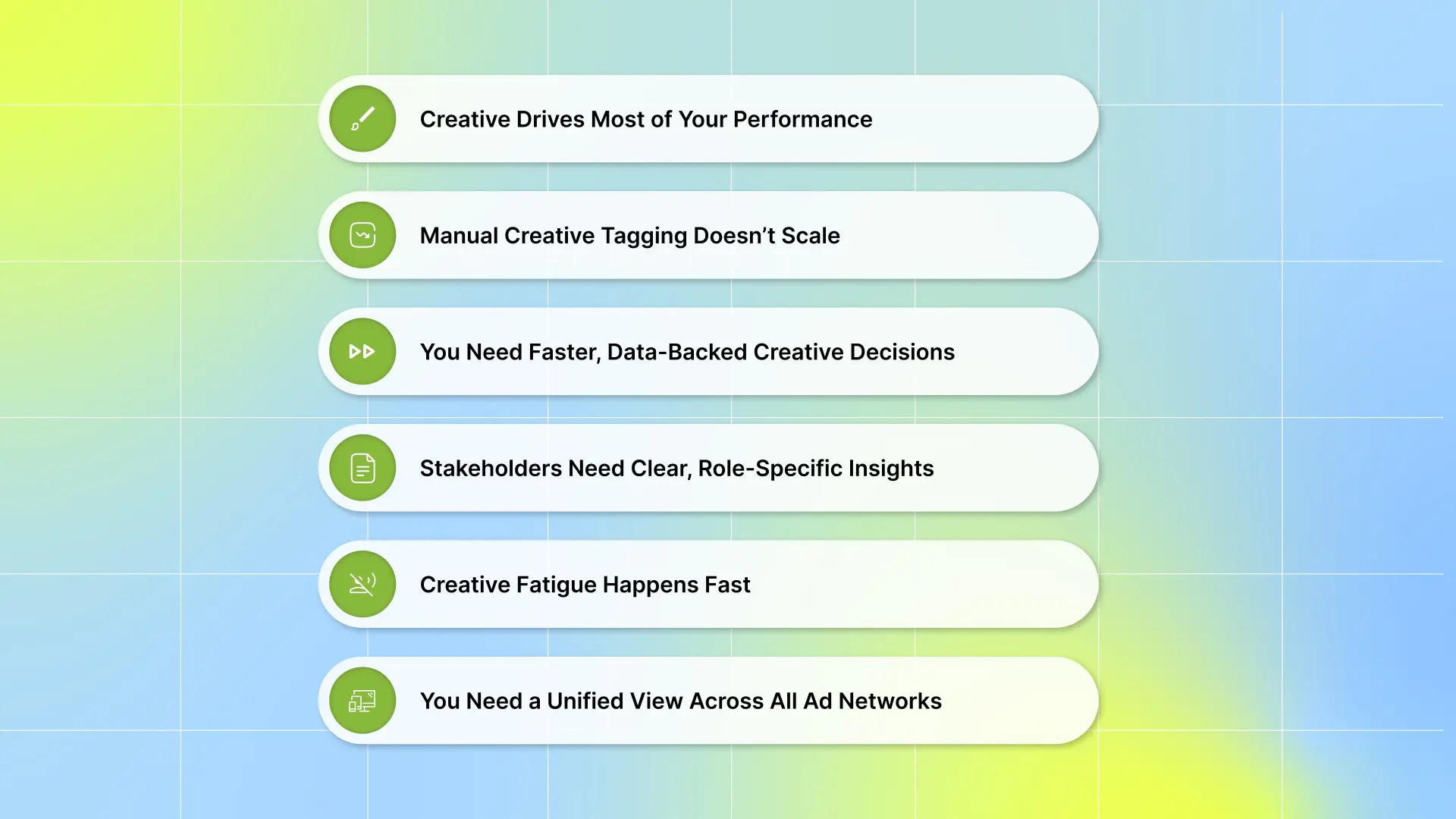
1. Creative Drives Most of Your Performance
Your success depends on choosing the right creative, not just the right audience or bid. A good analytics tool shows which storylines, product angles, gameplay clips, or hooks actually deliver conversions so you stop wasting spend on ideas that don’t work.
2. Manual Creative Tagging Doesn’t Scale
When you’re testing dozens of videos or playables each week, tagging elements manually becomes impossible. Human error in manual tagging leads to inconsistent categorization and unreliableinsights. An analytics tool automates this work, helping you track patterns in winning creatives without spending hours in spreadsheets.
3. You Need Faster, Data-Backed Creative Decisions
Your UA and creative teams should not wait days or weeks to learn what’s working. A dedicated analytics tool turns creative performance into clear next steps, what to scale, what to kill, and what to iterate next.
4. Stakeholders Need Clear, Role-Specific Insights
Your Head of Growth wants KPIs. Your Creative Lead wants patterns. Your agency clients want proof of value. A good creative analytics tool gives each person the exact view they need without overwhelming them with data.
5. Creative Fatigue Happens Fast
Whether it’s a gameplay sequence, a product demo, or a subscription value prop, every creative gets tired. A fatigue-tracking tool warns you before performance drops, helping you refresh ideas before they burn budget.
6. You Need a Unified View Across All Ad Networks
Meta tells one story. Google tells another. TikTok behaves differently altogether. An analytics tool consolidates data from all ad networks, MMPs, and CDPs in one place so you can see which creatives truly work across your full UA mix.
Now, it's important to understand what Madgicx actually offers and where its limitations begin.
What Is Madgicx, and Where It Falls Short?

Madgicx is an AI-powered advertising platform designed to help marketers automate and optimize their ad campaigns, especially on Meta. It combines AI-driven optimization, creative generation, analytics, and automation into a single interface, so you spend less time manually managing campaigns and more time scaling performance.
Here are the key features of Madgicx:
1. Identify Winning Creative Elements With AI: Madgicx shows you what’s working in your creatives, such as whether adding more humans or specific visual elements improves performance. It gives high-level signals about what elements may be helping your ads convert.
2. Cross-Channel Analytics Dashboard: With a live business dashboard, you can view performance data from multiple sources (Facebook, TikTok, Google Ads, Shopify, and more) in one place for faster reporting and decision-making.
3. One-Click and Custom Reporting: Madgicx offers prebuilt or custom drag-and-drop reports so you can quickly export and share performance results with your team or clients.
4. AI-Powered Campaign Optimization: Madgicx uses machine learning to audit your ad accounts daily and suggest optimization moves from budget adjustments to audience changes so your campaigns run more efficiently and at scale.
5. Spot Creative Fatigue and Losing Ads: Madgicx highlights ads that are slowing down or no longer performing well. It tells you which ads to pause, which ones to scale, and which ones need more testing.
6. Agentic Meta Ads Management: Madgicx now leads with named agents rather than a dashboard. The AI Marketer acts as a personal AI media buyer that runs Meta ads autonomously, while the Ads Rotation Agent and Creative Refresh Agent handle rotation and refresh cycles. It is an official Meta Business Partner.
7. AI Ads Generator: Madgicx has moved into AI creative generation, with an end-to-end generate-and-launch workflow that pushes new ads straight into campaigns. If you last looked at Madgicx as an optimisation dashboard, that framing is out of date.
Madgicx Pricing in 2026
Madgicx pricing is gated. The pricing page for Madgicx Pro Complete with AI says “see price inside the app”, you create an account and connect a Meta account to see the rate for your ad-spend bracket. Published brackets run from under $1K a month up to $30K+. What is published: the Tracking Pro add-on at $49/month per connected account, a $29/month early-bird offer for the data-analysis tier (explicitly not the full AI optimisation suite), and a 7-day free trial with all features. Third-party listings show “Madgicx Pro $99/month”, treat that as an entry-tier third-party figure, not the whole picture, because the vendor’s own page confirms spend-tiered pricing above it. Billing is monthly, quarterly or annual.
Where Madgicx Falls Short
Madgicx is great for automating Meta campaigns, but it misses key capabilities that modern UA teams need to scale creative performance with confidence. Here are the main areas where Madgicx falls short:
1. Limited Creative-Level Insights: Madgicx shows which ads are working, but doesn’t break down why creatives perform well at the element level, like hooks, emotions, characters, or scenes, which you need to make smarter creative decisions that drive ROAS.
2. Fatigue Handling Is Rules-Based, Not Criteria-Based: The Creative Refresh Agent will rotate and refresh ads, but you cannot define your own success and fatigue criteria, a 20% ROAS decline over seven days, say, or a spend-share drop, and have them tracked consistently across every platform you buy on.
3. No Playable Tagging: The platform doesn’t provide advanced multimodal tagging for playables, meaning you still need manual work to classify creative elements that actually affect playable ads performance.
4. Focused Mostly on Meta Without MMP/CDP Integration: Although Madgicx offers cross-channel dashboards, its core strength is Meta optimization. For UA teams wanting deep integrations with mobile measurement partners (MMPs) and customer data platforms (CDPs), it falls short.
Once these limitations become clear, many teams evaluate other platforms that provide more advanced creative analytics.
Also Read: Creative Fatigue: Understanding and Managing Ad Performance
Top 10 Alternatives to Madgicx in 2026
If you’re looking for platforms that offer deeper creative intelligence, stronger analytics, or broader cross-network support, several tools outperform Madgicx in key areas. These solutions help teams make faster, data-driven creative decisions.
Here are the top alternatives worth considering:
1. Segwise

Segwise is an AI-powered creative intelligence and generation platform built for UA teams, performance marketers, mobile game studios, DTC brands, subscription apps, and agencies running paid acquisition across multiple ad networks.
It unifies creative performance data from 15+ ad networks and MMPs, automatically tags creative elements using multimodal AI, and connects those elements directly to business outcomes like ROAS, CPA, CPI, LTV, IPM, conversion rates, and custom events. Instead of only showing campaign-level metrics, Segwise helps teams understand what worked, why it worked, where it worked, and what to build next.
Unlike traditional analytics tools, Segwise closes the loop between analysis and production. Its AI agents identify winning creative patterns, detect fatigue, monitor competitors, answer creative strategy questions, and generate new data-backed creatives across static, video, and playable formats.
Key Features
One place for all your creative data: Segwise brings creative performance data from Meta, Google, TikTok, Snapchat, YouTube, AppLovin, Unity, Mintegral, IronSource, Axon, MMPs, CDPs, and other sources into one unified view. Teams can track creative-level ROAS, CPA, CPI, LTV, IPM, spend, installs, CTR, CVR, and custom events without jumping between ad managers, MMP dashboards, and spreadsheets.
Tag-level creative element mapping: Segwise automatically tags creative elements such as hooks, dialogues, CTAs, characters, visual styles, emotions, formats, audio, on-screen text, product shots, and playable interactions. Every tag is mapped to performance, so teams can spot patterns like “this hook appears in most top-performing creatives” or “this gameplay mechanic drives higher IPM but lower ROAS” with MMP-attributed performance data.
AI Creative Strategy Agent: Segwise gives teams an always-on AI creative strategist with full context across their creative data, competitor data, tag performance, fatigue patterns, asset clusters, and custom metrics. Teams can ask questions in plain language, generate reports, analyze performance, and get recommendations without manually building dashboards or exporting spreadsheets.
AI-powered creative generation: Segwise turns winning patterns into new creative directions, briefs, storyboards, static ads, video ads, playable concepts, and creative variations. Instead of generating generic ad ideas, it creates data-backed creatives grounded in the hooks, CTAs, formats, visuals, and messages that are already driving performance.
Closed-loop creative tracking: Every AI-generated creative can be tagged and tracked once live, so its performance feeds back into the same creative intelligence system that created it. This helps teams continuously learn which generated ideas worked, which did not, and what to iterate next.
Custom dashboards and reporting: Teams can build dashboards around their own KPIs, apps, brands, campaigns, and stakeholder needs. Segwise also supports custom metrics, scheduled reports, tag-level reporting, CSV/PDF exports, and shareable dashboards for internal teams, agencies, and clients.
Studio view for multiple projects: Segwise lets teams manage creative analytics across multiple apps, games, brands, markets, or client accounts from one workspace. This is useful for studios, agencies, and portfolio teams that need consistent reporting across several projects.
Creative fatigue detection:Segwise monitors creative performance across major ad networks and flags fatigue before it wastes budget. Teams can define custom fatigue criteria, such as ROAS decline, spend share drop, CPI increase, or other business-specific thresholds.
Playable ad tagging and analysis: Segwise can tag and analyze playable ad elements and interactive components, helping mobile gaming teams understand which gameplay moments, mechanics, interactions, and end cards drive performance.
Competitor creative intelligence:Segwise tracks competitor ads, tags their creative elements using multimodal AI, and helps teams identify messaging shifts, overused angles, white space, and new creative opportunities.
How Segwise is the best Madgicx alternative
Segwise goes beyond campaign automation and surface-level reporting by focusing deeply on creative performance. While Madgicx is built primarily around media buying, campaign optimization, and Meta-focused workflows, Segwise is built for teams that need to understand and scale creative performance across multiple acquisition channels.
With Segwise, teams can connect creative elements to business outcomes, unify ad network and MMP data, analyze creative performance across 15+ networks, detect fatigue using custom criteria, monitor competitor creatives, analyze playable ads, and generate new creative iterations based on proven winning patterns.
This gives UA and performance marketing teams a clearer answer to the questions that matter most: what worked, why it worked, where it worked, what is fatiguing, and what should we make next?
Limitation
Segwise is best suited for teams running high creative volume across multiple campaigns, apps, brands, or ad networks. Teams running only Meta campaigns with a small creative library may not need the platform’s full cross-network depth.
Best for
Mobile game studios, DTC brands, subscription apps and performance agencies running high creative volume across several ad networks, teams whose question is not “which ad won” but “which element made it win, and what should we make next?”
Pricing
A 7-day free trial, with no engineering needed to connect accounts. Historical data is backfilled automatically on connection, up to two weeks on the trial and up to three months on paid plans, so you are looking at real patterns from day one rather than waiting for data to accumulate. Segwise starts at $499/month for advertisers spending up to $250K/month, with a special 50% discount for startups spending under $50K/month.
In short, Segwise delivers cross-network creative analytics, MMP and CDP integration, AI creative strategy, AI-powered creative generation, fatigue detection, competitor intelligence, and playable-level insights that Madgicx does not fully offer, making it the strongest Madgicx alternative for modern UA and performance marketing teams.
2. Smartly

Smartly (the company simplified its brand from “Smartly.io” to Smartly) is an AI-powered creative platform that helps brands produce, personalize, and activate ads at scale across social, CTV, and display channels. The platform combines automated creative production, omnichannel creative, and personalized storytelling to deliver high-performing creatives faster.
Key Features
1. AI-Powered Creative Production: Smartly enables brands to create “killer personalized storytelling fast as lightning,” supporting UGC, video, image, display ads, and CTV. It helps automate content refreshes to prevent fatigue and maximize impact.
2. Omnichannel Personalization at Scale: One concept can be transformed into thousands of creative variations personalized by region, language, and demographic through Smartly’s DCO engine.
3. Creative Insights: Smartly provides creative insights that help teams identify top-performing elements and spot themes that drive engagement.
Why Smartly Is a Better Alternative
Smartly.io is a strong alternative to Madgicx because it focuses on creative production, personalization, and omnichannel delivery. It offers pre-flight insights and large-scale personalization, which Madgicx does not provide. For teams that need to produce and deploy high volumes of creative variations across multiple channels, Smartly offers broader creative capabilities.
Limitation
While it excels at generating variations, it lacks granular, element-level creative analysis tied directly to performance metrics. The platform is also known to be on the higher end of pricing, which can make it less accessible for teams focused on performance efficiency over large-scale brand campaigns.
Best For
Mid-market and enterprise advertisers and agencies running very high paid-social and CTV spend. Explicitly a poor fit for small budgets, because of the percentage-of-spend model. Smartly manages $7B+ in ad spend across 800+ brands, including Samsung, Spotify, Uber and Ralph Lauren.
Pricing
Not publicly listed, demo and contact-sales only. Per third-party sources the commercial model is a percentage of managed media spend with a monthly minimum, split between a Self-Serve + Support tier and a higher-percentage Managed Service tier. Users report the monthly minimum rising to around €2,500. There is no free trial or free plan.
What Changed Recently
Smartly launched Synapse on 22 June 2026, an AI orchestration and memory layer sitting underneath its agents: it synthesises campaign data and business context, coordinates actions across channels, and learns from each campaign to sharpen later recommendations.
3. Improvado

Improvado unifies data across various sources and automates reporting, insights, and analytics workflows. It centralizes marketing data, harmonizes cross-channel datasets, and delivers AI-powered recommendations to help teams track performance and improve ROAS. The platform is designed to simplify analytics by replacing manual reporting with automated dashboards and monitoring.
Key Features
1. Automated Marketing Reporting: Users can leverage pre-built dashboards and AI-powered insights to automate reporting workflows and reduce manual analytics tasks.
2. Performance Tracking: Improvado gives instant visibility into metrics like CPM, CPC, impressions, spend, and ROAS while ensuring compliance with marketing guidelines.
3. Cross-Channel Data Harmonization: The platform transforms raw data into analysis-ready formats across channels, ensuring consistent and comparable reporting.
Why Improvado Is a Better Alternative to Madgicx
It automates cross-channel analytics, proactive monitoring, and AI-powered recommendations. Improvado offers deeper data infrastructure capabilities, especially for teams that need unified reporting across multiple data sources, areas where Madgicx is limited.
Limitation
While it excels at data aggregation, it does not provide creative-level insights or element-level analysis. It also lacks direct MMP integration. As a result, teams get reporting visibility but not the creative intelligence needed to optimize ads.
Best For
Marketing-operations and analytics teams that need one governed reporting layer across many data sources, rather than a creative tool.
Pricing
A Free Limited plan at $0/month and an MCP Only plan at $100/month are published; Advanced and Enterprise are custom and quoted after a demo. Third-party listings describe the paid editions as volume-based, priced on data rows per year rather than on seats or data sources.
4. Foreplay

Foreplay is first and foremost an ad-library, swipe-file and briefing tool for creative strategists, save ads, track competitors with Spyder, and build briefs and storyboards. Its analytics layer, Lens, adds performance dashboards, creative leaderboards and password-protected shareable reports on top of your ad accounts. Read it as adjacent to creative analytics rather than a direct substitute for it.
Key Features
1. Automated Reporting: Create and share creative reports quickly using any segment or metric, enabling teams to understand performance at a glance.
2. Performance Insights Through a Creative Lens: Foreplay offers enriched performance storytelling, helping creative and performance teams understand context beyond visuals and build reports with meaningful data.
3. Automated Inspiration: Foreplay enables agents that assist in researching, ideating, and iterating on ad concepts to support continuous creative improvement.
Why Foreplay Is a Better Alternative to Madgicx
For teams wanting to dig deeper into patterns, competitive comparisons, and actionable creative direction, Foreplay provides insights that go far beyond Madgicx’s optimization-first approach.
Limitation
However, Foreplay does not fetch or integrate performance data from MMPs, and it does not tag creative elements against your own first-party results, detect fatigue natively, or read playable ads. That is a real gap for mobile performance teams.
Best For
Creative strategists, DTC brands and agencies who want competitor research and a briefing workflow at a price that does not scale with media spend.
Pricing
Basic $59/month (1 seat), Workflow $175/month (up to 5 seats) and Agency $459/month (up to 10 seats), or $49 / $149 / $389 per month billed annually. Extra seats are $20 each; Enterprise is custom. Foreplay is seat-bundled, not ad-spend based, its explicit positioning against spend-tiered rivals. A 7-day free trial and a 14-day money-back guarantee apply.
What Changed Recently
Foreplay shipped a public API on 18 June 2026. Lens and the seat-bundled pricing restructure both landed in June 2025.
5. Atria

Atria is an AI-powered creative intelligence platform built for performance marketing teams running paid social campaigns on Meta and TikTok. The platform combines competitor research, creative analytics, AI-powered ad creation, and campaign execution in one workflow.
Key Features
AI-Powered Creative Intelligence: Atria automatically tags creatives across hooks, personas, formats, emotions, USPs, and other elements, helping teams understand what drives performance and identify winning patterns faster.
Competitor Monitoring: Through its Discovery feature, Atria tracks competitor ads, creative strategies, messaging, landing pages, and media mix in real time, giving teams a constant stream of inspiration and market intelligence.
Creative Generation & Execution: Powered by Raya, an AI creative-strategist agent reported to have launched around February 2026, trained on more than $5B of ad spend, Atria auto-tags creatives, monitors competitors, generates weekly ad concepts unprompted, and produces briefs, scripts and creative variations.
Why Atria Is a Better Alternative to Madgicx
Atria goes beyond reporting and optimization by covering the full creative workflow. Instead of only identifying winning ads, it helps teams research competitors, generate new concepts, create briefs, produce creatives, and launch campaigns without switching between multiple tools.
Limitation
Currently, Atria is focused on Meta and TikTok advertising. Teams that rely heavily on Google, YouTube, or LinkedIn campaigns may find its channel coverage more limited. There is no MMP integration and no playable-ad support.
Other Capabilities Worth Knowing
Radar grades your live ads A, D on ROAS, CTR, hook rate and retention with prescriptive fixes; Review Mining extracts ad angles and real customer language from Amazon, Google and uploaded reviews; and the ad library now spans 25M+ Meta and TikTok ads with semantic search by messaging angle. An MCP server and REST API are advertised as free and unlimited for now.
Pricing
Core $129/month, Plus $479/month and Business $959/month, all billed annually, with a custom Enterprise tier. A warning: several third-party sites still quote an older ladder with Plus at $269. That figure no longer matches Atria’s own pricing page, budget from the current numbers.
6. Motion
Motion is the creative analytics benchmark for DTC and consumer-app teams, and it has spent the last year turning itself into an AI-agent product rather than a dashboard. Every paid Motion plan includes Runneth, its always-on AI agent, which pre-watches, tags and analyses creatives.
Key Features
1. Ad leaderboard and creative analytics with AI tags and AI-generated tasks layered on top.
2. Slack-native workflow: ask in Slack and Motion ships briefs, hooks and reports back, with daily and weekly routines, iteration finders and alerts.
3. Inspo: competitor research with Brand Intel and boards (it replaced the older Creative Research suite and needs a paid plan), plus attribution integrations with Northbeam and Google Analytics.
Why Motion Is a Better Alternative to Madgicx
Madgicx optimises the buy; Motion interrogates the creative. If your problem is “we do not know which ads worked or why” rather than “our bidding is inefficient”, Motion answers the right question.
Best For
DTC, ecommerce and consumer-app performance teams spending $50k+ a month.
Pricing
Starter $750/month (up to $50k monthly ad spend), Pro $1,200/month (above $50k), Growth custom (above $125k). Seats are unlimited on every tier. Note this is ad-spend tiered, so cost rises with your media budget.
Limitation
The entry price is the highest of any self-serve tool here, there is no MMP integration for mobile attribution, and playable ads are out of scope.
7. AdCreative.ai
AdCreative.ai sits at the volume-generation end of the market: static, display and social creative, product video, UGC-style content and copy, generated fast and cheap with conversion-focused scoring on top.
Key Features
1. AI ad-creative generation across static, display and social, with scored outputs.
2. Video and product photography: product videos, UGC-style content and studio-quality ecommerce visuals generated from raw product photos.
3. Copy and competitor intelligence: AI headline and copy generation plus competitor campaign insight.
Why AdCreative.ai Is a Better Alternative to Madgicx
If the bottleneck is creative supply rather than campaign management, AdCreative.ai produces far more output per dollar than Madgicx’s AI Ads Generator, at a self-serve price.
Best For
SMBs, solo marketers and small agencies that need high-volume AI ad creative quickly.
Pricing
Starter $39/month (10 credits, 1 brand), Professional $249/month (50 credits, 10 brands), Ultimate $999/month (100 credits, 25 brands), Enterprise custom. Quarterly and yearly billing are discounted, and there is a 7-day free trial. Some third-party directories still list the Ultimate tier at $599, but the vendor’s own figure is $999.
Ownership Note
AdCreative.ai was acquired by Appier, announced 12 February 2025 and closed in March 2025 for around $38.7M. It continues under its own name, with generation being wired into Appier’s AIRIS CDP.
Limitation
It is a generator, not an analyst. There is no element-level tagging against your own performance data, no MMP join, and no fatigue detection.
8. GetCrux
GetCrux runs three agents, Creative Analyzer, Audience Analyzer and Creative Generator, and closes the loop by auto-publishing new creative back to the ad platform.
Key Features
1. AI Creative Analyzer: breaks ads into elements, finds patterns in winners, writes brand-aligned briefs and scripts.
2. AI Audience Analyzer: mines comments, reviews and competitor ads for objections and new angles.
3. AI Creative Generator: generates net-new creatives, checks brand compliance and auto-publishes to Meta, Google and TikTok.
Why GetCrux Is a Better Alternative to Madgicx
Its connector set goes well past Meta: AppLovin, Moloco, The Trade Desk and Criteo alongside Meta, TikTok and Google, with MMP and attribution links to AppsFlyer, Adjust, Singular, Northbeam and Triple Whale from its Professional plan, plus BI and warehouse connectors. That is the cross-network, MMP-joined view Madgicx does not offer.
Best For
Performance and growth teams at $500K+ annual ad spend, particularly mobile app and gaming advertisers.
Pricing
There is no free plan. Starter is $1,500/month for up to $100K in monthly ad spend and up to 2 ad accounts; Professional and Enterprise are custom.
Limitation
The published floor is high ($1,500/month), pre-flight testing and MMP integrations are gated behind Professional, and there is no playable-ad tagging.
9. Hawky
Hawky is the closest philosophical match to what Madgicx is trying to become: two always-on agents that run spend rather than report on it.
Key Features
1. Performance Agent: manages Meta, Google and YouTube campaigns 24/7 against a real KPI, CPA or ROAS, reallocating budget and pausing underperformers.
2. Creative Agent: generates on-brand creatives weekly from winning patterns and competitor strategy, routed through approval workflows. Statics today; video is listed as coming soon. Separately, Creative Studio (live July 2026) generates images and video.
3. FeatherDB: a shared memory layer across both agents holding brand guidelines, winning creatives, competitor insight and decision history, plus an AI Copilot for natural-language questions.
Why Hawky Is a Better Alternative to Madgicx
Hawky covers Google and YouTube as first-class channels, not just Meta, and puts configurable approval gates on every agent action, useful if autonomous buying makes you nervous.
Best For
Performance teams and agencies comfortable with a performance-linked commercial model who want an agent to actually run spend against a KPI.
Pricing
Not publicly listed. Three tiers, Dashboards, Ask and Auto-pilot, are all contact-sales. Per Hawky’s own FAQ, pricing is per brand, scaling with creative volume and questions asked, with no per-seat fees and unlimited users on every tier; the homepage describes a subscription minimum plus KPI-tied upside.
Limitation
No published pricing makes it hard to shortlist, its autonomous Creative Agent is statics-only (video comes from Creative Studio), AppsFlyer is the only MMP it names, and it does not list playable ads.
10. Adnova
Adnova is the operational end of the category: creative research, competitor tracking and bulk ad launching in one low-cost tool. (Check the domain, adnova.marketing is an unrelated ad network.)
Key Features
1. Creative Analytics 2.0: AI reports analysing creative performance across 14 dimensions.
2. Inspirations and Detective: a claimed 75 million-ad searchable library plus competitor launch tracking with strategy extraction.
3. Bulk Ad Launcher: push 100+ ads live at once, with a Creative Hub for asset review and 1,000+ Meta static templates for Canva and Figma.
Why Adnova Is a Better Alternative to Madgicx
Same Meta-first centre of gravity, but it adds research and competitor intelligence Madgicx does not have, at a fraction of the cost of the enterprise options here.
Best For
Hands-on Meta-first ecommerce brands and small agencies that want research plus execution without an enterprise price tag.
Pricing
Plus $150/month billed monthly or $119/month billed annually; Growth $309 or $249; Pro $499 or $399; Enterprise custom. Add-ons are priced separately: Ad Launcher $79/month, Creative Hub $39/month, Scenes $69/month. A free tier covers one workspace with a $25K monthly ad-spend limit.
Limitation
Adnova does not generate AI images or video, it is research, analytics and workflow. No MMP integration, no playable-ad tagging.
Also Read:Segwise vs Foreplay: Which One Is Right for You?
Conclusion
Ad performance today is increasingly driven by creative decisions, not just bidding strategies or audience targeting. As campaigns scale across platforms, teams need tools that go beyond surface-level reporting and automation to explain why certain creatives succeed and when they start to fatigue. While Madgicx helps with campaign efficiency, modern UA and growth teams require deeper creative intelligence, unified cross-channel visibility, and proactive insights to protect ROAS at scale.
If you are looking for the best alternative, Segwise stands out as the strongest choice. It offers advanced fatigue detection, playable ad tagging, tag-level creative element mapping, and seamless MMP and CDP integrations, so teams gain clarity on what to scale, what to refresh, and what to stop. Fromautomated tagging tocreative analytics, it gives your team everything needed to scale winning creatives with confidence.
Here are the key reasons why Segwise beats all other alternatives:
No-code integrations across 15+ ad networks and MMPs, Meta (Facebook/Instagram), Google, TikTok, Snapchat, YouTube, Axon (AppLovin), Unity Ads, Mintegral and more, alongside all five major MMPs: AppsFlyer, Adjust, Branch, Singular and Kochava. A single source takes about five minutes to connect; 10-15 minutes gets everything wired up, with no engineering required.
Track all key metrics at the creative level, including impressions, clicks, installs, CPI, ROAS, CTR, CVR, spend, and custom events.
Set custom fatigue rules across networks and get proactive alerts before performance dips.
Playable (interactive) ads are tagged and analysed automatically, a format almost no other creative tool can read, so gaming teams can see which gameplay moments, mechanics and end cards actually drive IPM.
From creative leads to UA managers, everyone gets a tailored view of creative performance that aligns with their KPIs.
Free tools include a freeVideo-to-Playable Converter tool to analyze creatives and build playables without extra cost.
So, why wait? Start your free trial and start scaling creatives with confidence!
FAQs
1. What role does AI play in modern creative analytics?
AI can analyze thousands of creative variables, score creatives based on historical performance, and even predict winners before heavy spend by learning from past campaigns.
2. How can creative analytics reduce ad spend waste?
By identifying underperforming creative elements early and highlighting patterns in winning assets, creative analytics tools help teams pause the wrong ads and reinvest in higher-impact creatives.
3. Can smaller UA teams benefit from advanced creative analytics?
Yes, even startups and lean UA teams can use creative analytics to make data-backed decisions early, reduce guesswork, and scale quicker without needing large analytics teams.
4. How much does Madgicx cost in 2026?
Madgicx no longer publishes its main price. The pricing page for Madgicx Pro Complete with AI says “see price inside the app”: you sign up, connect a Meta account, and see the rate for your ad-spend bracket (brackets run from under $1K a month to $30K+). Published figures are the Tracking Pro add-on at $49/month and a $29/month early-bird entry offer for the data-analysis tier, plus a 7-day free trial. Third-party listings show a $99/month Madgicx Pro tier, but that is not the vendor’s own figure.
5. Does Madgicx generate ad creative?
Yes. Madgicx now ships an AI Ads Generator with an end-to-end generate-and-launch workflow, alongside its AI Marketer, Ads Rotation Agent and Creative Refresh Agent. Descriptions of Madgicx as an analytics-and-bidding dashboard are out of date.
6. What is the best Madgicx alternative for mobile UA teams?
Segwise, because it is the only option here that joins ad-network data with all five major MMPs (AppsFlyer, Adjust, Branch, Singular and Kochava), tags creative down to the element level across video, audio, image, text and playable ads, and maps every tag to CPI, IPM, ROAS and LTV. GetCrux is the closest second on connector depth.
7. Which Madgicx alternatives publish their pricing?
Improvado ($0 and $100/month tiers), Foreplay ($59, $459/month), Atria ($129, $959/month billed annually), AdCreative.ai ($39, $999/month), Adnova (from $119/month annually), Motion ($750 and $1,200/month) and GetCrux ($1,500/month Starter) all publish figures. Segwise starts at $499/month for advertisers spending up to $250K/month, with a special 50% discount for startups spending under $50K/month. Smartly and Hawky are contact-sales only, and Madgicx gates its own headline price behind an app login.
8. Is Madgicx worth it for Shopify and DTC brands?
For small-to-mid Meta budgets where you want automation without hiring a media buyer, it is a strong option. The caveats are that it is Meta-first, works at ad level rather than element level, and reviewers repeatedly flag billing and cancellation friction. Check the cancellation terms before committing.
How We Evaluated These Tools
Every tool in this comparison was checked against the vendor’s own live pricing page. Where a vendor does not publish a price we say so, rather than repeating a stale figure from a third-party directory. Capability claims come from vendor documentation and product pages, and the Segwise capabilities described here reflect the shipping product.
Written and maintained by the Segwise creative intelligence team, the group that builds and runs Segwise’s creative tagging, analytics, generation and competitor-tracking agents for mobile UA, DTC and agency advertisers.