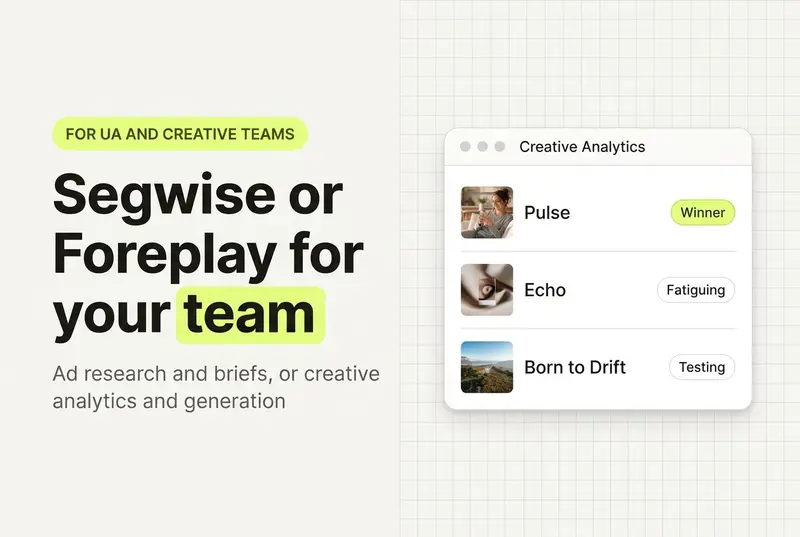
Pick Foreplay if your bottleneck is ideas: it saves and searches competitor ads, tracks rival Meta ads in Spyder, and writes briefs, from $49 to $459 a month. Pick Segwise if your bottleneck is knowing which parts of your own ads win across every network you buy, then making the next ads from them. Many teams run both.
The hard part is what happens after the brief: once those ads run on Meta, TikTok, AppLovin or Unity, which hook, CTA or visual actually moved ROAS? Segwise is an AI creative analytics and creative generation platform that tags every element of your own ads across 15+ ad networks and your MMP, maps each one to installs and ROAS, and helps you turn the winning elements into your next statics and videos.
Foreplay is an ad creative workflow platform sold as five apps: Swipe File, Discovery, Spyder, Lens and Briefs. It is research-first, and it is very good at it. This page compares the two tools head to head. If you want a ranked list of other tools instead, read our guide to Foreplay alternatives for creative teams.
TL;DR
- Creative strategists who live in competitor research: Foreplay. Its swipe file, Discovery search and Spyder tracking of rival Meta ads are its core, and Briefs turns references into scripts and storyboards.
- UA and growth teams buying on several networks: Segwise. It reads your own ads on Meta, Google, TikTok, AppLovin, Unity, Mintegral, Moloco and more, joins them to AppsFlyer, Adjust, Branch, Singular or Kochava, and tags every element against ROAS.
- Teams that need finished ads, not just briefs: Segwise. Foreplay's Briefs stops at scripts, storyboards and storyboard images; Segwise lets you make statics and video from your winning patterns.
- Small teams on a tight budget: Foreplay is the cheaper tool. Its Workflow plan is $149 to $175 a month with Lens for one brand, and pricing never rises with ad spend.
- Teams with budget for both: run Foreplay upstream for research and Segwise downstream for measurement and production. They overlap less than a comparison table suggests.
How do Segwise and Foreplay compare side by side?
Features and prices were checked on both vendors' own sites on November 6, 2026.
| What you compare | Segwise | Foreplay |
|---|---|---|
| Core job | Creative analytics and creative generation for your own ads | Ad research, competitor tracking, briefs, plus Lens analytics |
| Own-ad analytics | 15+ ad networks, including AppLovin (Axon), Unity, Mintegral and Moloco | Lens connects Meta and TikTok ad accounts (Workflow plan and up) |
| MMP data | AppsFlyer, Adjust, Branch, Singular, Kochava (optional) | No MMP named on the pages we checked |
| Element-level tagging | Video, audio, image, text and playables; 20+ standard tags, custom and naming-convention tags | Lens AI metadata: persona, hook transcription, top themes, custom tags, facial recognition |
| Playable ads | Tags playables and generates them as a managed service | Not listed |
| Fatigue alerts | Custom thresholds, email and Slack alerts | Not described on Foreplay's pages |
| Creative scoring | Pre-flight Testing scores up to 10 unlaunched creatives out of 100 | Foreplay Scores rank launched ads per dollar against your own past ads |
| Competitor ads | Meta, TikTok, LinkedIn and Google ad libraries, tagged with the same AI | Spyder tracks Meta ads 24/7 with up to 3 years of history; Discovery library; extension saves from Meta, TikTok and LinkedIn libraries |
| Briefs | Data-backed briefs and storyboards from your winning tags | AI scripts, storyboards and storyboard images in 150+ languages |
| Finished ad generation | Statics and video up to 30 seconds, including AI UGC-style ads; playables and CTV as managed services | Not listed; briefs go to a designer, editor or creator |
| AI chat or MCP | Creative Strategy Agent in the app; MCP on request; can't change campaigns or ad data | MCP for Claude, ChatGPT and other clients; public API |
| Seats | Unlimited on every plan | 1, 5 or 10 users by plan, then $20 per user |
| Price | From $499/mo (50% off under $50K spend) | $59, $175 or $459 a month ($49, $149 or $389 billed annually) |
| Pricing basis | Monthly ad spend band | Users and brands, never ad spend |
What is Foreplay, and what does each of its apps do?
Foreplay calls itself "The Complete Winning Ad Workflow," running "from the first spark of inspiration saving ads from facebook ad library to the final performance report." Its pricing page says it is trusted by over 10,000 growth teams and agencies.

Swipe File and Discovery: the Foreplay ads research tools
The Swipe File saves ads from anywhere through a Chrome extension or mobile app, into boards your team can tag, rate and share. The extension supports the Meta Ad Library, TikTok Ad Library and Top Ads, the LinkedIn Ad Library, Instagram and TikTok organic posts, and YouTube Shorts, with the Google Transparency Center listed as coming soon. Discovery is a searchable community library that Foreplay describes as "over 100M ads" in its menu and "200m ads" on its pricing page, with AI search, emotional analysis and persona detection.
Spyder: Foreplay competitor analysis on Meta
Spyder is Foreplay's Meta ad spy. You pick competitor brands and it saves every Facebook and Instagram ad they launch, "forever," with competitor ad history of up to 3 years, creative test grouping, landing page insights, top hooks, a timeline view and Slack or email updates. Spyder is not on Basic. Workflow includes 15 brands and Agency 50, and both become unlimited on annual billing. For a wider view of research tools, see our roundup of ad spy and competitor research tools.
Lens: Foreplay's creative analytics for Meta and TikTok
Lens connects your own Meta and TikTok ad accounts through Orcabase from Triple Whale. It builds top-performing and comparison reports, a creative testing dashboard, white-labeled and password-protected share links, CSV exports, and Foreplay Scores, which rank each ad per dollar spent against the ads you ran before. AI metadata adds persona targeting, hook transcription, top themes and custom tags. Benchmarks against other advertisers are set up for eCommerce only. Lens added app conversions such as App Installs and Tutorials Completed in June 2025, but no Foreplay page we checked names an MMP or a gaming network such as AppLovin or Unity. Foreplay's setup guide says the first sync "can take multiple hours or even days," and Lens is usable once 7 days of history is in.
Briefs and Foreplay AI
Briefs is Foreplay's production tool: AI script generation, storyboard generation, AI storyboard images, brand profiles and 150+ languages, with exports to PDF and Sheets. Foreplay's own FAQ says the brief "is sent off to the designer, video editor or UGC creator to produce the final product." That is the clearest line between the tools: Foreplay's AI helps you research and brief, and a person or another tool makes the ad.
Foreplay MCP and API
Foreplay launched its MCP on June 18, 2026. It connects Claude, ChatGPT and other MCP clients to the ad library, your swipe file, boards and Spyder watchlist. A public API is available on all current plans, with 10,000 credits a month included.
What is Segwise built for?
Segwise works on your own ads after they run. It brings creative and performance data from every network you buy into one place, tags each element, and helps your team decide what to make next.

Element-level tagging across every network and MMP
The Creative Tagging Agent watches, listens to and plays every ad you run and tags hooks, CTAs, characters, emotions, on-screen text, audio and pacing, with 20+ standard tags plus custom and naming-convention tags. Segwise is the only platform that tags playable ad elements. Creative analytics then maps each tag to ROAS, CPA, IPM and LTV across 15+ ad networks and five MMPs. Setup is no-code; most networks sign in with OAuth, and a few (AppLovin, Mintegral, Unity, Moloco) ask for an API key. The full list is in Segwise's integration docs.

See your winning hooks by network: Segwise lets you connect your ad networks and MMP without code and see which hooks win across all of them. Book a demo.
Fatigue alerts and new-creative tracking
Fatigue tracking watches each creative for a steady drop in performance and spend share, against thresholds you set (for example, a 20% ROAS decline over 7 days), and alerts you by email and Slack. You can also set success criteria for new creatives, such as a CPI target, and get told when one hits it. Pre-flight Testing scores up to 10 creatives out of 100 against your own winners before you spend on them.
Creative generation from your own winners
The Creative Generation Agent lets you make statics and videos up to 30 seconds, including AI UGC-style ads, from your own winning patterns. Each ad is tagged and tracked once it goes live, so the next round starts from better data. Playables and CTV spots are managed services, where the Segwise team finishes each asset; see playable ad generation for how that works. You can use each agent on its own, or do it all in one place by chatting with the Segwise agent: ask how your ads are performing, see what competitors are running, and make new ads from your winners.
Competitor tracking with the same tags
Segwise's competitor tracking follows rival ads in the Meta, TikTok, LinkedIn and Google ad libraries and tags them with the same AI it uses on yours, so gap reports show which elements competitors lean on that you haven't tested. It is built to feed your own creative decisions, not to replace a large research library.
Where Foreplay wins, and where each tool falls short
A fair comparison has to say where the other tool is better.
Where Foreplay is the better pick
- Research depth. Foreplay's community library, saved-forever Spyder history and hook extraction are deeper research tools than Segwise's competitor tracking.
- Price for small teams. Basic starts at $49 a month billed annually, and Lens on Workflow costs the same whether you spend $5K or $500K a month.
- Briefing workflow. Brand profiles, modular briefs, branded share pages and asset collection from creators are built for agencies that brief outside talent.
- AI tool access. Foreplay's MCP is self-serve on its plans. Segwise's MCP is switched on by request through your account manager. It can't change your campaigns or ad data.
Foreplay's limitations
- Foreplay's pricing page lists Meta and TikTok as the ad accounts Lens connects, and we found no Foreplay page describing MMP data, programmatic gaming networks or fatigue alerts.
- Lens is not on Basic, so own-ad analytics starts at $149 to $175 a month for one brand, plus $50 for each extra brand.
- Briefs produces scripts and storyboards, not finished ads.
- Foreplay's own pages disagree on two details: its pricing FAQ says you enter a credit card for the trial while product pages say "No credit card required," and the library size reads 100M in one place and 200M+ in another.
Segwise's limitations
- Segwise is not a research library. If browsing thousands of rival ads is your daily work, you will want a dedicated research tool next to it.
- It costs more than Foreplay at entry level, and pricing follows your monthly ad spend.
- Segwise imports up to 3 months of history, against Spyder's up to 3 years of competitor history.
- Playables and CTV are managed services, not self-serve builders.
Foreplay pricing vs Segwise pricing in 2026
Foreplay publishes four plans. Every paid plan has a 7-day free trial, and Foreplay offers a 14-day money-back guarantee after the first charge. Annual plans save about 15% and get unlimited Spyder brands, but Foreplay does not refund an annual plan you cancel.
| Plan | Monthly billing | Annual billing | Users | Lens brands | Spyder brands |
|---|---|---|---|---|---|
| Basic | $59 | $49 | 1 | None | None |
| Workflow | $175 | $149 | 5 | 1 | 15 (unlimited on annual) |
| Agency | $459 | $389 | 10 | 10 | 50 (unlimited on annual) |
| Enterprise | Custom | Custom | Unlimited | Unlimited | Unlimited |
Segwise starts at $499/month for advertisers spending up to $250K/month, with a special 50% discount for startups spending under $50K/month. Seats are unlimited and every feature is on every plan.
Worked cost math for three team shapes
These are list prices from both pricing pages; your quote may differ.
- A solo strategist doing research only: Foreplay Basic at $49 to $59 a month. Segwise is not built for this job.
- An eight-person DTC team on Meta with one brand: Foreplay Workflow is $175 plus three extra users at $20, so $235 a month. Segwise for the same team is the $499 starting price with no per-seat cost, so it only pays off if you also need generation, more networks or MMP data.
- A 15-person agency with ten client brands: Foreplay Agency is $459 plus five extra users, so $559 a month ($489 billed annually). Segwise's seats stay unlimited, and its growth agency setup keeps each client's data and reports separate. Compare more agency options in our guide to creative analytics tools for agencies.
Is there a creative analytics tool cheaper than Foreplay for a small team?
For a small team on Meta and TikTok, Foreplay is already among the cheapest ways to get creative analytics, because Lens pricing does not rise with ad spend. Segwise is not the cheaper choice there. It earns its price when you buy across more networks, need MMP-attributed results, or want new ads made from your winners. Our list of top creative analytics tools covers other price points.
Which should you choose? A decision rule
The flow below tells you which tool to buy first. The rule of thumb after it tells you when to add Segwise next to Foreplay.

Rule of thumb (not a law): add Segwise once two of these four are true. Otherwise, Foreplay alone is likely enough.
- You spend on 3 or more ad networks, or on any of AppLovin, Unity, Mintegral or Moloco.
- You report results from an MMP and want creative tied to installs, D7 ROAS or in-app events.
- You launch more than 20 new creatives a month and can't tag them all by hand.
- Your team needs finished statics and video every week, not just briefs.
For mobile games, condition 1 is usually true on day one, which is why the Segwise mobile gaming setup starts with gaming networks and playables. WGT, a golf game studio, reports its early concept-to-test cycle went 5x faster, from 2 to 3 weeks to 2 to 3 days, in its customer-reported case study.
Running Foreplay and Segwise together: who does what
Many teams keep both. This split avoids paying twice for the same job.

- Research and swipe file: Foreplay. Spyder and Discovery feed your strategists' boards.
- Briefing: either. Foreplay briefs from reference ads; Segwise's Creative Strategy Agent briefs from your own winning tags. Reference briefs are faster to start, and data briefs are easier to defend.
- Making the ads: Segwise or your studio. Foreplay hands briefs to a designer or creator.
- Measurement and fatigue: Segwise, across every network and your MMP.
- Client reporting: either. Foreplay has white-labeled Lens links; Segwise has custom dashboards, scheduled reports with Slack and email alerts, and share links for clients.
How to switch from Foreplay to Segwise, or add it alongside
- Keep your research. Bulk-download the boards you want to keep from your Foreplay swipe file (each board downloads as a .ZIP of its images and videos), and export any Lens reports you still need as CSV.
- Check your billing. Foreplay says you can cancel a monthly subscription at any time. Annual plans are not refunded, so if you are mid-year, run both until renewal rather than cancelling.
- Connect Segwise. Link your ad networks and MMP in the no-code setup. Segwise imports up to 3 months of history.
- Run both for one full creative cycle. Compare which tool told you sooner that a winner was fading, and which brief led to the better ad.
- Decide what each tool owns. If you keep Foreplay, drop Lens to the plan you need for research only, and let Segwise own analytics and generation.
Segwise or Foreplay: the call for your next quarter
Foreplay is the better tool for finding and briefing ideas, and Segwise is the better tool for knowing which parts of your own ads work across every network and turning them into new ads. If you only buy on Meta and TikTok and your bottleneck is ideas, Foreplay is enough. If you buy wider, report from an MMP or need finished ads each week, add Segwise. Your next step: list your networks and your monthly creative count, then run the two-of-four check above.