
Ad costs keep climbing, formats shift, and every campaign is expected to deliver consistent gains. With so many variables, it can be tough to tell if your results are strong or lagging. Google Ads Benchmarks give you a quick read on where you stand, helping you catch issues early, guide tests, and set goals based on performance rather than outdated numbers.
Reports this year point to higher CPCs, uneven conversion rates across formats, and stronger competition for high-intent clicks. Comparing your numbers to fresh benchmarks helps you decide where to adjust budgets, update creatives, or refine targeting, so you move closer to outcomes that align with real market conditions.
In this blog, we’ll explain what these benchmarks mean in practice, outline the key metrics that matter most, share updated 2025 figures across industries, and show how to turn the data into steps that lift results with fewer guesswork loops.
Why Google Ads Benchmarks Matter for Performance
Benchmarks give you a reference point based on many advertisers. They’re not goals to chase, but they help you gauge whether your numbers look strong, average, or weak. Costs have shifted in 2025, and conversion modeling continues to evolve so that outdated comparisons can mislead budgets. Use current benchmarks to set realistic expectations, guide testing, and highlight where improvements will have the most impact.
Key Google Ads Benchmark Metrics
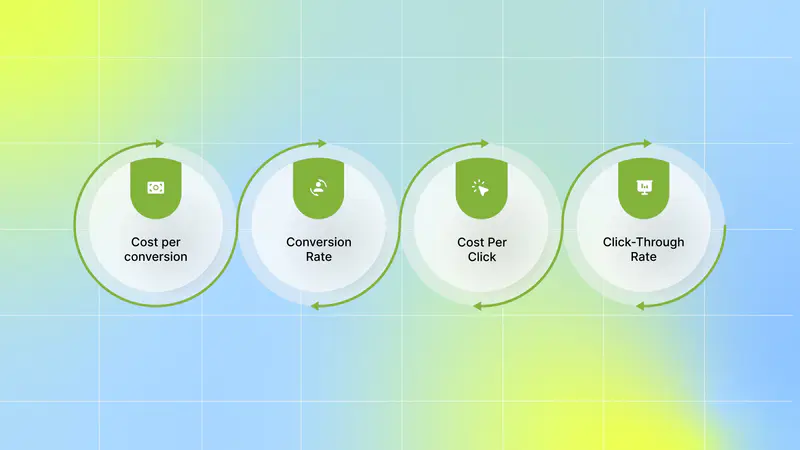
These core metrics give you a quick read on how your campaigns are really performing and where the biggest gains can come from:
1. Cost per conversion (CPA/CPL)
Your total ad spend divided by the number of tracked conversions (lead, signup, purchase, install).
Why it matters:CPA connects spend to an outcome you value. A rising CPA can mean more competition, a worse post-click experience, or changes in how conversions are counted. Broad 2025 reports show median CPL/CPA moving up year over year across many sectors. Still, the exact level depends heavily on which industries and campaign types are included in the dataset.
How to use it:
Compare your CPA to an industry range (not a single point). If your CPA is above that range, prioritize the smallest set of changes that affect both volume and quality, tighter audience selection, landing-flow fixes, or a creative that better matches intent.
Always layer CPA with downstream value (LTV, AOV, retention) before deciding to scale or cut.
2. Conversion Rate (CVR)
The percentage of clicks that result in the desired action. Conversions divided by clicks (or another agreed-upon denominator).
Why it matters:CVR reflects alignment among the ad, landing page, and user intent. It varies dramatically by format, and vertical search generally converts at higher rates than display, but mixing formats (for example, via Performance Max) changes how you should interpret that number.
How to use it:
Segment CVR by campaign type, creative, and keyword group.
Run controlled A/B tests on landing flows and measure conversion lift, not just clicks.
When CVR moves suddenly, check whether attribution or modeled conversions have changed before assuming the user experience improved.
3. Cost Per Click (CPC)
The average price you pay when someone clicks your ad.
Why it matters:CPC determines how many clicks you can buy within a budget. In 2025, broad reports indicate that average CPCs have increased for search; a typical 2025 headline reports around $5.26 for search across many industries, although actual CPCs can vary widely by niche and ad format. Use CPC to set realistic budgets.
How to use it:
Build a simple forecast (budget ÷ CPC × CVR) to estimate conversions, then stress-test it across a high- and low-CPC range.
If CPCs look high, try to improve relevance and Quality Score, or shift testing to formats and segments where intent and cost align with your unit economics.
4. Click-Through Rate (CTR)
The percentage of impressions that become clicks. Search CTRs are usually several percent; display CTRs are much lower (often under 1%).
Why it matters: CTR is an early signal of ad relevance. Typical search CTRs are several percent; display CTRs are often well below 1%. Those are rough rules of thumb; your vertical and placement mix will change the expected numbers. 2025 benchmarks show search CTRs clustering higher than display CTRs on average, but outliers are common across industries.
How to use it:
Treat CTR as a signal for creative relevance. Improve headlines, include strong CTAs, and test asset combinations to lift CTR.
Don’t chase CTR alone; combine it with conversion rate so you only scale creatives that actually convert.
Benchmarks are only comparable when you compare like with like. Performance Max, cross-channel mixes, and modeled conversions can shift CPC, CTR, and CVR without changing actual user behavior, so always annotate your comparisons with the campaign types and attribution models used.
With these four metrics tracked by format and framed by attribution, you get fast, actionable signals about where to test next. Those signals become more useful once you compare them to others in similar markets.
Also Read: Creative Optimization in 2025: Actionable Insights Report
Google Ads Benchmarks by Industry in 2025
(Overview infographic)
These figures show how budgets and results differ by industry in 2025. Use them to set expectations, pick which channels to test first, and spot where your results need closer work:
1. Average Google Ads Monthly Spend

The median monthly Google Ads spend sits at $1,057.45. Smaller teams often fall within the $1k–$10k range, while larger accounts scale higher based on revenue goals and customer value.
Treat the median as a starting point. Budgets well below it call for a learning phase to establish what works. Higher budgets demand stronger links between cost and measurable user value.
Median Spend by Industry:
Industry | Median Google Ads Spend |
Apparel / Fashion & Jewelry | $1,479.14 |
Arts & Entertainment | $968.05 |
Beauty & Personal Care | $1,098.58 |
Business Services | $1,097.55 |
Education & Instruction | $1,112.68 |
Furniture | $1,489.29 |
Health & Fitness | $1,179.48 |
Restaurants & Food | $679.78 |
Shopping, Collectibles & Gifts | $770.00 |
Sports & Recreation | $1,144.63 |
Travel | $847.73 |
These amounts help place your budget in context relative to businesses facing similar demand conditions.
2. Average Google Ads Cost Per Lead (CPL)

The median CPL across industries is $70.11. Lower-cost categories usually involve direct intent or simpler actions. Higher-cost categories often reflect longer buying cycles or higher lead value.
Check where your industry falls on this scale to understand whether your CPL is typical or signals a gap in targeting, messaging, or user flow.
Average CPL by Industry:
Industry | Average Cost Per Lead |
Apparel / Fashion & Jewelry | $101.49 |
Arts & Entertainment | $30.27 |
Beauty & Personal Care | $60.34 |
Business Services | $103.54 |
Education & Instruction | $90.02 |
Furniture | $121.51 |
Health & Fitness | $62.80 |
Restaurants & Food | $30.27 |
Shopping, Collectibles & Gifts | $47.94 |
Sports & Recreation | $47.47 |
Travel | $73.70 |
Higher-than-average CPLs often point to issues in message match, landing flow clarity, or audience selection. Stronger-than-average CPLs open room for cautious scaling while monitoring lead quality.
3. Average Google Ads Conversion Rate (CVR)

The median conversion rate in 2025 is 7.52%. This helps you judge whether your campaigns are turning clicks into meaningful actions at a healthy pace.
Categories with high-intent searches tend to convert more easily. Industries with longer evaluation cycles typically sit lower. Using industry-specific medians keeps your targets grounded in realistic user behavior.
Average CVR by Industry:
Industry | Average Conversion Rate |
Apparel / Fashion & Jewelry | 3.99% |
Arts & Entertainment | 4.84% |
Beauty & Personal Care | 7.82% |
Business Services | 5.14% |
Education & Instruction | 11.38% |
Furniture | 2.73% |
Health & Fitness | 6.80% |
Restaurants & Food | 7.09% |
Shopping, Collectibles & Gifts | 3.83% |
Sports & Recreation | 7.62% |
Travel | 5.75% |
These numbers reveal whether your traffic is behaving as expected or if deeper work is needed in offer strength, keyword intent, or landing clarity.
4. Average Google Ads Cost Per Click (CPC)

The median CPC for search ads in 2025 is $5.26. Higher CPCs often reflect competitive verticals where each lead is more valuable. Lower CPCs usually occur in broader or less saturated categories.
CPC alone can mislead. Combine it with CVR and expected value per user to understand true efficiency. The industry breakdown helps distinguish normal spend from overspending.
Average CPC by Industry:
Industry | Average Cost Per Click |
Apparel / Fashion & Jewelry | $4.31 |
Arts & Entertainment | $1.60 |
Beauty & Personal Care | $5.70 |
Business Services | $5.58 |
Education & Instruction | $6.23 |
Furniture | $3.86 |
Health & Fitness | $5.00 |
Restaurants & Food | $2.05 |
Shopping, Collectibles & Gifts | $3.49 |
Sports & Recreation | $2.64 |
Travel | $2.12 |
These figures help shape realistic forecasts and spot early signs of inflated bidding.
5. Average Google Ads CTR

Across industries, the median CTR for search ads is 6.66%. This reflects how often users click after seeing an ad. Matching or exceeding this number suggests alignment between your message and user intent.
Average CTR by Industry:
Industry | Average CTR (2025) |
Apparel / Fashion & Jewelry | 6.77% |
Arts & Entertainment | 13.10% |
Beauty & Personal Care | 5.71% |
Business Services | 5.65% |
Education & Instruction | 5.74% |
Furniture | 6.11% |
Health & Fitness | 7.18% |
Restaurants & Food | 7.58% |
Shopping, Collectibles & Gifts | 8.92% |
Sports & Recreation | 9.19% |
Travel | 8.73% |
Lower CTRs in a high-CTR industry point to issues with relevance, offers, or keyword targeting. High CTRs in low-CTR industries signal strong alignment and may justify broader testing.
Use these benchmarks as signals. Keep what’s performing well, adjust what isn’t, and refine your approach until cost and value start moving in sync. Once the numbers are clear, the real progress comes from turning them into practical steps.
Also Read: CPI, IPM, and ROAS Benchmarks for Optimizing Ad Spend
Performance Lift Analysis

Headline:
Measure the True Impact of Creative Changes on ROAS, CTR, and CPA
Buttons:
Explore Segwise
Start for Free
How Google Ads Benchmarks Support Better Campaign Results
Benchmarks become useful when you turn them into actions that reduce waste and increase wins. Here are practical ways to use them right now.

Set realistic targets: Use benchmarks to set baseline KPIs for new campaigns. If a 2025 benchmark shows average CPC is higher than your historical spend, set a phased budget with tests rather than fully ramping.
Prioritize tests with the biggest impact: Focus on changes that affect multiple metrics (for example, improving landing conversion rate reduces cost per conversion even if CPC stays the same). Run those tests first.
Use benchmarks by format and intent: Compare search to shopping, displaying them separately. Search often costs more but converts better; display costs less but is for awareness. Match your bid strategy to the role each format plays in your funnel.
Build a simple forecast: Combine benchmark CPC and conversion rate to estimate conversions per budget. This helps your planning calls and makes tradeoffs clear.
Update your benchmarks regularly: Platform shifts and seasonal trends change numbers. Use fresh 2025 reports as a check, and re-run your own short-term benchmarks monthly so you react to real changes in your account.
Tie benchmarks to value, not vanity: A cheap install that never retains still costs you money. Layer benchmarks with post-install or post-conversion metrics (e.g., retention, revenue per user) before scaling.
With these points in hand, you can adjust your approach with greater confidence and move closer to results that align with your goals.
Also Read: AI Ad Analysis Tools in 2025: Find What Drives Creative Success
Conclusion
Benchmarks highlight gaps, but they don’t reveal why those gaps exist. The biggest unknown in most accounts is creative quality and creative relevance. With formats like PMax sending traffic from many surfaces, creative becomes one of the strongest levers.
This is where Segwise fits. It’s AI agents automatically tag creative elements across images, video, and playable ads and link those tags (hook scenes, first dialogues, headlines, characters, influencer traits, CTA text, CTA dialogue, audio cues) to metrics such as CTR, IPM, and ROAS. This makes it easier to see which creative components support strong results and which drain spend.
It connects with Google Ads, major ad platforms, or MMPs, offering dashboards and custom tagging that align with your naming conventions so you can prioritize fixes and scale what works without manual sorting.
If you want clearer insight into which creatives lift your cost per conversion and which actually influence value, this gives you a straightforward path.
Start a Free Trial with Segwise to sync your Google Ads data and get focused guidance on what to scale and what to improve next.
FAQ's
1. What are Google Ads benchmarks, and how should I use them?
Google Ads Benchmarks are average performance numbers for metrics (e.g., CPC, CTR, CVR, CPA) aggregated from many advertisers. Use them as a reality check to see whether your campaigns are above, near, or below market norms and to pick the highest-impact tests.
2. How often should I refresh my benchmarks to make good decisions?
Use monthly checks as a baseline, and review more often if your account is large, running many tests, or if Google releases major updates or new campaign types. This keeps comparisons tied to current market conditions.
3. Which benchmark metrics matter most when deciding to scale or pause a campaign?
Look at CPA, CVR, CPC, and CTR together. CPA links spend to an outcome, CVR shows post-click value, CPC sets how many clicks you can buy, and CTR signals ad relevance. Combine these with longer-term value (for example, lifetime value) before scaling.
4. My CPA is higher than the industry benchmark. What quick fixes should I try?
Try small, measurable changes first: tighten audience and keyword selection, add negative keywords, simplify and speed up the landing page flow, and refresh the creatives to match user intent. Run controlled tests and measure conversion lift, not just clicks.
5. Do formats like Performance Max or modeled conversions affect how benchmarks should be read?
Yes. Campaign type and attribution model affect how conversions and traffic appear, so always compare like with like by noting the campaign type and conversion settings before drawing conclusions from benchmarks.