
Ever wondered why two people see the same ad but only one installs your app, subscribes, or makes a purchase?
That’s the everyday challenge for UA and growth teams. You launch dozens of campaigns, test endless creatives, and still can’t explain why results fluctuate so wildly. Without a clear understanding of who your high-value users really are, you risk wasting ad spend, missing ROAS goals, and optimizing for the wrong audiences.
Are you also struggling to identify which users truly drive your app’s growth? Customer attributes can fix that. This blog breaks down what customer attributes are, why they matter, and how you can use them to target smarter, personalize better, and scale faster across your app campaigns.
What Exactly Are Customer Attributes?
Customer attributes are the specific details that show who your users are, what they care about, and what drives their decisions after seeing your ads. These attributes help you connect your message to the right people and improve how you target, segment, and optimize campaigns.
When you understand your customers behavior and motivations, you can build app campaigns that feel relevant, convert better, and protect your ROAS.
Here are 5 simple reasons why customer attributes matter:
1. Smarter Targeting and Segmentation
When you know what defines your best users, their interests, devices, or behavior, you can create more precise audience segments. This helps you focus ad spend on users most likely to install, subscribe, or buy, rather than wasting impressions on low-intent audiences.
2. Better Creative Personalization
Customer attributes show which creatives connect with specific audiences. For example, your mobile game ads might perform better with players using mid-tier Android devices in Tier 2 regions, while your DTC brand ads work best with repeat shoppers who respond to value-based messaging. You can tailor visuals, copy, and offers to each segment for stronger engagement.
3. Higher ROAS and Lower CPA
By aligning campaigns with the right user profiles, you reduce budget waste and improve performance efficiency. The more accurately your campaigns match the right audience, the faster you see ROAS uplift and CPA drops without increasing overall spend.
4. Build Smarter Lookalike Audiences
Once you understand what your best users look like, you can feed those attributes into ad platforms to build accurate lookalike audiences. This makes your acquisition more predictive, helping you reach people who behave like your highest-value users from day one.
5. Improve Cross-Channel Consistency
Customer attributes help you understand which channels actually bring your highest-value users. By mapping user behavior and conversion patterns across Meta, Google, TikTok, and other networks, you can identify where your best customers come from and double down on those channels. This avoids wasting budget on underperforming sources.
Now that you know what customer attributes are and why they matter, let’s look at the different types you should be tracking.
Types of Customer Attributes You Need to Know
Not all users think, act, or convert the same way. The more specific you get about your users, the easier it becomes to attract the ones who actually convert. Here are the eight key types of customer attributes to focus on in your app marketing strategy:
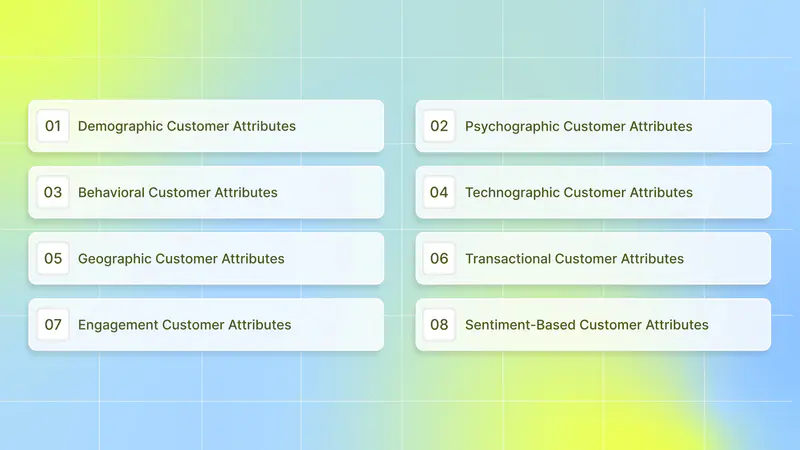
1. Demographic Customer Attributes
Demographic attributes describe the basic profile of your users, such as age, gender, income, and family status. These details help you understand which broad groups respond to different creative styles or offers.
For example, if you’re marketing a mobile puzzle game, you may find women aged 25–45 respond better to calm, strategy-focused creatives than younger audiences who prefer fast-action scenes.
2. Psychographic Customer Attributes
Psychographics explain what motivates your users, their interests, values, attitudes, and lifestyle choices. These attributes help you shape messaging and creative angles that feel relevant and personal.
For example, a DTC skincare brand may find that “results-driven” shoppers respond best to creatives featuring real before–and–after transformations, while “natural-ingredient” shoppers prefer clean, minimal visuals.
3. Behavioral Customer Attributes
Behavioral attributes show how users act, their usage habits, session frequency, purchase patterns, and churn tendencies. These insights help you target users who will go beyond installs and take high-value actions.
For example, for a subscription fitness app, users who complete trial workouts in the first 48 hours are more likely to subscribe, so you target similar behavior-based audiences in your campaigns.
4. Technographic Customer Attributes
Technographic attributes tell you what devices, operating systems, and technical setups your users use. This helps you pick the right ad formats and avoid spending on devices with poor performance.
For example, a mobile action game may discover that high-end Android users respond better to 15–30s gameplay videos, while low-end devices perform better with lightweight static or GIF-style creatives.
5. Geographic Customer Attributes
Geographic attributes include your users' countries, regions, cities, languages, and cultural patterns. These factors influence content preferences, buying power, and seasonal behavior.
For example, a subscription meditation app may see higher conversion rates in regions where stress-relief content resonates more, so ads focus on “calm routine” messaging, and “sleep better” messaging works better.
6. Transactional Customer Attributes
Transactional attributes show how your users spend their AOV, how often they purchase, their renewal habits, and their LTV potential. These attributes help you focus on users who deliver real revenue.
For example, a DTC supplement brand may find that customers with high first-order value become repeat buyers, so you target similar transactional profiles with bundle-focused creatives.
7. Engagement Customer Attributes
Engagement attributes show how users interact with your brand outside transactions, email opens, push activity, social interactions, or time spent on landing pages. They help you understand who is close to converting.
For example, for a mobile RPG game, users who watch full-length gameplay creatives tend to install at higher rates, so you build retargeting audiences based on that engagement behavior.
8. Sentiment-Based Customer Attributes
Sentiment attributes reflect how users feel about your product. These insights are gathered from reviews, comments, ratings, and feedback. This helps you understand expectations and shape creatives that highlight what people love most.
For example, if DTC customers consistently praise the “quick delivery” of your product, you can showcase that benefit in your hooks and CTAs to win more conversions from similar audiences.
Now that you know which customer attributes matter most, it’s equally important to understand the limitations of traditional data sources.
Why App Marketers Can’t Rely Only on Traditional Customer Attribute Data
Most UA teams still depend on traditional data sources to understand their users. But these sources only show part of the user journey. They tell you who interacted, not why they did, across platforms and campaigns.
Here are the key reasons why traditional tools no longer give you a complete view of customer attributes:
1) Traditional Tools Don’t Capture Real User Behavior
CRMs typically store basic details such as contact info, purchase history, and past interactions. They show who the user is and what they did, but not the deeper how or why behind their behavior across different channels or devices.
Surveys offer useful feedback, but the samples are usually small, biased, and hard to scale. You only hear from a tiny fraction of your users, often not the ones who most affect your performance. And even after collecting responses, you still need manual review and interpretation, which slows down and makes the data inconsistent.
2. Privacy Changes Reduce the Data You Receive
With iOS14+, ATT, and growing limits on cross-app tracking, you can’t rely on pixel data or third-party cookies to map actions back to specific users. Your customer-level data becomes incomplete or delayed, making it harder to see which audience segments actually drive installs, subscriptions, or repeat purchases.
3. Creative Saturation Makes It Hard to See Who’s Actually Responding
Users now see dozens of ads every day across multiple platforms, which makes their behavior harder to interpret. Traditional tools can’t tell you which types of users are responding to specific messages, formats, or value propositions.
As a result, you only see surface-level metrics, not the deeper attributes that explain why certain users convert. Without richer customer attribute data, you can’t understand who your campaigns truly resonate with or how different audiences react to the same ad.
To truly understand what drives user behavior and performance, you need to go beyond traditional tools and tap into modern data sources.
Data Sources That Reveal Real Customer Attributes for UA Teams
Knowing your audience deeply starts with collecting the right kind of data from every point where users interact with your brand. You need this data to understand who your users are, how they behave, and what motivates them to take action.
Here are some of the most effective ways to collect customer attribute data:

1. Attribution Platforms
Attribution platforms such as Appsflyer show you where your installs come from, which post-install events users complete, and how long they stay active.
This helps you build performance-based segments: who installs, who converts, who remains active. You can immediately see which channels or ad networks deliver high-value users. This is the first layer of truth for any UA funnel; without it, you can’t trust that your acquisition efforts are actually driving value.
2. Unified Profile Data
CDPs such as Particle and Salesforce bring all your user data into a single profile, including LTV, purchase patterns, lifecycle stage, and identity resolution across multiple devices. This gives you a complete view of the user journey.
With unified profiles, you can build accurate audience segments based on long-term behavior instead of relying on fragmented or incomplete data. This means you can find and scale audiences who are most likely to repurchase, re-subscribe, or stay engaged long-term.
3. Creative-Performance Data
Creative-performance data shows which types of users respond to which ads. With a platform like Segwise, you can fetch data from ad networks and MMPs/CDPs, automatically tag creative elements (hooks, CTAs, characters, formats), and map those tags to performance metrics.
This reveals clear patterns, such as which creative element attracts high-value users from your audience segment and which messages fail to convert. With these insights, you can match the right creative to the right audience and scale UA campaigns with more confidence.
By collecting customer attribute data from multiple sources and connecting them, you’ll target users who actually deliver long-term value for your ad campaigns.
Once you’ve collected the right data on customer attributes, the next step is turning those insights into action.
The Playbook: How UA Teams Turn Attributes Into Growth
Once you understand the customer attributes behind your best users, you can turn that insight into predictable growth. Instead of guessing which audiences to target or which creatives to scale, you follow a process that shows you why certain users convert and how to acquire more of them.
Here are the key steps to turn customer attributes into real UA growth:
1. Start With a Clear Experiment Design
You should begin by defining exactly what you want to learn.
Are you testing which creative angles attract high-LTV users?
Are you comparing device types or regions?
Are you trying to find which audience segment responds fastest to a new offer or gameplay hook?
Choose one hypothesis at a time. This ensures your experiments aren’t noisy and your results are easy to interpret. Good experiments start with one clear question and one variable you want to understand.
2. Tag Your Creatives and Data Properly
Accurate tagging is the foundation of good UA analysis. Segwise’s creative tagging automatically organizes images, videos, text, and playable ads to reveal which creative elements drive performance marketing success.
When your creatives are properly tagged, you can trace which user attributes respond to which creative elements. This makes your entire data layer more organized and actionable, especially when you scale to hundreds of creatives.
3. Map User Attributes to Creative Signals
Now you can link your attribution platforms data with your tagged creatives. Segwise creative analytics make creative decisions based on actual performance data from both ad networks and MMPs, so your team can scale winners and avoid losers. This connection shows how users behave after engaging with each creative.
If you’re integrating with MMPs such as AppsFlyer, you need to provide the AppsFlyer V2.0 API token. Follow these steps:
Select the profile dropdown on the top right and click on "Security center."
In the "AppsFlyer API tokens" section, click "Manage your AppsFlyer API tokens."
Copy the token you would like to share and input this as your Appsflyer API token to get started on Segwise.
Please add this video here: “https://youtu.be/eYOyCxgZ5MY?si=Fek6MjdQOjb-wv8k”
This step highlights behavioral patterns, such as which hooks often attract high-LTV users or which messages tend to resonate with long-term players.
4. Analyze Cohorts Instead of Raw Installs
Raw installs tell you nothing about user value. Cohorts reveal the truth. Look at:
LTV
Retention curves
Session depth
Purchase frequency
Churn windows
A creative may deliver cheap installs that churn in 24 hours, while another creative delivers fewer installs but higher-value users. Cohort analysis helps you spot this difference instantly.
5. Identify Your True ICP Based on Behavior
Once you see which users deliver value, define your ICP (Ideal Customer Profile). This might include attributes such as:
Device type and region
Interest category
Creative theme they clicked
Early engagement events (e.g., tutorial complete, add-to-cart, first purchase)
Session frequency or average basket size
Your ICP becomes a blueprint for how you target, what creatives you make, and where you scale spend.
6. Scale What Attracts High-Value Users
Increase investment in channels, audiences, and creatives that consistently attract high-value users. At the same time, reduce spending on ads that attract low-quality or early-churn cohorts.
7. Build Continuous Feedback Loops With Your Team
Share your findings with your creative, UA, and product teams so everyone works with the same insights. Use your attribute patterns to build better creative briefs, refine messaging, and set clearer testing priorities.
When your creative team knows exactly which attributes drive conversions, they can produce ads that consistently attract the right users, not just visually appealing content.
8. Keep an Always-On Optimization System
User behavior changes fast. New creatives attract different users, markets shift, and platform algorithms evolve. Keep monitoring how customer attributes link to creative performance, and refresh your ICP as you learn more.
But turning customer attributes into growth isn’t always easy. Let’s look at the biggest challenges.
Also Read: Unlocking Creative Insights: A Game-Changer in Mobile App Marketing
Fixing the Gaps That Stop UA Teams From Scaling Profitably
Even when you have access to customer attributes, turning that data into real UA insight is not always easy. Most teams deal with gaps, fragmented tools, and fast-changing platform rules that make it hard to see the full picture. Here are the biggest challenges that get in the way:

1. Multi-Network Fragmentation
Users interact with Meta, Google, TikTok, Snapchat, and more, but each platform measures performance differently. This fragments user insights and makes it difficult to understand how the same audience behaves across channels.
Solution: By unifying cross-network performance data into a single user view, UA teams can identify which channels bring high-value users, align creative strategy across platforms, and scale the campaigns that consistently deliver profitable growth.
2. Signal Loss From ATT and SKAN
Most reporting still stops at installs or early events, giving only a partial picture of who users are and what drives their value. Without deeper behavioral and attribute insights, UA teams optimize for volume instead of long-term revenue.
Solution: Layering LTV signals, behavioral cohorts, and creative attributes reveals which users turn into high-value customers, enabling smarter targeting, better creative decisioning, and growth that compounds over time.
3. Time-Based Creative Fatigue
Even the strongest creatives eventually lose impact. As performance drops, user behavior and attribute patterns shift, meaning yesterday’s winning signals may no longer match today’s audience. Without real-time visibility, teams keep spending on campaigns that are already past their peak.
Solution: Continuously monitoring creative performance against evolving user attributes helps UA teams refresh messaging, adapt targeting early, and replace declining ads before they drain budget.
4. Over-Segmentation Without Enough Volume
Breaking audiences into too many micro-segments leaves each group too small to produce statistically reliable learnings. This creates noisy insights and misleads UA teams into optimizing for users who appear valuable but don’t actually drive revenue at scale.
Solution: Focus segmentation around clearly differentiated, high-volume cohorts so performance data becomes trustworthy, allowing teams to confidently identify their true ICP and scale strategies backed by signal, not noise.
5. Compliance, Consent, and Privacy Boundaries
Stricter privacy standards limit how user data can be collected, shared, and stitched across platforms. Even with good intentions, gaps in consent and tracking make it difficult to maintain a clear, compliant view of user attributes and behavior.
Solution: Prioritize privacy-first data enrichment using aggregated signals, anonymized identifiers, and consent-aware integrations, so teams can protect user trust while still gaining the insights needed to optimize efficiently and scale responsibly.
Many of these challenges come down to the same issue: fragmented data leads to fragmented decision-making. Tools like Segwise help UA teams bring all creative and audience signals into one place so they can finally see which users drive sustainable growth and why.
Now that we’ve cleared the roadblocks, the next priority is understanding which customer attribute KPIs matter most, the ones that directly influence LTV, ROAS, and long-term user quality.
Customer Attribute KPIs App Teams Should Track
Not every metric helps you understand user quality. As a UA or Growth lead, you want KPIs that reveal who your strongest users are, how they behave, and which attributes predict long-term value. These signals help you target smarter and scale campaigns with confidence.
Here are the key customer-attribute KPIs you should track, along with what each one tells you:
KPI | Attribute Signal | UA Impact | Example Interpretation |
Retention Rate (D1, D7, D30) | Shows which user attributes correlate with long-term usage | Helps you focus spend on segments that stay active | “Users from Region A retain better than Region B, scale Region A lookalikes.” |
LTV (Lifetime Value) | Indicates which attributes predict revenue potential | Let's you scale segments that generate profit over time | “High-LTV users respond to benefit-led creatives, increase spend on those angles.” |
AOV / First Purchase Value | Reveals purchase strength by attribute group | Helps identify high-value DTC and subscription audiences | “Older iOS users have higher first-purchase values, retarget this group more.” |
Early Engagement Events | Shows behaviors linked to future conversion | Helps you optimize for early signals instead of waiting for late outcomes | “Users who finish onboarding in 24 hours are 3× more likely to subscribe.” |
Repeat Purchase or Renewal Rate | Shows customer loyalty profiles | Helps identify subscription-friendly or repeat-buyer segments | “Users who click testimonials renew at higher rates.” |
Add-to-Cart or Trial Start Rate | Early signal of buying intent | Helps build predictive models for performance | “Trial-starters from video creatives convert better than those from static ads.” |
Churn Probability Signals | Attributes linked to early drop-off | Helps avoid scaling creatives that attract low-quality users | “Humor-led ads bring cheap installs but churn-heavy users.” |
Also Read: Understanding Mobile App Attribution
Conclusion
Understanding and using customer attributes the right way helps you move from guesswork to precision. By identifying who your users are, what motivates them, and how they behave, you can create campaigns that feel more personal, drive better conversions, and improve ROAS.
While customer attributes tell you who your users are, Segwise shows you which creative elements actually convert them.
Our powerful, multi-modal AI creative tagging automatically identifies and tags creative elements like hook dialogues, characters, colors, and audio components across images, videos, text, and playable ads to reveal their impact on performance metrics like IPM, CTR, and ROAS.
Once creatives are tagged, Segwise creative analytics makes creative decisions based on actual performance data from both ad networks and MMPs to scale winners and avoid losers. Additionally, our creative insight discovery uncovers which hooks dialogues, visuals, and elements actually drive conversions for your audience.
In short: Segwise doesn’t just tell you what happened, it shows you why. You get data‑backed clarity on which creative elements work better.
So, why wait! Start your free trial and discover which creatives actually drive high-value users.
FAQs
1. How do you gather reliable customer-attribute data for apps or DTC businesses?
You can use attribution platforms (for install & event tracking), CDPs (which unify data across devices and touchpoints), or tools that log user behavior and transaction history. Combining multiple sources gives a fuller, more accurate picture.
2. Are custom or business‑specific attributes useful for UA teams?
Definitely attributes tailored to your app’s use case (e.g., “preferred game genre,” “skincare concern,” “subscription tier”) add nuance beyond standard categories. These allow you to micro‑segment and create highly relevant audiences.
3. What’s the risk of relying only on install data without attributes?
Relying solely on installs ignores who the users are and whether they provide long-term value. Without attribute data, you might attract many low‑value or churn‑prone users, leading to poor ROAS despite high install numbers.