
Key Takeaways
Strategy First: Programmatic advertising fails when automation runs without clear goals. A strong programmatic advertising strategy starts with defined UA objectives and is optimized continuously, not launched and left alone.
Quality Signals: Scaling impressions doesn’t guarantee results. High-performing programmatic campaigns focus on user quality by combining precise targeting, the right channels, and intent-driven formats.
Creative Clarity: Creative volume alone doesn’t drive performance. Understanding which creative elements influence installs, conversions, and ROAS is critical to scaling what actually works.
Proactive Control: Programmatic performance erodes when teams react too late. Continuous monitoring of creatives, frequency, and fatigue keeps budgets efficient and acquisition predictable.
System Thinking: Programmatic works best as a connected system; goals, audiences, creatives, measurement, and optimization work together, so every campaign makes the next one smarter.
Are your programmatic campaigns winning auctions but losing on ROAS, installs, or subscriber quality?
You push budgets through DSPs, impressions scale fast, and reach looks impressive, but performance quietly erodes. Frequency creeps up across unknown placements. Creative fatigue creeps in across placements you don’t fully control. Automation moves fast, but without a clear strategy, budgets get burned before you know what actually went wrong.
If your programmatic advertising strategy feels reactive instead of controlled, you’re not alone. This blog covers how to build a programmatic advertising strategy that actually works for user acquisition.
What Is Programmatic Advertising?
Programmatic advertising is a way of buying and showing ads using automated technology instead of manual negotiations. It uses data, algorithms, and proactive auctions to decide which ad to show on which placement, all in milliseconds. Instead of buying fixed placements, you compete in live auctions every time an impression becomes available.
As a UA manager, advertiser, or growth lead, you use programmatic to reach new audiences across games, apps, websites, CTV, and video inventory, while controlling bids, frequency, and performance goals. When done right, programmatic helps you acquire users at scale without sacrificing ROAS, retention, or user quality.
Here’s how it works, step by step: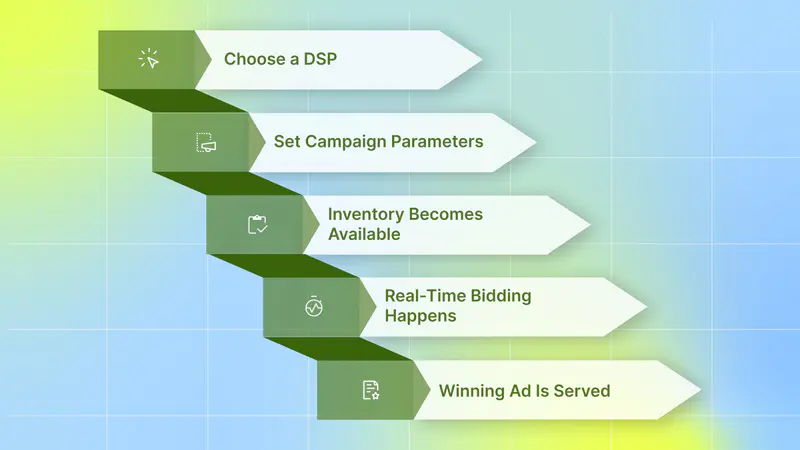
Choose a DSP: To get started with programmatic advertising, select a demand-side platform (DSP) that aligns with your goals and budget. This platform is where you’ll define your audience, set your spend, and choose ad formats.
Set Campaign Parameters: Inside the DSP, configure your campaign settings by specifying the target audience, location, device type, bidding strategy, and creative assets. This ensures your ads reach the right people at the right time.
Inventory Becomes Available: On the supply side, publishers make ad space available through supply-side platforms (SSPs). When someone visits a website or app, the SSP sends a bid request to an ad exchange.
Real-Time Bidding Happens: Connected DSPs receive bid requests and evaluate opportunities based on your campaign rules. Each DSP submits a bid instantly, which is called real-time bidding (RTB).
Winning Ad Is Served: The highest bidder wins the auction, and their ad is instantly displayed to the user. This entire transaction happens in milliseconds.
For UA teams, the key takeaway is this: programmatic performance is driven by the rules you set upfront and how quickly you act on feedback, not by the auction itself.
Now that you understand what programmatic advertising is and how it works, it’s important to recognize its key advantages.
Also Read: What is a Demand-Side Platform (DSP)? A Complete Guide
What Are the Benefits of Programmatic Advertising?
Programmatic advertising helps you acquire users at scale by automating media buying, improving targeting accuracy, and reducing wasted ad spend. It allows you to reach high-intent users beyond the major ad platforms.
Here are the key benefits of programmatic advertising:
1. Increased Efficiency at Scale
Programmatic advertising automates the entire media buying process. As a UA or growth lead, this means you don’t have to manually negotiate inventory or manage placements one by one across publishers.
This frees up your time to focus on creative testing, performance analysis, and optimization instead of campaign setup.
2. Improved Targeting for Higher-Quality Users
Programmatic advertising lets you target users based on signals like demographics, interests, behavior, context, and device usage. This helps you reach users who are more likely to install your app, subscribe, or purchase.
For mobile games, DTC brands, and subscription apps, better targeting means lower wasted impressions and more installs or conversions from users who actually retain, engage, or spend. Your budget works harder because it’s focused on user quality, not just reach.
3. Greater Transparency Across Spend and Performance
Programmatic advertising gives you visibility into where your ads appear, how often users see them, and how each placement performs. You can see which inventory, formats, and audiences are driving results.
This transparency helps you make faster, data-backed decisions. You can shift budgets away from underperforming placements, control frequency, and double down on what’s driving ROAS, CPI efficiency, or subscriber growth.
4. Better Personalization at Every Touchpoint
Programmatic advertising allows you to show different creatives and messages to different users based on their behavior and intent. Instead of running one generic ad, you can tailor messaging by audience, funnel stage, or use case.
For UA teams, this means stronger relevance, higher engagement, and better conversion rates. Personalized ads help you attract users who are more likely to convert while reducing creative fatigue and ad blindness.
Next, let's explore how to build a strategy that actually performs.
How to Build a Programmatic Advertising Strategy
Implementing a programmatic advertising strategy is not about launching campaigns quickly; it’s about setting up a system you can control, measure, and optimize over time.
Here are the key steps to build your programmatic advertising strategy:
1. Define Clear User Acquisition Goals
Start by defining what you want to achieve with programmatic advertising. Your goal should be specific and tied to user acquisition outcomes, not vague marketing activity.
Most UA-focused programmatic campaigns fall into one of these three stages:
Awareness: Use programmatic to introduce your app, game, or product to new users at scale. The focus here is reach, frequency control, and visibility.
Consideration: This stage is about educating users and building interest. Common goals include video engagement, site visits, or app store page views.
Conversion: Here, the goal is action. This is where efficiency, CPI, CPA, and ROAS matter most.
Your answer determines how you structure targeting, creatives, bidding, and measurement. Without a clear goal, it’s hard to know whether your campaign is actually successful.
2. Understand and Segment Your Target Audience
Casting a wide net usually leads to wasted spend. To make programmatic work, you need to understand who your best users are and how they behave.
Use your existing data, app users, purchasers, subscribers, or site visitors to identify:
Behavioral targeting: Targets users based on their past online actions, like pages visited or products viewed.
Contextual targeting: Places ads on pages with content relevant to your product or service. This is a powerful, privacy-safe alternative to cookie-based targeting.
Demographic targeting: Targets users based on age, gender, income, and other population characteristics.
Once you’ve identified your highest-value users, you can scale using lookalike modeling. Lookalike modeling uses your first-party data as a “seed” audience and finds new users with similar characteristics across the web. This is one of the most effective ways for UA teams to scale campaigns while maintaining user quality.
Segmenting your audience lets you tailor creatives and messaging, boosting engagement and helping you acquire higher-quality users rather than just more impressions.
3. Choose the Right Programmatic Channel and Format
Before selecting a DSP, decide how you want users to experience your ads. Different programmatic channels and formats support different user acquisition goals, and choosing the wrong format can limit performance even with strong targeting.
Common options include:
Display: Display ads are visual ads shown as banners or units on websites and apps. They typically appear at the top, side, or within page content and use images, text, or short animations to capture attention and drive clicks.
Native: Native ads are paid ads designed to match the look, feel, and format of the content around them. They appear as sponsored or recommended content and blend naturally into feeds or articles, making them less disruptive and more engaging.
Video: Video ads use motion and sound to deliver messages before, during, or alongside digital content. Programmatic video ads run across websites and mobile apps and are used to capture attention, explain value, and drive engagement at scale.
Connected TV (CTV): Connected TV advertising delivers video ads through internet-connected televisions and streaming devices. CTV ads appear within streaming content and allow advertisers to reach households using digital targeting instead of traditional TV buying.
Digital Out-of-Home (DOOH): Digital Out-of-Home advertising uses digital screens and billboards in public spaces like malls, airports, transit stations, and city centers. Programmatic DOOH allows ads to be bought and updated dynamically based on location, time, or external triggers.
Audio: Programmatic audio ads are delivered to users while they stream music, podcasts, or digital radio. These ads play before, during, or between content and help reach users during screen-free moments.
In-Game: In-game advertising places ads directly inside video games across mobile, PC, and console environments. Ads appear as part of the game world, such as billboards or interactive elements, allowing brands to reach players without disrupting gameplay.
4. Choose a DSP
Not all DSPs are built the same. When choosing a platform, focus on what matters for user acquisition, not just feature lists.
Evaluate platforms based on:
Inventory Access: Does the DSP connect to the ad exchanges and channels you need (e.g., CTV, audio)?
Targeting Capabilities: What are its data integration options? How sophisticated are its lookalike and contextual targeting tools?
Reporting and Analytics: How transparent are its reporting features? Can you easily export data for deeper analysis?
Fee Structure: Understand the platform fees. Are they a percentage of media spend, a flat fee, or something else?
The right DSP should make it easier to test, learn, and optimize, not add more complexity to your workflow.
5. Set Up Tracking and Measurement Properly
Before launching anything, make sure your tracking is set up correctly. This includes conversion tracking, attribution, and any post-install or post-purchase signals you rely on.
If tracking is incomplete or inaccurate, you won’t be able to understand what’s driving results or what’s wasting budget. Solid measurement is the foundation for optimization and performance conversations with stakeholders or clients.
6. Build Creative Assets
Design creative assets per channel specifications. Test different messaging, visuals, and calls to action to see which ones perform the best with your target audience.
For UA teams, this helps you:
Identify which messages attract quality users.
Reduce creative fatigue.
Scale what works instead of guessing what might.
Design creatives to be tested and iterated, not treated as one-off assets.
But how do you know which creative elements actually drive conversions?
This is where AI-powered platforms like Segwise come in. Segwise uses tag-level creative element mapping to show exactly which hooks, visuals, characters, colors, audio cues, or formats are driving performance. With full MMP attribution integration, you can uncover patterns like “this hook appears in 80% of top-performing creatives” and use those insights to make faster, smarter creative decisions.
7. Set Up Your Campaign
When setting up your campaign, align every setting with your acquisition goal. This includes:
Budget and pacing.
Bidding strategy.
Audience targeting.
Frequency controls.
Manual bidding gives you full control. You set the bids for each campaign or ad group. This requires constant monitoring and adjustment. Automated bidding uses the DSP's machine learning algorithms to set bids for you. It optimizes toward a specific goal, like maximizing conversions or achieving a target CPA.
Most advertisers today use automated bidding to improve efficiency. Avoid overcomplicating things early. Start simple, observe performance, and adjust based on data instead of assumptions.
8. Launch Your Campaign
It’s time for your campaign to launch. Double-check all your campaign settings, and get ready to monitor the results as they roll in, just in case you need to make any adjustments. Early adjustments help you protect your budget and keep performance on track before issues scale.
9. Analyze Results
Use the reporting tools provided by your DSP to track campaign performance and see how you’re performing against your goals. Use these insights to make adjustments, optimize your campaign, and inform the strategy for your future campaigns.
Programmatic works best when every campaign makes the next one smarter.
With the core strategy defined, the next step is to ensure execution remains efficient, controlled, and performance-driven as campaigns scale.
Also Read: A Complete Guide to Programmatic Media Buying and Advertising
8 Tips to Build Your Programmatic Advertising Strategy
Once your goals, audiences, formats, and tracking are in place, execution determines whether programmatic actually works for user acquisition. The most effective programmatic advertising strategies focus on relevance, control, and continuous optimization, not just reach or automation.
Below are the tips for UA and the growth teams:
1. Use First-Party Data to Acquire Higher-Quality Users
First-party data is one of your strongest advantages in programmatic advertising. This includes data from app users, purchasers, subscribers, and website visitors.
Using first-party data helps you build more accurate audience segments and reduce reliance on broad or low-intent targeting. For user acquisition, this means better conversion rates, stronger retention, and less wasted spend, especially as cookies and identifiers become less reliable.
2. Apply Dynamic Creative Optimization (DCO) for Personalization
Dynamic Creative Optimization (DCO) automatically serves different creative variations to users based on signals such as location, device, behavior, or context.
Instead of running a single static ad, DCO dynamically swaps elements such as visuals, headlines, and calls to action instantly. For UA teams, this improves performance by matching creatives to user intent without manually producing hundreds of versions.
3. Segment Retargeting to Drive Conversions
Retargeting is a powerful lower-funnel strategy, but only when done with proper segmentation. Showing the same ad to every past visitor usually leads to fatigue and wasted spend.
Segment retargeting audiences based on user actions. For example, users who viewed a product page should see different messaging than users who abandoned checkout or onboarding. Pair this with frequency controls to avoid over-serving the same users.
4. Leverage Contextual Targeting for Privacy-Safe Relevance
Contextual targeting places ads next to relevant content. This tactic is gaining importance in the post-cookie era. Advanced contextual solutions use natural language processing to understand the true sentiment and topic of a page.
This improves relevance and helps ensure your ads do not appear next to inappropriate content.
5. Use Cross-Device Targeting to Improve Attribution and Consistency
Users don’t convert on a single device. They may discover your app on mobile, research on desktop, and convert later on another screen.
Cross-device targeting helps you reach the same user across devices while maintaining consistent messaging. This improves attribution accuracy and prevents duplicated spend caused by treating the same user as multiple audiences.
6. Take an Omnichannel Approach to Support the Full UA Funnel
An effective programmatic strategy uses multiple channels together, not in isolation. Different channels support different stages of the user acquisition funnel.
In-app and mobile formats work well for installs and conversions, while video and CTV help build awareness and consideration. Aligning goals, creatives, and measurement across channels improves overall acquisition efficiency and reduces reliance on a single platform.
7. Focus on Creative Quality, Not Just Creative Volume
Scaling programmatic campaigns often leads to creative overload, more ads, but weaker performance. Instead of producing endless variations, focus on relevance and clarity.
High-performing programmatic creatives are clear, non-intrusive, and aligned with user intent. For UA teams, regularly removing fatigued creatives is just as important as launching new ones.
But how do you know when a creative is starting to fatigue?
This is where AI-powered platforms like Segwise make a difference. Segwise fatigue tracking catches performance decline before it impacts budget allocation and campaign results. You can also set custom fatigue criteria and catch fatigue before it impacts your ROAS.
8. Monitor Performance Continuously and Optimize Early
Programmatic moves fast, which means performance issues can scale quickly if ignored. Monitor campaigns regularly for rising costs, declining engagement, or creative fatigue.
Early optimization, adjusting bids, creatives, audiences, or frequency, helps you protect your budget and keep performance stable. Programmatic works best when optimization is proactive, not reactive.
Conclusion
Building a programmatic advertising strategy that works is not about chasing automation or scaling spend as fast as possible. It’s about setting clear user acquisition goals, understanding your highest-value audiences, choosing the right formats and channels, and continuously optimizing creatives, targeting, and bids based on real performance signals. When programmatic is treated as a system, it becomes a reliable way to acquire users at scale without sacrificing ROAS, retention, or user quality.
Programmatic advertising automates ad delivery, but it does not explain which creative elements actually drive installs, conversions, or ROAS for those ads. Segwise fills this gap by directly linking creative performance to user acquisition outcomes.
Our powerful, multi-modal AI creative tagging automatically identifies and tags creative elements like hook dialogs, characters, colors, and audio components across images, videos, text, and playable ads to reveal their impact on performance metrics like IPM, CTR, and ROAS.
With tag-level performance optimization, you can instantly see which creative elements, themes, and formats drive results across all your campaigns and apps. Moreover, fatigue tracking catches performance decline before it impacts budget allocation and campaign results.
So, are you ready to take control of your programmatic advertising strategy?
Start your free trial to see exactly which creative elements are driving installs, conversions, and ROAS!