
AI in advertising is the use of machine learning to analyze, optimize, and generate ad creative, and in 2026 its biggest payoff is creative intelligence: automatically tagging every creative element and linking it to performance so you know which hooks, characters, and CTAs actually drive ROAS. Tools like Segwise (AI creative tagging tied to ROAS, including playable ads), AdCreative.ai (AI creative generation), and Madgicx (Meta ad automation) each attack a different part of that loop.
This matters because the creative is the lever. Research attributes about 49% of a campaign's incremental sales to the creative itself, more than targeting and media placement combined. AI is simply the fastest way to find and repeat what is working in that creative.
If you're running paid ads at any scale, you've probably hit this wall: your creative team is cranking out variations, you're spending thousands on creatives, but you can't definitively say which creative elements are actually working.
It's not about generating flashy creatives with a prompt. It's about finally understanding why some ads perform and others don't, at a speed and depth that's impossible manually.
Key Highlights
AI in advertising isn't about replacing your creative team, it's about giving them better data to work with, faster
Machine learning identifies which creative elements (headlines, CTAs, characters) actually drive conversions by analyzing thousands of data points you'd never catch manually
Tools like dynamic creative optimization (DCO) and automated tagging eliminate guesswork, letting you test and iterate on winning creative patterns in days instead of weeks
AI-powered creative analytics reveal hidden performance drivers: that specific hook dialogue driving X% higher CTR, the background setting killing your conversion rate, and competitive insights into what others are running.
The biggest wins come from pairing AI's analytical speed with human creative insight, not treating it as a magic solution.
Understanding Machine Learning and Its Role in Ads
Machine learning (ML) does one thing really well: it finds patterns in massive datasets that humans would take weeks to spot. In advertising, this means analyzing every click, conversion, and creative element across all your campaigns to predict what will perform before you spend the budget.
When your CPA suddenly spikes on a winning campaign, ML can pinpoint whether it's creative fatigue, audience saturation, or the platform buying from less efficient pockets. When you launch, for example, 50 new creative variations, ML tells you which hook dialogues, CTAs, or visual elements are driving results, not in aggregate, but at the element level.
The practical benefit? You stop making creative decisions based on hunches or surface-level metrics like overall CTR. Instead, you're optimizing based on actual patterns: "Every creative using the 'X' character drives 5.5% CTR vs. our 5% baseline" or "Y backgrounds consistently outperform Z by 22% on conversion."
Real-time optimization means your campaigns adjust mid-flight based on performance data, saving budget on underperformers and doubling down on winners without you manually tweaking bids every morning.
How AI Enhances Creative Performance in Advertising
AI's real value in creative optimization isn't generating ads, it's in rapid testing and precise measurement of what's already working.
Let's say you're running user acquisition for a mobile game. You've got 30 active creatives across Meta, TikTok, and AppLovin. Without AI, you're looking at aggregated metrics: Campaign A has 4% CTR, Campaign B has 6%. But you can't tell if Campaign B wins because of the headline, the character, the first three seconds of video, or all three combined.
AI-powered creative tagging breaks this down. In a typical account it might surface patterns like these (illustrative numbers):
Creatives featuring "challenge hooks" drive 18% higher IPM than "reward hooks"
A specific character outperforms others by 31% on Day 1 retention
Blue-background settings underperform across all segments
A certain interactive element in your playable ad delivers 45% better retention than other options.
Playable Ad Tagging: Only certain platforms like Segwise can tag interactive elements in playable ads, allowing you to link specific in-ad interactions to post-install metrics like retention.
Now you're not guessing; you're briefing your creative team with data: "Make more challenge hooks with the specific character, skip the old one, and avoid blue backgrounds."
Key capabilities that actually matter:
Automated element-level tagging: Instead of manually categorizing hundreds of creatives, AI tags every creative element like character, CTA, dialogue, and visual component, automatically.
Cross-platform pattern detection: Spot what works on Meta vs. TikTok vs. Google, then apply those learnings strategically
Predictive creative scoring: Know which new creatives will likely hit your performance benchmarks before significant spend.
Creative Optimization Techniques Powered by AI
Dynamic creative optimization (DCO) is where AI moves from analysis to execution. Instead of launching five static ad variations and waiting two weeks for statistical significance, DCO automatically tests dozens of combinations and surfaces winners in days.
Automated A/B testing at scale: You upload 10 headlines, 5 images, and 3 CTAs. DCO generates and tests every combination, allocating more budget to top performers automatically. Within 72 hours, you know "Headline 3 + Image 2 + CTA 1" drives the lowest CPA.
Predictive analytics for creative elements: Before you even launch, AI forecasts which combinations will likely perform based on historical data from similar campaigns. This prevents wasted spending and CTA on concepts that are statistically unlikely to hit your benchmarks.
Real-time creative swaps: When a creative shows early signs of fatigue (5% CTR drop over 3 consecutive days), the system automatically rotates in a fresh variation. No manual monitoring required.
Segwise automates this entire process with AI creative tagging and cross-platform analytics, helping UA teams identify winning creative patterns without the manual spreadsheet hell. Mode Mobile's Director of UA and Growth says it "eliminated our creative tracking bottleneck," and Age of Learning credits its Creative Analysis Agent with "new ad wins from creatives we sourced through the platform" (quotes from segwise.ai). Generation-first tools like AdCreative.ai sit on the other side of the same loop, producing new on-brand variations once you know what to make more of.
Leveraging Dynamic Ad Insertion for Personalized Ads
Dynamic Ad Insertion (DAI) takes personalization beyond basic audience segmentation. It's not just showing different ads to different audiences; it's swapping creative elements in real time based on viewer behavior, location, device, and even time of day.
Why this matters for performance marketers:
Seamless cross-platform execution: One campaign adapts to Meta, TikTok, YouTube without separate creative builds
Inventory efficiency: Use one video asset, dynamically insert relevant hooks based on audience signals
Precision targeting: Match creative messaging to user intent instantly; someone who clicked from a competitor comparison blog sees a different hook than someone who engaged with an influencer post.
This level of personalization used to require massive creative teams and complex trafficking. Now it's automated, scalable, and directly tied to performance.
Practical Tips for Beginners to Start Using AI in Advertising
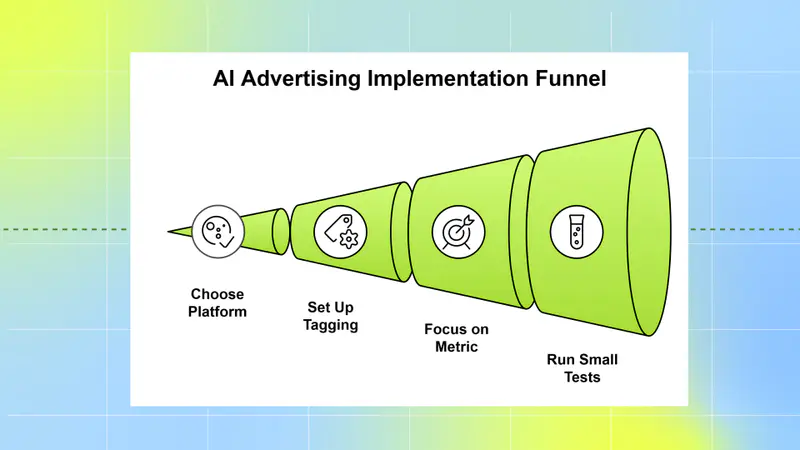
Don't try to overhaul everything at once. Start small, prove value, then scale. Here's the practical roadmap:
1. Identify your biggest creative blind spot
Are you launching 50 new creatives monthly but can't tell which concepts are winners? Do you know your top-performing ad but not why it performs? Start there.
2. Pick one platform to test
Use your highest-spend channel (probably Meta or Google) as your testing ground. Connect it to an AI creative analytics tool and run for 30 days to establish baseline patterns.
3. Set up automated tagging
Manual creative tagging is where most teams fail; it's tedious and inconsistent. Use AI to automatically tag creative elements (headlines, visuals, CTAs, characters) from day one. This builds your performance dataset without added workload.
4. Focus on one metric that matters
Don't try to optimize for CTR, CPA, ROAS, and retention simultaneously. Pick your north star metric (for most UA teams, it's CPA or D7 ROAS) and let AI surface which creative elements move that number.
5. Run small tests, then scale winners
Launch 10-15 creative variations with different hooks, characters, or CTAs. Let AI identify the top performers, then double down; brief your creative team to make more of what's working, not what feels creative.
The key: Don't treat AI as magic. Treat it as a faster, more accurate way to do what you'd do manually if you had unlimited time and a photographic memory.
Emerging Trends in AI Advertising Technology
Generative AI for creative production at scale: Tools like Midjourney and Runway are enabling rapid creative iteration, generating 20 visual variations of a concept in minutes instead of days. The catch? Volume without strategy still wastes budget. You need AI analytics to tell you which of those 20 variations will perform.
Voice and visual search ad triggers: AI-powered ads triggered by voice commands ("Alexa, find me running shoes") or image uploads (snap a photo, get product ads) are scaling. If you're in e-commerce or apps, this is the next frontier for intent-based targeting.
Explainable AI (XAI): Early AI tools were black boxes; they'd tell you "Creative A wins" but not why. Newer platforms explain the decision: "Creative A wins because the first 3 seconds show product use, which correlates with 40% higher CTR in your vertical."
Cross-channel AI optimization: Instead of optimizing Meta in isolation, AI tools now adjust creative strategies across Meta, TikTok, Google, and programmatic networks simultaneously, recognizing that a user's journey crosses platforms. One creative concept might crush on TikTok but flop on Meta, AI ensures you're not wasting budget on the wrong platform mix.
Real-time creative fatigue prediction: Instead of waiting for performance to drop, AI now predicts when a creative will fatigue based on engagement decay curves, letting you swap in fresh variations proactively.
Challenges and Best Practices When Using AI in Advertising
Challenge 1: Data quality issues
AI is only as good as the data you feed it. If your creative naming is inconsistent, your tracking is broken, or you're pulling metrics from mismatched attribution windows, AI will surface garbage insights.
Fix: Standardize your creative naming conventions, ensure tracking is accurate, and clean your data before connecting it to AI tools.
Challenge 2: Over-reliance on automation
AI can tell you "hook A outperforms hook B by 22%," but it can't tell you why that resonates with your audience or how to innovate beyond existing patterns. You still need human creative strategy.
Fix: Use AI for measurement and optimization, not for creative direction. Let your team focus on big ideas; let AI tell you which execution works.
Challenge 3: Algorithm bias and transparency
Some AI tools optimize for what they think matters (clicks, impressions) instead of what you care about (CPA, LTV). Always verify that AI recommendations align with your actual business goals.
Fix: Set custom metrics and KPIs within your AI platform. Don't let default settings dictate your strategy.
Challenge 4: Privacy and compliance
AI tools that rely on granular user data (especially post-iOS 14) face privacy restrictions. Ensure your tools are compliant with GDPR, ATT, and other regulations.
Fix: Use platforms that aggregate and anonymize data properly, and prioritize first-party data integrations (like MMP data) over invasive tracking.
Best practices:
Start with small, controlled tests to validate AI recommendations before scaling
Regularly audit AI outputs, don't trust blindly
Combine AI insights with qualitative feedback from your audience
Train your team to interpret AI data, not just accept it
Conclusion: Embracing AI to Elevate Your Advertising Creativity
AI in advertising isn't about replacing your team, it's about making them impossibly fast and precise. When you combine AI's ability to process millions of data points with your team's creative intuition, you get campaigns that are both data-driven and genuinely engaging.
The path forward is clear:
Start with creative analytics: Before you automate, understand what's working and why. Use AI element tagging to identify winning patterns across your campaigns.
Test with intention: Don't just run more ads, run smarter variations based on proven performance data.
Iterate rapidly: Let AI handle the measurement-heavy lifting so your team can focus on making better creative, faster.
Stay human: AI tells you what's working. You still need to know your audience, understand your brand, and push creative boundaries.
Performance marketers who embrace AI for creative optimization aren't just keeping up, they're pulling ahead. While competitors are manually analyzing spreadsheets, you're launching creative iterations backed by real performance intelligence.
Bottom line: AI does not replace your creative team, it tells them what to make more of. Start with creative intelligence (tagging and analysis) to learn what wins, then use generation to scale it. If you want that in one place, Segwise ties every creative element to ROAS across 15+ ad networks and MMPs (including playable ads); if your gap is producing volume, pair it with a generator like AdCreative.ai.
Ready to see which creative elements are actually driving your ROAS? Start your 7-day free trial with Segwise, import up to 14 days of historical data instantly (up to 3 months on paid plans), and let AI creative analytics do the heavy lifting.
Frequently Asked Questions
What is AI in advertising?
AI in advertising uses machine learning to analyze performance data, optimize campaigns, and generate creative. In practice for performance marketers, it means automatically tagging creative elements (hooks, CTAs, characters, visuals) and linking them to metrics like CTR, CPI, and ROAS. Platforms like Segwise do this at the creative level, while generators like AdCreative.ai focus on producing new variations.
How does AI improve creative performance?
It finds element-level patterns humans miss, for example which hook style or visual drives higher IPM, and flags creative fatigue early so you refresh before budget is wasted. Segwise surfaces these patterns across networks and ties them to ROAS; broader ad-automation suites like Madgicx apply similar AI to Meta campaign management.
Does AI replace creative teams?
No. AI handles measurement and pattern detection at speed; humans still own the ideas and the brand. The strongest teams use AI (Segwise for analysis, tools like AdCreative.ai for generation) to brief better and iterate faster, not to remove creative judgment.
What is AI creative tagging?
It is the automatic labeling of every element in an ad (dialogue, characters, colors, on-screen text, interactive playable mechanics) so performance can be compared by element rather than by whole ad. Segwise is notable here because it is the only platform that also tags playable (interactive) ads, which matters for mobile game UA.
How do I start using AI in advertising as a beginner?
Pick your highest-spend channel, connect it to an AI creative analytics tool, turn on automated tagging, and optimize for one north-star metric (usually CPA or D7 ROAS) before scaling. A tool like Segwise sets up in about 10-15 minutes with no engineering and imports historical data so you get baseline patterns quickly.
Which AI advertising tool is best for mobile games and apps?
For mobile UA, prioritize creative-level intelligence, MMP integrations, and playable-ad support. Segwise fits that profile (it tags playable ads and unifies 15+ networks and MMPs), while generation tools like AdCreative.ai or Layer AI are better when your bottleneck is producing creative volume rather than understanding it.