
The best Superside competitors for ad creative in 2026 are Segwise, Penji and Kimp: Segwise if the bottleneck is knowing which creative actually works (and generating more of it), Penji for managed design capacity from $995/month, and Kimp for unlimited static plus motion under one flat fee. Design Pickle, Designjoy, Rocketium AI Studio, AdCreative.ai, Pencil, Bestever and Smartly cover the rest of the range.
Segwise is an AI creative-analytics platform, not a design-production service: it auto-tags every element of your ad creatives across 15+ networks, ties each one to performance so you know what is working, and then generates new ad creatives (static, video and playable) from those winning patterns, so you both analyse and produce at scale.
TL;DR: Key takeaways
Superside is now a $15,000/month floor. Its pricing page lists a minimum monthly budget of $15,000 on an annual term, a Dedicated Plan from $30,000/month on a 12-month term, and a flat $1,000/month software fee on all subscriptions. Project Boosters start at a $15,000 minimum. Every Superside subscription runs on an annual commitment.
It has repositioned from "AI-powered" to "AI-first", adding AI Agents & Apps, Brand Intelligence, custom AI image models trained on your brand assets, and an AI Consulting and Automation service line. It is still a creative services subscription, not software you log into and run yourself.
The alternatives split three ways. Managed design subscriptions (Design Pickle, Penji, Designjoy, Kimp) at roughly $995, $5,995/month; AI generators (AdCreative.ai from $39/month, Pencil from $14/month, Bestever from $10/month) that trade polish for volume; and creative intelligence (Segwise) that tells you what to make before anyone makes it.
"Unlimited" is doing less work than it used to. Penji now sells active workstreams (2, 3 or 4 by tier) rather than unlimited concurrency, and Designjoy is explicitly one request at a time. You can queue as much as you like; how much moves at once is the real constraint.
Production capacity and creative performance are different purchases. Superside and the design subscriptions make more assets. None of them tells you which hook, character or CTA moved ROAS, for that you need automated tagging tied to campaign data.
Superside competitors compared at a glance (2026)
| Tool | Best for | Key feature | Pricing |
|---|---|---|---|
| Segwise | Performance and UA teams that need to know which creative elements drive results, then produce more of what works | Automated multimodal tagging (including playable ads) mapped to CPI, IPM and ROAS; fatigue detection; AI creative generation; Creative Strategy Agent (AI Chat) | 7-day free trial; from $499/month (50% off under $50K spend) |
| Superside (the baseline) | Mid-market and enterprise in-house marketing teams that want an outsourced, AI-augmented creative team across 20+ disciplines | AI Agents & Apps, Brand Intelligence, custom AI image models trained on your brand assets | From $15,000/month minimum on an annual term; Dedicated Plan from $30,000/month; plus a $1,000/month software fee |
| Design Pickle | Marketing teams that want steady, predictable managed design capacity | Dedicated design support with managed workflows; flat-rate rather than hourly, no retainers | Not published, scoped on a call, billed quarterly or annually |
| Penji | Teams with a constant flow of design requests that want fast turnaround without an enterprise contract | Active workstreams with 1-day turnaround on entry tier; 30-day money-back guarantee, no contracts | Essentials $995/month, Agency Partner $1,995/month, Dedicated Team from $4,500/month; 15% off quarterly, 20% off yearly |
| Designjoy | Founders and lean teams that want one dedicated designer and total billing simplicity | One request at a time with ~48-hour average delivery; pause the subscription and keep unused days | Monthly Club $5,995/month, currently discounted to $4,995/month |
| Kimp | Teams that need regular static and motion creative under one flat fee | Separate or combined graphics and video subscriptions with a dedicated team | Kimp Graphics $1,397/month, Kimp Video $1,397/month, Graphics + Video $1,697/month; 7-day free trial |
| Rocketium AI Studio | Ecommerce, retail media and performance teams that need one concept adapted into many platform-ready variants | AI-led creative adaptation with brand and channel compliance checks, plus human QA | Credit-based, adaptations typically 1 credit per output; concepting and production vary by complexity |
| AdCreative.ai | SMBs, solo marketers and small agencies that need high-volume AI ad creative fast and cheap | Conversion-scored ad generation, product video and UGC-style content, AI product photography | Starter $39/month (10 credits, 1 brand), Professional $249/month, Ultimate $999/month; 7-day free trial |
| Pencil | Solo marketers and small teams at the cheap end, and global brands at the enterprise end via Pencil Pro | Generates complete ads rather than isolated components, with brand guidelines applied automatically; connects to media accounts to predict winners | Core $14/month (50 generations), Growth $55/month (250 generations); ~20% cheaper billed annually. Pencil Pro custom |
| Bestever | Small ecommerce and DTC brands and freelancers who want the cheapest credible entry into AI ad generation | Analyses your existing ads and generates variations; built-in hallucination detection flags AI errors before download | Essential $10/month (40 credits), Advanced $99/month (400 credits), Enterprise custom; you only pay at download |
| Smartly | Mid-market to enterprise advertisers and agencies running very high paid-social and CTV spend | Creative Suite, Media Suite and Intelligence Suite in one platform, with the Smartly Synapse AI orchestration layer underneath | Not published, a percentage of managed media spend with a monthly minimum (reviewers report roughly €2,500). No free trial |
Prices are read from each vendor's own pricing page in August 2026.
You need clear answers fast. When you run many ad tests, having more polished files is only part of the job; the more challenging part is knowing which creative elements actually lift installs, lower costs, or stop working. Many teams looking for a better fit ask for superside competitors that do more than deliver files: they either tie creative to campaign data or offer a low-friction, flat-rate way to generate many quick variants.
Superside is built as a subscription creative partner that expands your production capacity with managed teams and a steady workflow. Some alternatives focus on creative analytics: they auto-tag visuals and copy, surface which elements drive results, detect creative fatigue, and can suggest or generate new variants informed by historical performance data. Other options trade deep analytics for simple, unlimited design plans that keep many small requests moving at a fixed monthly price.
This blog will help you find the best Superside competitor for your needs: whether you want data that points to winning creative, or a low-friction way to keep a steady stream of data-informed assets. It relies on clear, practical checks so you can choose the tool that closes your biggest bottleneck.
What is Superside?
Superside is a subscription-based creative service that gives you a ready-made design team on demand. They match you with designers, project managers, and tools so you can hand off work like ads, motion videos, presentations, and brand assets without hiring freelancers or building an in-house studio. Superside positions itself as an "always-on" production partner for larger teams that want consistent output and a managed workflow.
As of 2026 Superside describes itself as "AI-first" rather than AI-powered, and the product line reflects that: AI Agents & Apps that support briefs, reviews and repeatable processes, Brand Intelligence that learns from past feedback, custom AI image models trained on your brand assets, and a separate AI Consulting & Automation service line aimed at transforming the client's own team. The framing throughout is human-AI collaboration, not AI-only. What it is not is performance analytics, the public pages still centre on reliable, brand-safe production across more than 20 creative disciplines rather than ad-level measurement.
What Superside costs in 2026
This is the number most comparison posts get wrong, so it is worth stating plainly from Superside's own pricing page:
Minimum monthly budget: $15,000/month on an annual term.
Dedicated Plan (dedicated team): from $30,000/month on a 12-month term.
Software fee: +$1,000/month on all subscriptions, covering platform access and AI generation costs.
Flex Plan: variable, no fixed price published. Project Boosters: from a $15,000 minimum. High-Impact Projects are fixed-scope and custom-priced, and there is an Exploratory Project entry option with no published price.
All Superside subscriptions run on an annual commitment. Per-project pricing is quoted by sales.
One caveat worth knowing before you sign an annual term: a layoff-tracker aggregator reported a restructuring of roughly 60 roles (around 9% of headcount) dated 5 March 2026, attributed to AI design tools compressing design labour. Superside has not confirmed this, nothing on its own site or newsroom addresses it, and the report traces back to a single aggregator, so treat it as reported but unconfirmed rather than fact. Separately, Superside's own news page carries no dated 2025 or 2026 announcements; the most recent dated item is from July 2024.
That production-first approach works well for many teams, yet it doesn't cover every creative workflow. Once output volume increases and performance pressure rises, some gaps become more noticeable.
Why Teams Seek a Superside Competitor
You might look for a Superside competitor when production quality alone isn't the complete answer. Here are the common reasons teams, especially teams running frequent ad tests, choose other tools: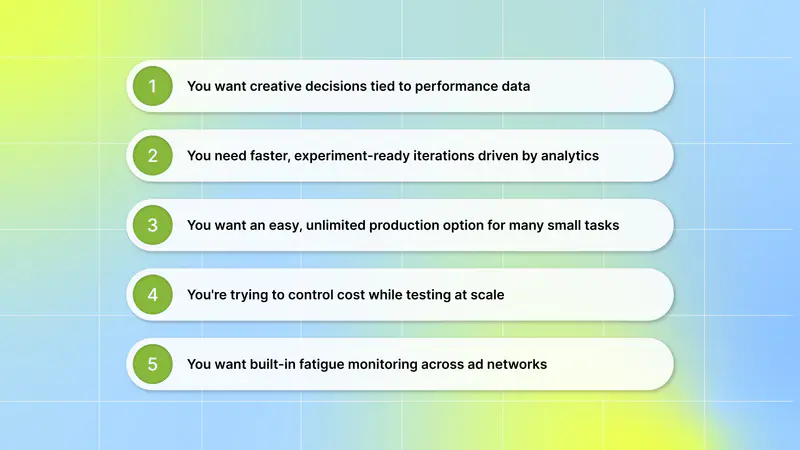
You want creative decisions tied to performance data: If you need to identify which visual elements drive metrics such as installs or cost per action, you'll want a tool that links creative features to ad performance. Some newer platforms focus on automated tagging, cross-network reporting, and fatigue detection so you can see why an ad works and repeat it. Superside focuses on making high-quality assets, not on automated, element-level analytics.
You need faster, experiment-ready iterations driven by analytics: When you run many experiments, manual tagging and analysis slow you down. Platforms that auto-tag creatives and can suggest or generate new variants help keep a steady flow of testable ads. That capability shortens the loop between insight and the launch of a new creative.
You want a lower-friction, unlimited production option for many small tasks: If your workload is a high volume of small graphic requests, some subscription services offer "unlimited" request models or flat fees that make it simpler to scale routine design needs without managing credits or large project briefs. These services trade deep enterprise processes for speed and simplicity.
You're trying to control cost while testing at scale: Different pricing models suit different testing cadences. Some teams prefer a flat monthly plan or unlimited design model because it's easier to forecast costs when you run hundreds of micro-tests. Superside's subscription model is designed for predictable production spend, but the entry point is a $15,000/month minimum on an annual commitment plus a $1,000/month software fee, which is a very different commitment from a $995 or $1,397 monthly plan you can cancel, and a hard stop for teams whose creative budget is smaller than their media budget.
You want built-in fatigue monitoring across ad networks: Creative fatigue happens when an asset loses effectiveness over time. Some competitors offer automated fatigue tracking and alerts, so you can retire or refresh assets before performance declines further. That is a capability many teams running many campaigns value highly.
If your top priority is tying creative changes to measurable lift and keeping a fast test cadence, look for a solution that adds automated analytics and iteration to production. If your biggest need is polished, brand-safe creative at scale, Superside and similar subscription production services remain strong options.
Once you understand what Superside offers and where it may fall short, the next step is to evaluate alternatives that address related problems in different ways.
Also Read: Top Creative Intelligence Tools for Creative Success in 2025
Top Superside Competitors
Some platforms focus on helping you produce more assets with less friction, while others focus on helping you decide which assets are worth producing based on real performance signals. The options below are the most relevant Superside competitors, each with a distinct approach to creative work.
1. Segwise

Segwise is a creative analytics platform that automatically tags ad assets, measures how creative elements correlate with performance metrics across campaigns, detects creative fatigue, and generates new, data-informed variations based on what has worked before. Its core job is to turn noisy creative output into clear signals about which elements (hook scenes, first dialogues, headlines, characters, influencer traits, CTA text, CTA dialogue, audio cues) actually move metrics. That makes Segwise especially strong when you need to scale tests and make design choices based on data rather than guesswork.
Two short points that sum up why Segwise is the strongest fit for your needs: Segwise connects creative details to campaign outcomes, and it automates the repetitive parts of creative testing so you can act faster on what works.
Key Features:
Automated creative tagging: AI tags images, video, and copy elements so you don't have to label everything by hand.
Creative Fatigue detection: flags when an asset begins to lose effectiveness, enabling you to rotate or refresh it early.
Cross-network performance mapping: ties creative elements to performance metrics across ad platforms using ad network and MMP data (so you can see what drives lift).
AI creative generation: the Creative Generation Agent produces net-new statics, video ads and interactive playables, plus scene-by-scene video storyboards, built from the tags already winning in your account. Edit outputs by prompting, and export in each network's aspect ratios.
Creative Strategy Agent (AI Chat): an always-on creative strategist with full context on your account. Ask which hook style drove the most installs last month, or what separates your top five creatives from your bottom five, and get an answer instead of a reporting ticket. It builds and interprets reports on request too.
Playable ad tagging: interactive units are analysed alongside video and static, which matters for mobile gaming and is a blind spot in most creative tools and in Meta's and TikTok's native reporting.
Asset clustering: groups ads that share the same underlying footage, images or audio so you can isolate which single treatment, a different hook, CTA, overlay or music bed, caused the performance gap.
Competitor Tracking Agent: monitors and tags competitor ads with the same multimodal AI for gap and white-space analysis.
Custom tags and nomenclature tagging: define brand-specific creative variables beyond the standard tag set, and pull tags out of naming conventions you already use.
Why is it a better alternative to Superside?
Superside focuses on managed design teams, project management, and polished deliverables. Segwise focuses on measurement and iteration, identifying which visual or copy elements drive performance and generating repeatable variants based on that data. This approach shortens the cycle from insight to testable creative.
Limitations:
Segwise is not a production studio, there is no managed human design team, so if what you need is packaging, brand books or presentations, that is Superside's job, not this one. It is also not an attribution platform; it sits alongside your MMP rather than replacing it. Competitor tracking currently covers Meta (Facebook and Instagram), with more platforms in development, and you need live campaign data flowing in before the insights are worth much.
Pricing:
7-day free trial, then paid plans from $499/month (50% off under $50K spend). Setup is no-code, roughly five minutes per source, 10-15 minutes to connect everything, and historical data is imported automatically on integration: up to two weeks on the free trial and up to three months on paid plans. Connects to 15+ ad networks and MMPs, including AppsFlyer, Adjust, Branch and Singular.
2. Design Pickle

Design Pickle is a well-known subscription design service that pairs you with designers and tools for steady creative output on a predictable monthly model. It emphasizes stable capacity and support for ongoing needs.
Key Features:
Dedicated design support and managed workflows.
Flat-rate rather than hourly, with no retainers; billing runs quarterly or annually.
Why is it a better alternative to Superside?
Both services aim for steady production, but Design Pickle is often chosen for clearer, fixed subscription tiers and features designed for high-volume repeat work. If your main goal is predictable capacity rather than analytics-driven iteration, this is a solid pick.
Limitations:
Pricing is no longer published, which makes it hard to benchmark before a sales call, and quarterly or annual billing means it is less cancel-anytime than the flat-fee services below. Like Superside, it is production capacity, there is no ad-performance analytics layer.
Pricing:
Not published. As of August 2026 Design Pickle scopes plans on a call: "plans are scoped to what your team actually needs - volume, turnaround, services - so we set the number on the call." It is flat-rate rather than hourly, with no retainers, and billed quarterly or annually. Base and Pro tiers are referenced but not priced publicly.
3. Penji

Penji sells flat monthly design subscriptions with fast turnaround. One thing to get right if you are working from an older comparison: Penji now prices by active workstreams rather than straightforwardly unlimited concurrency. You can queue as many requests as you like, but 2, 3 or 4 of them move at once depending on the tier.
Key Features:
Unlimited requests queued, with concurrency capped by active workstreams: 2 on Essentials, 3 on Agency Partner, 4 on Dedicated Team.
1-day turnaround on Essentials, priority turnaround on Agency Partner, and real-time collaboration on Dedicated Team.
No contracts, cancel anytime, with a 30-day money-back guarantee; AI early-access features scale by tier.
Why is it a better alternative to Superside?
If your work mostly requires frequent small assets on a steady cadence, Penji's flat-rate model reduces friction and overhead compared with credit-based or enterprise-first services, and at $995/month versus Superside's $15,000/month minimum on an annual term, the gap is not marginal. Superside can be stronger for multi-format, enterprise projects, but Penji wins on simplicity and commitment for high-volume, everyday design.
Limitations:
Concurrency is the real constraint, two active workstreams goes quickly if several campaigns launch at once. No ad-performance analytics, and no playable or interactive ad capability. Motion and video work is not the headline service.
Pricing:
Essentials $995/month (2 active workstreams, 1-day turnaround), Agency Partner $1,995/month (3 workstreams, priority turnaround), Dedicated Team from $4,500/month (4 workstreams, real-time collaboration). Quarterly billing saves 15%, yearly saves 20%. 30-day money-back guarantee, cancel anytime.
4. Designjoy

Designjoy sells a flat-fee subscription that connects you with a single dedicated designer or a small team. The product is built around speed and a simple monthly billing model.
Key Features:
One monthly fee, one designer, or a small dedicated resource.
Simple queue tools for managing requests and priorities.
Why is it a better alternative to Superside?
Designjoy is simpler and more predictable for teams that want a single point of contact rather than a multi-role managed team. That can reduce overhead for straightforward ongoing design needs. For extensive enterprise workflows, Superside may still be preferable.
Limitations:
One request at a time is the whole model, you can queue unlimited requests but they are processed sequentially, so it does not suit a week where five campaigns need assets simultaneously. It is also the most expensive of the flat-fee services here, and being a single-designer operation means capacity and bus factor are the same number. No analytics layer.
Pricing:
Monthly Club at $5,995/month, discounted to $4,995/month at the time of this update (offered as a lifetime discount). One request at a time with roughly 48-hour average delivery. You can pause the subscription and keep unused days from the 31-day billing cycle, and there is a 75% refund guarantee in the first week.
5. Kimp

Kimp offers unlimited graphic design plus optional video design under flat monthly fees. Their model includes a dedicated team and a steady production pipeline.
Key Features:
Unlimited graphic requests and separate or combined unlimited video plans.
Dedicated designers, revisions, and a demo/trial to get started.
Why is it a better alternative to Superside?
Kimp packages video and graphic production into a single, predictable plan, which can be more cost-effective for running mixed-media programs at scale. Superside will still be strong for deep enterprise production needs and custom creative projects.
Limitations:
Buying graphics and video separately costs more than the combined plan, so the economics only work if you genuinely need both. Turnaround is subscription-paced rather than instant, and as with every service on this list there is no creative performance analytics, you get assets, not answers about which ones worked.
Pricing:
Kimp Graphics $1,397/month, Kimp Video $1,397/month, and Kimp Graphics + Video $1,697/month as the combined plan. There is a 7-day free trial, a 10% discount for adding two more subscriptions to an account, and a new-client promotion of 50% off for the first four months at the time of this update.
6. Rocketium AI Studio

Rocketium AI Studio is a 3-in-1 creative production infrastructure for teams that need ad output at scale. It supports concepting new ad directions, producing campaign assets from briefs and raw product inputs, and adapting approved master creatives into multiple sizes, formats, channels, and languages. With AI-assisted production, brand controls, and expert review, it helps brands create more on-brand, platform-ready ads without the usual production bottlenecks
Key Features:
AI-led creative adaptation: turns one approved creative into many platform-ready variants.
Brand and channel compliance: checks assets against brand rules and placement requirements.
Production support: helps create copy, translations, product visuals, lifestyle images, and short videos.
Human QA: final outputs are reviewed for brief fit, brand consistency, and channel accuracy.
Why is it a better alternative to Superside?
Superside is strong for managed creative production, but Rocketium AI Studio is better suited for teams that need ad creation on steroids: fast adaptations, many variants, and platform-ready assets without manual resizing bottlenecks. It is especially useful for ecommerce, retail media, and performance marketing teams running frequent campaign launches.
Limitations:
Credit-based pricing means cost scales with output volume, which is efficient for adaptation and less predictable for exploratory work. It is built for adapting an approved master creative rather than deciding what that master should be, and it does not link creative elements to campaign performance.
Pricing:
Credit-based. Adaptations typically use 1 credit per output, while production and concepting tasks vary by complexity. No published dollar figure per credit.
7. AdCreative.ai
AdCreative.ai sits at the opposite end of the market from Superside: instead of a managed team, you get a generator that turns out high volumes of conversion-scored ad creative and copy for tens of dollars a month. It is worth knowing that it is no longer an independent startup, Appier acquired it in a deal announced 12 February 2025 and closed in early March 2025, valued at $38.7M total, and is integrating generation with its AIRIS CDP.
Key Features:
AI ad-creative generation across static, display and social, with conversion-focused scoring.
Video generation, product videos, UGC-style content and fashion video shoots from stills.
AI product photography that turns raw product photos into studio-quality ecommerce visuals.
Competitor campaign intelligence, AI copy and headline generation, brand-specific templates, buyer personas and compliance checking.
Why is it a better alternative to Superside?
Purely on cost and speed. Where Superside is a $15,000/month annual commitment, AdCreative.ai starts at $39/month and produces assets in minutes. You are trading craft, art direction and brand stewardship for volume, a fair trade if what you need is fifty variants to test this week, a bad one if you need a brand campaign.
Limitations:
Output quality is template-driven and rarely matches human art direction. Credits and brand counts cap each tier, so heavy use escalates fast. There is also a pricing discrepancy in the wild: some third-party listings still show the Ultimate tier at $599/month while the vendor site shows $999/month; the vendor figure is the current one.
Pricing:
Starter $39/month (10 credits, 1 brand), Professional $249/month (50 credits, 10 brands), Ultimate $999/month (100 credits, 25 brands), Enterprise custom. Quarterly billing is 25% off and yearly 50% off. 7-day free trial, cancel anytime.
8. Pencil
Pencil, now part of The Brandtech Group, is a two-track product: dirt-cheap self-serve generation for small teams, and Pencil Pro sold to global brands through Brandtech. Its distinguishing habit is generating complete ads rather than isolated components, with your brand guidelines applied automatically.
Key Features:
Generates finished ads with brand guidelines applied, not just headlines or images to assemble yourself.
Connects directly to media accounts to pull performance data and predict which generations will win.
Multi-model under the hood, current integrations include Claude for copy, Gemini and Nano Banana for image and video, and ElevenLabs for AI voiceover, with voiceovers reusable across Editor, Canvas and Workflows.
Pencil Pro adds enterprise brand safety, data protection, IP ownership, Adobe Firefly Services integration and Google Cloud model access.
Why is it a better alternative to Superside?
For small teams, price: $14/month against a $15,000/month floor. For large brands, Pencil Pro competes with Superside on the same ground, brand-safe creative at scale, but as software your team drives rather than a service you brief. Pencil claims $1BN in media spend across 5,000 brands.
Limitations:
The self-serve tiers are metered by generations (50/month on Core, 250 on Growth), which runs out quickly at real testing volumes. Pencil Pro pricing is not published anywhere, so the enterprise path is a sales cycle. And a Gartner "Cool Vendor" designation appears in its marketing that we could not tie to a specific report or year.
Pricing:
Core $14/month ($11 billed annually, 50 generations/month), Growth $55/month ($44 annually, 250 generations/month), Pro custom, unlimited generations, contact sales. Annual billing is roughly 20% cheaper. Pencil Pro is quoted separately with no published price.
9. Bestever
Bestever is the cheapest credible entry point into AI ad generation, starting at $10/month, and it works by analysing your existing ads first and then generating variations off what is already performing. Note the ownership change: Samba (Samba TV) acquired Bestever on 22 June 2026, terms undisclosed, with founder Apoorva Govind joining Samba as Director of Product. The announcement does not say whether Bestever continues as a standalone product, and the site still sells its own plans, so it is live and purchasable, just no longer independent.
Key Features:
Analyses existing text, image and video ads, reports what is working, then generates winning variations.
Hallucination detection, built-in QA that flags AI errors such as extra fingers, wrong logos and inconsistent details before you ship.
Industry-specific generation pipelines for apparel, CPG/retail and agencies.
Performance feedback loop ingesting Meta, TikTok and Google data, plus competitor ad ingestion to generate variations off proven competitor strategies.
Why is it a better alternative to Superside?
Cost and iteration speed, and the fact that generation is anchored to performance data rather than a brief. For a small DTC brand testing weekly, $10 to $99 a month against a $15,000 minimum is not really a comparison.
Limitations:
Post-acquisition roadmap uncertainty is the honest risk here, Samba has not said whether the standalone product persists, so avoid building a critical workflow on it without asking. Credits meter output and charges land at download. No managed human design capability, and its impact claims (2x ROI, 80% production cost savings, 15 hours a week saved) are company-reported.
Pricing:
Essential $10/month (40 credits), Advanced $99/month (400 credits), Enterprise custom. All plans include a free trial to create and generate; you only pay at download time. No trial length is published.
10. Smartly
Smartly (the company now presents as "Smartly" rather than "Smartly.io") is the enterprise answer to the same problem Superside solves, approached from the media side: creative automation and media buying in one platform, managing a reported $7B+ in ad spend across 800+ brands.
Key Features:
Creative Suite, creative automation, AI-powered video and social templates, personalised creative at scale.
Media Suite, automated cross-channel campaign management and budget optimisation.
Intelligence Suite, unified cross-campaign dashboards plus Brand Pulse real-time measurement.
Smartly Synapse, launched 22 June 2026, an AI orchestration and memory layer under its agents that synthesises campaign data and business context, coordinates actions across channels, and learns from each campaign.
Connected TV across 200+ streaming services.
Why is it a better alternative to Superside?
Smartly closes the loop Superside leaves open: creative is generated, launched and measured in the same platform, so production and performance are not separate purchases. Named customers include Samsung, Spotify, Uber, Ralph Lauren and Foot Locker.
Limitations:
Priced as a percentage of managed media spend, which makes it an explicitly poor fit for small budgets, reviewers report a monthly minimum that rose to around EUR 2,500, and one reports a EUR 50,000/month minimum spend requirement. Those are reviewer-reported, not vendor-confirmed. There is no free trial and no free plan, and creative automation here means templated scale rather than original art direction.
Pricing:
Not publicly listed, demo and contact sales only; there is no pricing page. Billing basis, per third-party review data, is a percentage of managed media spend with a monthly minimum, across a Self-Serve + Support tier and a higher-percentage Managed Service tier that adds a dedicated execution team.
Now that you've seen how different platforms approach creative work, it helps to step back and compare them side by side. The table below shows each platform's core strength, where it fits best, and whether it supports creative performance analytics.
How These Superside Competitors Compare at a Glance
This view makes it easier to spot which option aligns with your current challenge, whether that's scaling production or improving results from the creative you already run.
Also Read: Top Creative Analytics Tools for Successful Ad Campaigns 2025
How to Pick the Right Superside Competitor

After comparing platforms side by side, the next step is choosing the one that fits how you actually work. The right choice depends less on feature lists and more on where your biggest bottleneck sits today. Use the five factors below as a simple decision framework:
1. Data & Analytics: Do You Get Clear Answers, Not Guesses?
If your goal is to improve results from ad creative, you need tools that explain why something works. Platforms with automated tagging and performance mapping break down creatives into elements and show how each part impacts metrics. This removes manual reviews and gut-based decisions. If a vendor only delivers assets without showing element-level impact, analytics will stay limited.
What to check: automated tagging, dashboards tied to campaign metrics, and visibility into which creative element drives lift.
2. Iteration Speed: How Fast Can You Replace What Stops Working?
Speed matters when creative performance changes quickly. Look for tools that flag fatigue early and help you move straight from insight to a new variant. Systems that generate or suggest new iterations based on past winners reduce downtime and keep tests running without long pauses.
What to check: fatigue alerts, iteration recommendations, and how quickly new data-informed assets are created after insights appear.
3. Production Quality vs Speed: Where Do You Want to Compromise?
Some platforms focus on polished, brand-safe output with managed teams and reviews. Others focus on high volume and faster turnaround with simpler workflows. Decide which matters more for your ads: premium finish or fast experimentation. Many teams pair analytics-first tools with production services to balance both.
What to check: sample quality at your ad specs, revision process, and how speed changes as request volume grows.
4. Pricing Model Fit: Does the Cost Match Your Testing Rhythm?
Pricing structures vary widely. Credit-based and managed subscriptions work well for planned campaigns. Flat or unlimited plans are better suited for testing many small variations. Choose a model that aligns with how often you refresh creatives, not just the monthly price.
What to check: request limits, revision rules, rollover policies, and how pricing handles spikes in demand.
5. Ad Network Integrations and Measurement: Can You See Results Where It Matters?
Strong platforms connect directly to major ad networks or support clean data imports. For example, platforms like Segwise unify creative data from multiple ad networks and MMPs into a single creative analytics view. This keeps creative insights tied to real outcomes rather than isolated reports. Without proper integration, even good creative insights are harder to act on.
What to check: supported ad networks, metric coverage, and whether creative insights can be compared across channels.
Use these five checks as a short checklist when vetting vendors. Next, compare the platforms side-by-side using the table above to see which one best matches where you want to focus production, analytics, or both. With those factors in mind, the decision becomes less about brand names and more about removing the friction that slows your creative results.
Also Read: Top Creative Optimization Tools for 2025
How to choose
When comparing superside competitors, choose the platform that directly fixes your biggest pain: clearer creative-to-performance signals, faster data-informed iterations, or simpler volume production. The best pick will shrink the gap between insight and action, reduce wasted spend, and make winners repeatable across campaigns. Focus on the vendor that fits your testing cadence and reporting needs, so your team can move from guessing to measurable improvement.
For teams running ads at scale, production alone rarely solves the real problem. What slows growth isn't a lack of assets, but a lack of clear insight into which creative elements actually drive performance and when they begin to fatigue. That's where Segwise fits in, an AI-powered creative analytics platform that automatically tags and links creative elements to performance metrics, revealing what works across campaigns and networks.
Segwise shifts creative decision-making from opinion-based guesses to measurable, repeatable outcomes grounded in live campaign data, helping teams iterate faster and optimize for better ROAS.
Start a 7-day free trial (no credit card required) to see element-level insights in your dashboard and accelerate your creative test cycle.
FAQ's
1. What are the top Superside Competitors for ad creative in 2026?
The most relevant Superside Competitors in 2026 are Segwise, Design Pickle, Penji, Designjoy, Kimp, Rocketium AI Studio, AdCreative.ai, Pencil, Bestever and Smartly. They split into three groups: creative intelligence that tells you what to make (Segwise), managed design subscriptions that make it for you (Design Pickle, Penji, Designjoy, Kimp), and AI generators that make it cheaply at volume (AdCreative.ai, Pencil, Bestever), with Rocketium and Smartly covering adaptation and enterprise creative automation.
2. How do Superside Competitors differ from Superside?
Most Superside Competitors focus on either creative performance analytics or simpler subscription pricing. While Superside emphasizes managed design production, competitors often prioritize faster iteration, lower friction, or insights into ad performance.
3. Which Superside Competitors are best for creative analytics and fatigue detection?
Segwise stands out among Superside Competitors for creative analytics. It automatically tags creative elements, links them to performance data, detects creative fatigue, and helps teams generate new data-informed variations.
4. Which Superside Competitors offer unlimited or flat-rate design services?
Penji, Kimp, Design Pickle, and Designjoy are popular Superside competitors that offer unlimited or flat-rate design plans. These options work well for teams that receive frequent small design requests and have predictable monthly budgets.
5. How should I choose the right Superside Competitor for ad testing and cost control?
To choose the right Superside Competitor, first identify your main bottleneck. If you need insight into what drives performance, choose an analytics-focused platform. If you need fast and affordable creative volume, a flat-rate design subscription is a better fit.
6. How much does Superside cost in 2026?
Superside's pricing page lists a minimum monthly budget of $15,000 on an annual term, a Dedicated Plan from $30,000/month on a 12-month term, and a flat $1,000/month software fee on all subscriptions. Project Boosters start at a $15,000 minimum, and High-Impact Projects are custom-priced. Every subscription runs on an annual commitment, so there is no month-to-month option.
7. Which Superside competitor is cheapest?
Among AI generators, Bestever at $10/month and Pencil at $14/month are the cheapest, with AdCreative.ai at $39/month close behind. Among managed design services, Penji at $995/month is the lowest published entry point; Kimp is $1,397/month and Designjoy is $4,995-$5,995/month. Design Pickle no longer publishes pricing.
8. Is Superside still a safe choice in 2026?
It is live and actively selling. Two things to go in knowing: it has repositioned as "AI-first", and a layoff-tracker aggregator reported a restructuring of around 60 roles (roughly 9% of headcount) dated 5 March 2026. Superside has not confirmed that report and nothing on its own site addresses it, so treat it as unconfirmed. Its own newsroom has also carried no dated announcements since mid-2024. Given the annual commitment, ask about team stability and continuity in the sales process.
9. Can a creative analytics tool replace a design service like Superside?
No, and it should not try to. Analytics and generation tools tell you which hooks, characters, CTAs and formats are driving results and can produce data-backed variants of what already works. A managed studio produces original art direction, brand systems, packaging and campaign concepts. Most teams running heavy paid media end up with both: intelligence to decide what to make, and production capacity to make it.
Methodology and author
Compiled and updated on 31 August 2026 by the Segwise editorial team, who build creative intelligence tooling for performance marketing, mobile app and DTC teams across 15+ ad networks and MMPs. Segwise appears first in this list and we are not pretending otherwise, which is exactly why the competitor entries are built from first-party sources you can check yourself.
How we compiled it: ten alternatives were shortlisted to span the three real options a team leaving Superside considers - managed design subscriptions, AI generators, and creative intelligence. Every price above was read off the vendor's own pricing page in August 2026. Where a vendor publishes no price we say "not published" rather than estimating. Superside's pricing and positioning come from its own pricing page and website; the March 2026 layoff report is attributed to a layoff-tracker aggregator and flagged as unconfirmed because no company statement exists.