
The creative trends moving CPI in 2026 are AI-native production at scale, longer-form ads (60+ seconds), faceless UGC, interactive end cards, native-first creative built per channel, and creator partnerships replacing in-house studios. Everything else, from "neuro-aesthetic micro-storytelling" to whatever the trade press calls it next quarter, is mostly noise. Segwise's creative tagging and fatigue tracking sit underneath all six trends because each one only works when you can see which elements are actually carrying the campaign.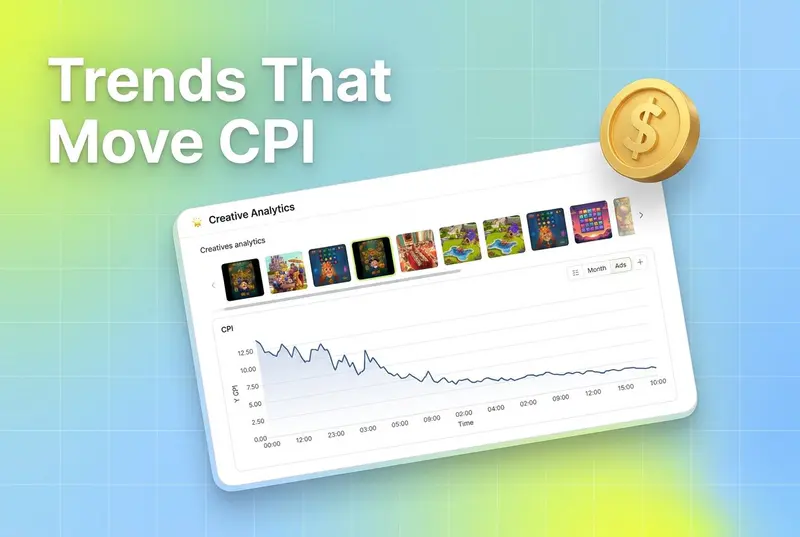
The creative trends moving CPI in 2026 are AI-native production at scale, longer-form ads (60+ seconds), faceless UGC, interactive end cards, native-first creative built per channel, and creator partnerships replacing in-house studios. Everything else, from "neuro-aesthetic micro-storytelling" to whatever the trade press calls it next quarter, is mostly noise. Segwise's creative tagging and fatigue tracking sit underneath all six trends because each one only works when you can see which elements are actually carrying the campaign.If you read every "trends" deck published between January and April this year, you would walk away believing that thirty different things are simultaneously revolutionizing performance creative. Some of them might be. Most of them are not.
The trends in this post are the ones that show up in spend data, in cost-per-install benchmarks, and in the working calendars of UA managers actually shipping ads at scale. They have proof behind them, not just LinkedIn slides. The ones we left out failed that test.
A note on framing. CPI is the headline metric, but everything below applies to ROAS, CPA, CAC, and any other downstream goal you care about. If a creative trend is genuinely moving CPI, it is almost always moving the funnel below it too. Mobile gaming has historically been the leading indicator for performance creative shifts, and Sensor Tower's ongoing creative trend research has tracked how character-led, narrative, and surprise-driven formats migrate from gaming into broader UA over time. The 2026 trends below follow the same pattern: most started in gaming and are now dominant across DTC, subscription, and fintech UA too.
Also read AI in Performance Creative: What's Working and What's Still Hype in 2026
Key takeaways
AI-native production has moved from novelty to default. Brands using AI-generated video creative report up to 47% higher CTR and 29% lower CPA, according to a 2025 Adweek deep-dive on AI UGC, with one footwear brand cutting production from 25 days to 36 minutes.
Longer-form ads are quietly winning on attention-priced surfaces. MNTN Research's 2025 CTV creative analysis found roughly equivalent attention rates across 15-, 30-, and 60-second cuts, killing the lazy "always go shorter" assumption.
Faceless UGC is not a workaround. It is a cost structure shift. Production at $5 to $10 per minute and avatar-led testimonials are passing the same FTC compliance bar as human creators, per Social Media Examiner's 2026 AI ad guide.
Interactive end cards and playables are now table-stakes on Unity, Moloco, Meta Audience Network, and most programmatic DSPs. Tappx's 2026 UA mix analysis shows playables filtering out low-intent installs and lifting downstream retention.
Native-first beats repurposed. Native creative on TikTok performs 40% to 60% better than recycled Meta content, and Andromeda-era Meta campaigns reward 8 to 15 distinct concepts per ad set, not minor variants of one.
Creator partnerships are eating studio budgets. 57% of marketers plan to increase creator-partnership spend in 2026, up from 48% the year prior, with partnership ads delivering 19% lower CPAs and 13% higher CTR than traditional brand ads on Meta.
Eric Seufert's "ad testing trap" thesis is the most important piece of context for anyone running creative in 2026. Mobile Dev Memo's 2025 essay on the creative flood explains why volume without measurement collapses your signal, not your CPI.
How we picked these six trends
A creative trend earns a spot on this list when it shows up in three places: meaningful CPI or ROAS movement in independent campaign data, sustained adoption across more than one ad network, and clear primary-source coverage from people who actually run paid media. We threw out anything that lived only in vendor decks, anything backed only by a single case study, and anything that showed up in 2024 trend reports and never converted into recurring spend.
The remaining filter is durability. Some trends from 2024, like vertical-only video and AI music beds, have already collapsed into baseline best practice. They are not "trends" anymore, they are just how you ship ads. The six below are the ones still actively shifting where the spend goes.
1. AI-native production at scale
The story for 2024 was "you can use AI to make ads." The story for 2026 is that almost everyone is, and the brands not doing it are paying a measurable creative-cost penalty.
Adweek's comprehensive 2025 audit of AI UGC and faceless content put hard numbers on the shift. Brands using AI-generated video report up to 47% higher click-through rates, 40% higher ROI, 29% reduction in cost-per-acquisition, and 72% higher ROAS for those layering AI on top of existing optimization. Production cost sits at roughly $5 to $10 per minute against $3,000 for a comparable studio shoot. One footwear advertiser cut production from 25 days to 36 minutes and reduced CPA by 27%.
Those are not single-vendor case studies. They are aggregated across multiple campaigns and platforms, and they explain why creative volume per advertiser has roughly tripled in the last 18 months on Meta alone.
The thing that has changed in 2026 specifically: AI-native production now means producing end-to-end with AI tools instead of using AI to fill gaps. A brand might generate the script with one model, the avatar with another, the b-roll with a third, and stitch in a real product clip at the end. The whole pipeline runs in a day. Social Media Examiner's 2026 podcast with Caleb Kruse framed Meta's stated goal bluntly: full automation of the media-buying cycle, where an advertiser enters a product URL, sets a budget, and lets the platform generate everything.
The catch is the one Eric Seufert keeps writing about: production volume goes up, but tagging discipline often does not. If you are shipping 80 AI variants a week without tagging the elements that actually carry performance, you are buying noise. This is the gap Segwise's creative tagging agent was built to close. Multimodal AI analyzes every video, audio, image, and text element across a creative and maps each tag to performance metrics. Without that layer, the AI volume play turns into a CPI-flat-but-budget-up trap.
2. Longer-form ads (60 seconds and up)
The 6-second hook era did not end. It just stopped being the whole story.
For most of 2023 and 2024, the dominant advice was "front-load everything, make it 15 seconds, retire fast." That advice still applies on attention-rationed surfaces like Reels and TikTok feed. But on YouTube, in-app rewarded placements, and increasingly on Meta's CTV inventory, longer videos are converting better in the metrics that matter most for LTV-sensitive advertisers.
The pattern is most visible in mobile gaming. Story-driven 60-second-plus ads, built around character arcs, gameplay reveals, and product reveals at the end, are pulling higher D7 retention and stronger payer conversion than truncated 15-second versions of the same concept. The reason is structural: longer ads filter for higher-intent viewers, and the platforms that reward completion (rewarded video, CTV, YouTube TrueView) compound that filter.
MNTN Research's 2025 analysis of CTV creative attention found roughly equivalent attention rates across 15-, 30-, and 60-second ads, which is the opposite of what most performance marketers assume. Attention does not collapse linearly with length. It collapses when content fails to hold it, regardless of length. That distinction kills the lazy "always go shorter" heuristic.
What you actually want, in 2026, is a length that matches the surface and the message. Use the longer cut for the surface that rewards completion. Use the shorter cut for feeds where the algorithm punishes any drop in completion rate.
The execution risk is creative fatigue accelerating fast on the longer cuts. A 60-second video has more failure points than a 15. When it goes stale, it goes stale dramatically. Catching that decline before it bleeds budget is exactly what Segwise's fatigue tracking exists for, and the difference between an early intervention and a late one is usually measured in five-figure spend.
3. Faceless UGC
This is the trend that gets the most pushback and produces the most ROAS. Both things are true.
Faceless UGC, video ads built around voiceover, screen recordings, AI avatars, stock visuals, and product footage without an on-camera human creator, has gone from a 2024 experiment to a 2026 staple. The economics are genuinely different. Adweek's audit pegged the production cost at $5 to $10 per minute versus $3,000 for a comparable studio shoot, with 75 AI-generated variants producible for the cost of one traditional spot.
The compliance picture also changed. The FTC's 2024 final rule on AI-generated reviews and testimonials made it clear that the same rules apply to AI personas as to paid human creators: fabricated first-person claims are prohibited either way. That settled the question of whether faceless UGC is "real" advertising. It is. The boundaries are the same as for human-led UGC.
Why faceless UGC works for performance marketers, in plain terms:
- It removes the bottleneck of finding, briefing, and shipping with creators on schedule.
- It can localize at scale. AI avatars dub into 100+ languages, which is decisive for global UA campaigns.
- It produces test variants in hours instead of weeks, which is the only way to keep up with Andromeda-era creative volume requirements.
- It strips the creator-personality variable out of the test, which makes element-level diagnosis easier.
The catch is that 52% of viewers are less engaged when they suspect content is AI-generated, per the same Adweek audit. The fix is not to hide AI usage, it is to combine AI scaffolding with real customer language, real product footage, and specific outcome claims. The faceless format that works in 2026 is not a synthetic person delivering a synthetic script. It is a synthetic delivery mechanism for verifiable customer truth.
Tagging is again where this either becomes a CPI machine or an expensive time-waster. With faceless UGC, the variables you are testing are voiceover style, hook line, b-roll selection, on-screen text, and CTA placement. If you tag those at the element level and tie tags to install and ROAS data, you can isolate what is actually driving the win. Without that, every test produces a winning ad and zero learning.
4. Interactive end cards and playable ads, everywhere
Playables used to be a mobile gaming format. They are not anymore.
Tappx's 2026 UA mix analysis framed the shift cleanly: interactive end cards (IECs) and HTML5 playables now run across Unity Ads, Moloco, Meta Audience Network, and most programmatic DSPs and SDK networks. A single well-built playable can scale across all of them with minor spec adjustments. The standard build is HTML5 plus JavaScript, 2 to 5 MB, 10 to 30 seconds of interaction, with a clear fast-loading end card.
The reason they earn budget is downstream user quality, not just clickthrough. As Tappx put it, playables filter out "accidental" or low-intent installs. Users who interact for 10+ seconds before installing convert at higher rates and retain longer. That shifts the unit economics, and it is why mobile gaming UA leads have been carving out playable budget for two years even when raw install costs were higher.
The 2026 expansion is into non-gaming verticals. Subscription apps, fintech, and even DTC brands are now using interactive end cards as the conversion-side closer after a video ad. The pattern is "video does the storytelling, interactive moment closes the loop." A small interaction (swipe, tap, scroll-to-reveal, mini-quiz) lifts conversion meaningfully versus a static install button.
The trade-offs are still real. Playables take longer to produce than a video. They require HTML5 dev work. Spec compliance varies by network and you have to optimize for fast load times. None of those reasons are fatal in 2026 because the production tooling has matured. But playables are not a "ship it Friday" format, and treating them like one is how teams burn three weeks on a build that loads in five seconds and crashes the install rate.
The measurement layer matters here too. Playables are notoriously hard to tag because the "creative" includes interaction logic, not just visual elements. This is exactly the gap Segwise was built to close, it is the only platform that tags playable (interactive) ads alongside video, audio, image, and text. Without that, playables become a black box that is either working or not, with no path to iterating on the elements actually carrying performance.
5. Native-first creative, built per channel
The single most expensive mistake of 2026 is repurposing creative across channels.
The data on this is unambiguous. Native creative built specifically for TikTok performs 40% to 60% better than recycled Meta content. The same direction holds in reverse: TikTok-native creative running on Meta typically underperforms Meta-native versions of the same concept. The reason is structural, not stylistic. Each platform's algorithm is now creative-first, and each platform rewards the format conventions of its own organic content.
For TikTok specifically, "native" means raw, fast-paced, hook in the first 2-3 seconds, vertical, with audio designed for sound-on viewing. Polished brand content underperforms by design.
For Meta in the post-Andromeda era, the rules are different. The Andromeda update completed its global rollout in October 2025, and the data since shows broad targeting now delivers 49% higher ROAS than lookalike targeting, with creative diversity (8 to 15 distinct concepts per ad set, not minor variants) emerging as the primary performance lever. A controlled test surfaced by performance marketing analysts found a single ad set with 25 diverse creatives producing 17% more conversions at 16% lower cost than a traditional 5-ad-set structure.
For YouTube, native means designed for the format you are buying: skippable in-stream needs a 5-second hook, bumpers need full-message-in-6-seconds, in-feed needs different pacing entirely.
The implication for production teams is uncomfortable. You cannot ship one master creative and call it cross-channel. You need a base concept and platform-specific cuts that respect each channel's organic conventions. That triples or quadruples the variant count, which is exactly why AI-native production (trend #1) and creator partnerships (trend #6) are growing in lockstep with this one. They are the only ways to keep up with the volume requirement.
The trap is producing channel-specific volume without channel-specific measurement. If you tag every variant the same way and pool the data, you lose the per-channel insight. The fix is unified creative analytics that preserves channel-level granularity while still allowing cross-platform comparison, which is what Segwise's cross-platform creative analytics dashboards across Meta, Google, TikTok, Snapchat, YouTube, AppLovin, Unity Ads, Mintegral, IronSource, and MMP integrations with AppsFlyer, Adjust, Branch, and Singular are designed to provide.
6. Creator partnerships replacing studios
The slowest trend on this list is also the most structural. Studios are losing creative budget to creator networks, and the gap is widening.
The most reliable number on this is the year-over-year shift in marketer intent. 57% of marketers plan to increase creator-partnership spend in 2026, up from 48% in 2025, the largest year-over-year focus increase of any ad format. Performance is part of the reason: industry research surfaced by Social Native and others reports partnership ads delivering 19% lower CPAs and 13% higher CTR than traditional brand ads, and 71% of consumers saying they make a purchase within days of seeing creator content on Meta surfaces.
The ad-spend math is also moving. The creator economy is projected to hit $37 billion in global ad spend in 2025, growing four times faster than the overall media industry. The delivery model has shifted from one-off sponsorships to ongoing partnerships, typically 2 to 4 videos per month per creator, with 45% of creators over 100K followers actively preferring long-term arrangements over single-spot work.
For UA managers, the operational implication is that the creator pipeline is now a production pipeline. You are not buying a Reel anymore. You are buying a recurring stream of native UGC at a rate that no in-house studio can match on cost per minute. The studio you used to brief is increasingly the post-production layer, not the producer.
The hard part is creative diagnosis at this volume. With 5 creators each shipping 3 videos a month, you have 15 new variants every 30 days, plus iterations. Identifying which hooks, props, voiceover styles, and CTAs are carrying ROAS without manual tagging is mathematically impossible at that pace. This is, again, exactly the workflow that automated creative tagging was built for.
If your creative pipeline produces more variants per week than one analyst can manually tag in a day, you are operating in the regime where automated tagging stops being a nice-to-have and becomes the only way the unit economics work.
Trends to ignore (signal vs hype)
Roughly two-thirds of what gets called a "creative trend" in 2026 trend reports does not move CPI in any measurable way. A partial list of things to deprioritize:
"Neuro-aesthetic" or "emotion-AI" optimization tools. Most are repackaged sentiment analysis with worse calibration than tagged performance data. The signal is in conversion behavior, not in inferred emotional response.
AI-generated music beds as a standalone trend. This is now baseline production, not a differentiator. Treat it like fonts.
"Anti-creative" or deliberately ugly aesthetics. Worked briefly on TikTok, has not transferred to Meta or YouTube, and creative-quality penalties on Andromeda hit it hard.
Hyper-personalization at the impression level. Genuinely useful for the largest 1% of advertisers with mature data infrastructure. For everyone else, the production cost outruns the lift.
Memes as a creative strategy. Memes work as one-off flares, not as a campaign engine. Treating them as a trend confuses tactical opportunism with structural advantage.
Avatar-led "AI influencers." The compliance bar is the same as for human creators (per the FTC), but the consumer skepticism penalty (52% lower engagement when AI is suspected) is steeper. Use AI for delivery layers like dubbing and b-roll generation, not as the personality.
VR or AR ad formats outside of platform-native placements. The reach is still too narrow. Worth watching, not worth budget.
Generative video tools as a competitive moat. They were a moat for about six months in 2024. Now they are utilities. Treat the advantage as the iteration speed, not the tool.
The pattern across all of these is the same: they are real techniques, but they do not move CPI for most advertisers. The six trends in the main list do.
What this all adds up to: the ad testing trap
The single most important framing for creative strategy in 2026 comes from Eric Seufert at Mobile Dev Memo. His October 2025 essay on the creative flood and the ad testing trap makes the argument that AI-native production has flipped the bottleneck. The constraint is no longer making the ads. It is testing them well.
In Seufert's framing, generative AI is deflationary for content production but inflationary for distribution. Every advertiser can now ship more variants per week than they could realistically test six months ago. The platforms reward this volume on the algorithmic side (Andromeda explicitly favors creative diversity), but the in-house testing infrastructure of most performance teams was not designed for it. The result is a "creative flood": more variants, less per-variant signal, more spend on ads that happened to win the auction without producing reusable creative learning.
The trap is treating ad volume as the metric and ignoring whether the testing infrastructure can actually attribute lift to creative elements. You can ship 80 AI variants a week and learn nothing. You can ship 20 well-tagged variants and learn something useful every week. The advertisers who win 2026 are the ones who close the measurement gap, not the ones who ship the most.
This is the spine running through every trend on this list. AI-native production needs tagging. Longer-form ads need fatigue tracking. Faceless UGC needs element-level diagnosis. Playables need interaction-aware tagging. Native-per-channel creative needs unified-but-channel-aware analytics. Creator partnerships need pipeline-grade diagnosis. The trends are real, the production cost-curves are real, but the measurement layer is what turns them into CPI-moving outcomes versus expensive content factories.
How to put this into practice
A practical sequence for a UA team building a 2026 creative engine, drawn from how the highest-performing teams we work with structure their pipeline:
Tag everything before you scale. If you cannot already see which hooks, CTAs, voiceover styles, characters, and visual treatments are driving installs, fix that first. Volume without tagging produces noise, not insight. This is the primary problem that the Creative Tagging Agent inside Segwise solves, and the reason teams using it report up to 20 hours saved per week per app or brand.
Build a base concept, then ship channel-native cuts. One master creative becomes 4 to 6 platform-specific variants, not one cross-channel deliverable.
Layer faceless UGC for volume, real-creator UGC for authority. The split most teams settle on is roughly 60% faceless or AI-native for testing and iteration, 40% creator-partnership content for evergreen winners.
Add an interactive end card or playable to every winning video concept. The lift on conversion is consistent enough that this should be a default, not a question.
Watch for fatigue continuously, not retrospectively. Set fatigue thresholds at the campaign level (e.g., 20% ROAS decline over 7 days) and let the system flag rather than waiting for weekly reviews.
Run a weekly creative-strategy review against tagged data, not raw performance. Asking "which hooks are working" is more useful than asking "which ads are working." The first generalizes. The second does not.
Bottom line
The six trends actually moving CPI in 2026 are AI-native production at scale, longer-form ads on attention-priced surfaces, faceless UGC, interactive end cards and playables across networks, native-first creative built per channel, and creator partnerships replacing in-house studios. What unites them is volume that breaks any creative team without an automated tagging and analytics layer underneath. The "creative flood" is real, the production tooling is mature, and the platforms are openly rewarding diversity at scale. The differentiation in 2026 is no longer who can ship the most ads. It is who can see which ads are actually working and turn that signal back into the next batch.
Segwise was built for exactly that loop. Multimodal AI tagging across video, audio, image, text, and playables. Fatigue tracking with custom thresholds. AI-powered creative generation grounded in your winning tags. Unified data across Meta, Google, TikTok, Snapchat, YouTube, AppLovin, Unity Ads, Mintegral, IronSource and MMPs (AppsFlyer, Adjust, Branch, Singular). The creative engine your trends list assumes you have.
Frequently Asked Questions
What creative trends are actually moving CPI in 2026?
The trends that consistently show up in independent campaign data are AI-native production at scale, longer-form 60-second-plus ads on attention-priced surfaces, faceless UGC, interactive end cards and playables across networks beyond gaming, native-first creative built per channel, and creator partnerships replacing in-house studio production. Most other "trends" in 2026 reports do not produce measurable CPI movement. Tools like Segwise, Smartly, and Madgicx focus on the measurement layer that makes any of these actually work at scale.
What does the "ad testing trap" mean for performance marketers?
The ad testing trap is Eric Seufert's framing, in his Mobile Dev Memo essay, of what happens when AI lets you ship far more creative variants than your testing infrastructure can attribute to. You produce volume but not learning. The fix is element-level tagging tied to performance metrics, which platforms like Segwise, Hawky, and Foreplay are built to provide.
How do I run AI-native production without losing CPI signal?
Tag every creative element before scaling volume. AI lets you ship 50 to 100 variants a week, but without tagging the hooks, CTAs, voiceover styles, characters, and visual treatments, you cannot tell which elements are carrying performance. Segwise's Creative Tagging Agent does this multimodally across video, audio, image, text, and playables, which is the layer most AI production stacks lack. Tools like Sett, Marpipe, and Smartly approach the same problem from different angles.
Are longer-form ads really better than 15-second cuts?
It depends on the surface. On attention-priced inventory like YouTube TrueView, CTV, and rewarded video, 60-second-plus ads with story-driven structure are pulling stronger downstream LTV than truncated versions. On feed-based inventory like Reels and TikTok For You, shorter cuts with front-loaded hooks still win. The rule is to match length to surface, not to default short or long. Creative analytics tools like Segwise, Smartly, and Triple Whale can compare per-format performance across the same concept.
Should I replace my in-house studio with creators?
Most performance teams are not replacing studios outright, they are restructuring the split. Faceless and AI-native production handles testing volume, creator partnerships handle evergreen and authority creative, and the in-house studio shifts toward post-production and brand work. 57% of marketers plan to increase creator-partnership spend in 2026, but the studio still owns brand consistency. Segwise, Pearpop, and Aspire each address different pieces of this stack.
Why are interactive end cards now mandatory in non-gaming verticals?
Because they shift unit economics. Interactive end cards filter out low-intent installs and lift conversion versus a static install button on the same video. The build cost is HTML5 plus JavaScript, 2 to 5 MB, 10 to 30 seconds of interaction. Subscription apps, fintech, and DTC brands have been adding them in 2026 as the closer on top of video ads. Segwise is the only platform that tags playable (interactive) ads at the element level, which Tappx, Unity, and Moloco rely on for their playable inventory.
What's the difference between AI-generated UGC and faceless UGC?
Faceless UGC is the broader category, ads with no on-camera human creator, which can be voiceover-plus-screen-recording, voiceover-plus-stock, or AI-avatar-led. AI-generated UGC is specifically when the persona delivering the message is synthetic. The compliance rules are identical (the FTC treats fabricated AI testimonials the same as fabricated human testimonials), but the consumer trust penalty is steeper for AI personas. Most 2026 winning faceless UGC blends real customer language and footage with synthetic delivery layers like dubbing or b-roll. Tools like Segwise, HeyGen, and Arcads each address different parts of the production-and-measurement stack.
How do I tell which trends are signal and which are hype?
Three filters: does it show up in independent campaign data (not vendor decks), is it being adopted across more than one ad network, and is there primary-source coverage from people running the spend. If a trend is only in trade press and only mentioned by a single vendor, treat it as hype. The six trends in this post passed all three filters. Most do not.