
Performance marketing is a feedback loop: you test, you learn, and you iterate. Yet, the biggest bottleneck in this loop remains the handoff between User Acquisition (UA) and Creative teams.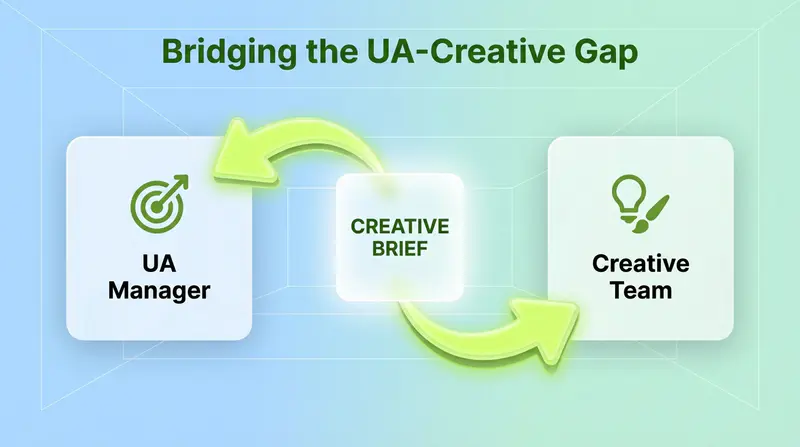
For elite creative strategists at top-tier performance agencies, the creative brief is not a bureaucratic formality; it is the most critical document for scaling and optimizing Return on Ad Spend (ROAS). It’s the artifact that translates raw campaign data into actionable, testable production hypotheses, ensuring that every asset produced has a high probability of success.
This guide breaks down the practitioner’s approach to building a data-driven creative brief, focusing on the strategic components that move the needle and how to leverage modern creative intelligence platforms to fuel them.
Key Takeaways
The Brief is a Hypotheses Document: An effective brief must be rooted in data and present a clear, testable hypothesis about a specific audience, hook, and creative element, not just a list of required assets.
The "Winning Hook" is the Core: Agency strategists prioritize defining the specific hook or key message, the first 3-5 seconds, that will capture the audience's attention and drive engagement.
Data Must Precede Concept: Before any ideation begins, the brief must clearly present why the previous concepts failed and which creative elements (visual style, CTA, emotion, audio) drove or killed performance.
Creative Fatigue Detection is a Briefing Signal: A proactive, automated warning of a sudden drop in a creative's performance signals the need for a new brief focused on refreshing or pivoting the core message, requiring proactive monitoring of metrics like Cost Per Install (CPI) and Click-Through Rate (CTR).
Automate Creative Intelligence: Manual data consolidation and tagging create bottlenecks. Tools that unify creative data from multiple ad networks and automatically tag winning and losing elements (like Segwise) are essential for rapid, data-backed brief generation.
Also read How a Creative Management Platform Helps in Scaling Ads
The Creative Brief: Bridging the UA-Creative Gap
A creative brief should function as the translator between two distinct languages: the quantitative language of the UA Manager (CPI, ROAS, LTV) and the qualitative language of the Creative Team (composition, visual style, narrative).
In a high-velocity agency environment, the brief's goal is singularity: to maximize the creative team’s output efficiency by reducing ambiguity and focusing production on elements with proven performance potential.
Why Standard Briefs Fail in Performance Marketing
Traditional creative briefs often fail in a performance context for a few key reasons:
Too Vague/Brand-Focused: They prioritize "brand feel" over performance mechanics, leaving the creative team guessing which hook or angle to use to generate clicks and conversions.
No Clear Hypothesis: They ask for "more concepts" rather than testing a specific, data-backed hypothesis (e.g., "Hypothesis: A 3-second hook showing character success will drive a 15% higher CTR than a hook showing the problem.")
Lack of Deconstructed Data: They summarize high-level campaign metrics but fail to deconstruct why the previous top-performing ad worked and why the failing ad tanked. This leaves the creative team unable to iterate effectively.
Deconstructing the Agency-Grade Creative Brief

Based on the frameworks used by successful agency strategists, an elite performance creative brief is broken down into specific, non-negotiable sections.
Section 1: The Performance Context & Problem Statement
This section grounds the creative team in the why and the what of the brief, using hard data.
The Goal: Clearly define the specific performance goal for this brief. Is it to lower CPI? Increase retention (D7 or D30)? Increase a specific custom conversion event?
The Audience: Go beyond simple demographics. Use insights from the ad network to identify the behavioral pain points, psychographics, and existing creative consumption patterns of the target audience.
The Data Pivot: State the performance problem clearly. Example: "Our previous top-performing asset (Creative ID 403A) has triggered an alert for Fatigue Detection, showing a 30% drop in ROAS over the last 7 days. The goal of this brief is to test a new hook and angle to replace its performance."
Section 2: The Winning Creative Hypothesis (The Core)
This is the most crucial section, moving from "what" to "how." A good hypothesis is specific, measurable, achievable, relevant, and time-bound (SMART).
According to an analysis of creative briefing best practices, top strategists focus their hypothesis on four key pillars:
1. The Hook (0–5 Seconds)
The hook is the creative element that dictates the entire performance of the ad, especially on short-form video platforms like Meta, TikTok, and YouTube Shorts. The brief must specify:
Type of Hook: What kind of opening are you testing? (e.g., "Problem/Solution," "POV Storytelling," "Testimonial," "Quick-Cut Montage").
Specific Action: What specific visual action or emotional beat should occur in the first three seconds? (e.g., "A user clearly failing at a task," "A rapid, satisfying product transformation," "A clear statement of scarcity/urgency.")
Inspiration: Provide a direct link to a competitor or past internal creative whose hook you are explicitly trying to copy, iterate on, or disprove.
2. The Angle/Narrative
This defines the core message or benefit statement that the creative will communicate. It's the reason the user should care.
The Value Proposition: Which specific feature or benefit is being tested? (e.g., Testing "Saves Time" vs. "Saves Money").
The Creative Angle: What is the overarching theme? (e.g., "Competitor Comparison Angle," "User-Generated Content (UGC) Mock Review Angle," "In-Game Gameplay Tutorial Angle").
3. Winning/Losing Element Mandates
This is where historical creative intelligence drives the new brief. Instead of guessing what to include, the strategist uses data to specify which elements must be included and which must be avoided.
Mandate (Winning Elements): Which elements have been proven to lift key metrics? (e.g., "Must feature the character 'Axel' in a victorious pose, as character-specific creatives consistently deliver 50% lower CPI," "Must use the 'Upbeat Indie' audio style, as our data shows it increases CVR by 20%.")
Prohibit (Losing Elements): Which elements are confirmed conversion killers or high-cost drivers? (e.g., "Do not use the color red in the background, as it has been tagged in all creatives with a CPI >$5," "Avoid long-form voiceovers; focus on on-screen text and music only.")
The strategist must also leverage Competitor Creative Tracking to inform mandates. If competitor analysis (using platforms like Segwise) reveals an oversaturated messaging angle, the brief must explicitly prohibit it. Conversely, if a competitor angle is performing well but your team hasn't tested it, it becomes a high-priority mandate.
Section 3: Data-Backed Production Inputs
The brief needs to eliminate ambiguity in the production phase.
Required Assets: (e.g., 3x 15-second videos, 2x statics, 1x playable ad).
Technical Specs: Aspect ratios, file types, text limits.
Call-to-Action (CTA): Specify the exact language and visual placement of the CTA to be tested (e.g., "Test 'Learn More' vs. 'Install Now' on the end card," "CTA must appear at the 8-second mark.")
Testing Protocol: Clearly state the A/B test structure. This ensures the creative team knows the production effort will be validated correctly (e.g., "Test Angle A vs. Angle B, holding Hook Type and CTA constant").
The Creative Intelligence Bottleneck: Why Agencies Need Automated Data
The most significant roadblock to creating a truly data-driven brief is the manual labor required to gather the necessary insights.
To specify a winning element like "character 'Axel' in a victorious pose" or to prohibit a "long-form voiceover," a strategist first needs to:
Consolidate performance data (ROAS, CTR, CPI) from Meta, TikTok, Google, and others.
Manually review every single creative asset.
Manually tag each asset with relevant elements (e.g., "Axel Character," "Victorious Pose," "Long Voiceover," "Red Background").
Map the performance metrics to those manual tags to identify trends.
This process is so time-consuming that most agencies revert to gut-feel briefs rather than data-backed briefs, slowing down iteration and scaling. This bottleneck is precisely why agencies and studios leverage creative intelligence platforms.
Segwise: Automating the Briefing Pipeline
An AI-powered creative analytics platform like Segwise is designed to solve this data-to-briefing challenge, allowing strategists to move from manual data collection to pure strategic execution.
Segwise achieves this by unifying creative data from all major ad networks-including Meta, Google, TikTok, Snapchat, YouTube, AppLovin, Unity Ads, Mintegral, and IronSource-and integrating with all major Mobile Measurement Partners (MMPs): AppsFlyer, Adjust, Branch, and Singular. This provides a single source of truth for all creative performance metrics.
Crucially, the platform uses Multimodal AI Analysis to automatically tag every element of the creative, including:
Video Analysis: Visual elements, scene changes, product shots, and visual styles.
Image Analysis: Colors, compositions, characters, products, emotions, and visual styles for static and end cards.
Audio Analysis: Transcribing spoken dialogue, identifying hook lines, voiceover styles, and audio emotional tone.
Text Analysis: Extracting and analyzing on-screen text, headlines, and benefit statements.
Playable Ads: Segwise is the only platform that tags playable (interactive) ads, which is critical for mobile gaming studios.
By automatically mapping these tags to key performance indicators (KPIs) like ROAS, retention, and CPI, the platform transforms raw data into actionable intelligence. A creative strategist can instantly generate a Tag-Level Report showing, for instance, that all creatives tagged with "Quick-Cut Montage Hook" are driving a 50% better ROAS than "POV Storytelling Hook." This insight moves directly into the brief as a non-negotiable mandate, halving the creative production time by eliminating trial-and-error.
The early detection of creative performance decline is also automated with Fatigue Detection, providing strategists with an early warning system that signals exactly when a new, data-backed brief needs to be created, preventing the significant loss of ad spend from quickly decaying assets.
Practical Steps: Writing Your Next Data-Driven Brief
For every new brief, follow this three-step methodology:
Step 1: Creative Audit and Element Identification
Isolate the Performance Delta: Identify the top 3 and bottom 3 creatives from the past 7-14 days.
Deconstruct Winning Elements: Use your creative intelligence platform to analyze the top performers. Look for patterns in the hook, the visual style, the CTA placement, and the audio type. Example: All winners use a 3-second 'fail-to-win' structure, a synth-pop background track, and a green end card.
Identify Conversion Killers: Analyze the bottom performers for shared elements. These become the Prohibit list in your brief. Example: All losers use a long voiceover and have the CTA appear after the 10-second mark.
Step 2: Formulate the Hypotheses and Angle
Define the Test Variable: Based on the audit, decide which single element you will pivot. Focus the brief around that pivot (e.g., "Test a new Hook against a proven Angle" or "Test a new Angle against a proven Hook").
Define the Specific Pivot: Translate the data into a new, testable creative angle or message. If the previous angle was "Save Time," the new one might be "Achieve Expert-Level Results with Zero Effort."
Write the SMART Hypothesis: Example: "We hypothesize that a new UGC Mock Review Angle, featuring a 'Slow Motion Fail' Hook, will lower CPI by 20% compared to the existing 'Product Demo Angle' by appealing to the validation-seeking audience segment."
Step 3: Production Mandates and Alignment
Finalize Mandates/Prohibits: Transfer the winning and losing elements directly into the brief's mandates. Do not allow deviation from these data-backed rules.
Define Deliverables and Protocol: Be explicit about the number of assets, required length, and the test name (e.g., "Tactic: Angle vs. Angle Test / V3").
Review with Creative Leads: The strategist must walk the creative lead through the Hook, Angle, Mandate sections, focusing on why the data dictated each choice, ensuring the creative team is aligned on the performance mechanics before any design work begins.
Conclusion
The data-driven creative brief is the secret weapon of high-velocity performance marketing agencies. It transitions the creative process from an art-driven guess to a science-backed experiment. By focusing on data-informed hypotheses, deconstructing past performance down to the element level, and clearly mandating winning and losing creative ingredients, strategists close the debilitating feedback loop between media spend and creative production.
The ability to create these briefs at scale rests entirely on the quality and speed of creative intelligence. If your team is still manually consolidating data and tagging video elements, you're experiencing a critical bottleneck in the production cycle. Want to see how multimodal AI tagging can reveal which creative elements drive your highest ROAS? Try Segwise for free to accelerate your creative iteration cycles.
Frequently Asked Questions
What is the most common mistake made in performance creative briefs?
The most common mistake is a lack of specificity, particularly in the Hook and Hypothesis sections. Many briefs simply ask for "a new video showing product benefits" without specifying which benefit to emphasize, which visual style performed best in the past, or what the specific test variable is. This forces the creative team to guess and slows down the feedback loop.
How often should a creative strategist generate a new brief?
Brief frequency should be dictated by data, not the calendar. A new brief is required when a current top-performing asset hits Creative Fatigue (a clear drop in metrics like ROAS or CPI), when there's a significant change in audience targeting (new geo or platform), or when Competitor Tracking reveals a major competitor launching a winning new angle that demands a response. Fatigue Detection is a key feature in creative intelligence platforms for triggering these briefs proactively.
Should the creative brief include budget details?
While a strategist should be aware of budget constraints, the brief itself typically focuses on the creative mandate and hypotheses. The UA Manager handles the media budget allocation and bid strategy. However, the brief should indirectly account for budget by mandating assets appropriate for the expected spend (e.g., a brief for a $50k/day campaign requires more iterations and variations than a $1k/day campaign).
What is a "Winning Element Mandate" in a creative brief?
A Winning Element Mandate is a non-negotiable instruction derived from historical creative analytics that requires the inclusion of a specific creative component (like a character, visual style, audio tone, or type of on-screen text) because that element has been automatically tagged and proven to drive superior performance (e.g., higher CTR, lower CPI) across past campaigns. This capability is directly powered by Tag-to-Metric Mapping (e.g., in Segwise), which shifts the brief from subjective preference to objective data.
How does AI-powered tagging help generate a better creative brief?
AI-powered creative tagging (like that used by Segwise's Multimodal AI) automatically analyzes the content of the ad-visuals, audio, text, and even playable ad interaction-and assigns performance tags. This eliminates the manual effort of categorization and directly maps every creative element to performance metrics (ROAS, retention). The strategist can instantly see which specific hook or emotion is driving results, allowing them to include data-backed mandates in the brief in minutes, not days.