Creative Workflow Tools: Best Magicbrief Alternatives to Scale

Are you spending hours organizing creatives, chasing feedback, and still feeling unsure about which ideas work?
When your entire user acquisition engine depends on fast, high-quality creative output, the wrong workflow tool doesn’t just slow you down; it costs you installs, revenue, and your chance to hit monthly targets. And the bigger your portfolio gets, the harder it becomes to keep creative production, testing, and iteration from slipping into chaos.
If you’ve been using Magicbrief and feel it’s not keeping up with the demands of UA for mobile games, DTC brands, subscription apps, or agency clients, this guide is for you. This blog covers why Magicbrief falls short for performance-focused teams and the best alternatives that help you move faster, stay organized, and build creatives that actually drive growth.
Why You Need a Creative Workflow Tool
A creative workflow tool is a system that helps you organize your ads, manage feedback, track versions, and move creatives from idea → production → testing without losing speed. It keeps your team aligned and your assets structured so you can hit your UA goals. In short, it gives you a clean, repeatable process for producing, analyzing, and iterating creatives across all your channels.
Here are the biggest reasons you need a strong creative workflow tool:
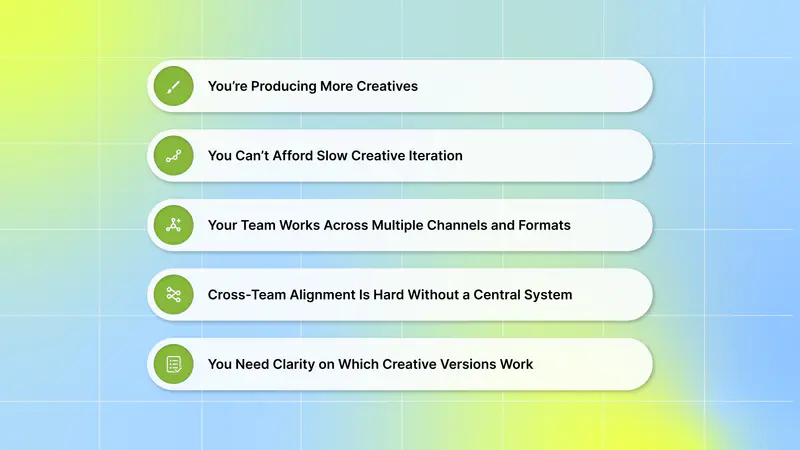
1. You’re Producing More Creatives
As a UA manager or creative lead, you are expected to launch dozens, sometimes hundreds, of variations each month. Without a workflow tool, you lose time searching for files, tracking changes, or figuring out which version is final. A tool keeps everything labeled, organized, and easy to find.
2. You Can’t Afford Slow Creative Iteration
Your best campaigns fatigue fast, especially in mobile gaming, DTC, and subscription apps. If your workflow slows down, your CPAs rise, and your ROAS drops. A proper system helps you move from idea to new variation quickly, so you can refresh ads before performance falls.
3. Your Team Works Across Multiple Channels and Formats
Each ad network favors different styles, formats, and creative angles. Without a centralized system, it becomes difficult to track what was built for Meta vs TikTok vs Google, how each version performs, and which ideas should be adapted for other channels.
A workflow tool keeps your creative brief organized across channels so your team can stay consistent, move faster, and avoid recreating assets from scratch.
4. Cross-Team Alignment Is Hard Without a Central System
When the UA, growth, and creative teams don’t have a single place to review assets and understand what’s working, communication breaks down quickly. You end up with scattered messages, unclear priorities, and creative decisions made without performance context.
A workflow tool brings structure by giving everyone a shared view of creative progress, the “why” behind each iteration, and what needs to happen next.
5. You Need Clarity on Which Creative Versions Work
Without organized reports, you lose visibility into:
Which hook actually improved CTR?
Which visual lowered CPI?
Which storyline lifted IPM?
Which layout delivered better retention?
A structured workflow lets you trace performance back to creative decisions, so you know exactly what to scale next.
Once you know why a strong workflow system matters, the next step is looking at what Magicbrief is and where it struggles.
What Is Magicbrief, and Where It Falls Short?

Magicbrief is a creative analytics, research, and briefing tool designed to turn messy ad data into clear creative direction. It helps you understand which creative elements perform well, track competitor ads, and create structured briefs your creative team can act on. It aims to bridge the gap between media buyers and creative teams by giving everyone a shared place to analyze insights and plan new ads.
Magicbrief includes a few helpful creative workflow and inspiration features, such as:
1. Creative Analytics: Magicbrief highlights which creative elements are performing above or below average. It helps you understand what’s working so you can make more confident creative decisions.
2. Creative Research & Competitor Tracking: You can follow any brand to see what ads they’re running, how often they’re creating new creatives, and which themes or hooks they use. Magicbrief also offers AI competitor summaries to help you stay updated without doing manual checks.
3. Creative Briefs: Magicbrief includes a complete briefing system where you can organize references, performance insights, templates, and feedback. This helps reduce back-and-forth between UA and creative teams.
4. Automatic Slack Reporting: You get automated performance summaries and competitor updates sent directly to Slack, making it easier to keep your team aligned without constant manual reporting.
5. Streamlined production: Manage your pipeline in one place for more efficient content production.
Where Magicbrief Falls Short
Magicbrief gives you helpful creative insights and research tools, but when you’re responsible for scaling campaigns across Meta, TikTok, Google, Snapchat, and multiple apps or clients, you need deeper, more performance-driven capabilities. Here are the areas where Magicbrief falls short for user acquisition teams.
1. No Deep Integration With UA Performance Data Across Networks
Magicbrief only pulls performance data from Meta, TikTok, YouTube, and LinkedIn. It does not integrate with:
Google Ads
Snapchat
DSPs
MMPs (Appsflyer, Adjust, Singular, Kochava)
CDPs (Segment, mParticle, Bloomreach)
This means you can’t see a unified picture of how your creatives perform across these channels. For growth teams running multi-network campaigns, this is a major limitation because you can’t map creative decisions across channels.
2. No Automated Creative Tagging at Element Level
Performance teams often need high-resolution tagging (e.g., hooks, characters, colors, audio cues) tied to results. Magicbrief’s inspiration and workflow tools don’t provide automated multimodal tagging based on tag-level performance data.
3. No Creative Fatigue Tracking or Performance Alerts
Magicbrief doesn’t detect when a creative begins to fatigue, and it doesn’t send proactive alerts that help you protect yourbudget.
For UA teams who scale aggressively and rely on early signals, you might catch performance issues only after wasting spend.
4. Offer Visual Reports
Magicbrief offers visual creative reports, but you cannot map insights to different stages of your funnel. This makes it harder for UA managers, creative leads, or agency directors to package insights to fit their internal workflows or client expectations.
5. No Playable Ad Tagging or Insights
If you’re in mobile gaming or subscription apps, playable ads are a core part of your pipeline. Magicbrief does not tag playable elements. This leaves a major gap for teams relying heavily on playable ads to improve IPM, ROAS, and scale on networks like AppLovin, Unity, and Mintegral.
Now that you know where Magicbrief falls short, it’s essential to look at tools that fill those gaps more effectively.
Also Read: Why Playable Ads Are Dominating Mobile UA And How You Can Win Big
Top 5 Alternatives to Magicbrief
If you want faster production, clearer insights, and smarter creative decisions, several tools offer capabilities that exceed Magicbrief's. Here are the top alternatives that help you organize, analyze, and scale your creatives with far more efficiency:
1. Segwise

Segwise is an AI-powered creative analytics and generation platform that helps UA and performance marketing teams understand which creative elements drive performance. It connects creative elements (hooks, dialogs, visuals, formats, etc.) directly to business outcomes (ROAS, CPA/CPI, LTV, IPM, conversion rates), so teams stop guessing what works and start scaling creatives with data-backed confidence.
Key Features
1. Tag-Level Creative Element Mapping: See which specific creative elements drive performance. With this, you can instantly see which creative elements, themes, and formats drive results across all your campaigns and apps.
2. Custom Dashboards and Reporting: Build dashboards around your specific KPIs and stakeholder needs. Create automated reports that show how creative decisions impact ROAS across all your apps and campaigns.
3. Studio View for Multiple Projects: Manage creative analytics for multiple apps, games, or brands from one unified interface. Switch between projects instantly while maintaining consistent performance tracking across your entire portfolio.
4. Creative Fatigue Detection: Automated monitoring detects a continuous decline in performance metrics and spend share using internal logic. Catch fatigue before it impacts your budget allocation and campaign results.
5. Playable Ad Tagging and Analysis: The only platform that tags playable ad elements and interactive components.
6. Creative intelligence-driven generation: Auto-generate new ad creative variations using creative elements that drive performance identified through your creative insights.
How Segwise Is the Best Magicbrief Alternative
Segwise integrates performance data across all major networks, MMPs, and CDPs, offers full automated creative tagging mapped to ROAS/CPI/IPM/LTV, and provides creative fatigue tracking, playable ad tagging, and custom dashboards, none of which Magicbrief offers. With Segwise, you get a complete creative intelligence system designed for UA performance, giving you clarity on what works, why it works, and what to build next.
Limitation
Pricing and enterprise terms are usually delivered via demo and custom quote, which adds procurement steps for teams looking for a simple, self-serve sign-up.
In short, no other platform offers Segwise’s level of creative intelligence. With full MMP + network integration and playable tagging, it gives UA teams unmatched visibility into what drives performance and how to scale it. For teams who want data-backed creative decisions, not guesswork, Segwise stands far ahead as the strongest MagicBrief alternative.
2. Bestever

Bestever is an AI-powered ad creation and catalog-based video generation platform that helps you produce high-performing ads at scale. Instead of guessing what to make, Bestever uses AI to turn your product catalog, prompts, or competitor learnings into ready-to-launch video ads.
Key Features
1. AI Catalog Ad Generation: Bestever automatically generates personalized, on-brand creative variations using your product catalog. This allows you to produce fresh, channel-ready ads every day without manual editing.
2. Video Ad Generation at Scale: You can paste a product URL and instantly get multiple video ads for Meta, TikTok, LinkedIn, and other channels. The platform builds your catalog, designs variations, and outputs polished videos for UA testing.
3. Competitor Ad Analysis at Scale: Bestever breaks down your competitors ads, identifies what’s working for them, and uses those learnings to create new variations for your product. This gives you a shortcut to industry-validated concepts and helps you stay ahead without spending hours in ad libraries.
Why Bestever Is a Better Alternative
Bestever offers deeper AI-powered creative production capabilities than Magicbrief. While Magicbrief focuses mostly on research and creative briefs, Bestever actually creates high-performing video ads for you at scale, generates personalized catalog ads, analyzes competitor creative strategies, and turns prompts into ready-to-launch videos.
Limitation
Even though Bestever excels at creative production, it mainly targets catalog-heavy e-commerce brands, not gaming studios, subscription apps, or agencies managing multiple channels and attribution sources. Its focus is on generating ads rather than analyzing tag-level creative performance.
3. Omneky

Omneky is an AI-powered creative production and optimization platform that helps brands scale ad creation across channels in minutes. It combines generative AI, creative analytics, and automated workflows to produce high-performing image and video ads at scale.
Key Features
1. Smart Ad Studio for Fast Production: It automatically generates on-brand ad variations using proven creative insights. Teams can refine visuals, messaging, and concepts in seconds without manual design work.
2. Creative Analytics for Optimization: It consolidates campaign insights and highlights what’s working across platforms. With AI-driven trend detection, teams can make faster, data-backed creative decisions.
3. Creative Brief Builder & Ad Approval Hub: The platform includes tools to unify creative guidelines, performance insights, and workflows. Teams can manage approvals, tag assets, and centralize feedback to speed up production cycles.
Why Omneky Is a Better Alternative to Magicbrief
Omneky goes beyond creative organization by offering full-scale AI ad generation, product visualization, and creative optimization, areas where Magicbrief lacks depth. While Magicbrief focuses on research and basic briefing, Omneky delivers automated production, analytics, and brand-level creative scaling.
Limitation
However, Omneky is primarily built for fast creative production and lacks deep tag-level element mapping or attribution-integrated insights that some performance teams require.
4. Foreplay

Foreplay is a creative workflow and ad inspiration platform designed for performance marketers, media buyers, and creative teams. It helps teams collect ads from any platform, analyze competitor strategies, build briefs, and streamline the entire creative production cycle.
Key Features
1. Swipe File Builder for Instant Creative Inspiration: Foreplay lets users save ads from Meta, TikTok, LinkedIn, and more directly into organized swipe files. This helps creative teams quickly gather references and structure creative ideas without manual tracking.
2. Smart Search Engine for Deep Creative Discovery: Foreplay’s AI-powered search lets users discover ads by keywords, brand, product category, creative themes, pacing, hooks, or performance signals. This dramatically improves research efficiency compared to manual creative exploration.
3. Collaboration & Sharing Tools: Foreplay makes it simple to build moodboards, share creative insights, and present performance reports. It keeps everyone aligned in one workspace.
Why Foreplay Is a Better Alternative to MagicBrief
Foreplay delivers a far more comprehensive creative workflow ecosystem combining ad discovery, competitive tracking, storyboarding, and collaboration in one place. Unlike MagicBrief, which focuses mainly on organizing ads and basic brief creation, Foreplay provides deeper market intelligence, automated insights, and tools built specifically for performance-driven creative teams who need speed and strategic clarity.
Limitation
However, Foreplay does not fetch or integrate performance data from MMPs. This creates a gap for performance teams who rely on attribution-level insights to make creative decisions.
5. Singular (Creative IQ)

Singular’s Creative IQ is a performance-focused creative analytics platform that helps growth teams identify which creative elements drive results across campaigns. It combines attribution, creative tagging, and ROI reporting into a unified system, allowing marketers to analyze creative efficiency.
Key Features
1. Visual Creative Reporting (Creative Gallery): Creative IQ provides a visual gallery where videos, images, and creatives are displayed alongside KPIs like CTR, CVR, and ROAS. Teams can quickly compare winning vs. underperforming assets and visually understand what trends are emerging across channels.
2. AI-Powered Creative Tagging: Singular automatically tags creatives based on attributes such as colors, scenes, characters, branding, call-to-action, and more. This enables deeper insight into which creative elements correlate with results and allows for advanced filtering and pattern discovery.
3. Custom Reporting & Dimensions: Users can build customized reports with their own dimensions, such as campaign strategy, audience type, creative category, or funnel stage. This helps teams align creative insights with business-specific KPIs and reporting structures.
Why Singular (Creative IQ) Is a Better Alternative to MagicBrief
Singular offers far more advanced creative analytics capabilities. It combines multi-channel attribution, granular creative tagging, and customizable ROI-driven reporting, giving UA teams actual performance intelligence rather than surface-level inspiration.
Limitation
However, Creative IQ is primarily built as an analytics extension of Singular’s MMP and marketing analytics suite, which means its creative intelligence is less specialized. It also lacks advanced creative-element mapping and does not offer playable-ad–specific tagging features.
Also Read: Segwise vs Bestever: Which Tool Is Right for You?
Conclusion
The right creative workflow tool is essential when your UA performance depends on fast production, clear organization, and reliable creative insights. Magicbrief is helpful for inspiration and basic briefing, but it doesn’t provide the deeper performance tracking, automated tagging, or multi-channel visibility that modern UA teams need. The alternatives highlighted above offer stronger options for creative analysis, workflow management, and scalable production.
If you are looking for the best alternative, Segwise stands out as the strongest choice. It unifies all your creative, performance, and attribution data so you can instantly see which ads, elements, and concepts drive real revenue, not just clicks. From automated tagging to tag-level creative element mapping, it gives your team everything needed to scale winning creatives with confidence.
Here are the key reasons why Segwise beats all other alternatives:
Instantly see which hooks, dialogues, visuals, themes, and formats drive ROAS, CPI, IPM, and LTV across every campaign and channel.
Detects performance decline early and sends proactive alerts so you can refresh creatives before results drop.
The only platform that tags and analyzes interactive playable components critical for gaming and app UA teams.
Build dashboards for your KPIs and automate reports for teams, stakeholders, or clients.
Free tools include a free Video-to-Playable Converter tool to help you analyze creatives and build playables without extra cost.
So, are you ready to see which creative elements truly drive performance? Start your free trial now!
FAQs
1. Are creative workflow tools helpful for agencies managing multiple clients?
Yes. They help consolidate creative insights, maintain consistency across projects, and automate reporting, which is crucial when juggling multiple campaigns and stakeholders across clients.
2. Can creative workflow tools help with fatigue detection?
Some advanced platforms include fatigue tracking, alerting you when an ad’s performance begins to decline so you can refresh assets before spend efficiency drops, a major advantage over basic tools.
3. Can creative workflow tools integrate with other marketing systems?
Many tools can integrate with analytics platforms, MMPs, CRMs, and project management systems to help you combine creative insights with broader campaign data. Integration support varies by tool and plan.