
The landscape of performance marketing is a relentless race, and Google Ads, with its vast ecosystem encompassing YouTube, Performance Max (PMax), Display, Shopping, and Discovery formats, is evolving at breakneck speed. For user acquisition (UA) managers, creative teams, and growth leaders, understanding why a particular creative succeeds or fails, and then acting on that insight, shouldn't be a days-long manual slog. Yet, for many, it still is.
Enter Artificial Intelligence (AI). In 2026, AI is no longer a futuristic concept but a foundational technology reshaping how we analyze, generate, and optimize advertising creatives on platforms like Google Ads. It promises to transform every creative asset into a data point, every pattern into a playbook, and every win into a repeatable, scalable formula.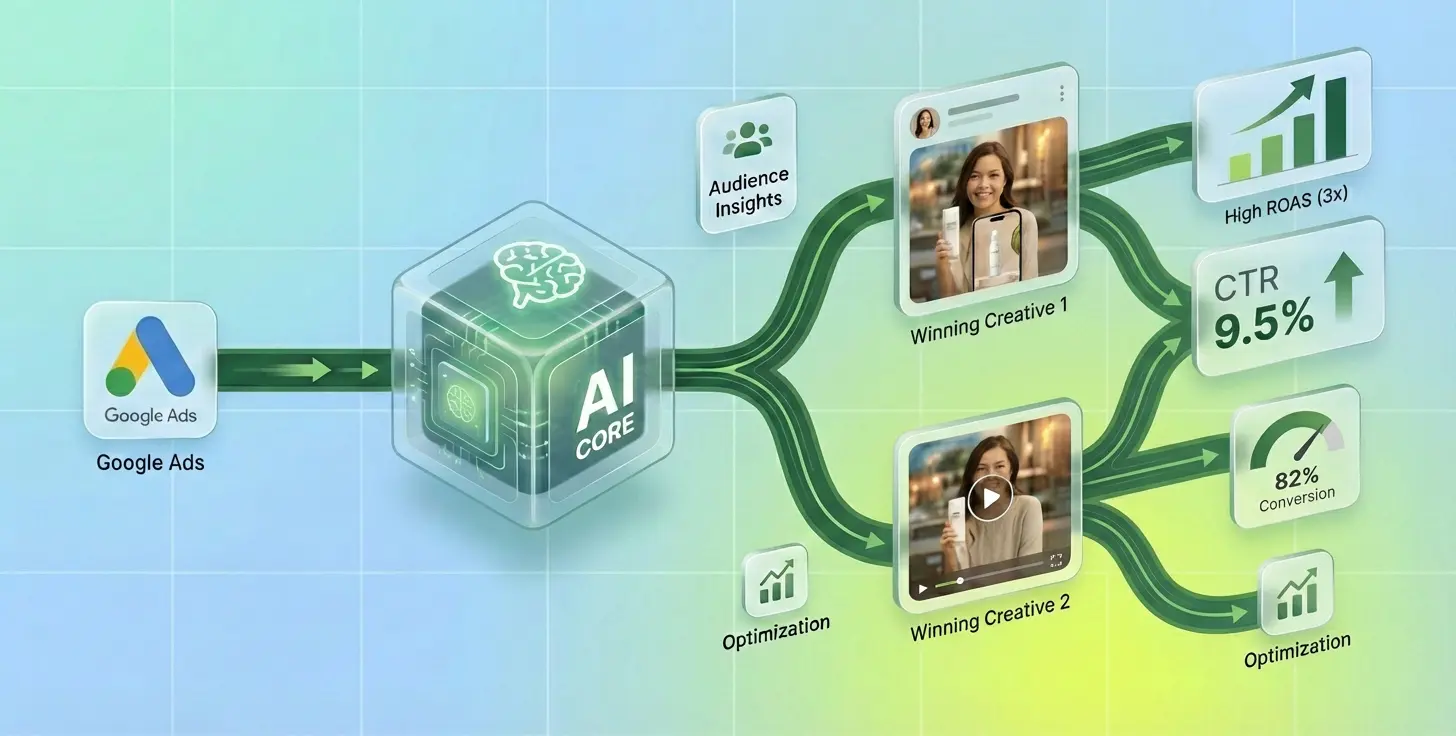
TL;DR / Key Takeaways
Google Ads in 2026 is AI-first: Expect even more sophisticated AI-driven automation, especially with Smart Bidding and the continued evolution of Performance Max (which we anticipate will resemble a 'PMax 2.0' in feature set), emphasizing AI-driven creative variations and transparency.
Manual creative analysis is unsustainable: Manually tagging, analyzing, and iterating on diverse Google Ads creatives is time-consuming, prone to bias, and fails to scale, leading to creative fatigue and suboptimal ROAS.
AI provides deep creative intelligence: AI visually and auditorily analyzes creatives, auto-tagging elements like CTAs, colors, product placements, and emotional tones, then connects these elements directly to performance metrics like ROAS.
Generative AI streamlines creative production: AI tools can automatically generate new ad copy, headlines, images, and videos based on proven patterns and performance data, significantly accelerating creative iteration cycles.
Benefits are measurable and significant: AI-powered creative insights lead to increased efficiency, faster creative testing, reduced wasted ad spend, improved ROAS, and enhanced personalization at scale.
Human oversight remains crucial: While AI automates repetitive tasks and provides data, human strategy, creative intuition, and ethical considerations are still essential for success.
The Google Ads Creative Conundrum: Why Manual Analysis Falls Short
The modern Google Ads ecosystem is remarkably complex, featuring a diverse array of ad formats. From engaging YouTube video ads and the all-encompassing Performance Max campaigns to dynamic display banners, responsive creatives, and specialized Shopping and Discovery formats, marketers are constantly challenged to create compelling content across multiple touchpoints.
However, the sheer volume and diversity of these creatives present a significant hurdle for traditional analysis. Marketers often grapple with fundamental questions:
Why did this specific creative variant outperform others?
Which visual elements or hooks resonated most with a particular audience segment?
Did a "price" hook or a "pain point" hook drive higher conversion rates?
How did a creative's performance differ across mobile versus desktop?
Answering these questions manually is an exhaustive, labor-intensive process. It involves sifting through vast amounts of data, manually categorizing creative elements, and attempting to correlate them with performance metrics. a task that is not only time-consuming and susceptible to human bias but also inherently unscalable. This often results in delayed insights, missed opportunities, and the costly impact of creative fatigue, where ad performance declines due to overexposure or lack of fresh ideas.
How AI Revolutionizes Creative Insights for Google Ads
In 2026, AI offers a powerful antidote to the manual creative conundrum, fundamentally transforming how marketers gain insights and optimize their Google Ads campaigns.
AI-Powered Visual and Audio Analysis
The cornerstone of AI-powered creative insights is its ability to "understand" creative content at a granular level. Advanced multimodal AI goes beyond simple metrics, analyzing the actual content of ads:
Frame-by-frame video analysis: For YouTube and Performance Max video assets, AI can analyze visual elements in every frame, detecting scene changes, on-screen text, product shots, and overall visual styles.
Auto-tagging of elements: AI automatically tags specific creative components such as Calls-to-Action (CTAs), dominant colors, layout structures, product placements, emotional tones, and ad formats. This process turns every creative asset into a quantifiable data point.
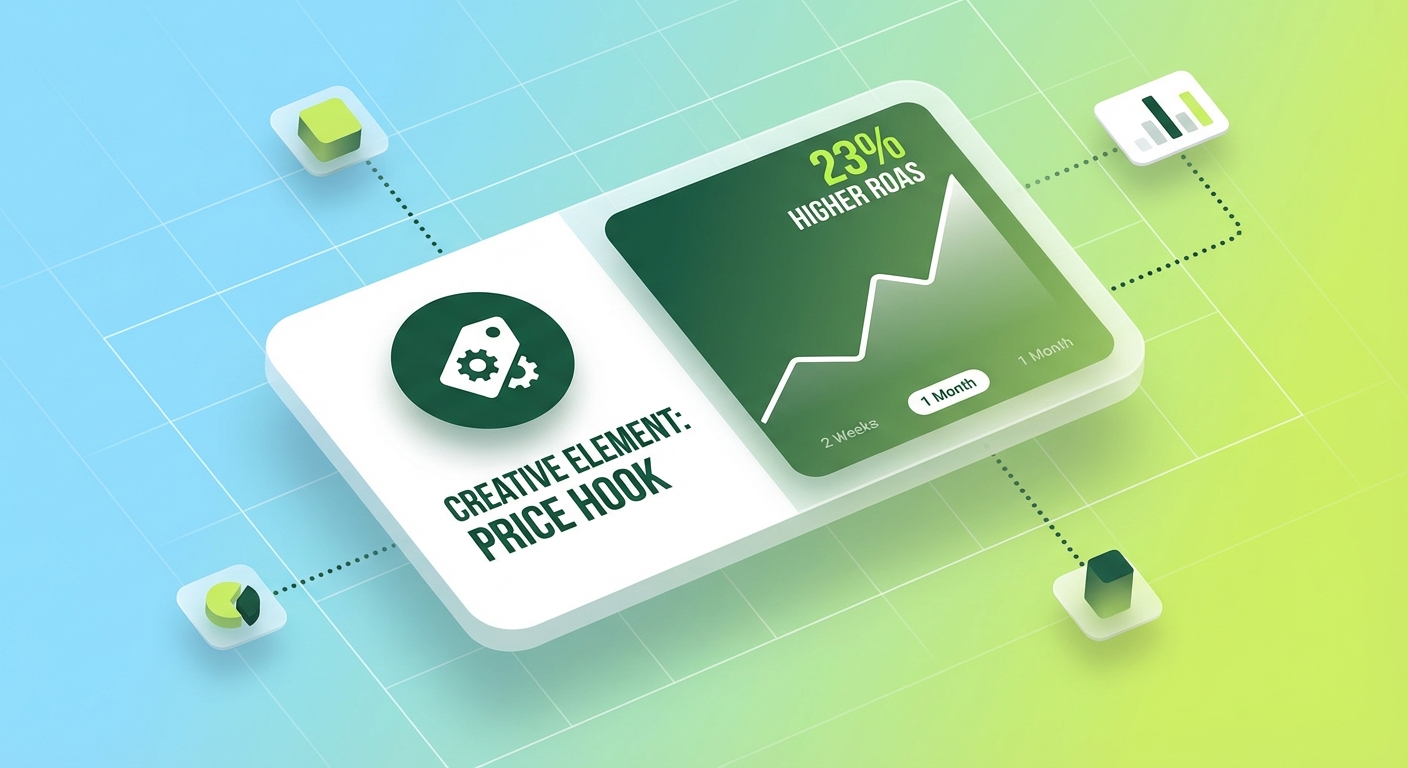
Surfacing performance patterns: By correlating these tagged elements with backend attribution data (like ROAS and conversions), AI can surface actionable patterns. For example, it might reveal that "Price + product in the first 2 seconds = 23% higher ROAS" for a specific audience segment. This level of insight is virtually impossible to achieve manually.

Connecting Creative Elements to ROAS and Conversion Data
One of the most critical breakthroughs is AI's ability to directly link specific creative elements to key performance indicators (KPIs) like Return on Ad Spend (ROAS), Cost Per Install (CPI), or conversion rates. While traditional analytics tools track campaign metrics, AI-powered platforms provide creative-level intelligence, showing which hooks, CTAs, characters, or visual styles are actually driving business outcomes. This unified view, combining creative data from ad networks with attribution data from Mobile Measurement Partners (MMPs), provides a holistic understanding of creative effectiveness.
Audience and Sentiment Mining for Creative Angles
Beyond analyzing your own creatives, AI can extend its intelligence to understand your competitive landscape. It can scan competitor ads to extract successful visual and messaging angles. By applying the same multimodal AI tagging to these competitor creatives, marketers can identify oversaturated messaging and white-space opportunities in the market.
AI-Driven Creative Generation and Iteration
Perhaps the most impactful application for efficiency, AI is now actively involved in creative generation. Leveraging insights from top-performing elements, AI can:
Generate new creative variations: Platforms can automatically produce multiple versions of YouTube or Display ads, including copy, images, headlines, and CTAs, informed by data-backed winning patterns.
Accelerate testing cycles: With rapid generation, marketers can test more creative variations faster, quickly identifying winners and scaling them across campaigns.
Ensure brand consistency: Despite automation, AI tools can be configured to adhere to brand guidelines, delivering ready-to-launch creatives that are both performance-optimized and on-brand.
Google's own AI, including Gemini-powered tools, is increasingly taking over creative generation, from refining ad copy to creating images and videos, auto-optimizing them based on user behavior in real-time. This shift allows advertisers to input basic goals and assets, with Google's AI handling placements, bidding, creative testing, and targeting across its vast network.
Measurable Benefits: The Impact of AI on Google Ads Creative Performance

The integration of AI into Google Ads creative insights yields tangible benefits for performance marketers:
Faster Creative Testing Cycles: By automating analysis and generation, AI allows teams to test new creative hypotheses and launch variations much faster. This rapid iteration significantly shortens the feedback loop, enabling quicker identification of winning elements and more agile campaign adjustments.
Reduced Wasted Ad Spend & Improved ROAS: Early detection of creative fatigue and precise identification of underperforming elements prevent sustained budget allocation to ineffective ads. Conversely, rapidly scaling high-performing creatives based on data-backed insights can lead to significant ROAS improvements. For instance, a privacy-first SaaS company scaled YouTube ads by 2x with a lower Customer Acquisition Cost (CAC) by using AI to identify top-performing creator types and messaging.
Data-Backed Creative Production Velocity: Creative teams receive clear, quantifiable insights into what works, allowing them to produce new assets with higher confidence. AI-powered creative generation can halve production time and produce numerous data-backed iterations quickly, overcoming production bottlenecks.
Enhanced Personalization at Scale: AI analyzes user behavior and preferences to deliver highly tailored ads, increasing engagement and conversion rates. This level of personalization, previously unfeasible with manual processes, is now achievable at scale.
Enhanced Team Alignment: With a single source of truth for creative performance, UA managers, creative teams, and growth leaders can collaborate more effectively. Data-driven creative briefs replace assumptions, fostering a shared understanding of success metrics and driving collective accountability.
"See Problems Before They Hit": AI spots pattern changes in creative performance, audience behavior, and market movements weeks before humans might. Platforms with proprietary algorithms (like Segwise’s Automated Fatigue Detection) are designed to flag performance decline early, enabling marketers to address issues proactively rather than reactively, saving budget and performance.
Implementing AI for Google Ads Creative Insights: Key Considerations
Adopting AI for creative insights isn't just about flipping a switch; it requires strategic implementation:
Seamless Integration: Choose platforms that offer robust, no-code integrations with your Google Ads account and other essential tools like Mobile Measurement Partners (MMPs: AppsFlyer, Adjust, Branch, Singular). This ensures a unified view of creative performance and attribution.
Historical Data Analysis: Leverage platforms that can import and analyze historical data (e.g., up to 90 days) to establish baselines, identify long-term trends, and train AI models effectively from day one.
Custom Tagging and Reporting: While AI automates much of the tagging, the ability to define custom tags relevant to your brand, campaigns, or specific creative elements is crucial for deep, business-specific insights. Custom dashboards and scheduled reports keep stakeholders informed.
Cross-Platform Creative Intelligence: While Google Ads is a critical channel, an ideal solution offers insights across multiple ad networks (Meta, TikTok, Snapchat, etc.). This holistic view allows you to identify winning creative elements that transcend platforms, improving overall performance marketing strategy.
Human-in-the-Loop Strategy: AI is a powerful tool, but it doesn't replace human creativity, strategy, or intuition. The most effective approach combines AI's analytical prowess with human strategic oversight, ensuring that creative output aligns with brand values and nuanced market understanding. Marketers must provide strong inputs, focus on data quality, and train their teams on AI-first tools.
If you're looking to unify your creative data across all major ad networks and MMPs, and automatically tag creative elements using multimodal AI (including the unique ability to tag playable ads, which is critical for mobile gaming studios and a key differentiator in the creative intelligence space), platforms like Segwise offer a powerful solution. Segwise provides creative-level intelligence, revealing exactly which elements drive performance and which don't, helping teams make data-driven creative decisions that save time and reduce wasted ad spend.
Also see How AI Creative Insights Drive Hyper-Personalization in DTC
Conclusion
The evolution of Google Ads in 2026 is undeniably tied to the advancements in AI. Automating creative insights is no longer a luxury but a necessity for performance marketers aiming for superior ROAS and sustained growth. By embracing AI-powered creative intelligence, teams can move beyond manual guesswork, gain unprecedented clarity into why their ads perform, and accelerate their creative iteration cycles. This shift empowers marketers to allocate resources more strategically, produce high-performing creatives faster, and maintain a competitive edge in an increasingly automated and data-driven advertising landscape.
Want to see how multimodal AI tagging and unified creative analytics can transform your Google Ads creative strategy and boost your ROAS? Explore how Segwise's AI-powered creative intelligence platform can save your team up to 20 hours per week by providing actionable insights across Meta, Google, TikTok, and more.
Also read how Segwise helps with Cross-Platform Ad Campaign Management: Meta, Google, TikTok & DSPs
Frequently Asked Questions
What kind of Google Ads creatives can AI analyze?
AI can analyze a wide range of Google Ads creative types, including YouTube video ads, Performance Max video and image assets, display banners, responsive display ads, and even shopping ad visuals. Multimodal AI can process video (frame-by-frame), images, audio, and on-screen text to extract actionable insights.
How does AI connect creative elements to ROAS?
AI platforms integrate directly with your Google Ads account and backend attribution data from MMPs. They automatically tag specific creative elements (e.g., CTAs, colors, themes, emotional tones) within your ads and then correlate these tags with performance metrics like ROAS, CPI, and conversions, revealing which elements drive the best outcomes.
Is AI creative generation reliable for brand guidelines?
Yes, AI-powered creative generation tools are designed to be configured with your brand guidelines. You can input your brand's style guides, logos, color palettes, and messaging preferences to ensure that automatically generated ad copy, images, and videos remain on-brand and compliant.
What's the difference between AI creative insights and traditional analytics?
Traditional analytics typically focus on campaign-level metrics (e.g., overall CTR, conversion rate), telling you what happened. AI creative insights, however, delve into the creative itself, analyzing individual elements within the ad to tell you why certain creatives perform well, linking specific components to performance metrics.
How much historical data is needed for AI analysis?
Most AI creative intelligence platforms can import and analyze historical data, often up to 60 days, upon setup. While AI models can start providing insights with less data, their accuracy and predictive capabilities improve significantly with a larger volume of historical creative performance data.