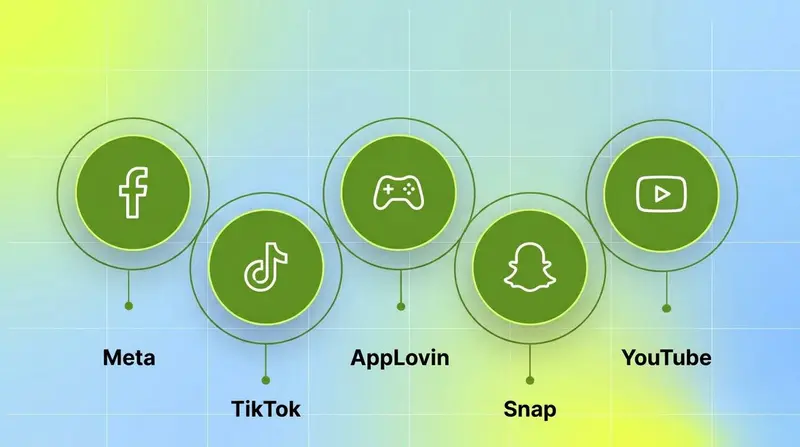
Producing winning ad creative across Meta, TikTok, AppLovin, Unity, Snap, and YouTube in 2026 means respecting each channel's format quirks (9:16 vertical for Reels, TikTok, Snap, and Shorts; 4:5 for Meta Feed; 16:9 for YouTube in-stream; MRAID playables under 5 MB for AppLovin and Unity), and the multi-format creative tools that automate this best are Segwise, Hawky, and Madgicx: Segwise auto-exports every generated creative into 1:1, 4:5, 9:16, and 16:9 ratios on download for direct upload to all six networks, Hawky pairs element-level diagnostics with AI agents and creative generation that resizes one creative into every placement, and Madgicx focuses on Meta-centric Quick Ads workflows.
Ship one creative across every channel without adapting to these specs and you pay for it in CPI, learning-phase resets, and rejected uploads.
Most performance teams already know this. They still ship the wrong format anyway. A 1:1 square gets repurposed into a Reels slot and renders with letterbox bars on top and bottom. A 30-second YouTube cutdown gets sent to TikTok and tanks because the hook lives at second 8. A polished brand video shipped to TikTok gets ignored because it does not feel native. These mistakes are not creative failures, they are spec failures, and they compound fast when you scale across five or six networks.
This cheat sheet covers what actually matters for each channel: aspect ratio, video length, hook timing, sound behavior, native feel, and the format-specific conventions that move CPI. We pulled current specs from official platform docs (TikTok Business Help Center, Google Ads Help for App campaigns, Meta Business Help, Snapchat for Business, AppLovin Axon docs) and cross-checked with Udonis and Triple Whale. Use this as the reference you keep open when briefing creative or QA-ing uploads.
Also read Image-to-Video for App Ads: A Step-by-Step Workflow for 2026
Key takeaways
9:16 vertical is the universal default in 2026. If you can only produce one ratio, produce 9:16. Meta Feed and YouTube in-stream are the two big exceptions where 4:5 and 16:9 still win.
Hook within the first 2-3 seconds on every channel. TikTok and Meta Reels punish slow openers harder than YouTube in-stream, which gets a 5-second skip window.
Sound-on by default for TikTok, YouTube Shorts, and Snap. Sound-off by default for Meta Feed and AppLovin/Unity/Mintegral interstitials, where 80%+ of impressions render muted. Caption everything.
Native feel beats polished production on TikTok and Snap. Polished production wins on Meta Feed, YouTube in-stream, and Brand Takeovers. AppLovin/Unity reward gameplay-first creative, not brand spots.
Playable ads on AppLovin, Unity, Mintegral, and IronSource cap at 5 MB, must be a single MRAID-compliant HTML file with base64-encoded assets, and support both portrait and landscape.
Re-export the same source creative into 1:1, 4:5, 9:16, and 16:9 instead of building each format from scratch. This is exactly what Segwise's Creative Generation Agent does on download.
What "format quirks" actually means
Every ad network publishes a spec sheet. Aspect ratio, max file size, codec, captions, safe zones. Following the spec sheet gets your creative approved, not winning. Format quirks are the unwritten rules each channel develops over time: the sound-off default on Meta Feed, the gameplay-first norm on AppLovin, the creator-first aesthetic on TikTok, the 6-second discipline on YouTube bumper.
These quirks move CPI more than spec compliance. A Meta-optimized video shipped to TikTok meets the spec sheet, gets approved, and then runs at 2-3x the CPI of a TikTok-native creative because it feels like an ad, not a TikTok. A 30-second YouTube cutdown hits the TikTok 60-second cap, but the hook is at second 8 because YouTube tolerates slow openers and TikTok does not.
The cheat sheet below covers both: the spec sheet (what the platform requires) and the format quirks (what the platform rewards). Aspect ratio, length, hook timing, sound default, native feel. One section per channel.
1. Meta (Facebook + Instagram): Best for cross-placement scale with Advantage+
Meta is the most format-fragmented channel of the bunch. A single Advantage+ campaign serves Feed, Reels, Stories, and the right-rail desktop placement, and each one rewards different creative shapes. The platform tries to auto-crop a single asset across placements. It works poorly. Most account teams now upload distinct cuts per placement and let Advantage+ pick winners.
Reels. 9:16 vertical, 1080 x 1920 minimum. Reels ads cap at 90 seconds. The performance sweet spot sits at 15-30 seconds, with a hook in the first 2 seconds. Reels content is consumed sound-on, but Meta still recommends captions because the autoplay mute rate on Facebook is higher than Instagram. Treat Reels as a creator-style placement: handheld feel, fast cuts, on-screen text overlays.
Feed. 4:5 portrait (1080 x 1350) or 1:1 square (1080 x 1080) are the strongest performers. 16:9 horizontal still works but loses screen real estate. Feed videos cap at 241 minutes but practically nothing over 30 seconds gets watched. 80%+ of Feed impressions render sound-off, so caption everything and front-load the visual story.
Stories. 9:16 vertical, 1080 x 1920, max 2 minutes. Same vertical asset as Reels but treat the safe zones differently. The top 14% and bottom 20% of the Stories frame are blocked by the profile chrome and the swipe-up CTA, so keep logos and key messaging in the middle 66%.
Advantage+ Shopping Campaigns and Advantage+ App Campaigns. Upload as many creative variants as you can across all four ratios (1:1, 4:5, 9:16, 16:9). Meta's algorithm picks placements automatically and serves each variant where it fits. Single-aspect campaigns underperform multi-aspect campaigns. Meta's text-in-ads guidance recommends keeping text under 20% of the image to maximize delivery.
Hook timing on Meta Feed is more forgiving than TikTok, but the platform still rewards a strong opening. Aim for face-on-camera or product-in-frame within the first 1-2 seconds. CTAs work better at the end on Reels, in the middle on Feed (where users scroll past faster).
2. TikTok: Best for native-feeling discovery and Spark Ads
TikTok is the channel where format quirks matter most. The spec sheet is generous (5-60 seconds, 9:16 vertical, 540 x 960 minimum), but the format quirks are unforgiving: polished brand spots get scrolled. TikTok content has to feel like TikTok content.
In-Feed Ads (the default). 9:16 vertical, 9-15 seconds is the engagement sweet spot per Udonis, file under 500 MB, .mp4 or .mov. Captions 12-100 characters. Avoid TikTok UI imitations (no fake heart icons, no fake captions overlaying the creator's face). Watermarks from other platforms (the TikTok-on-Reels watermark, the IG handle) get rejected.
TopView. Premium placement that takes over the screen on app open. 5-60 seconds, 9-15 recommended, bitrate at least 2,500 kbps for crisp full-screen rendering. The first 3 seconds run as a takeover with no UI overlay, then the ad transitions into the For You feed. Design for both phases: open with a takeover-friendly visual, then build to a CTA in the in-feed phase.
Spark Ads. The format that changed TikTok advertising. Spark Ads promote organic posts (your own or a creator's, with permission) instead of running standalone creative. They keep all organic engagement (likes, shares, comments), inherit the original caption, and use the creator's profile image. The result feels exactly like a real TikTok because it is one. Spark Ads consistently outperform standalone In-Feed ads on CPM and CTR for most categories. If you have organic TikTok presence or work with creators, Spark Ads should be your default.
Playable ads. .zip package under 5 MB, MRAID-compliant, video preview transitions to interactive demo, CTA available throughout. Critical for mobile gaming.
Carousel Ads. 2-35 images, 1200 x 628 (horizontal), 640 x 640 (square), or 720 x 1280 (vertical). Single shared caption and CTA across all cards. The first image card matters most because it dictates swipe-through rate.
Hook timing on TikTok is the tightest of any channel: the first 1-2 seconds decide everything. Native-style hooks (face-on-camera, on-screen question, low-fi handheld) outperform polished cinematic openers consistently. Sound is on by default, and audio drives discovery (trending sounds get amplified by the algorithm), so design with sound first.
3. AppLovin, Unity, Mintegral, IronSource: Best for in-app gaming inventory at scale
These four networks (sometimes called the SDK networks or in-app networks) are bundled together because their format requirements are nearly identical. They serve full-screen ads inside other mobile apps, mostly games. Two formats dominate: interstitial and rewarded video. Both reward gameplay-first creative, not brand spots.
Interstitial video. Full-screen video shown between app sessions or level transitions. AppLovin's VAST spec accepts both portrait and landscape, 5-30 seconds, video file under 4 MB (under 2 MB recommended for optimal playback). Most networks recommend 15-30 seconds. Hook within 3 seconds because users see the close button at second 5 on most networks.
Rewarded video. Opt-in ads where the user gets an in-app reward (extra life, virtual currency, ad-free run) for completing the watch. Length runs 15-30 seconds, with 30 seconds being the standard for AppLovin rewarded. Completion rates run 80%+ because users want the reward. CPMs are higher than interstitial because the inventory is opt-in. Format-wise: gameplay footage outperforms brand or live-action by a wide margin in this inventory.
Playable ads. This is where AppLovin, Unity, Mintegral, and IronSource diverge most from Meta and TikTok. Playables are interactive HTML5 demos shipped as a single MRAID v2.0-compliant HTML file with base64-encoded assets, .zip package under 5 MB. Both portrait and landscape orientations required. The user plays a stripped-down version of the game inside the ad slot, then taps a CTA to install.
App open ads, banner ads, native ads. Available on all four networks via Pangle (TikTok's audience network), AppLovin MAX, Unity LevelPlay, and IronSource. Banner sizes follow the IAB standard: 320 x 50, 300 x 250, 728 x 90.
Native feel on these networks does not mean "looks organic." It means "looks like gameplay." A 30-second clip of game footage with on-screen text outperforms a polished brand spot 9 times out of 10. Sound is mostly off by default (the user is mid-game), so caption everything and design for muted viewing.
4. Snapchat: Best for full-screen vertical immersion and AR
Snap is the most format-strict channel of the bunch: 9:16 vertical only, 1080 x 1920, no exceptions. The platform has built its entire ad stack around full-screen vertical video and AR Lenses, and other ratios get rejected at upload.
Snap Ads (single image or video). 9:16 vertical, 3-180 seconds, under 10 seconds recommended for full completion. .mp4 or .mov, H.264, max 1 GB but Snap recommends under 32 MB for fast load. The top 150 px and bottom 150 px are reserved safe zones (top for the username and timestamp, bottom for the CTA bar), so keep logos, key text, and CTAs out of those areas.
Story Ads. A series of 3-20 single Snap Ads chained together as a Story. Same per-snap specs as standard Snap Ads but with a tile thumbnail (1080 x 1920) that lives in the Discover feed. Brand names and tile titles cap at 55 characters.
Collection Ads. Single video or image plus a row of 4 product tiles below. Each product tile is 160 x 160 px. Used for shopping and DTC catalogs.
AR Lenses. Snap's signature format. Face Lenses, World Lenses, and Camera Try-On let the user interact with branded AR overlays through the camera. 2D assets ship as PNG with transparency. 3D models ship as FBX, OBJ, or glTF, optimized for mobile rendering. A visible brand logo or brand name must be displayed on every Face Lens and World Lens, ideally top-left or top-right, just under the top UI elements. Lenses are interactive ads that drive both reach and engagement, and they run at higher CPMs than standard Snap Ads but with much higher recall.
Hook timing on Snap is tight (first 2 seconds), and sound is on by default. Snap's audience skews younger than Meta or YouTube (Gen Z heavy), so creative tone leans casual and personal. Polished brand spots underperform here the same way they do on TikTok.
5. YouTube: Best for long-form storytelling and Shorts at scale
YouTube is the only major channel where 16:9 horizontal is still a strong default, because in-stream ads run before, during, and after horizontal YouTube videos. But Shorts has shifted the platform toward 9:16 vertical for any campaign that wants reach beyond logged-in desktop viewers.
Shorts ads. 9:16 vertical, 1080 x 1920, .mp4 or .mov. Shorts ads can run up to 3 minutes, but only the first 60 seconds play in the Shorts feed before an overlay prompts the user to tap through to the full ad on the watch page. Practically, Google recommends keeping Shorts ads under 60 seconds. Sound is on by default.
In-stream skippable ads. The classic YouTube ad format. Plays before or during a YouTube video, skip button appears at second 5. 12 seconds minimum, 3 minutes maximum recommended. 16:9 horizontal default but 9:16 vertical and 1:1 square also work for cross-placement campaigns. Hook timing is the most forgiving of any channel because users have to actively tap skip, which buys you the first 5 seconds. But the gap between second 5 and second 6 is the highest-skip moment of the entire ad.
In-stream non-skippable. 15-30 seconds, no skip button. Used for awareness campaigns where reach matters more than CTR. Same aspect ratio options as skippable.
Bumper ads. 6 seconds, non-skippable, 16:9 horizontal default. Designed for brand recall and frequency. The 6-second discipline is the hardest creative constraint on any major platform. Bumper ads work best as a single visual, a single message, no narrative arc.
App campaign creative for Google.Google's App campaign guidance recommends uploading the maximum number of assets allowed per type (4 text, 20 each for images, videos, HTML5). Google's machine learning picks combinations and serves them across YouTube, Search, Play, and Display. Diversifying across themes, styles, and orientations improves reach. Google specifically calls out that emphasizing app experience over story works best for video, and that videos should contain 2+ cut changes within the first 5 seconds.
Hook timing on YouTube depends on the placement. Bumper ads (6 seconds): hook at second 0. In-stream skippable: hook before second 5 (skip button). Shorts: hook before second 2. Sound is on by default across all YouTube placements, so design audio-first.
6. Cross-channel adaptation rules
The mistake most teams make is treating each channel as a separate creative project. The better workflow is to produce one master creative per concept, then adapt to each channel's spec sheet and format quirks on export.
Here is the rule set we apply when adapting a single source creative across all six channels:
Master in 9:16 vertical. It is the universal default. Re-cropping vertical to square or horizontal is easier than the reverse, because vertical creative usually keeps the subject center-frame.
Front-load the hook to second 1. The tightest channel (TikTok) decides the timing for everyone else. A hook that works on TikTok works on Reels, Snap, and YouTube Shorts.
Caption everything. Meta Feed (sound-off default) and AppLovin/Unity (mid-game default) require it. TikTok and YouTube Shorts reward it. Snap accepts it. There is no channel where captions hurt.
Build three length cuts. A 6-second bumper, a 15-second standard, and a 30-second extended cut from the same source. This covers 80% of placements across all six channels.
Watch the safe zones. Snap reserves top/bottom 150 px. TikTok reserves the right edge for engagement icons. Stories reserves the top 14% for profile chrome and the bottom 20% for the CTA bar. Keep logos and key text in the middle 60% of any vertical frame.
Re-export per channel, do not auto-crop. Auto-crop tools letterbox or zoom-crop, both of which read as low-effort. Re-frame each export instead, even if it means moving the subject up or down a few pixels.
Treat AppLovin and Unity differently. Gameplay-first creative outperforms brand or live-action by a wide margin. If you are running mobile games, reserve gameplay clips for the SDK networks and brand-feel creative for Meta and YouTube.
Run Spark Ads on TikTok, not standalone uploads. If you have any organic TikTok presence (yours or creator-partnered), Spark Ads will outperform standalone In-Feed every time.
Cross-channel format comparison
How to choose the right format for each channel
If you are scaling across five or more channels, adopt a multi-format export workflow. Building each format from scratch does not scale past a small set of creatives. Re-exporting one master across 1:1, 4:5, 9:16, and 16:9 with channel-specific safe zones does. The best ad creative analysis tools in 2026 (Segwise, Hawky, Madgicx) help you identify which winning patterns to scale, and Segwise's Creative Generation Agent automates the multi-format export step itself.
If your creative team can only produce one master cut, master in 9:16 vertical with captions. It covers Meta Reels, Meta Stories, TikTok, Snap, and YouTube Shorts. You will lose some performance on Meta Feed (where 4:5 wins) and YouTube in-stream (where 16:9 wins), but you will not lose entire placements.
If you are running mobile gaming UA across SDK networks, build gameplay-first creative. AppLovin, Unity, Mintegral, and IronSource reward gameplay clips over brand spots. Polished live-action that works on Meta Feed will underperform here. Reserve brand creative for Meta and YouTube, and ship gameplay creative to the in-app networks.
If you have organic TikTok presence, default to Spark Ads. Standalone In-Feed ads are the fallback, not the default. Spark Ads inherit the organic post's caption, profile image, and engagement, and they consistently outperform standalone uploads on CPM and CTR.
If you are running Snap, design for AR first if budget allows. Standard Snap Ads work, but AR Lenses run at higher CPMs with much higher recall and shareability. For DTC and Gen Z brands, AR is the format quirk that moves Snap from a secondary channel to a primary one.
If you are testing new creative concepts, start on TikTok and Meta Reels. Both channels reward fast iteration and native feel, both have short hook windows that surface winning concepts quickly, and both let you scale to YouTube and Snap once a concept proves out. The 9:16 master cut transfers cleanly.
Bottom line
Format quirks move CPI as much as creative concept does. Every channel has its own spec sheet and its own set of unwritten rules: TikTok rewards native-feel, AppLovin rewards gameplay, Meta Feed renders sound-off, YouTube bumper gives you 6 seconds. Ship one creative across every channel without adapting and you pay for it. The fix is not a creative-quality fix, it is a workflow fix: master in 9:16 vertical, caption everything, build three length cuts, re-export per channel with the right safe zones. Segwise's Creative Generation Agent is built around this exact workflow, generating winning creatives based on your performance data and exporting each one in 1:1, 4:5, 9:16, and 16:9 on download, ready for Meta, TikTok, AppLovin, Snap, and YouTube.
Frequently asked questions
What is the best aspect ratio for ads in 2026?
9:16 vertical is the universal default in 2026. It works across Meta Reels, Meta Stories, TikTok, Snap, and YouTube Shorts, which together cover the majority of mobile ad inventory. The exceptions are Meta Feed (where 4:5 portrait wins), YouTube in-stream (where 16:9 horizontal wins), and AppLovin/Unity (where both portrait and landscape are accepted). Tools like Segwise's Creative Generation Agent, Hawky, and Madgicx help you export one source creative into all four ratios automatically, so you do not have to choose.
How long should my ad creative be on each channel?
The sweet spots vary by channel. TikTok In-Feed performs best at 9-15 seconds. Meta Reels and Stories at 15-30 seconds. Meta Feed under 30 seconds. Snap Ads under 10 seconds. AppLovin and Unity rewarded video at 15-30 seconds. YouTube Shorts under 60 seconds. YouTube in-stream skippable at 12 seconds to 3 minutes. YouTube bumper at exactly 6 seconds. Build three length cuts (6, 15, 30 seconds) from one master and you cover most placements. Segwise's tag-to-metric mapping shows which length performs best for your specific account, alongside competitors like Hawky.
What are TikTok Spark Ads and why do they outperform standalone uploads?
Spark Ads promote organic TikTok posts (your own or a creator's, with permission) instead of running standalone creative. They keep the organic engagement (likes, shares, comments), inherit the original caption, and use the creator's profile image. Because Spark Ads look exactly like real TikToks, they consistently outperform standalone In-Feed uploads on CPM and CTR. Per Udonis, Spark Ads can run for up to 10 minutes (vs. 60 seconds for standalone), inherit the original aspect ratio, and continue to accumulate organic engagement during the campaign. Tools that track creative performance across networks, such as Segwise, treat Spark Ads as a separate creative type because the performance profile is different.
How do I adapt one source creative for Meta, TikTok, AppLovin, Snap, and YouTube?
Master in 9:16 vertical with captions, hook in the first 1-2 seconds, build three length cuts (6, 15, 30 seconds), and re-export per channel rather than auto-cropping. Keep logos and key text in the middle 60% of the frame to respect Snap's top/bottom safe zones, TikTok's right-edge engagement icons, and Stories' profile chrome. For AppLovin, Unity, Mintegral, and IronSource, build gameplay-first creative separately because the in-app networks reward gameplay over brand. Segwise's Creative Generation Agent automates the multi-format export step on download (1:1, 4:5, 9:16, 16:9), and competitor tools like Madgicx Quick Ads handle similar workflows.
What's the difference between AppLovin, Unity, Mintegral, and IronSource ad specs?
The four SDK networks (AppLovin MAX, Unity LevelPlay, Mintegral, IronSource) have nearly identical format requirements: full-screen interstitials and rewarded video at 5-30 seconds, both portrait and landscape supported, video files under 4 MB recommended, and playable ads as MRAID-compliant HTML zips under 5 MB. The biggest practical difference is bidding integration and inventory mix, not creative specs. All four reward gameplay-first creative over brand or live-action, so a single set of gameplay assets can run across all four networks. Segwise integrates with all four ad networks (alongside Meta, TikTok, Google, Snap, and YouTube) and unifies their creative-level data into a single dashboard.
Best ad format for mobile gaming UA?
For mobile gaming UA, the format mix that works in 2026 is: 9:16 vertical gameplay clips for AppLovin, Unity, Mintegral, IronSource, and TikTok In-Feed; 16:9 horizontal gameplay clips for YouTube in-stream; and playable ads (MRAID HTML zips under 5 MB) for AppLovin, Unity, Mintegral, and IronSource. Segwise for mobile gaming AI-tags what happens inside playable ads using multimodal AI, identifying which interactive gameplay elements drive installs. Competitors like Hawky and Madgicx focus on video and static creative analysis but do not handle playable ads at the same depth.
Best ad format for DTC brands on Meta and TikTok?
For DTC brands, 4:5 portrait wins on Meta Feed (caption-heavy, product-in-frame within the first 1-2 seconds), 9:16 vertical wins on Meta Reels and Stories (creator-style, fast cuts), and 9:16 vertical Spark Ads win on TikTok (creator-partnered or UGC-style). Snap AR Lenses and Camera Try-On are also strong for DTC fashion and beauty. Segwise for DTC and ecommerce tags product shots, lifestyle imagery, hooks, benefit-focused messaging, and social proof elements across all five channels, alongside competitors like Madgicx and Triple Whale, helping DTC teams identify which creative elements drive ROAS.
How does Segwise help with multi-format creative production?
Segwise's Creative Generation Agent generates new winning creatives based on the patterns the Creative Strategy Agent identifies in your performance data, then exports each generated creative in 1:1, 4:5, 9:16, and 16:9 aspect ratios on download. The exports are ready to upload directly to Meta, TikTok, Google, Snap, AppLovin, Unity, Mintegral, IronSource, and YouTube without manual re-cropping. Segwise integrates with 15+ ad networks and MMPs (Meta, Google, TikTok, Snap, YouTube, AppLovin, Unity Ads, Mintegral, IronSource, AppsFlyer, Adjust, Branch, Singular, Kochava). Hawky also generates images and video, and Madgicx focuses on Meta-centric Quick Ads workflows. Segwise adds playables and AI UGC-style video, plus tagging across 15+ networks, which is why teams use it as a single tool instead of stitching together a creative analysis platform plus a creative generation platform.